presenter

Sky News presenter Jayne Secker suffers from hiccups in hilarious 4pm bulletin

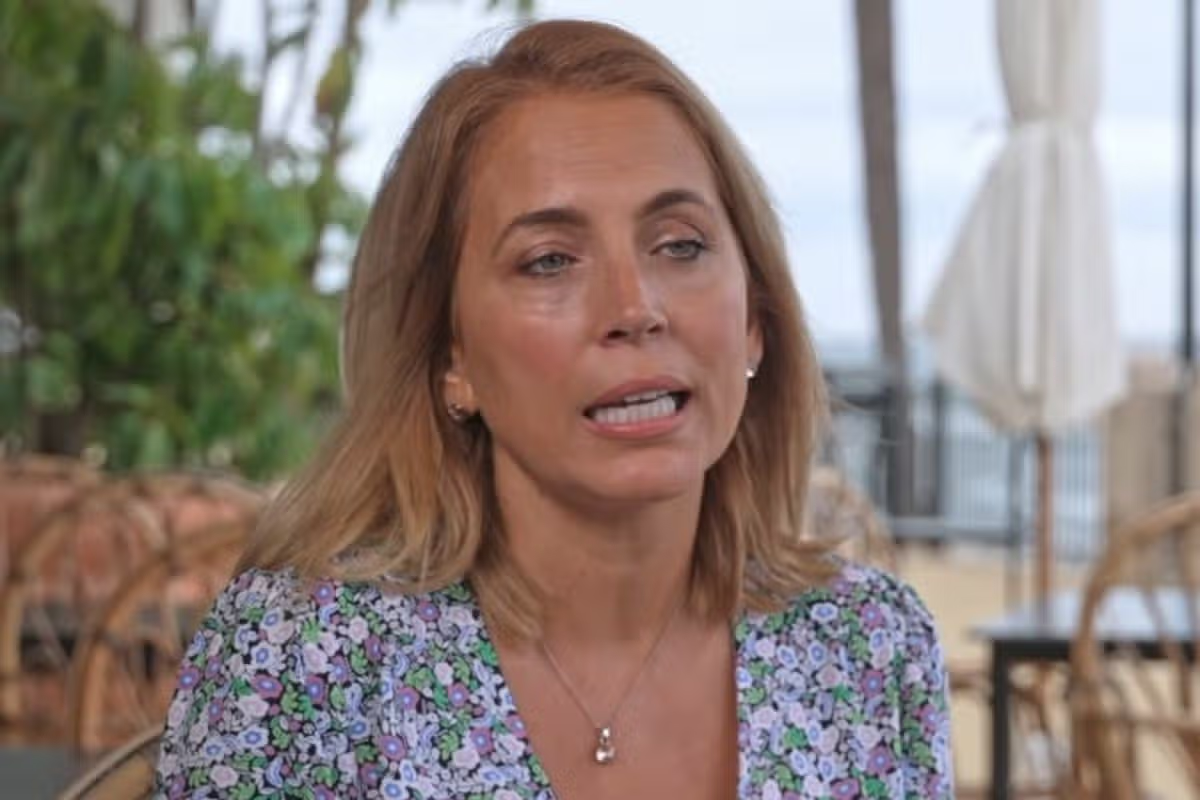
Newsreader Jayne Secker suffered from a bout of hiccups whilst presenting the 4pm bulletin on Sky News Today

Sky News presenter Jayne Secker suffers from hiccups in 4pm bulletin

Sky News presenter Jayne Secker suffered from a bout of hiccups whilst presenting the 4pm bulletin on Thursday. The newsreader, 53, was back in her usual slot on the live TV channel but as she began addressing the nation, she was befallen by a case of the hiccups, and couldn’t stop.

She began: “The wait is over! After more than half a century astronauts are finally on their way back [hiccup] to the moon!” It appeared that she let out a slight giggle as she began to present the next item.

Ever the professional, Jayne managed to regain composure in time to be able to continue with the rest of her news reporting segment.

READ MORE: Strictly’s Claudia Winkleman’s fake tan fail in ‘worst’ experienceREAD MORE: Good Morning Britain sparks backlash over Ed Balls debate ‘Is this even newsworthy?’

Jayne has appeared on Sky News Today since 2014, and initially appeared alongside Colin Brazier, and has been employed by the broadcaster since 2002.

Many viewers may be unaware that she is the daughter of the late Tyne Tees anchor Kathy Secker. Jayne’s media career began on home turf, editing student newspapers and securing an internship at BBC Radio Newcastle, before becoming a BBC trainee after graduating from the University of Stirling.

The Bedlington-born star, who was the first person to interview astronaut Tim Peake live from space, has a famous lineage; her mother Kathy joined ITV in 1976 and became well-known for presenting shows like Lookaround, the Birthday Spot, and the daily North East Tonight bulletins, as well as her own series Kathy and Co.

Kathy also made waves on radio, hosting her own show on BBC Radio Newcastle on Sunday afternoons, with her last broadcast airing just two weeks before her death in December 2015 at the age of 70.

Kathy, the founder of the renowned Grace House charity in Sunderland, a cause that Jayne proudly patronises, died at her home in Newcastle after she failed to turn up to a planned day out with friends.

BBC Newcastle, for whom she was still presenting a weekly show, confirmed the sad news on Twitter, now known as X, at the time. Paying tribute to Kathy, they wrote: “Some very sad news. Kathy Secker, one on our longest serving presenters, has died. She’ll be hugely missed.

“Kathy’s passing comes as a huge shock. Our thoughts are with her family. We’ll have a tribute on Sunday @ 2pm.” During her tenure at Sky News, Jayne spent a decade as a foreign correspondent, often reporting from conflict zones such as the Middle East, before joining their long-running rolling news programme.

Like this story? For more of the latest showbiz news and gossip, follow Mirror Celebs on TikTok, Snapchat, Instagram, Twitter, Facebook, YouTube and Threads.


Source link

Who is ex-BBC Radio 2 Breakfast Show presenter Scott Mills?

SCOTT Mills has been a staple on our screens and radios for decades, bringing audiences the breakfast shows on Radio 1 and 2 over the years.

But on March 30, 2026, the Dj was axed by the BBC over reported allegations about his “personal conduct”.

Scott began presenting Radio 1 in 1998

The BBC said: “While we do not comment on matters relating to individuals, we can confirm Scott Mills is no longer contracted to work with the BBC.”

As reported by the Mirror, Lorna Clarke, Director of Music at the BBC, confirmed the sacking in a statement to staff.

It read: “I wanted to personally let you know that Scott Mills has left the Breakfast show, and the BBC.

“I know that this news will be sudden and unexpected and therefore must come as a shock.

“Not least as so many of us have worked with Scott over a great many years, across a broad range of our programmes on R1, 5Live, R2 and TV.

“I felt it was important to share this news with you at the earliest opportunity.”

Who is Scott Mills?

Scott Mills is a radio presenter from Eastleigh, Hampshire.

He began his career at the age of 16 as a host of his local radio station Power FM.

He was given the graveyard slot (1am-6am) on the station and became the youngest permanent presenter on mainstream commercial radio.

Scott later went on to work at GWR FM Bristol, Piccadilly Key 103 in Manchester and Heart 106.2 in London before becoming a national radio star.

Scott joined Radio 1 in 1998 as a presenter for the early breakfast show between 4am-7am.

In July 2005 he shifted to an early-evening weekday slot while covering for Sara Cox who was on maternity leave.

Sara decided to not return so the slot became The Scott Mills’ Show from 1pm-4pm, Monday to Friday.

When did Scott Mills join BBC Radio 2?

It was announced on July 1, 2022 that Scott was set to join Radio 2.

His show, which ran from 2-4pm, began on 31 October of that year.

The show replaced Steve Wright in the Afternoon which ended in September 2022.

He later took over the Radio 2 breakfast show on January 27, 2025.

When he announced he was leaving Radio 1, Scott said: “Time actually does fly when you’re having fun, and that’s certainly been the case over the past 24 years at my beloved Radio 1.

“The station I pretended to be on in my bedroom from the age of six.

“The station I told my mum I wanted to work at, but never in a million years thought I would.”

Scott has commentated on Eurovision

What else has Scott Mills presented?

Scott has also appeared on a number of TV Shows.

From 2006-2007 he appeared as a reporter Paul Lang in the medical soap Casualty.

He has also been a contestant on Never Mind The Buzzcocks, Supermarket Sweep, Mastermind and Most Haunted.

In 2009 Scott Mills: The Musical played for three nights at the Edinburgh Fringe festival.

In 2010 he did another fringe show The Bjorn Identity which was The Bourne Identity to the music of ABBA.

He’s also commentated on Eurovision since 2011.

Is Scott Mills married?

Scott is married to his husband Sam Vaughan.

The pair started dating in 2017 before getting engaged in 2021.

in June 2024, the couple tied the knot in a lavish ceremony in Barcelona.

Source link

Oscars are too political? Speeches have been less political over time

Twenty-three years ago, the Oscars were in turmoil. President George W. Bush had just begun an invasion of Iraq after the Sept. 11 attacks, and as the nation’s TV screens filled with the “shock and awe” campaign, many did not know quite how to proceed with Hollywood’s biggest night.

ABC wanted to postpone, presenters begged off, Jack Nicholson urged his fellow actor nominees to boycott (animated feature winner Hayao Miyazaki did), documentary winner Michael Moore attempted to directly shame Bush from the stage (to loud boos) and many of the acceptance speeches acknowledged the war and included pleas for peace.

President Trump’s recent decision to attack Iran is not precisely the same — American troops have thus far not invaded and the Bush administration’s media blitz of rockets lighting up the sky is absent. No one expected the Oscars to be canceled or delayed and there has been no talk of boycotts; whether the war and (if polls are to be believed) its general unpopularity are noted, either by host Conan O’Brien (who has already said he will not be mentioning Trump) or the winners, remains to be seen.

But if recent history is any indication, it could go unmentioned. Which would be something of a political statement in itself: It would be terrible if the false notion that awards shows have become too political had a chilling effect on anyone who wanted to use their platform to speak about something important they care about.

Thus far, film and television awards winners have stayed away from the issues that have prompted widespread public outrage and protests this year — including the often brutal methods of Immigration and Customs Enforcement, the ongoing concern over the war in Gaza and the endless revelations of the Epstein files.

Despite complaints from certain quarters, awards shows, particularly the Oscars, rarely have more than one or two truly political moments. But this year, the absence has been notable.

Compared with the Grammy Awards, where Trevor Noah, in his final stint as host, roasted Trump and anti-ICE sentiment reigned in speeches and on pins, this year’s Golden Globes (which aired three weeks before the Grammys) appeared to exist in another world. A few stars wore similar pins and spoke on the red carpet, but aside from a few digs about Epstein and CBS News from host Nikki Glaser, there was no mention of the many issues roiling the nation. (As he was beginning to make late-in-speech remarks about this being an important time to make films, Kleber Mendonça Filho, Brazilian director of the non-English language film winner “The Secret Agent,” ran over time and was played off.)

Has Hollywood lost its spine? Or, having been beset for years by grievances that the Oscars have become “too political” and “too woke,” are filmmakers and actors saving their outrage and passion for social media and bowing to pressure to keep their acceptance speeches grateful and celebratory?

“I know that there are people who find it annoying when actors take opportunities like this to talk about social and political things,” said Jean Smart on the Golden Globes red carpet, adding, when she won for actress in a TV comedy: “There’s just a lot that could be said tonight. I said my rant on the red carpet, so I won’t do it here.”

It was an echo of Jane Fonda’s famous 1972 Oscar speech: “There’s a great deal to say, and I’m not going to say it tonight.” And, perhaps, a response to more recent “shut up and dribble” criticism, as distilled by 2020 Golden Globes host Ricky Gervais, who cautioned the audience: “If you do win an award tonight, don’t use it as a platform to make a political speech. You’re in no position to lecture the public about anything. You know nothing about the real world.”

Indeed, as Oscars ratings have plummeted over the last 20 years, some have suggested that political speechifying is to blame. This is patently absurd. Viewership for just about everything except the Super Bowl has dropped dramatically, and the Oscars ratings do not take into account the millions who watch portions of the show on social media. (We’ll see what happens when the Oscars move to YouTube in 2029.)

And the Oscars have never been particularly political.

Speeches that deviate from the ubiquitous laundry list of thank yous always get more attention, whether they’re political or not, for the simple reason that they’re so dang unusual. But taken as a whole, either by decade or particular telecast, the Oscars is mostly, and consistently, apolitical. As in, almost every minute of a three-hour-plus show, year after year after year.

Unless, of course, you consider thanking God to be political. Which I do not. Nor do I categorize as such any speech that underlines the fact of a historic win (as Halle Berry did in 2002), encourages Hollywood to tell more diverse stories (as Cate Blanchett did in 2014) or reminds audiences in a general way that systemic oppression and war are bad (as Adrian Brody did amid his ramblings in 2025).

Many of the speeches that have been branded as “political” are simply underscoring the themes of the films being honored — in 2009, both Dustin Lance Black and Sean Penn advocated for gay rights when accepting Oscars for “Milk,” which chronicled the life of assassinated gay rights activist Harvey Milk. Likewise, John Irving supporting abortion rights and Planned Parenthood after winning for “The Cider House Rules” in 2000 and John Legend and Common speaking passionately about civil rights, past and present, after winning for “Glory,” a song from the civil rights drama “Selma,” in 2015 was only natural.

Sacheen Littlefeather refuses an Academy Award on stage.

Sacheen Littlefeather refuses the lead actor Academy Award on behalf of Marlon Brando in 1973.

(Bettmann Archive)

A purely political speech, to my mind, directly calls out specific leaders, policies or crises, which may or may not have anything to do with the film being awarded. The most famous are, of course, Marlon Brando’s decision to send Sacheen Littlefeather to accept his Oscar for “The Godfather” and protest the treatment of Native Americans, and Vanessa Redgrave’s 1978 denunciation of “Zionist hoodlums” who were demonstrating against her involvement in a pro-Palestinian documentary even as she accepted for supporting actress in “Julia.”

In 1993, while many Oscars attendees wore red ribbons to honor those living with HIV/AIDS and call for government assistance, then-couple Susan Sarandon and Tim Robbins took it further, using their time as presenters to ask the U.S. government to allow HIV-positive Haitians being held at Guantanamo Bay to be let into the country. That same year, presenter Richard Gere used the fact that “1 billion people” were watching to send “sanity” to Chinese leader Deng Xiaoping in the hopes that he would allow the people of Tibet to “live free.” (Then-Oscars producer Gil Cates quickly denounced the three presenters; Gere did not return to the Oscars until 2013.)

A year after Moore blasted Bush over Iraq, Errol Morris, winning for “The Fog of War,” briefly compared the war in Iraq to the “rabbit hole” of Vietnam (which was the subject of his film). In 2015, “Boyhood” star Patricia Arquette used most of her supporting actress speech to demand equal wages for women. That same year, “Birdman” director Alejandro G. Iñárritu dedicated his award to his fellow Mexicans, with the hope that they would be treated by Americans “with dignity and respect” so that together, they could build a “great immigrant nation.” (Which frankly plays more purely political now than it did at the time.) A year later, Leonardo DiCaprio spoke about climate change after winning for “The Revenant.”

In 2019, Spike Lee, accepting for adapted screenplay (“BlacKkKlansman”), called on voters in the upcoming election to mobilize and “be on the right side of history” and in 2024, “Zone of Interest” director Jonathan Glazer, accepting for international film, riled many by comparing the dehumanization required for the Holocaust to occur with events in Gaza.

Even now, the most notable examples of political speeches, the ones that are always mentioned, are from the freaking ‘70s. Which certainly obliterates the idea that the Oscars have grown more political and undermines the argument that it is a Big Problem.

Put these relatively few moments next to the endless hours of acceptance speeches that, with varying degrees of emotion, honor the art of movie-making and the legions that support those who are doing it (including God, parents, spouses, children, some random but heaven-sent teacher) and it’s difficult to see much “wokeness.”

The people who gather at the Oscars are storytellers, and many of the stories they tell deal with uncomfortable truths about our collective past, present and future (including best picture front-runners “One Battle After Another” and “Sinners”). Of course nominees and winners have opinions about politics, science, social issues, international conflict and those suffering without recourse or voice — that’s why they make movies. So if a few of them decide to skip thanking their manager or the studio head and say a few words about climate change or whatever current law/policy/presidential action they believe is making lives worse for a lot of people, that’s their choice. They just won an Oscar!

For those uncomfortable watching it, just use the 45 seconds to grab a snack and by the time you’re back, the host will be moaning about how long the show is and the next five winners will inevitably cry and smile; praise their fellow nominees; thank the producers; say something sweet about their cast, crew and mamas; before telling their kids they love them and it’s time to go to bed.

And that’s OK too.

Source link

Eamonn Holmes sparks concern after presenter ‘falls asleep and slurs on air’

Veteran presenter Eamonn Holmes appeared to fall asleep at his GB News desk during his morning segment, leading to viewers sharing their concerns for the star

Eamonn Holmes has sparked concern over his well-being after appearing to fall asleep during his morning slot on GB News. The Northern Irish presenter, 66, has had a tough few years when it comes to his health, and his latest appearance has led to fans being worried about the veteran.

Eamonn was presenting his morning show on the channel during an interview with Chief Secretary to the Prime Minister, Darren Jones MP. But he apeared to nod off momentarily during the conversation.

The host was seen fiddling his his microphone before seemingly zoning out and closing his eyes. A few seconds later, he lifted his head and focused back on his sound kit and mobile phone.

READ MORE: Ryan Thomas shares life-changing health diagnosis – ‘I still feel quite overwhelmed’READ MORE: A Woman of Substance explained: Is the Channel 4 drama based on a true story?

Co-host Ellie Costello continued with the chat, but Eamonn’s antics are said to have caused concern among staff. A source speaking to The Sun said: “It hasn’t gone unnoticed that Eamonn has been struggling a lot more lately

“Today he was falling asleep on air and slurring his words. There were lots of messages coming in about it.”

Ensure our latest headlines always appear at the top of your Google Search by making us a Preferred Source. Click here to activate or add us as your Preferred Source in your Google search settings.

Fans were quick to share their own concern online after the chat. One user wrote: “Please help Eamonn Holmes. He’s obviously struggling, falling asleep this morning. Slurring his words. The guy needs medical assistance!!”

Another said: “Why is Eamonn Holmes basically falling asleep on air? He looks either off his face or just so tired he can’t stay awake!” And a third added: ““Concerned Eamonn Holmes seems more slurry than usual.”

Eamonn’s health concerns have been well documented in recent years. He first shared his chronic pain diagnosis in 2021. The issue was initially caused when he dislocated his pelvis. He slipped three discs and then broke his shoulder during his recovery period.

Speaking on the Session 7 podcast, Eamonn previously explained: “I’m sick. I’m in a wheelchair. That’s been horrendous to deal with for two years.

“Certainly I don’t think TV wants to know you when, I mean there’s nothing you and I are talking and no one can there’s anything wrong but I can’t get up.”

He admitted that he required daily care. However, he insisted that once he is sat in his wheelchair, he is still able to “do everything”.

Eamonn went on to acknowledge that the wider world struggles to “deal with” people with disabilities, particularly in regards to providing the appropriate accommodations.

Like this story? For more of the latest showbiz news and gossip, follow Mirror Celebs on TikTok , Snapchat , Instagram , Twitter , Facebook , YouTube and Threads .


Source link

The One Show presenter Angela Scanlon tipped to become new host of Strictly Come Dancing

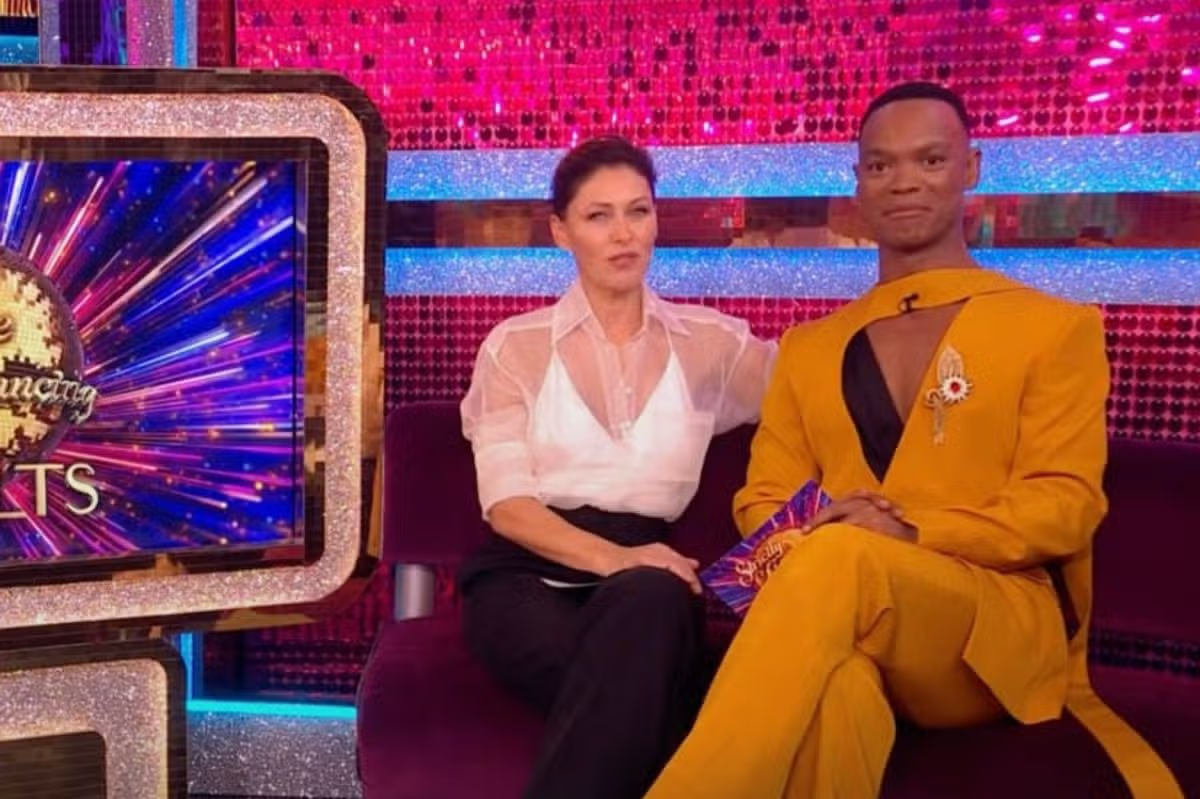
Strictly Come Dancing bosses are after Tess Daly and Claudia Winkleman replacements as both presenters left at the end of the last series, won by former England footballer Karen Carney

The One Show presenter Angela Scanlon is said to be in line to become the new Strictly Come Dancing presenter.

Angela, who has been a reporter on the BBC flagship show since 2016 and more recently has hosted in the absence of Alex Jones, has been lauded as “a top professional”. A source says Strictly bosses are particularly keen on Angela, 42, as they feel she is “BBC through and through”.

Tess Daly and Claudia Winkleman left the popular programme at the end of the last series, having forged a successful regular partnership since 2014. Several names have been linked to their vacant posts, including Alan Carr after his triumph on The Traitors last year, but it is now believed Angela will waltz onto the programme. She herself was a contestant in 2023, dancing with Carlos Gu who remains on the show.

A source told the Daily Mail: “It’s looking likely that Angela could get one of the jobs. The Beeb love a regional accent, she’s one of the BBC’s own and she’s no trouble whatsoever. She is BBC through and through and is regarded as a top professional. The BBC knows she is loved as a presenter of The One Show and that is what those making the hire are really looking at.”

READ MORE: Strictly Come Dancing’s Karen Hauer returns to social media after ‘brutal’ axe from BBC showREAD MORE: Amy Dowden concedes Strictly comeback was ‘too soon’ following cancer battle

It is believed that so-called “chemistry tests” are the next stage, and they are due to take place after Easter. However, sources understand Angela, of County Meath, Ireland, has the right personality to fit in.

“There have been many names bandied around, some of which are not realistic… For Angela, Strictly would be a no-brainer. She might not be a superstar but she would grow with the role,” the insider continued.

Strictly bosses have had meetings in recent weeks as they plan for the next series of the programme, which typically starts in the autumn. It is said managers want at least one of the new faces to have a distinctive regional accent, a box mother-of-two Angela ticks.

Speaking in December when asked about the vacancies, Angela, a former magazine journalist, said: “You know what, I am such a fan of the show and have been forever, I would certainly answer the call.”

Alex Jones herself had been rumoured with one of the jobs, but it is thought she and Angela are reticent about teaming together despite their rapport on The One Show. Zoe Ball, the former host of Strictly’s spin-off show It Takes Two, is also believed to be in the running for one of the roles.

But bosses are also said to be mulling over the prospect of having a male anchor, the first since the late Bruce Forsyth who presented Strictly Come Dancing for nearly 10 years. The veteran entertainer departed after the 2013 series.

Source link