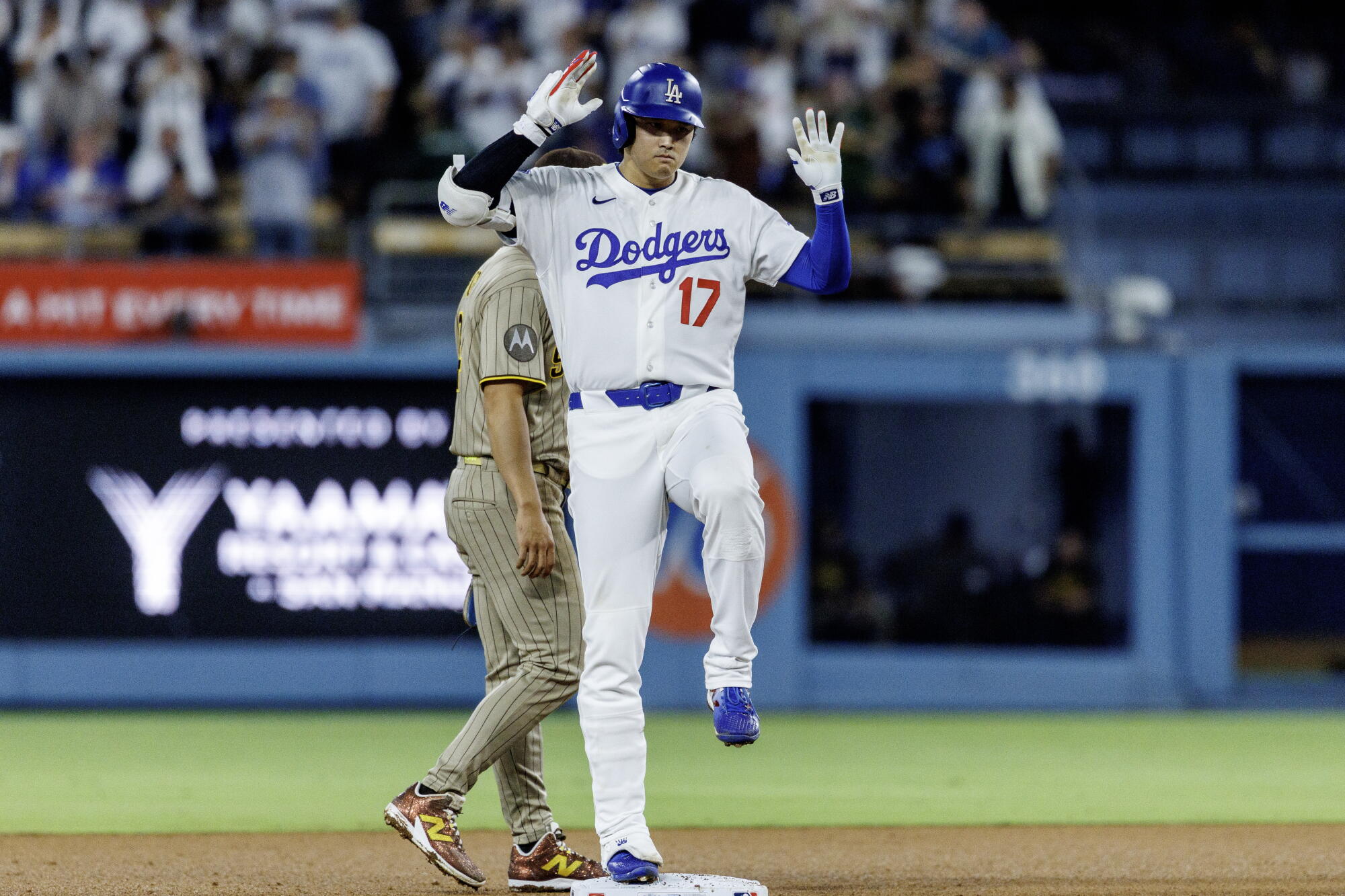
Who’s hot and who’s not as Dodgers prepare for the postseason
Dodgers right fielder Kyle Tucker has never shied away from just how bad his performance at the plate was for much of his first season in Los Angeles.
For the first five months of the season, when he’d show brief glimpses of progress before sinking back into an extended slump, Tucker’s .683 OPS was the third-worst among Dodgers hitters with at least 100 plate appearances, better than only Hyeseong Kim and Kyle Freeland, who both spent time in triple A.
In September, however, he found a sustainable adjustment. He fixed his bat path, extending through the ball more consistently instead of pulling off of it. He posted a .889 OPS in September, on par with his four straight All-Star seasons before signing with the Dodgers.
Now, all of a sudden, he looks like a potential difference-maker in the postseason.
“The last month or so is more or less what I expect out of myself,” Tucker said in a recent conversation with The Times. “The biggest thing is we have an opportunity now being in the playoffs to win another World Series. Once the playoffs start, you can forget about any stats or personal numbers. The only one that really matters is the win column. So that’s just what I’m gonna try and contribute towards.”
The Dodgers offense had a lot of success stories like Tucker’s in the final month of the regular season. He helped carry the offense, along with Teoscar Hernández and Mookie Betts, who turned around their seasons down the stretch, and Will Smith, who returned from the IL and quickly found his home run swing.
The Dodgers’ starting rotation is their biggest strength going into the postseason. But the offense’s performance against elite pitching, and the bullpen’s execution in tight games, could make or break a series.
Here’s how some other key players are trending going into the postseason:
Designated hitter Shohei Ohtani: Fortunate to have the bye

Shohei Ohtani appears on the right track for a successful postseason.
(Gina Ferazzi / Los Angeles Times)
Ohtani returned from the IL with five games left in the season, and he went five for 21 with one extra-base hit.
All indications from general manager Brandon Gomes and manager Dave Roberts in video conference calls before the Dodgers’ closed workout Tuesday were that Ohtani was feeling good physically.
“I feel confident that you’re going to see the best version of Shohei of the last two months,” Roberts said. “I know that’s sort of a low bar given his injury, but I do think that he’s as healthy as he’s been in quite some time, and every day from the training staff, it keeps getting better. So, number one, he’ll be a threat being in the lineup, but I do think that the performance piece will be what we’re hoping for.”
First baseman Freddie Freeman: Ice cold

Freddie Freeman did not hit well in September.
(Ronaldo Bolaños / Los Angeles Times)
Freeman, who pushed through a bout with tendinitis in his right knee earlier this month, hit just .184 in September and went 0-for-7 in his last two games.
On Tuesday, Freeman said he had no pain in his knee. But finally acknowledged that the injury could have affected his swing mechanics, while again emphasizing that he wouldn’t use that as an excuse.
Freeman has a plan for the bye week that he hopes will set him in the right direction for the playoffs.
“I’m going to hit on the field every day,” he said Sunday. “I already know how my Tuesday is going to go. There’s going to be a lot of blocked balls to left [field], a lot of flares into left. I’m hoping as Tuesday goes Wednesday, I’ll come back and those will be put down a little more. Thursday they’ll be moved over to shortstop and by Friday I will be feeling good. That is how my head is thinking right now.”
Center fielder Andy Pages: Out of the gate running
It was hard to predict how the center fielder would look at the plate when he returned from a fracture in his left hand. He recorded a 1.181 OPS in six games and homered twice in the final regular-season series against the San Francisco Giants.
“He went into last October really scuffling, and it sort of bled into October,” Roberts said over the weekend. “Where, I think right now he feels really confident, swinging the bat well, and the hope is that this one bleeds into October as well.”
Reliever Edgardo Henriquez: Healthy
Henriquez is “trending really well” after throwing live batting practice, Gomes said. If this week continues to go smoothly, the flame-throwing right-hander is expected to be on the NLDS roster.
“Given the body of work, what he’s done, the unique skill set,” Roberts said, “could be huge for us — will be huge for us.”
Reliever Edwin Díaz: Strong finish
Díaz made five appearances after his latest return from the IL (neck). He gave up just one hit in those games, with a 52.9% strikeout rate.
“I don’t know if we could have asked much more out of Edwin,” Gomes said. “Felt like each outing was more and more sharp and looking more like himself. So feel that he’s in a great place right now. Stuff out of hand is as good as it’s been all year. And we know that he has pitched in the hottest of hot games in the past and in any role, especially in the postseason. So he’s looked great, and glad that he’s in the position that he’s in and was able to bounce back after the IL stint.”
NLDS weather: Sweltering
Los Angeles’ weather forecast for this weekend, when the Dodgers are set to host the first two games of the NLDS, shows temperatures reaching the high 90s. The Dodgers are scheduled to play Game 2 at 5 p.m. on Sunday. But Saturday’s game time will depend on the results of the wild-card round. First pitch for Game 1 could be at 1 p.m. or 6 p.m.