Unification minister warns war preparation raises conflict risks

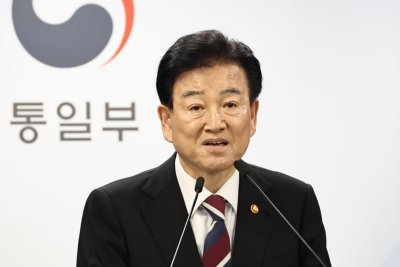
South Korean Unification Minister Chung Dong-young speaks to reporters at a press briefing in Seoul, South Korea, 18 February 2026. Chung said South Korea will seek to reinstate a no-fly zone over the border with North Korea under the suspended 2018 inter-Korean military pact aimed at easing tensions, and expressed regret over drones sent by South Korean civilians into North Korea earlier this month. Photo by YONHAP / EPA
March 13 (Asia Today) — South Korea’s Unification Minister Chung Dong-young warned Friday that preparing for war could increase the likelihood of conflict on the Korean Peninsula, emphasizing that “peace itself is the path forward.”
Chung made the remarks during the third meeting of the Korean Peninsula Peace Strategy Advisory Group held at the Inter-Korean Talks Headquarters in Seoul.
“People often speak lightly of war and repeat the phrase that if you want peace, you must prepare for war,” Chung said. “But preparing for war only raises the chances of war.”
Chung also pointed to growing global instability, citing the upcoming U.S.-China summit and tensions related to the Iran crisis.
“The Korean Peninsula sits on unstable ground and tends to sway whenever global events shift,” he said.
Noting the global interconnectedness of security issues, Chung said the distance between Seoul and Tehran is about 6,700 kilometers but developments in the Middle East can still affect the Korean Peninsula.
“A war 6,700 kilometers away is shaking the Korean Peninsula,” he said, adding that the situation underscored the importance of maintaining peace and stability in the region.
Experts attending the meeting suggested that North Korea’s recently proposed “two-state theory” should be reinterpreted in light of current conditions.
They proposed linking it to the inter-Korean confederation stage of South Korea’s long-standing National Community Unification Plan and called for the creation of a new peace roadmap for the Korean Peninsula reflecting changing security dynamics.
Participants also urged the government to shift from a “pace-maker” role to a more proactive “peace-maker” role by expanding diplomatic engagement.
They recommended exploring multilateral approaches involving neighboring countries and international organizations in addition to dialogue between the United States and China.
— Reported by Asia Today; translated by UPI
© Asia Today. Unauthorized reproduction or redistribution prohibited.
Original Korean report: https://www.asiatoday.co.kr/kn/view.php?key=20260313010004062