


Leigh-Anne Pinnock shrugs off Jesy drama as she flashes underwear at premiere
LEIGH-ANNE Pinnock shrugged off her Jesy Nelson drama as she flashed her underwear at a film premiere – after Little Mix reunion hopes were dashed this week.
Day ago, Jesy, 34, shocked fans when she released her bombshell documentary which, according to sources, was “upsetting” for Leigh-Anne, 34, and fellow bandmate Perrie Edwards, 32, and Jade Thirlwall, 33.
Jesy’s Prime doc, called Life After Little Mix, caused shockwaves when she made claims of “feeling alone” during a tough time in the girl group.
But putting on a brave face, Leigh-Anne pulled out all the stops at the London premiere of Charli XCX’s movie, The Moment.
The mum-of-two looked incredible in the daring crochet maxi dress.
The outfit showed off her incredible figure, and she completed her sexy look with a striking neon green bandeau top.


Leigh-Anne also cheekily flashed her thong in the see-through outfit.
The star’s striking look made sure to turn heads on the red carpet, and she looked incredible as she posed for the waiting cameras.
Little Mix was the first group to win The X Factor back in 2011, before going on to break UK singles chart history with five No. 1s and selling more than 75million records worldwide.
Jesy quit the band after nine years, blaming battles with her mental health and struggles with the pressures of fame as her reasons for leaving.
The band then went on a hiatus in 2021.
Last week, Little Mixers everywhere had been hopeful the girlband would regroup after Jesy hinted that their six-year feud was over after the girls had privately reached out.
In her recent documentary Jesy revealed her secret suicide attempt days before quitting the group – suggesting her cry for help was ignored by bandmates.
Fighting back tears in the doc, she said: “That made me feel really alone. I felt like there was no point. That no one cared.”
But while Jesy gave fresh hope about the possibility of reconciling with the girls, Leigh-Anne, Jade and Perrie’s reactions over the last week, suggest maybe not.
A source told The Sun: “Jesy’s confession has obviously opened up a can of worms for the girls.
“The documentary itself and the backlash that has followed, has brought up a lot of bad feeling from the past.
“It’s been upsetting for the girls, but they are focused on their solo careers and the future now.”
It comes after Jade broke down in tears on stage as she sang Natural At Disaster, whilst on her current solo tour.
The track is said to have been written about her struggling friendship with Jesy, with lyrics including: “It’s hard to love you when you hate yourself. Can’t be there for you without negatively impacting my mental health.”
Seemingly in another swipe at Jesy, she then chose to play Natural At Disaster over her latest Instagram post.
Sharing video footage from behind the scenes at her show in Chicago, JADE wrote: “And all that jazz.”
One fan commented: “The song choice… I hope you’re not shading Jesy. I love you all.”
Perrie meanwhile has kept off social media, last posting a week ago to promote her new song Woman In Love.
She brought forward the release by four days after originally announcing it would be available on the same day as Jesy’s doc.
While Leigh-Anne has been more active than usual on social media.
She has been busy posting about her new album My Ego Told Me To as she goes on tour.
She told fans: “I can’t tell you how excited I am to perform this album live for you!
“Get me back to my happy place nowww! This one’s going to be so special!”
Dua Lipa stuns in netted dress as she supports fiancé Callum Turner at film premiere
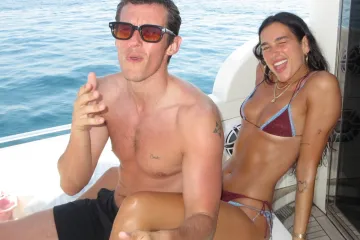
DUA Lipa shows she’s a real catch as she wears a netted dress to fiancé Callum Turner’s film premiere.
The singer, 30, shone in the mesh gown alongside Callum at the Berlin launch of Rosebush Pruning.
Callum, 36 yesterday, stars in the satirical thriller — and he’s also being talked up as the next James Bond.
Dua has fronted campaigns for Versace, Yves Saint Laurent Beauty, Pepe Jeans and Puma.
The lucrative deals have helped boost her fortune into the tens of millions and firmly cement her status as one of pop’s highest earners.
Fresh from her sold-out Radical Optimism stadium tour, the music star showed off a £25,000 engagement ring.


Callum and Dua first sparked dating rumours in January 2024 after they were spotted looking close at a Los Angeles afterparty.
By that December, she set tongues wagging when she posted festive snaps wearing a sparkling diamond ring.
Following a whirlwind romance, they finally confirmed their engagement in June 2025.
The Fantastic Beasts actor has previously shared the story of their first meeting.
Describing his superstar fiancée as “the most beautiful woman in the world”, he revealed they met at a mutual friend’s birthday party in LA in 2024.
The pair bonded after discovering they were reading the same book.
“We sat next to each other and realized we were reading the same book, which is crazy,” Callum told The Sunday Times in October.
“It’s called ‘Trust’ and I had just finished the first chapter and I told her and she looked at me and said ‘I just finished the first chapter too’. I said, ‘So we’re on the same page.’”
The book Trust is a 2022 Pulitzer Prize-winning novel by Hernán Díaz exploring themes of money and ambition.
Since going public, the couple have been spotted together at awards ceremonies and film premieres on both sides of the Atlantic.
They are expected to marry later this year.
Margot Robbie looks stunning in see-through corset dress as she leads stars at Wuthering Heights premiere in London
MARGOT ROBBIE looked stunning in a see-through corset dress as she lead the stars at the Wuthering Heights premiere in London.
The Barbie actress, 35, made sure all eyes were on her as she stepped onto the red carpet in Leicester Square in an eye-catching ensemble.
She dazzled in a see-through nude mesh gown with gold detailing and a white corset underneath, which showed off her incredible figure.
The top of the dress was connected with rope straps which held onto a frilly choker around her neck.
She brought her look to life with a pair of strappy gold heels and had her dark locks pulled back into a chic bun.
Margot went for a cool make-up look complete with pink eyeshadow, a nude lip and some blush.
READ MORE ON MARGOT ROBBIE


She was joined on the red carpet with her co-star Jacob Elordi, who looked dapper in an all-grey suit.
He towered over her in in a grey shirt, trousers, tie a long flowing blazer jacket which he paired with smart black shoes.
The Hollywood actors were all smiles as they posed up a storm together, with Jacob pulling in Margot with his hand around her waist.
The leading pair were joined by a whole host of stars from the worlds of television and film.
The iconic Helen Mirren graced the carpet in a navy suit jacket and trousers, along with a white shirt and a gold and silver necklace.
She wore a pair of funky matching navy heels and beamed from ear to ear for pictures.
Meanwhile, Charli XCX, who composed a full concept album and soundtrack for the film, looked sensational in a pink strapless gown with a veil draping her entire body.
The singer looked ethereal as her dark heavy make-up could be seen underneath her veil.
A whole host of Love Island stars descended upon Leicester Square to rub shoulders with Hollywood’s finest.
Harry Cooksley and Shakira Khan were giving power couple energy as she looked sultry in a short black dress with straps and a thigh-high cut out.
She paired her outfit with fishnet tights and layers of metal chains around her neck.
While Harry looked smart in a matching black suit, with a white shirt and a gold brooch.
Conor Phillips and Megan Forte Clarke also opted for matching ensembles, in a black frilly gown and a jacket and trouser combo.
Newly-married series 9 winners, Kai Fagan and Sanam Harrinanan looked happier than ever as they smiled for the photographers, despite it raining in the capital.
Strictly Come Dancing star Tasha Ghouri wowed in a red wine corset with a frilly skirt and Liberty Poole looked amazing in a figure-hugging black mesh gown with a red mermaid tail and black gloves.
Wuthering Heights has been written and directed by Emerald Fennell and is loosely inspired by Emily Bronte’s classic 1847 novel of the same name.
Margot and Jacob play Catherine Earnshaw and Heathcliff, respectively, and are joined in the film by Hong Chau, Shazad Latif, Alison Oliver, Martin Clunes and Ewan Mitchell in supporting roles.

Margot Robbie turns heads in Chanel velvet ballgown paired with diamond necklace at Wuthering Heights premiere in Paris
MARGOT Robbie sparkles again at a Wuthering Heights premiere — with a diamond necklace and matching ring.
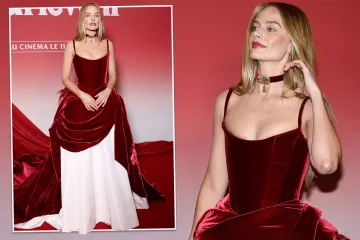
She wore a red Chanel velvet ballgown in Paris, then changed into a black corset dress for the after-party.
Last week Margot, 35, wore a £6million necklace for the Hollywood launch.
Tomorrow she and co-star Jacob Elordi, 28, attend the UK premiere in London’s Leicester Square.
Margot last week made her Wuthering Heights co-star Jacob weak at the knees in a “breathtaking” black corset.
Leading man Jacob said the uplifting black number was “an absolute banger” and described it as “devastating”.


The 28-year-old Australian plays Heathcliff opposite Margot’s Cathy in the upcoming film adaptation of Emily Bronte’s 1847 novel.
He even filled his married co-star’s dressing room with roses for Valentine’s Day while shooting the tragic love story.
His fellow Aussie Margot, who posed in a minidress for the latest cover of Vogue Australia, said she was bowled over by the romantic gesture — despite having only had her first son with husband Tom Ackerley, 35, four months earlier.
Interviewing each other for the magazine, Margot said: “You made my day and, as Heathcliff, filled my room with roses. It was so cute.
“I remember thinking on Valentine’s Day, ‘Oh he’s probably a very good boyfriend, ’cause there’s a lot of thoughtfulness in this’.
“You did a lot of very thoughtful things — it wasn’t just the gesture of the roses.”
Kennedy Center was always in the political spotlight but not like this
Last Tuesday, Philip Glass withdrew the delayed premiere in June of his latest symphony, No. 15. Originally meant to celebrate the 50th anniversary of the John F. Kennedy Center for the Performing Arts in 2022, it is a portrait of Abraham Lincoln, but the composer decided the values of the current Kennedy Center were “in direct conflict to the message of the symphony,” which is inspired by Lincoln’s 1838 Lyceum Address.
In rebuke to Glass, Kennedy Center spokesperson Roma Daravi’s quick response was: “We have no place for politics in the arts.”
Two nights later, the chairman of the Kennedy Center board (who also happens to be president of the United States) hosted at the “no place for politics” center a bevy of Republican politicians and donors for the gala premiere of “Melania,” a documentary about and produced by his wife, the first lady.
Three days after that, the president, with no warning to Congress (which administers the Kennedy Center), center staff or the public, announced on his social media platform that he would close the facility July 4 for two years to undertake a major renovation. This may get the center off the hook for putting together a new season, what with all its departures (voluntary and not) of competent artistic directors, but it also means the center’s one remaining major institution, and its crown jewel, the National Symphony, is suddenly homeless.
The fact is, the Kennedy Center has always been political. The same goes for orchestras. And Lincoln’s seeming role as a symphonic football is nothing new, either.
But political doesn’t — or, at least, once didn’t — necessarily imply partisan. In March 1981, two months into his presidency, Ronald Reagan turned up at the Kennedy Center for the premiere of a new production of Lillian Hellman‘s “The Little Foxes,” and was photographed happily congratulating a smiling Elizabeth Taylor backstage. Also present was the gruff playwright.
Hellman, who had been a member of the Communist Party and was called up in front of the House Un-American Activities Committee in 1952, and Reagan, an avid anti-Communist, couldn’t have had much use for each other politically. But there they were, soaking up art and glamour (if maybe not in that order) together. It was also in 1952 and thanks to Sen. Joseph McCarthy’s Communist witch hunts that the first inklings of a national performing arts center in Washington, D.C. developed.
Aaron Copland’s “Lincoln Portrait,” for speaker and orchestra, written in 1942 in the wake of the Pearl Harbor attack, had been slated for a performance at Dwight D. Eisenhower’s inauguration in 1952. Complaints about Copland’s leftist leanings pressured Eisenhower to cancel the performance, but left inklings in Ike’s mind that the nation needed a performing arts center in Washington, D.C. In 1955, he instituted a District of Columbia Auditorium Commission and that led to the National Cultural Center Act of 1958.
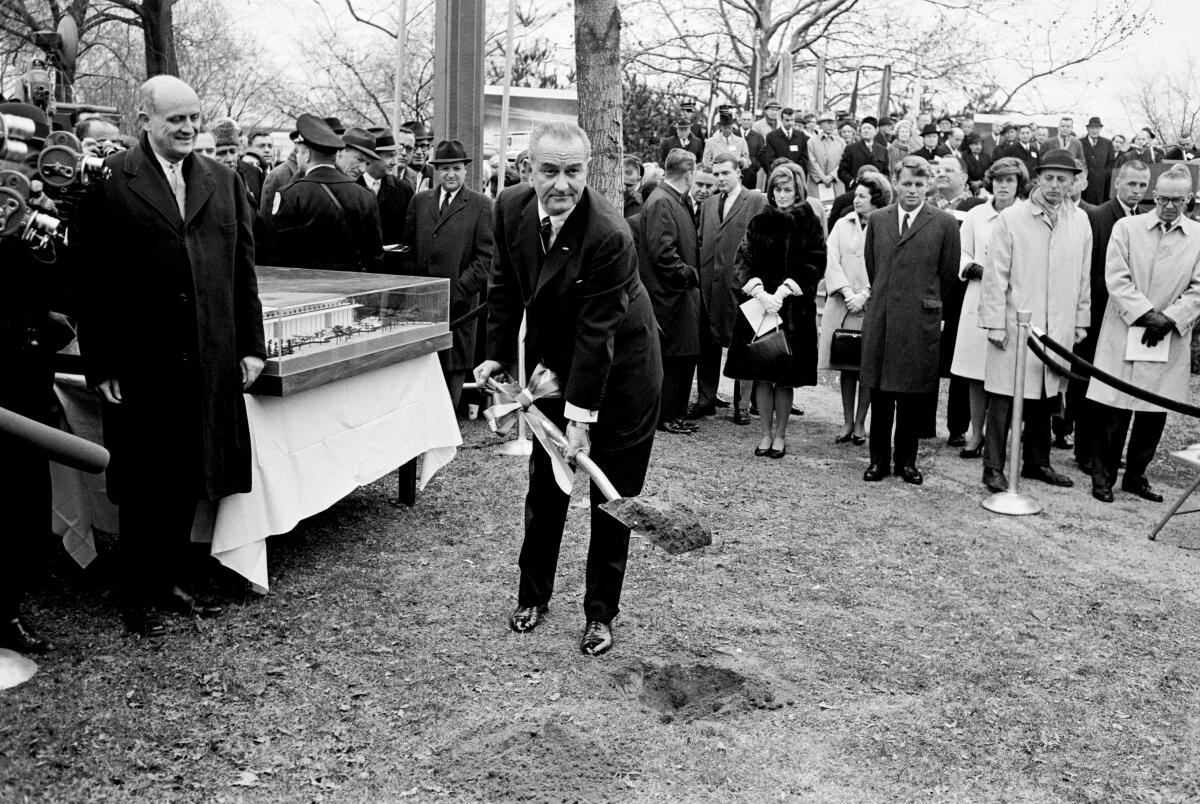
Bipartisan support became a no-brainer. Kennedy was an enthusiast and, in his presidency, both First Lady Jacqueline Kennedy and former First Lady Mamie Eisenhower worked together to support the cultural center. In 1963, just days before his assassination, JFK hosted a White House fundraiser for the center. A year later, President Lyndon B. Johnson broke ground for what was to become “a living memorial to John F. Kennedy” with the gold-plated spade that President Taft had used for the Lincoln Memorial.

President Lyndon B. Johnson lifts a shovel full of dirt during ground-breaking ceremonies for the John F. Kennedy Center for the Performing Arts in 1964 while members of the Kennedy family look on.
(Bettmann Archive / Getty Images)
The Kennedy Center proved political from Day 1. Leonard Bernstein was commissioned to write a theatrical piece for the center’s opening in 1971, which turned out to be an irreverent “Mass” — musically, liturgically, culturally and, most assuredly, politically. Most of all it was an unmistakably protest against the Vietnam War. In his own protest, President Nixon stayed home.
“Mass” was ridiculed by critics and sophisticates. And so was the Kennedy Center in its monstrosity. But the composition ultimately came to be seen as a precursor of musical Postmodernism and possibly Bernstein’s greatest work, a monument in its own right. The Brutalist monumentalism of the Kennedy Center also grew over time to be loved, increasingly bringing cachet to a diverse nation’s artistic needs.
All of that has, however, been called into question by a new administration noisily remaking the center as partisan and politicizing even renovation and Lincoln.
You don’t take on renovation of a single concert hall overnight, let alone an entire performance center with several theaters, including a major concert hall and opera house. This requires architects and acousticians deeply schooled in theaters, and each has its own acoustical needs. You touch anything, and it will affect the sound. Both the opera house and concert hall could use acoustical work, but that is a very big deal. If this sudden renovation comes as a surprise to staff, that means there have been no consultations, no proposals, no models, no feedback. Best to add to the budget some hundreds of millions of dollars to fix mistakes.
Before even considering anything else, a space has to be found for the National Symphony. It is possible to create temporary structures or renovate existing buildings into acoustical wonders, as architect Frank Gehry and acoustician Yasuhisa Toyota have proved. In Munich, the temporary Isarphilharmonie, which has Toyota acoustics, is so successful that some are saying the city doesn’t need a new concert hall after all.
So, given the timing of this precipitous announcement, it is hard to believe that something isn’t also going on with attitudes toward Lincoln and Glass’ displeasure with the Kennedy Center administration. For what it’s worth, Presidents Ford, Carter, George H.W. Bush, Clinton and Obama have all narrated Copland’s “Lincoln Portrait.”
Lincoln has been central to Glass’ work for more than four decades. The composer first used Lincoln in Act V (known as “The Rome Section”) of Robert Wilson’s 12-hour opera, “the CIVIL warS: a tree is best measured when it is down” (a prescient title for current Kennedy Center thinking), which had been intended for the 1984 Olympic Arts Festival in L.A. but was never produced here for lack of funds.
Lincoln shows up in Glass’ 2007 opera, “Appomattox,” commissioned by San Francisco Opera and later revised and expanded for Washington National Opera in 2015. The opera offers a look at how the Civil War ended with high-minded statesmanship. The first act of Glass’ 2013 opera, “The Perfect American,” about the last days of Walt Disney, ends with a flashback of Walt, who idolized Lincoln, visiting Disneyland and getting into an argument about slavery with the animatronic Lincoln, which gets so worked up it attacks Walt.
Politics are rarely far away from orchestral or operatic life. At a recent appearance of the Chicago Symphony at the Soraya, Italian conductor Riccardo Muti followed an impressively grand performance of Brahms’ Fourth Symphony by telling the audience how the arts keep us honest and played as an encore the overture to Verdi’s “Nabucco,” as an example of how an opera could motivate public support for Garibaldi’s nationalist movement. Garibaldi also makes an appearance with Lincoln in the Glass/Wilson “Rome Section.”
A few days later at the Renée and Henry Segerstrom Concert Hall, the thrilling Orquesta Sinfónica de Minería from Mexico City revealed an inspiring model of Latin American cooperation. On the program was Cuban composer Paquito D’Rivera’s “Concerto Venezolano,” featuring the fearless improvising Venezuelan trumpet soloist Pacho Flores. The concerto also featured solos on the Venezuelan cuatro by Héctor Molina, but his name was only announced last minute, due to current travel uncertainty.
One of the greatest recordings of Shostakovich’s Fifth Symphony, his grab-you-by-the-gut answer to Stalin and celebration of Russia, is by the National Symphony under Mstislav Rostropovich, recorded in 1994 at the Kennedy Center. Stalin saw the symphony as his deification. Rostropovich exuded, in the Kennedy Center aura, the expression of an overwhelmingly triumphant celebration of the end of the Soviet repression. You can take the symphony and the opera out of the Kennedy Center, but you can’t take the essence of the Kennedy Center, the living memorial to the ideal of something larger than political ego, out of the symphony and opera.
Margot Robbie wows at film premiere wearing eye-wateringly expensive necklace once owned by Elizabeth Taylor
ACTRESS Margot Robbie hits a Hollywood height at her new film’s premiere — wearing a £6million necklace once owned by Elizabeth Taylor.
The Taj Mahal diamond is a heart-shaped gold pendant set in jade and hanging from a gold, ruby and diamond chain made by Cartier.
It was given to Elizabeth by fifth hubby Richard Burton for her 40th in 1972.
Margot wore it to the world premiere of Wuthering Heights in Los Angeles, where she was earlier joined by co-star Jacob Elordi and singer Charli XCX, who recorded the film’s soundtrack.
The actress, Cathy in the adaptation of Emily Bronte’s 1847 novel, said the necklace was poignant as it had “a lot of romantic history”.
She said: “It’s our big Hollywood world premiere — we’ve got to go all out.


“This is Elizabeth Taylor’s necklace. It’s the Taj Mahal diamond that Richard Burton gave to her.
“There’s something kind of Cathy and Heathcliff about Richard Burton and Elizabeth Taylor in my mind, so it felt appropriate.”
The diamond was created for a 17th century Mughal emperor who commissioned the Taj Mahal.
It was later acquired by Cartier, with Burton buying it from them to give to Elizabeth.
Following her death in 2011, it was sold at auction for £6million to an anonymous buyer.