pratt

News Analysis: Uncertainty, frustration define messy midterm battles for mayor, governor and Congress

With little more than a week left until primary voters winnow the candidates for Los Angeles mayor, California governor and Congress, there remains a palpable sense of political uncertainty among the electorate — attributable to a lack of clear front-runners, redrawn political maps, messy party infighting and competing voter frustration with both President Trump and the state’s Democratic establishment.

In a state where Democrats hold a substantial advantage among registered voters and Trump lost in 2024 by more than 20 percentage points, MAGA-aligned Republicans are nonetheless competing on a message of ineptitude from longtime liberal leaders to address the state’s most intractable problems. Even some Democrats have railed against the status quo.

With Trump’s grip on the Republican base intact despite abysmal overall approval ratings, many Republican candidates have courted his approval — and been hammered for it by their Democratic opponents.

But those same Democrats have found it harder to explain why their own party should continue to lead the state despite allowing its affordability, housing and homelessness crises to take root and persist — taking little responsibility while swiping at each other for having failed to find solutions sooner.

All that party infighting — present before every primary, but at a fever pitch now — comes against a backdrop of broader voter unease about the war in Iran, volatile oil and gas prices, and the burgeoning threat of AI to the American workforce.

Republican voters are being warned of a blue wave in November giving Democrats control of Congress and grinding Trump’s agenda to a halt. Democratic voters are being warned of Trump administration efforts to undermine local and state elections, and of control of Congress unfairly slipping from reach thanks to further Republican redistricting following a U.S. Supreme Court decision undermining the Voting Rights Act and its protections for majority-Black districts across the South.

Many California voters — some already shaken or burned by former Rep. Eric Swalwell dropping from the gubernatorial race amid sexual assault and rape allegations last month — appear hesitant to cast ballots early, despite warnings that the Trump administration may try to discount those mailed at the last minute.

“Voters don’t want to make a mistake. They’re not absolutely certain,” said Rob Stutzman, a Republican consultant in California. “It’s just not real clear where to land.”

James Adams, a political science professor at UC Davis who studies elections and public opinion, said California Democrats this cycle “have a candidate problem and they have a message problem,” in that they are trying to convince voters to back them “not because they offer exciting ideas or inspiring leadership, but because their Republican opponents are even worse.”

And that message — offered as they gerrymander California in a race to the bottom with Republicans nationally — isn’t cutting it, Adams said.

“People are alienated from our current politics not because Americans are cynical, but because people recognize that they deserve better.”

Outsider shakes up L.A. mayor’s race

Amid entrenched homelessness, affordability concerns and lingering anger over the bungled response to last year’s wildfires, the L.A. mayor’s race was “supposed to be a referendum” on embattled Mayor Karen Bass, Stutzman said.

And yet, Bass remains in the lead, and many voters remain confused about which way to turn away from her — if at all.

Bass has won the endorsement of three council members who are members of the Democratic Socialists of America, despite City Councilmember Nithya Raman, an ally who’d previously endorsed Bass and is a member of the DSA herself, entering the race to her left.

Unable to consolidate support from the city’s progressive flank, Raman is now running neck and neck for a second-place finish and a chance to face Bass in the November runoff with former reality TV personality Spencer Pratt, who has remained in contention in ultra-liberal L.A. despite pushing a MAGA-aligned message to Bass’ right.

Pratt, who did not respond to a request for comment, lost his Pacific Palisades home in the fires and has won over many frustrated city residents with his anti-establishment message and cheeky AI videos — including one casting him as Batman, taking on a corrupt Democratic bourgeoisie.

Pratt, a registered Republican, has tried to dance around politics in the race, calling his campaign a “nonpartisan” one and comparing himself to President Obama politically. But he is backed by many Republicans, has echoed Trump’s rhetoric around restoring “common sense” and a “Golden Age” to L.A., and recently responded to Trump saying that he’d heard Pratt “is a big MAGA person” — and Raman posting the quote to X — with a meme of himself shrugging.

Fernando Guerra, founding director of the Center for the Study of Los Angeles at Loyola Marymount University, said he’s glad city voters have choices this race, because they clearly aren’t happy. He said Angelenos are less optimistic today than ever before and are deeply frustrated with “this same liberal Democratic regime from Bradley to Bass over 50 years” — a reference to former Mayor Tom Bradley, who first took office in 1973.

Voters are clearly tired of that regime, which has succumbed to “policy paralysis” in the name of “inclusion” and trying to please everyone, Guerra said — but not so much that they will consider going MAGA for Pratt.

“People say, ‘Yeah, Democrats have really f—d it up, but there’s no way we’re going to [back] Republicans. Look what they’ve done to the nation.’”

Others aren’t so sure. In its voter guide, the progressive group LA Forward wrote that the “most important thing” in the June 2 primary is to block Pratt — whom it called a “right-wing reality TV buffoon” — from advancing, and the best way to do so is to vote for Raman.

“We would much rather see a Bass/Raman runoff, with no chance of Pratt becoming mayor, than a Pratt/Bass runoff where a Pratt win would be a real possibility — plunging LA into a Trumpian mayoral nightmare,” the group wrote.

An unsettled gubernatorial contest

In the gubernatorial race, none of the many Democratic candidates has been able to consolidate a sizable lead, creating a lingering apprehension that Republicans could somehow eke out a stunning upset in the biggest of blue states.

That’s in part thanks to leading Democratic candidate Xavier Becerra, the former California attorney general and U.S. Health secretary under President Biden, being dogged by insinuations, including from fellow Democrats, that he was somehow complicit in a scheme by underlings to steal from his campaign coffers, despite prosecutors in the case — which resulted in his former chief of staff pleading guilty — never alleging wrongdoing on his part.

It’s also thanks in part to the fact that the leading progressive, Tom Steyer, is a billionaire who has bought his way into contention with nearly $200 million of his own money — in an election cycle in which progressive voters nationwide are decrying billionaires as the clearest symbol of all that is wrong with the nation’s lopsided economy.

“This kind of weird self-loathing rationale of why he’s the right guy to take on billionaires because he is one? You can’t build a Mamdani movement around that,” said Stutzman, referring to New York City Mayor Zohran Mamdani, who shot to power on a democratic socialist platform last year.

The Democrats have also struggled to combat the criticism — leveraged time and again by their Republican competitors — that their party has failed for years to solve California’s most substantial problems, and deserves to be ousted from power.

Republican Steve Hilton and Democrat Xavier Becerra speak during a break in the April 28 gubernatorial debate.

Republican Steve Hilton and Democrat Xavier Becerra speak during a break in the April 28 gubernatorial debate.

(Eric Thayer / Los Angeles Times)

Former Fox News commentator Steve Hilton has hammered that message in ads and on the debate stage, lambasting the Democratic establishment for pushing so much unnecessary regulation that it has chased out business and investment and made everything from gas to housing to groceries more expensive for average residents.

He has blamed Democrats for California’s high rates of poverty and unemployment, its high cost of living and high taxes, its record homelessness and its poor public school results.

In an interview, Hilton said he understands that California voters may not like Trump — who endorsed him — and may have conflicting beliefs about federal and international policy, but that California’s biggest problems have “nothing to do with President Trump.”

“Voters need to decide on what direction they want to take in terms of the policies that affect their daily lives in California,” he said, and those are “devised and enacted within California by our politicians here in Sacramento.”

He also said it’s no surprise that some of his Democratic rivals have also acknowledged that the Democratic establishment has been a failure, because “if you pretend otherwise, you show that you’re just completely out of touch with public opinion.”

Rusty Hicks, chair of the California Democratic Party, said “every campaign is entitled to run the race that they believe matches their story,” even if that means questioning the party’s past performance. But he also said polling hasn’t shown that message to be an effective one, and he’s confident that voters will show their ongoing trust in the party at the polls.

Redistricting, sniping and name-calling

The decision by California voters last November to pass Proposition 50 and allow the state’s Democratic leaders to redraw the state’s congressional maps to favor Democratic candidates in a handful of additional districts — part of a wider redistricting war sparked by Trump — has intensified the primary races in those areas.

As an example, longtime incumbent Reps. Ken Calvert (R-Corona) and Young Kim (R-Anaheim Hills) are now competing to represent the same redrawn swath of Orange, Riverside and San Bernardino counties, and have bitterly attacked one another. Kim has called Calvert a “swampy,” “sleazy” and “corrupt” politician guilty of “sabotaging President Trump’s agenda.” Calvert has called Kim a “RINO,” or Republican In Name Only, and a “Trump-hating liberal.”

Democrats have also sniped at each other, including in the race to replace retiring Rep. Darrell Issa (R-Bonsall) in his redrawn district in San Diego and Riverside counties — where Trump also holds an outsize presence.

Rep. Young Kim and Rep. Ken Calvert are opponents in a heated race in a newly redrawn congressional district.

Rep. Young Kim and Rep. Ken Calvert are opponents in a heated race in a newly redrawn congressional district.

(Associated Press)

Stutzman said it will be interesting to see how those primaries play out, but also how Democrats there and in other races perform in November — when Democrats are expected to perform well nationally given Trump’s lousy ratings, but Democrats in California could underperform thanks to statewide frustration with affordability, housing and homelessness here.

“People are like, ‘Eh, you know, yeah, Trump — but there’s some problems here,’” Stutzman said.

Hicks said he expects California voters to not only elect another Democratic governor, but to “push back on a Trump administration and congressional Republicans and Republicans around the country that have sought to rig the game in their favor,” including by “ensuring that we fulfill the promise of Proposition 50 by winning congressional seats and retaking the House of Representatives.”

He said the current political moment “can feel like a pressure cooker,” but Californians will “continue to adapt and overcome and be resilient, just as they always have been.”

Source link

Trump likes Pratt. Will that help, or hurt?

We’re really almost there.

There is just over one week remaining before the June 2 primary for Los Angeles mayor, city attorney, city controller and eight of the 15 City Council seats.

As of Friday morning, 333,000 mail-in ballots had been cast in the race, up from 321,000 at the same time in 2022, according to the L.A. County Registrar/Recorder.

The Trump card

Spencer Pratt’s foes in the Los Angeles mayor’s race like to say that the former reality television star lacks the experience needed to run a big city.

But Pratt might have an even bigger liability — any sense that he may be aligned with President Trump.

Cygnal, a national polling group that has worked for Republican candidates, found that tying Pratt to Trump and the MAGA movement is a bigger turnoff to Democrats than his reality television past.

According to its poll of 500 likely Los Angeles voters, Pratt’s reality TV resume made 59% of overall Democrats less likely to vote for him. By comparison, tying Pratt to MAGA and Trump made 65% of Democrats less likely to vote for him, Cygnal said.

Pratt is a registered Republican and on Wednesday, Trump signaled support for Pratt in the mayoral race. On Thursday, former Trump advisor Steve Bannon said the president didn’t formally endorse Pratt out of fears it would hurt Pratt’s chances in Democrat-dominant Los Angeles.

L.A. mayoral candidate Spencer Pratt hosts a campaign "block party" event.

Spencer Pratt at a recent campaign block party in South Los Angeles.

(Robert Gauthier / Los Angeles Times)

Overall, including Democrats and Republicans, 24% of voters said tying Pratt to Trump made them more likely to vote for him while 50% of voters were less likely to vote for him because of it.

“Karen Bass is a fairly reserved individual, but you have to believe that backstage she was doing a happy dance after she heard Donald Trump’s comments,” said Dan Schnur, a professor of politics at USC, UC Berkeley and Pepperdine University.

The strongest pro-Pratt argument is a public safety argument that Pratt will reject “defund the police” policies and hold repeat offenders accountable.

The poll showed Bass at 25% support, Pratt at 22% and Councilmember Nithya Raman at 18%.

You’re reading the L.A. on the Record newsletter

Sign up to make sense of the often unexplained world of L.A. politics.

Big money for Blumenfield seat

It hasn’t had the same sizzle as the mayor’s race, or been as pricey as the acrimonious campaign for city controller. But the battle to replace City Councilmember Bob Blumenfield in the west San Fernando Valley is turning into yet another high-stakes, big-money contest.

In that three-way race, a handful of special interests have now put more than $1 million into various efforts to elect businessman Tim Gaspar.

The Central City Assn., a downtown-based business group, has spent the most so far, pouring more than $400,000 into mail pieces, web videos and other campaign expenses, according to Ethics Commission filings. Most of its money has been coming from Airbnb, which is looking to loosen the city’s rules on homesharing platforms, by allowing second homes to be used as short-term rentals in the run-up to the 2028 Olympic Games.

Political aide Barri Worth Girvan, who is running to replace Blumenfield, criticized Gaspar over the influx of money, saying the “West Valley is not for sale.”

“Airbnb has destroyed countless neighborhoods around Los Angeles, and they clearly believe that my opponent will allow them to do that in the San Fernando Valley,” said Worth Girvan, who works for county Supervisor Lindsey Horvath. “Let me be clear — I will not allow that in our neighborhoods.”

Gaspar, in a statement, said he’s proud of the coalition supporting him.

“Like so many Angelenos, they are ready for change and new ideas that will actually get something done. Barri is offering nothing but the same tired excuses, empty promises, and failed ideas,” he said.

Under the city’s campaign finance rules, donors cannot give more than $1,000 to the campaign of a council candidate. However, independent expenditure groups can spend unlimited amounts, as long as they do not coordinate with the campaigns of their favored candidate.

Some of the other Gaspar backers who are spending large sums include the California Alliance of Family Owned Businesses, which represents McDonald’s franchisees, the California Apartment Assn. and Working Californians, a committee sponsored by International Brotherhood of Electrical Workers Local Union 18, which represents employees of the Department of Water and Power.

That committee is also partly funded by Airbnb, according to the Ethics Commission website.

Ethical supes

The Los Angeles County Board of Supervisors voted this week to establish its first ethics commission.

The creation of the new body aimed at preventing and eliminating corruption in county government was mandated by Measure G, which voters approved about 18 months ago.

That measure overhauled the county charter to create an elected county executive position and increase the number of supervisors from five to nine.

It also stipulated the establishment of an ethics commission and an office of ethics compliance, helmed by an ethics compliance officer.

Polling shows the effort has broad public support, according to Sara Sadhwani, a political science professor at Pomona College who served on a task force that made recommendations to the supervisors.

But there was still controversy before the Board of Supervisors voted 5-0 Tuesday to support to approve the plan.

Supervisor Janice Hahn said the ethics commission was intended to be an independent body whose members were not directly selected and appointed by elected officials.

She proposed an amendment that would have made it so commissioners were chosen from a list of qualified and interested people via a lottery system.

Hahn lost that battle and the county approved the plan without the change. The county assessor, the chair of the Board of Supervisors and starting in 2028, the newly minted county executive, will each appoint one ethics commissioner.

Those three commissioners will then select the other four members of the commission, who are subject to the approval of the supervisors.

State of play

— “THE HILLS” ARE ALIVE: The Times dived deep on Spencer Pratt’s history as well as his campaign, showing how he rose from reality television villain on “The Hills” to become a leading contender for L.A. mayor.

— TRUMP BUMP?: President Trump signaled support for Los Angeles mayoral candidate Spencer Pratt on Wednesday, wading into the local election less than two weeks before the primary.

— FRESH PRINCE: Spencer Pratt’s campaign for Los Angeles mayor has paid the Hotel Bel-Air more than $15,000 since April 7, according to Pratt’s latest campaign finance filings.

— PROGRESSIVE BLOCK: Three members of the L.A. City Council’s progressive bloc endorsed Mayor Bass for reelection, snubbing fellow progressive Nithya Raman in the June 2 primary. The endorsements from Eunisses Hernandez, Ysabel Jurado and Hugo Soto-Martínez underscore fractures on L.A.’s left. All three are members of the Democratic Socialists of America, as is Raman.

— HOLLYWOOD HOPEFULS: In campaign ads, interviews and the recent televised debate, the top three contenders: incumbent Mayor Bass, former reality TV villain Spencer Pratt and Raman, have made the ongoing production slump a pivotal topic, highlighting their plans to revitalize the industry while deploying the issue to undercut one another.

— WHITHER LATINOS?: Latinos make up nearly 37% of the L.A. electorate, making their votes crucial for anyone with mayoral ambitions. That has campaigns putting out ads and social media posts in Spanish, hitting the ground in Latino majority neighborhoods and rallying for key endorsements.

— HUNGRY FOR MORE: It’s the biggest slate of democratic socialists Los Angeles has ever seen. The L.A. chapter of Democratic Socialists of America is looking to push City Hall further left by backing candidates for city attorney and four City Council seats in the June 2 primary.

— OH, AND A BUDGET: The Los Angeles City Council signed off on a $15-billion budget for 2026-27 on Thursday, preserving Mayor Karen Bass’ police hiring plan while socking away more money for potential emergencies.

— AIRPORT DELAYS?: A $30 minimum wage for hotel and airport workers will be delayed after Los Angeles elected officials persuaded a group of business leaders to drop a ballot measure that would have devastated the city budget.

QUICK HITS

  • Where is Inside Safe? The mayor’s signature program moved 69 people indoors near Chinatown this week in Jurado and Hernandez’s council districts.
  • On the docket next week: The City Council will vote to approve a formal letter to remove the gross tax repeal from the November ballot.

Stay in touch

That’s it for this week! Send your questions, comments and gossip to LAontheRecord@latimes.com. Did a friend forward you this email? Sign up here to get it in your inbox every Saturday morning.

Source link

L.A. mayoral hopeful Spencer Pratt is making a big splash, but can he swim?

Spencer Pratt, please give me a call.

We should talk.

You say you want to be mayor of Los Angeles, but do you really?

I know that being a candidate has rescued you from anonymity after your career in reality TV went off a cliff. You’ve got CEOs backing you, and fans raving, and you’ve managed to milk social media attention.

But at some point you might have to answer questions from the reporters you’ve been avoiding.

And if you win, you’re going to have to drive to City Hall five, six, seven days a week, and I don’t know if you saw my column a few weeks ago, but the fountain on the south lawn hasn’t worked in about 60 years. If you get elected, you better put a wrench in your lunch box, because nobody has figured out how to fix it.

So that’s the reality, pretty much. And the unions will want what they want, and the socialists on the City Council will be lying in wait, especially after President Trump blew you a cross-country air kiss and certified your MAGA credentials.

More than 30,000 people are waiting for their broken sidewalks to get fixed (I’m not exaggerating) but there’s no money, and if you hire several thousand more police officers as you’ve pledged, the city would be bankrupt for the next decade or so and you’d need to take out a loan to buy a doughnut.

So call me, like I say, because I think there’s still time to change your mind.

If you choose to proceed, and if you actually win, it might feel like you’re in a sequel to that reality show you did called “I’m a Celebrity … Get Me Out of Here,” and you may end up praying the show gets canceled. The mayor’s hours are long, and everywhere you go, someone will want you to fix this problem or that, and as you wander the halls of power you’ll think back on your campaign pledges and hear the constant echo of a line from H.L. Mencken:

“For every complex problem there is an answer that is clear, simple, and wrong.”

Can I confess something?

I’m feeling guilty about all of this.

Not to sound presumptuous, but I feel partly responsible for the fact that you’re in contention for the job.

Like you, I’ve been calling out issues with the management of L.A., and I’ve been doing it for years. But I had the good sense not to run for mayor.

Why’s that?

Because unlike you, I know the fixes aren’t as easy as we’d like them to be.

When Karen Bass was running the first time, I had a long talk with her about her homelessness plan, among other things. At the end of the day, she asked for my input.

I reminded her that as much as people would like for the city’s top elected official to immediately clear the streets, a mayor is limited by shared power with the City Council.

By drug epidemics and untreated mental illness that are largely under county authority.

By uncertain funding from the nation’s capital.

By global forces that transformed the economy and created staggering levels of inequality that are made all the worse by the high cost of housing.

Bass was aware of all that, but said that having worked in Sacramento and D.C., and having built relationships with county supervisors, she’d be able to build better systems and get better outcomes.

So how has she done?

Not great. And then there’s the fire.

As I’ve said before, leaving the country despite forecasts of elevated wildfire risk was probably the worst mistake of her political career.

I don’t need to remind you of that. Having lost your house in the Palisades, you know that Bass badly underreacted, then stumbled on the rebuilding, and then had a hand in downplaying the Fire Department’s failure to adequately deploy and extinguish the fire that became an inferno.

To summarize, she’s left herself wide open to a challenge.

And she probably can’t believe how lucky she is that you might be her November competition, if the two of you bounce out Councilmember Nithya Raman and the other candidates in the June 2 primary.

I don’t hold it against you that you haven’t worked in government or politics before. These days, a lot of voters prefer outsiders. But it might have helped if you’d done something of purpose at some point in your life, like run a successful business or volunteer at a food bank. Were you junior high class president, or were you in the Boy Scouts? Anything could help.

Not that being the boyfriend and later the husband of someone on an MTV reality show called “The Hills,” which chronicled the work of a woman who went from “Laguna Beach: The Real Orange County” to an internship at Teen Vogue, can’t prepare a young man for statesmanship.

In this culture, you could ride that all the way to the White House.

But the flimsy resume could explain, Spencer, why you’ve been taking so many social media-fueled potshots at Bass without offering anything of substance.

Let’s arrest drug zombies.

OK, then what?

I’d advise you to study the primer by my colleagues Doug Smith and Andrew Khouri on what you can and can’t do about homelessness as a mayor in L.A. Clearly, you’ve got a lot of boning up to do. In fact, I’m reminded of a line by a Philadelphia columnist years ago, when he said of a politician who wasn’t up to the job: He’s been standing in shallow water for so long, he doesn’t realize he can’t swim.

If I were you, I’d consider the fact that President Trump made the mistake of promising easy fixes. He was going to deliver a massive infrastructure program. He was going to deliver healthcare reform that was better and cheaper for everyone. He was going to lower consumer prices on Day One, and here we are, with millions of people wondering how they’re going to pay their bills while Trump rigs it so he doesn’t have to pay the IRS.

All that being said, I’m glad you decided to run, because elected officials need constant reminders that their jobs are not secure, even when the challengers are way in over their heads. I’d almost like to see you win, because that’s one reality show I’d be sure to watch.

And I say this despite the fact that you once told your talk show buddy Alex Jones — who insisted that 9/11 was an inside job and that the Sandy Hook massacre of 20 children was a hoax — that melting ice caps are overrated. Or, as you explained it to Jones, “we’ve all seen footage of the polar bears swimming to new pieces of ice.”

When the general election rolls around, and the ice begins to break, will you know how to swim?

steve.lopez@latimes.com

Source link

Steve Hilton and Spencer Pratt need Latinos, not Trump

With less than two weeks before the primary election, Steve Hilton is leading in the polls for governor, and Los Angeles mayoral hopeful Spencer Pratt is making the city’s progressive class sweat.

If the former Fox News commentator and the reality television bad boy move on to November’s general election, they’ll be running as conservatives in a super-blue state and city where most voters loathe President Trump.

The president endorsed Hilton last month, posting on social media that he “is a truly fine man, one who has watched as this once great State has gone to Hell.” On Wednesday, Trump said he wants Pratt to “do well … I heard he’s a big MAGA person,” before claiming that California elections are rigged and that he would have won the state two years ago “if we had Jesus Christ come down and count the votes” because “I do great with Hispanics.”

Trump was right about one thing — the importance of Latino voters. If Hilton and Pratt are to pull off historic upsets, they’ll need this bloc, which has emerged as a mercurial swing vote in local, state and national elections — but only if stirred into action by anger. And if ever there was a year for Latino anger, 2026 is it.

In recent years, Latinos in California have drifted rightward as they tire of Democratic policies, from L.A. City Hall to Sacramento. Rick Caruso captured a majority of the Latino vote in his unsuccessful bid for L.A. mayor four years ago, and there are more Latino Republicans in the state legislature than ever. Some of the most Latino areas in Southern California saw the biggest shifts toward Trump from 2020 to 2024.

Hilton has held town halls in small, Latino-majority cities across a state that’s about 41% Latino. He frequently appears alongside lieutenant governor candidate Gloria Romero, a pioneer in challenging disaffected Latinos to not always vote Democrat.

Pratt has shared AI-generated salsa and merengue songs that hail him as a savior and uses Spanglish when referring to Mayor Karen Bass as “Basura” — trash. He’s starting to roll out endorsements from Latino business groups and held a block party in South L.A. this week for which a Instagram post tried to draw supporters with the promise of a taco truck.

So if the candidates know that Latinos are essential to their long-shot campaigns, why the hell aren’t they running as far and fast from Trump as possible?

Two years ago, Trump — the most anti-Latino president since James Polkgrabbed a larger share of the Latino electorate than any Republican presidential candidate ever had. GOP leaders predicted that Latinos were finally theirs. But Trump annihilated that advantage by launching his deportation deluge. Now, he has turned off even some die-hard supporters by starting a war in Iran, which has further strained an already shaky economy.

President Donald Trump

Trump annihilated the advantage the GOP had with Latinos by launching his deportation deluge.

(Manuel Balce Ceneta / Associated Press)

A New York Times/Siena poll released this month found that only 20% of Latinos support Trump — the lowest during his two terms. A Pew Research Center survey, meanwhile, found that only 66% of Latinos who voted for Trump now approve of him, compared to 81% of white Trump supporters.

Instead of running away, Hilton and Pratt seem fine with hitching their prospects to this political Titanic.

Hilton sought and received Trump’s endorsement, arguing that it’s better to have a friendly relationship with the White House than the antagonistic path California’s elected leaders have chosen.

But most voters want no part of Hilton’s kumbaya. Proposition 50, a direct rebuke of Trump’s gerrymandering efforts in other states, passed with more than two-thirds of the vote last fall. A CalMatters analysis found that Latino-majority precincts voted in bigger numbers for the ballot initiative than for Kamala Harris two years earlier.

Hilton can promise Latinos his “Califordable” agenda and eat all the tacos he wants. But our economic malaise was caused in large part by Trump, who recently said he thinks about Americans’ financial struggles “not even a little bit.”

For Hilton not to decry such cluelessness is almost as ridiculous as his recent boasts that he — the British son of Hungarian refugees who became a U.S. citizen just five years ago — is the candidate of “legal” immigrants. That’s a callback to the days of Proposition 187, when Republicans obsessed with the state’s changing demographics turned off my generation of Latinos by demonizing our undocumented friends and family. The GOP was finally starting to emerge from the political wilderness with Latinos, but Hilton cozying up to Trump will drag the party back into that weak salsa place.

Pratt has been coyer on his thoughts about Trump, but at least he seems to realize that the president might be a liability. The Republican said his party affiliation doesn’t since the mayor’s race is nonpartisan. He has portrayed himself as focused solely on improving Los Angeles, telling CBS News, “I don’t do national politics. I don’t do tribal politics.”

But for someone who says he wants to make L.A. a world-class city, Pratt seems unconcerned about Trump’s assault on us, including last summer’s unchecked immigration raids and temporary occupation by the Marines and the National Guard. Rather than denounce those moves, Pratt has instead denounced L.A.’s sanctuary city ordinance and vowed to work with ICE and other federal immigration agencies to target bad hombres if he becomes mayor, even though a majority of those rounded up in the raids had no criminal history.

It’s as if Pratt’s understanding of Latino L.A. ends with an Erewhon burrito. He continually platforms supporters who portray L.A. as a multicultural wasteland. And when another mayoral candidate, City Councilmember Nithya Raman, posted Trump’s praise of Pratt on social media, he responded with a snippet of himself making a dismissive face during a debate.

But this is nothing to dismiss. For Pratt and Hilton to win, they need Latinos to believe in them. And why would we believe anyone who hitches their wagon, even a little, to Trump?

Source link

How Hollywood’s production crisis became a key issue in the L.A. mayor’s race

Los Angeles City Councilmember Nithya Raman, who serves the 4th District, makes her way across an empty, unnamed backlot, presenting her case to be the city’s next mayor.

“Studio lots like this one used to be filled with people, costumers, electricians, set medics, caterers, thousands of Angelenos making a living,” she says in the video posted on social media. “Now these lots are quiet. Since 2018, shooting days in the city have fallen by half.”

After telling voters this issue is “personal” (her husband is a TV writer and producer), criticizing Mayor Karen Bass’ leadership on the matter and outlining her own plans, Raman proclaims, “I’m running for mayor to make sure Los Angeles stays the film and TV capital of the world.”

Placing the concerns of the entertainment industry at the center of the city’s mayoral race would have been unthinkable even in the last election cycle. But the production crisis, which has rocked Hollywood and pummeled its workforce, has reached a critical juncture. The state of L.A.’s signature industry is now a political flashpoint alongside affordability, crime and homelessness in the upcoming election.

A person films an interaction with mayoral candidate Spencer Pratt

A person films an interaction between mayoral candidate Spencer Pratt and another person on his cellphone during a “Community Meet and Greet” event out of a house for sale on Long Ridge Avenue in a residential neighborhood of Sherman Oaks on Saturday.

(Etienne Laurent/For The Times)

In campaign ads, interviews and the recent televised debate, the top three contenders: incumbent Mayor Bass, former reality TV villain Spencer Pratt and Raman, have made the ongoing production slump a pivotal topic, highlighting their plans to revitalize the industry while deploying the issue to undercut one another.

For decades, elected officials have not had to focus on the film and TV business, let alone turn it into a campaign issue. It was simply a given that local production would continue to play a dominant role in the city’s economy as it has for more than a century.

But the cumulative effects of consolidation, runaway production to tax-friendly states and countries and the end of the streaming boom has caused Los Angeles to lose billions in economic activity, shed some 57,000 jobs over the last four years and led to the closing of more than 80 film and television production service businesses across the city since 2022.

“For us, ‘save Hollywood’ is more than a slogan and more than headline. It is what needs to be done,” said Pamala Buzick Kim, one of the co-founders of Stay in LA, a grassroots campaign aimed at increasing film and television production in Los Angeles.

To be sure, the biggest driver of where studios and producers film are state and federal tax credits, over which the city has no control.

But Buzick Kim and others argue that “there is lots the mayor can do, hand-in-hand with the City Council.”

Mayor Karen Bass walks with Nilza Serrano during Avance's politics and tacos event

Mayor Karen Bass, center, walks with Avance Democratic Club President Nilza Serrano, to the right of Bass, during Avance’s politics and tacos event at Ernest E. Debs Regional Park in Los Angeles on Saturday.

(Christina House/Los Angeles Times)

For starters, say filmmakers and advocates, much can be done to tackle the city’s sclerotic bureaucracy, onerous regulations and a slow and costly permitting process that has pushed filmmakers to flee to friendlier and cheaper locales.

While steps have been put in place recently, including a pilot program offering reduced-cost filming permits for shoots that demonstrate a “low impact” to the surrounding community, many complain such steps have come too little and too late.

A man examines woodwork in a shop

Scott Niner, president and owner of Dangling Carrot Creative, checks on woodwork being produced at his shop in North Hollywood.

(Jason Armond/Los Angeles Times)

“The industry is in collapse and people have been talking about fixing things for years, but all we get are incremental little changes,” said Ed Lippman, a location manager of 34 years who lives in Sherman Oaks and has worked on such shows as “ER” and “The X-Files” and movies including “Galaxy Quest.” “And if the city is not being business-friendly, the business will go elsewhere.”

Compounding the problem, the Los Angeles area has more than 100 jurisdictions, many of which have their own set of rules and regulations regarding filming.

“There needs to be universal standards,” said Travis Beck, a location manager for commercials, small films and music videos. “Burbank is different from Glendale, which is different from Pasadena.”

The recent kerfuffle over filming “Baywatch,” the lifeguard reboot at Venice Beach, underscored both the efforts to bring production back to L.A. — enticed by a $21-million tax credit — and the complex, baffling red tape required to film here.

When shooting began in March, the production encountered a number of hiccups, including that it needed nearly double the parking space it had received a permit for, which was not part of the original approvals.

An anonymous crew member claimed on Facebook that government restrictions had forced production to relocate from Venice Beach. Production staff denied they had relocated. However, the incident prompted a backlash, becoming a rallying cry over L.A.’s burdensome filming bureaucracy.

The “Baywatch” team quickly met with city and county officials and resolved the issue, securing an agreement for a 20% parking discount from the city, and the mayoral candidates used it as an opportunity to score political points.

Pratt slammed the city’s permitting problems.

“LA turned its back on Hollywood — now the golden goose needs CPR,” he wrote on his Substack.

Bass highlighted her administration’s leadership on the matter.

“The City of Los Angeles will always clear bureaucratic barriers, making it easier and more affordable to film in the entertainment capital of the world,” she wrote on X last month.

On April 21, the mayor unveiled programs to offer productions 20% discounts on city-owned parking lots and other equipment, reduced filming fees at places like the Griffith Observatory and reopened the Central Library for filming. Last August, she appointed Steve Kang, president of the Los Angeles Board of Public Works, as the city’s film liaison.

Raman has pledged her support for expanding the state’s $750-million tax incentive program, streamlining permitting and lowering fees and eliminating those for small productions. She has also said she will establish a dedicated city film office with a liaison who understands production.

Nithya Raman speaks to a crowd outdoors behind Nithya for Mayor chalk message on ground

Councilmember and mayoral candidate Nithya Raman speaks to a crowd at the “Families for Nithya” event at Vineyard Recreation Center in Los Angeles on Saturday.

(Myung J. Chun/Los Angeles Times)

“Los Angeles is losing Hollywood,” Raman said in a statement. “Not because productions want to leave, but because we’ve made it too hard for them to stay.”

On his Substack and various podcast interviews, Pratt has promised to slash location fees in half, speed up permit approvals, reduce on-set city staff for the majority of productions and waive all fees for shoots with budgets under $2 million.

All three candidates have attacked one another over their approach to Hollywood.

Pratt and Raman have said Bass moved too slowly to address spiraling production and retain film jobs, saying she enacted measures only recently as the mayoral race was heating up.

Speaking on the Monks & Merrill podcast, Pratt criticized Bass’ moves to cut costs to film at the Griffith Observatory, saying, “Who needs that shot right now with the homeless poop all around it?”

The incumbent mayor has defended her administration’s record with the entertainment industry.

Bass and Pratt have taken Raman to task, calling her out for what they say is her lack of advocacy during her time on the City Council.

“She feels very strongly about it. But never offered one motion on the industry, and when motions came up on the industry she either recused herself, or got up and walked out,” said Bass during a debate this month.

Citing a potential conflict of interest over her husband’s work in television, Raman refrained from voting on several motions related to Hollywood.

Many working in the industry would like to see full-throttled support coming from the mayor’s office that will get results. They note how New York City has successfully promoted itself as a leading film destination over the years. (Kang, the city’s chief film liaison, said the city is working on a similar marketing campaign to promote filming that will launch by early fall.)

“For all the talk about, ‘We need to support and bring back filming,’ if they just did basics like lowering the fees and simplifying the process … that would actually help people and get things produced,” said Chris Fuentes, 66, who worked for 30 years as a location manager until he retired last year.

“We’ve heard a lot of great things, but not all things are possible in the mayor’s remit,” said Buzick Kim, noting that tax incentives are a state and federal issue.

Still, she said, “the mayor must understand that Hollywood needs to be made a priority and to find and create inspired thinking to make things easier and cheaper.”

Kang agrees, but says there are limits to what the mayor can achieve.

“We definitely can do a lot to really open up the entertainment industry, but at the same time, we recognize the larger impact needs to come from Sacramento and Washington, D.C., because L.A. just does not have the resources to compete with other jurisdictions in providing millions of dollars in tax incentives,” he said.

For most working in the industry, they just want city leadership that will execute on more than just talking points.

“This is the birthplace of cinema,” Beck said. “It shouldn’t be so hard to film here.”

Source link

Mayoral hopeful Spencer Pratt woos Valley voters in a rival’s district

Lake Balboa resident Jose Meraz is looking for a mayor who will turn L.A. around, cleaning up streets that he says are “filled with garbage.”

Schoolteacher Tracey Schroeder, a Republican candidate for state Assembly, is unhappy about crime, open-air drug use and the slow rebuilding effort in the wake of the Palisades fire, which destroyed thousands of homes.

Greg Whitley, a resident of Reseda, said he’s frustrated with homelessness and the influx of what he called “criminal illegal aliens.”

“I live with the Spanish community. Great people,” he said. “But these illegals that come here for criminal reasons, they’re making them look bad, and they don’t like it.”

All three showed up outside a five-bedroom home in Sherman Oaks on Saturday, looking to speak with reality TV personality Spencer Pratt, now waging an insurgent campaign for Los Angeles mayor in the June 2 election.

Mayoral candidate Spencer Pratt, left, poses with a supporter

Mayoral candidate Spencer Pratt, left, poses with a supporter during a community meet-and-greet event Saturday at a home on Longridge Avenue in a residential neighborhood of Sherman Oaks.

(Etienne Laurent/For The Times)

Standing in the entry to the home’s two-car garage, the onetime star of “The Hills” spent more than two hours shaking hands, giving hugs and posing for photos with his admirers, who waited in line under punishing San Fernando Valley sunshine.

Pratt used social media to invite the public to the campaign event, which took place in the district represented by one of his mayoral opponents, City Councilmember Nithya Raman.

He did not deliver any speeches outside the property, which is listed for rent on Zillow for $15,950 per month. He and a member of his security personnel said he was not taking interviews.

Pratt has been running in voter surveys behind Mayor Karen Bass, who is running for reelection, sometimes swapping places with Raman for second and third. He turned in a strong debate performance this month and has been outpacing his rivals in fundraising, according to the most recent disclosure reports.

While running for office, Pratt has blamed Bass for the 2025 wildfire that destroyed much of Pacific Palisades, including his home. He has railed against the city’s handling of homelessness, saying he would pursue a “treatment first” approach toward people with drug addiction who are living on the street.

Mayoral candidate Spencer Pratt, back to the camera, speaks with supporters

Mayoral candidate Spencer Pratt, back to the camera, speaks with supporters Saturday during a community meet-and-greet event.

(Etienne Laurent/For The Times)

Pratt said recently that he wants to increase Los Angeles Police Department staffing to 12,500 officers over the next decade, up from about 8,600. Speaking with one supporter on Saturday, he said the city needs to “make sure all the laws are being enforced.”

“Plenty of functioning cities enforce their laws,” he said.

That message resonated with many of the people in line.

“He is advocating for the safety and security of our families — specifically, for mothers to be able to walk their kids to school,” said Saba Lahar, a resident of Sherman Oaks, moments after talking to the candidate.

Pratt fans dropped off ballots, picked up lawn signs and stopped to pick up coffee drinks from the Hustle N Dough doughnut truck parked out front.

Some showed up even though they cannot cast ballots in L.A.

A man photographs his father holding a "Pratt for L.A. Mayor" sign in the street

Ruben Jr., no last name given takes a picture of his father during mayoral candidate Spencer Pratt’s community meet-and-greet Saturday in Sherman Oaks.

(Etienne Laurent/For The Times)

Brian Rodda, who runs a walking food tour company, described himself as “an unsatisfied Angeleno” even though he lives in West Hollywood, which is not part of the city of L.A.

“Sadly, because I do live in West Hollywood, I cannot vote for him,” he said. “But I certainly think we need a change.”

Source link

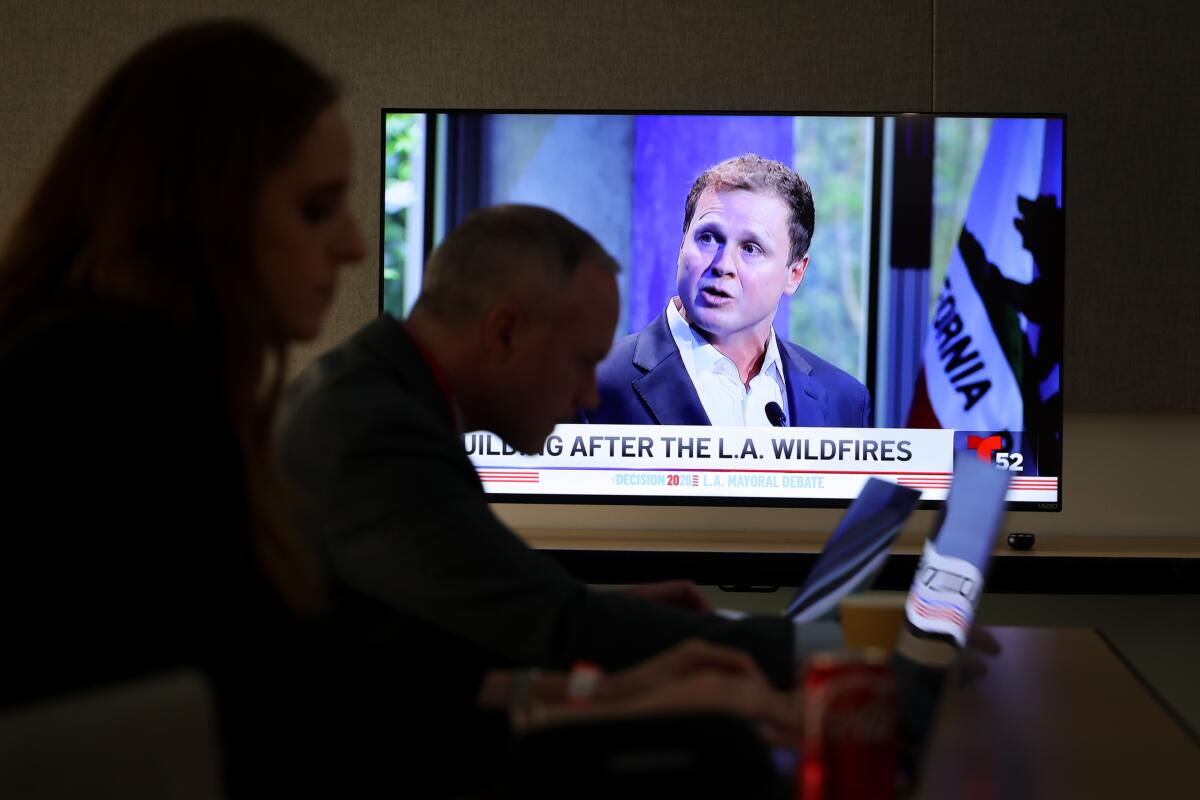
Two winners, one loser in tonight’s L.A. mayor’s debate

Karen Bass, Spencer Pratt and Nithya Raman each came into tonight’s mayoral debate with goals for what may be their only time together on stage.

As the incumbent mayor, Bass had to weather blows from her challengers while trying to sell voters on her fitness for another term, despite a disastrous 2025.

As a reality TV star with no political experience, Pratt needed to show that he could offer substance instead of just AI fanboy videos and the name-calling — “Karen Basura” — he has indulged in on social media.

Raman’s task was perhaps the hardest. As a city councilmember whose two previous campaigns were backed by the local Democratic Socialists of America chapter, she needed to convince Pratt-curious voters that she’s more conservative than Bass. Yet for others, she needed to appear liberal enough to peel away support from the mayor and come out as a progressive lioness to excite Democrats in a year where GOP candidates like Pratt have to answer for the disaster that is President Trump’s second term.

Only one of the three failed.

At times, Raman was tongue-tied trying to answer simple questions. Moderators kept telling her she was going over her time. Answering a yes/no question about whether noncitizens should be allowed to vote in city elections, the councilmember went on and on, until the moderator cut her off.

While Raman offered some policy plans, she also played a card straight out of Trump’s arsenal. She claimed that Pratt and Bass were teaming up against her — an unlikely scenario that drew laughs from the audience. She got more and more frustrated, to the point that when Bass was allowed time for a rebuttal, she dejectedly proclaimed, “I haven’t been offered that in a lot of this debate.”

Raman, who had endorsed Bass’ reelection before throwing her hat in at the last minute, came off as inexperienced, touchy and unprepared.

The line of the night was Pratt dismissing Raman as a “random councilmember” — which is how the L.A. political world responded to her entry into the race. She was so upset about Pratt’s remark that she continued to whine about it to a KNBC reporter after the debate.

What’s shocking about Raman’s flop is that she should know how important it is to project well to a television audience, given that her husband is a screenwriter. Her tone was flat, when she needed to be passionate.

No one had to remind Pratt of that. He was parrying tough questions on a big stage for the first time, facing an audience who knew him only as the Angry L.A. White Guy he has reveled in playing.

He mostly succeeded.

At his best, Pratt came off as a boisterous bro with enough charm to call himself “humble” without coming off as obnoxious. He dominated the flow of conversation without coming off as commandeering, even interrupting Raman at times to let Bass speak. At one point, he even said “Sorry” when he had taken up too much time and the moderators cut him off.

He was light on specifics, other than saying he was going to do better than the others and that he would prioritize public safety above all. Instead, he was the one person on stage who used anecdotes to sell himself, citing conversations about abused animals, downtown workers too afraid to eat outside and film producers hiring local gang members to keep their shoots safe.

As a TV personality-turned-influencer, Pratt knows that storytelling is far more effective than drowning the audience in statistics, as Bass and Raman did.

But the bad Pratt flared up at times. He earned a reprimand from KNBC anchor and debate co-moderator Colleen Williams when he called the mayor an “incredible liar.” Affecting high-pitched voices to mock Bass and Raman came off as juvenile and possibly sexist. And when it came to last summer’s federal immigration raids that terrorized Southern California, Pratt appeared flummoxed when Bass pointed out that 70% of those arrested didn’t have criminal records — a use of stats that hit.

Bass was also who she had to be — measured, forceful and raring to defend her record, without coming off as defensive. She wasn’t exactly inspirational, but she didn’t have to be. The city’s powerful labor unions have backed her, along with much of the Democratic establishment.

Raman and Pratt are right in deeming Bass the old guard of a beat-up city — but the old guard didn’t get there without knowing how to win.

Source link

What do Jeanie Buss, Colin Jost and Dave Winfield have in common? A stake in L.A. mayor’s race

The roster of campaign contributors to Los Angeles mayoral candidates has something in common with the courtside seats at Lakers games: Both are sprinkled with the rich and famous.

There’s Colin Jost, “Saturday Night Live’s” Weekend Update host, popping up as a donor to Councilmember Nithya Raman. Mayor Karen Bass, meanwhile, counts former Major League Baseball star Dave Winfield among her contributors.

Lakers governor and part-owner Jeanie Buss is there too, as a donor to reality TV personality Spencer Pratt. All three gave the maximum $1,800 contributions to their chosen candidates.

With Los Angeles at the center of the entertainment industry, big names like Jost, Winfield and Buss (none of whom responded to requests for comment) are par for the course in local elections. There might have been even more celebrity contributions were it not for the late-breaking entries of Pratt and Raman in the race, said political consultant Mike Trujillo.

“It’s a very short timeline that is not usual for a mayor’s race where you’re challenging an incumbent,” said Trujillo, who isn’t affiliated with any of the mayoral campaigns. “It takes a while to get these celebrities.”

Trujillo said he expects more big names will contribute if no candidate wins a majority in the June 2 primary, which would trigger a runoff in the Nov. 3 general election.

In 2022, “E.T.” director Steven Spielberg gave $1,500 to Bass’ first campaign for mayor as well as $125,000 to the independent expenditure group “Communities United for Bass for LA Mayor 2022.” J.J. Abrams, the director of “Star Wars: The Rise of Skywalker,” also gave $125,000 to the group.

Jeffrey Katzenberg, the co-founder of DreamWorks Animation, gave nearly $2 million to the pro-Bass group.

Winfield and Buss weren’t the only names associated with the sports world to wade into the mayoral maelstrom.

Brian McCourt, son of former Los Angeles Dodgers owner Frank McCourt, contributed the maximum $1,800 to Bass’ reelection campaign. He is the president of the McCourt Foundation, which runs the Los Angeles Marathon.

Magic Johnson’s son, Andre Johnson, who now runs Magic Johnson Enterprises, also gave the maximum to Bass.

Bass also collected donations from “Grey’s Anatomy” actor James Pickens Jr. and from Pauletta Washington, Denzel Washington’s wife. In 2025, Bass received $1,800 from Edythe Broad, the widow of billionaire developer Eli Broad and co-founder of the Eli and Edythe Broad Foundation.

Raman received dozens of contributions from successful Hollywood writers, producers and directors. She is married to Vali Chandrasekaran, a writer for hit TV shows including “30 Rock” and “Modern Family.” She took in maximum contributions from stand-up comedian Adam Conover as well as musician Joanna Newsom, the wife of Andy Samberg.

The most recent campaign contribution reports showed Pratt raising nearly $540,000 since Jan. 1, more than any other candidate. About $131,000 of his contributions were in so-called un-itemized contributions of under $100, significantly more than any other candidate.

Among the itemized contributions, Pratt reported getting $1,800 from Rick Salomon, the professional poker player who is known for a 2004 sex tape with Paris Hilton. Salomon’s daughter Tyson Salomon, a social media influencer, gave $1,250 to Pratt.

Two other mayoral candidates, tech entrepreneur Adam Miller and community organizer Rae Huang, also raised more than $200,000 each, though there were fewer household names in their contributions

Miller loaned his own campaign $2.5 million.

Source link