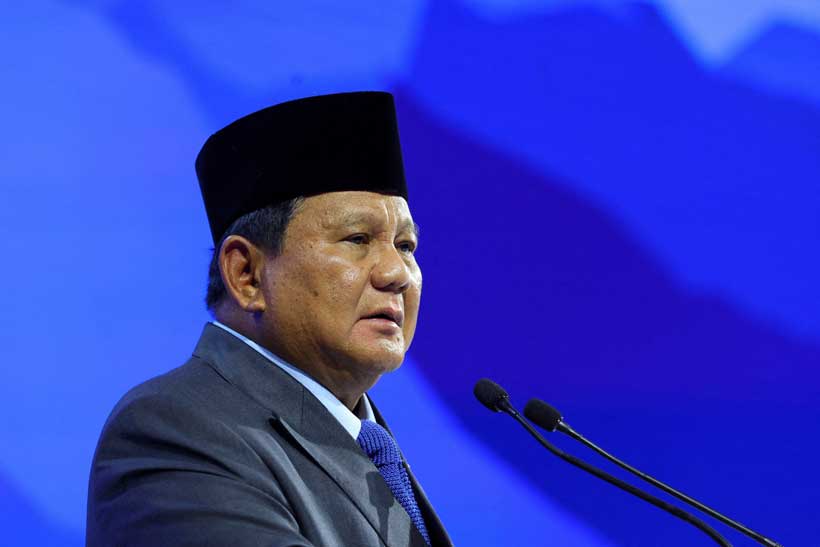
Is Prabowo leaving ASEAN in the haze?
For the last few weeks, Indonesia has been struggling to contain the land and forest fires on its territory. The disaster leads to a cross-border haze crisis affecting neighboring countries, including Malaysia, Singapore, Brunei Darussalam, and the Philippines. Indonesian President Prabowo Subianto’s approaches to the environmental issue arouse uncertainties about his commitment toward ASEAN cooperation and good relations with surrounding states. Prabowo’s inaction on Malaysia’s and Brunei’s plan to take the matter to the ASEAN meeting is also questionable, considering his image as a “foreign policy president.”
Recurring regional environmental crisis
The transboundary smoke caused by peatland fires mostly originates from Indonesia, specifically the islands of Sumatra and Borneo. The slash-and-burn method used to clear land is a main factor contributing to the widespread fires, with El Niño season worsening the situation. To mitigate seasonal disasters, the Indonesian government has attempted to strengthen domestic regulations, yet the problem persists. The haze is not simply an environmental issue, as it has a cross-boundary impact in various aspects of Southeast Asia. Wildlife is at risk, schools are forced to move online, people are experiencing respiratory issues, and other public activities are severely disturbed.
ASEAN member states have understood that this problem should be solved regionally for quite a long time. They have maintained coordination under the ASEAN Agreement on Transboundary Haze Pollution (AATHP), which was fully ratified by all members in 2015, with Indonesia ironically being the last to ratify. However, the agreement lacks strong implementation, as the willingness of the party to act is a significant part of the treaty. This may reflect the ASEAN Way’s value of highly respecting the sovereignty of other member states.
Stay ahead of the geopolitical week.
MD Briefing delivers expert analysis across five global fronts — the Indo-Pacific, energy, geoeconomics, European security, and the Middle East — every Monday morning. Free.
Indonesia’s officials stated that they are committed to the AATHP. They emphasize their own actions of reporting daily updates to the ASEAN Coordinating Centre for Transboundary Haze Pollution Control (ACC THPC). They also openly accept assistance from foreign countries to put out the fires. Nevertheless, President Prabowo’s reaction to seeing this issue as a regional problem is nowhere to be found. He indeed made some meaningful gestures in response to the forest fires, yet he mostly saw it from a purely domestic lens. For instance, Prabowo visited several hotspots in Riau, Sumatera, and provinces in Borneo. At a recent high-level government meeting, he also instructed the chief of the Indonesian police to enforce the laws against perpetrators of forest fires, including several corporations, and to conduct further investigations.
Is Prabowo really committed to ASEAN?
As the impact of the smoke has reached neighboring countries, an official statement or public apology from Prabowo is urgently needed. This political gesture will reassure ASEAN citizens that Indonesia is responsible for this matter and willing to cooperate with other member states. For instance, during the 2015 and 2019 Southeast Asian haze disasters, President Joko Widodo showed that he publicly regretted that the fires affected Malaysia and Singapore, and he even felt embarrassed as Indonesia was the primary source of the smoke.
Furthermore, making a formal apology is not always a sign of weakness, as it demonstrates a deep respect for the other party. Prabowo himself apologized to Vladimir Putin for not being present at the ASEAN-Russia Commemorative Summit, which he openly stated during a visit a few days ago. He may also do the same to ASEAN leaders to calm relations amid the crisis.
Despite reports that the Ministry of Foreign Affairs of Indonesia and relevant institutions are actively communicating with other ASEAN states, a clear statement from Prabowo is still required.
A lack of response on regional coordination may leave observers wondering, as Prabowo is known as a foreign policy president and a “de facto foreign minister.” Since the first day of his administration, he actively engaged with global leaders through overseas trips. As of June 2026, Prabowo has visited 29 countries and engaged in over 50 international engagements. This number reflects his strong interest in connecting with foreign counterparts. He also reached out to various powers and blocs, including participation at the Board of Peace (BoP) and a recent official trip to Russia.
However, Prabowo seems to ignore the reality of the current regional crisis caused by fires originating in his country. He remained silent on Brunei and Malaysia’s intention to discuss the issue at the ASEAN level. Even when the foreign public went into uproar through demonstrations at the Indonesian Embassy in Kuala Lumpur and heavy criticism on social media. His choice to focus more on the domestic side of the environmental crisis raises questions about his priority to work with ASEAN.
In the long run, Prabowo’s lack of enthusiasm for ASEAN collaboration will damage Indonesia’s long-standing image in the region and challenge the basis of the country’s foreign policy. Since 1967, Indonesia has always been taking a dominant role in the organization. No wonder the country is associated with the terms “ASEAN de facto leader” and “natural leader.” Indonesia, along with other member states, helps ASEAN to grow as one of the leading regional organizations, and conversely, the bloc strengthens Jakarta’s bebas aktif foreign policy principle. ASEAN has become a platform for Southeast Asian small and middle powers to articulate their foreign policies when engaging with external actors in the middle of great-power competition.
Despite many criticisms of ASEAN’s consensus mechanism, Prabowo still needs to maintain the commitment toward the regional bloc. To date, ASEAN continues to be relevant for Indonesia, especially during the ongoing haze crisis, as stated in Law 38 of 2008 that ASEAN is a cornerstone of Jakarta’s foreign policy.