SACRAMENTO — As Democratic leaders in California challenge President Trump’s latest effort to restrict the use of mail-in ballots, they also must grapple with a troubling development in the last election.
A significant number of mail-in ballots arrived too late to be counted in the Nov. 4 special election for Proposition 50, Gov. Gavin Newsom’s successful measure to reconfigure the state’s congressional districts, according to state data.
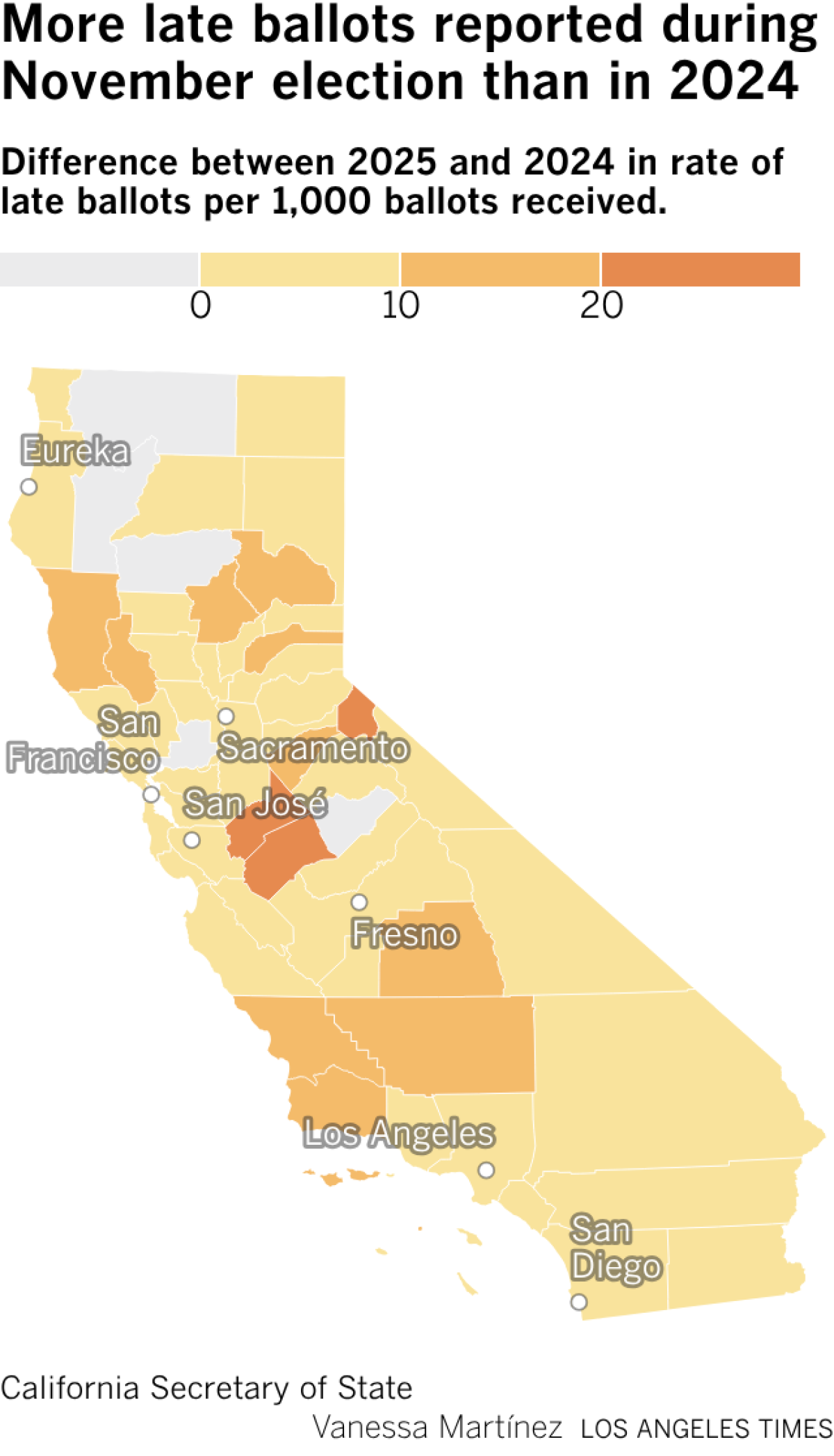
Ballots came in late at an average rate four times higher than that of the 2024 election, with rural counties seeing some of the biggest increases, according to a Times review.
“Something changed,” said Melvin E. Levey, who heads the Merced County Registrar of Voters. “We don’t like seeing late ballots and if someone has made the effort to vote, we want to count it.”
Merced saw almost a sevenfold increase in late-arriving mail ballots in the November election compared with the year before.
Vote-by-mail ballots are considered late if they are not postmarked on or ahead of election day or do not arrive within seven days of election day.
The issue appears to be linked to the U.S. Postal Service, which last year reduced the number of trips to pick up mail at post offices in mostly rural areas. Election officials warned before Nov. 4 that the Postal Service changes could delay the postmarking of ballots and lead to votes not being counted.
During the Nov. 4 election in California, an average of 8 out of every 1,000 vote-by-mail ballots were rejected by counties because they arrived too late, according to Secretary of State data. In the 2024 general election, which included the presidential race, an average of 2 of every 1,000 vote-by-mail ballots were rejected for being late.
In Kern County, for example, 3,303 mail-in ballots — or 1.95% of returned mail-in ballots — were not counted in the 2025 special election because they arrived too late. In 2024, that number was 332 — or 0.14%. And in Riverside County, 5,831 ballots — or 0.95% of those mailed in — were deemed too late to count, more than double the number of late ballots rejected in 2024.
Postal Service spokesperson Cathy Purcell recommended that voters mail their ballot a week in advance of when it must be received by election officials to ensure it arrives on time.
“You should never be mailing your ballot on election day,” Purcell told The Times.
Before last’s year’s special election, California Secretary of State Shirley Weber issued a similar warning about the delays. Anyone dropping off their ballot at a post office on election day should get it postmarked at the counter, she said.
“We don’t want anyone to just toss it into the mailbox as we have been able to do in the past and have it counted,” she said. “The Postal Service has said that they may not be counted in certain areas.”
California voter data expert Paul Mitchell expressed astonishment about the Postal Service’s guidance.
“We’ve had six, eight years of elections where people were feeling confident about mailing in their ballot,” said Mitchell, vice president of the voter data firm Political Data Inc. “Now the USPS is saying they have to mail it in a week early.”
“That is a dramatic change that can disenfranchise voters who are just following the same pattern that they’ve used in prior elections,” he added.
Democrats have been defending the vote-by-mail system in the face of Republican attacks. Trump recently signed an executive order to impose federal restrictions on mail-in ballots and, without evidence, has long criticized mail-in ballots as a source of fraud and a factor in his 2020 election loss to Joe Biden.
The Nov. 4 special election on Proposition 50 was the Democrats’ attempt to counter Trump’s push for Republican-led states, most notably Texas, to redraw their electoral maps to keep Democrats from gaining control of the U.S. House of Representatives in the 2026 midterms and upending his agenda. The ballot measure overwhelmingly passed.
Nearly 89% of votes in the Nov. 4 election were vote-by-mail ballots, according to Weber’s office. In addition to Proposition 50, tax measures were also on the ballots in some counties.
Postal Service changes
About a month before the Nov. 4 election, Weber and Atty. Gen. Rob Bonta held a news conference to encourage California voters to vote early because of service changes at the U.S. Postal Service.
Bonta told reporters that voters living 50 or more miles from six large mail processing centers in urban areas who mailed their ballots on election day would not have those ballots postmarked in time. The centers are in Los Angeles, Bell Gardens, San Diego, Santa Clarita, Richmond and West Sacramento, according to Bonta’s office.
The changes at the U.S. Postal Service are part of a 10-year plan that kicked off several years ago aimed at improving services and reducing costs at the independent federal agency.
In the 17 counties that are mostly or entirely within the 50-mile distance from the mail facilities, the average rate of late ballots doubled in the November 2025 election compared with the election the year before — from 2.5 per 1,000 ballots received in 2024 to 5.6 per 1,000 in 2025.
But in counties that are entirely or mostly outside of the 50-mile radius, the average rate of late ballots quadrupled — from 2 per 1,000 ballots received in 2024 to 9.3 per 1,000 in 2025, state election records show.
Similar complaints about late ballots because of the mail changes have been reported in other states, including in Snohomish County, Wash., according to the New York Times.
The U.S. Postal Services told the Times that there are “any number of factors” that may affect the timeliness of mail.
“The Postal Service has successfully delivered America’s election mail, and we are confident that we will do so again this year,” spokesperson Nikolaj Hagen said. “We rely on long-standing, robust and tested policies and procedures, which have proven successful in the secure and timely delivery of election mail.”
Hagen added that “adjustments to our transportation operations will result in some mailpieces not arriving at our originating processing facilities on the same day that they are mailed.”
Postmarks are generally applied at those processing facilities, Hagen said, so the postmark date may not reflect the date the mail was collected by a letter carrier, dropped off at a retail location, or placed in a collection box.
While the U.S. Postal Service uses postmarking as an internal tool to track the place and date the mail was accepted, outside entities also use the postmarks for their own purposes, including the Internal Revenue Service, which requires federal tax returns to be mailed by April 15.
Several U.S. senators, including Sen. Alex Padilla (D-Calif.), sent a letter in January to USPS Postmaster Gen. Dave Steiner warning that changes to postmarking will make it more difficult for people, particularly those in rural areas, to vote by mail and pay tax bills on time.
On Tuesday, Trump signed an executive order that seeks to put new federal controls on voting by mail in states, repeating his long-held but unsubstantiated claim that mail-in ballots are a source of widespread fraud in U.S. elections.
The order directs the U.S. Postal Service to take control of mail balloting by designing new envelopes with special bar codes that will allow the federal government to ensure that such ballots go out only to eligible voters.
States must follow the USPS process if they plan to use the federal mail system for sending or receiving ballots. They also must submit to the USPS lists of eligible voters in advance of such ballots passing through the mail system.
Separately, the Republican National Committee is challenging a Mississippi law that allows ballots that arrive up to five days after election day to be accepted and counted. The case was argued before the conservative-leaning U.S. Supreme Court in March.
Times staff reporter Kevin Rector contributed to this report.