Pope Leo’s American roots give him unique political power
Addressing reporters on a recent flight to Algeria, Pope Leo XIV invoked the Gospel, called himself a peacemaker and pledged to keep speaking out on behalf of the downtrodden.
“Too many people are suffering in the world today,” he said. “Too many innocent people are being killed, and I think someone has to stand up.”
Pontiffs have a tradition of weighing in on global strife, and Leo’s words were in keeping with long-standing church teaching. Appearing in front of reporters in this fashion was also not new: Pope John Paul II began taking questions from journalists on the papal plane in the 1970s.
But the first American pope was in fact wading into an unprecedented political tempest — responding to a series of broadsides from President Trump that drew Leo into debates over the war with Iran, immigration policies and more, all while Catholics in the U.S. and around the world looked on.

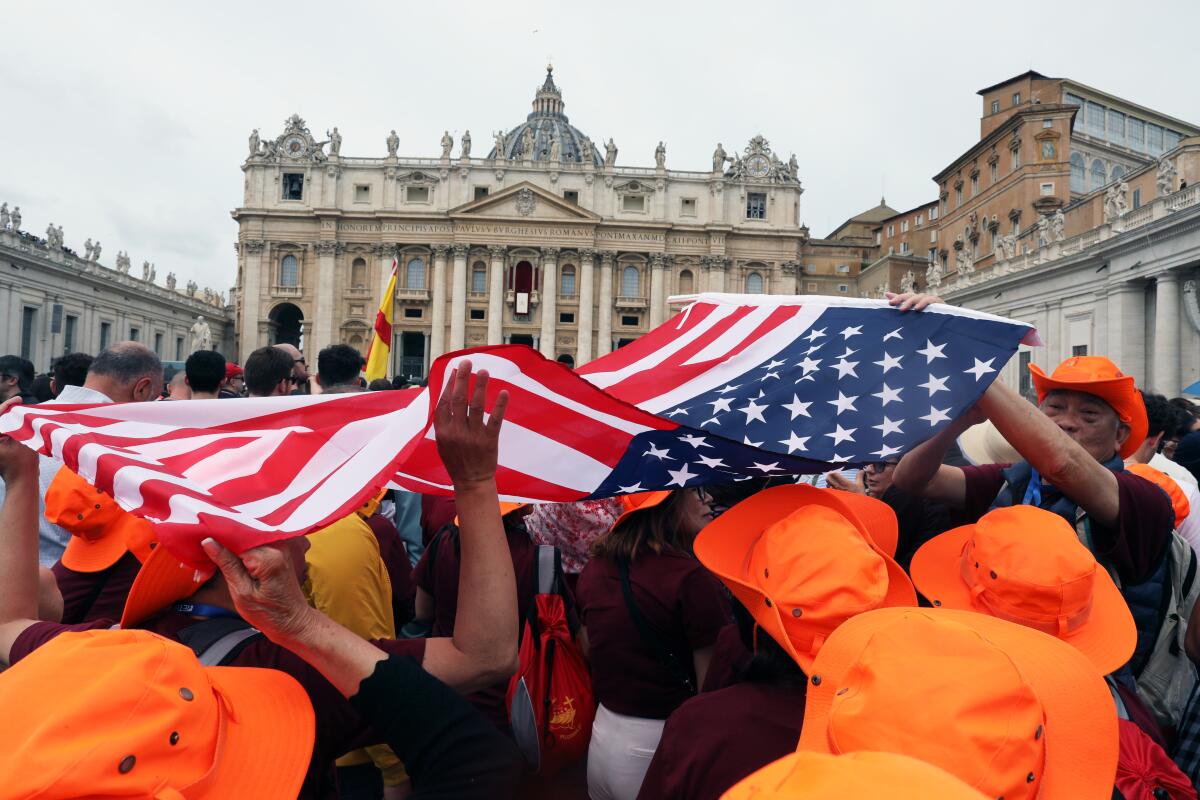
Missionaries from Austin, Texas, gather for prayer in St. Peter’s Square on May 11, 2025.
(Marco Di Lauro / Getty Images)
With no permanent peace deal in sight to end the war, two of Trump’s top lieutenants — Vice President JD Vance and Secretary of State Marco Rubio, both Catholics and potential 2028 presidential candidates — have also been pulled into the fray. On Thursday, Rubio met Pope Leo at the Vatican in what he said was a long-planned diplomatic visit. Next month, Vance will release a memoir, “Communion: Finding My Way Back to Faith,” detailing his 2019 conversion to Catholicism.
Trump’s invective has not abated, even in the week his chief diplomat met the pontiff. Ahead of Rubio’s visit, Trump repeated his claim that Leo was “just fine” with Iran developing a nuclear weapon. In response, Leo said that his critics should go after him “truthfully,” noting that the Catholic Church has spoken out against all nuclear weapons.
Against the backdrop of this sparring, Rubio sought to downplay the drama after his official visit to the Holy See, which lasted about two hours. On X, he said the meeting with Leo focused on their “shared commitment to promoting peace and human dignity.”
The episode has revealed the unique power Leo holds on the U.S. stage, with his inherent understanding of the country’s politics and an ability to deliver his message in an accent that at times reveals his Chicago roots.
“He’s speaking in English and he’s American,” said Father James Martin, a Jesuit priest and author, most recently of the memoir “Work in Progress.” “People can’t dismiss him as not understanding the United States.”
For weeks, Leo has been asked to respond to a cascade of insults from Trump, including accusations that he is “weak on crime,” that he was chosen as pope because of Trump, and that the leader of the world’s 1.4 billion Catholics should “get his act together.”
In measured tones, Leo has repeatedly said he does not want to fight with the president. He counters that he is merely preaching the Gospel. On that flight in April, the pope told journalists: “I do not look at my role as being political, a politician. I don’t want to get into a debate with him.”
He added: “I will continue to speak out loudly, looking to promote peace, promoting dialogue and multilateral relationships.”
He may not be a politician, but Leo’s preaching, ranging from Iran to immigration and global warming, has touched a nerve with Trump. In the U.S., Catholics often serve as a powerful swing vote and hold a wide range of views on those issues. But even in a time of deep division and political malaise, enthusiasm for the pontiff, born and raised in the Chicago area, is hard to dismiss.
Leo’s ascendancy comes as engagement with the Catholic Church appears to be growing in the United States. Though comprehensive data are hard to come by, parishes are reporting renewed interest.
Mark Gray, a senior research associate at the Center for Applied Research in the Apostolate at Georgetown University, said there was evidence of an increase in baptisms, a trend that appeared to predate Leo’s election as pope last May.
Some of the new American converts lean more conservative, experts said, part of a broader rise in traditionalism. Amid tensions over whether the church should focus more on traditional issues of morality, such as abortion and marriage, or global concerns like war and migration, Leo has stressed that all are welcome and that he wants the church to function as a big tent.
Making history
U.S. presidents have long sought to court the pope, mindful of the country’s sizable Catholic population and its potential as a swing vote in elections. Woodrow Wilson was the first president to meet with the pope, in 1919, during talks after the end of World War I. Since Dwight Eisenhower made a trip to Rome in 1959, every president has traveled to meet the pope, some more than once.
That includes Trump, who traveled to see Pope Francis in 2017, accompanied by First Lady Melania Trump and his daughter Ivanka Trump. He also attended Francis’ funeral in 2025.
Asked if there was any precedent for Trump’s clash with the pope, Steven Millies, a professor of public theology at Catholic Theological Union in Chicago, invoked an English king who changed the course of church history: “Henry VIII invites a comparison,” he said. Henry rejected Catholicism in the 1500s and founded a new church in order to ratify a divorce rejected by the pope.
Though Trump — who is not Catholic — has not suggested any such schism, he certainly appears to have discarded most niceties. The president has not apologized for any of his comments, though he did, after widespread backlash, take down a social media post that appeared to depict him as Christ.
Trump is constitutionally blocked from seeking another term, so picking a fight with Pope Leo may not have lasting political implications for him. But it’s a different story for Vance and Rubio, both of whom may need to appeal to the country’s Catholic voters to further their ambitions.
In the 2024 election, the Catholic vote tilted more decisively to the right, with 55% supporting Trump compared with 43% for Kamala Harris, according to the Pew Research Center. Four years earlier, Catholics were evenly divided, with 50% supporting Joe Biden, a practicing Catholic, and 49% backing Trump.
Rubio noted as he headed to Rome that “obviously we had some stuff that happened” between the White House and the Vatican. Vance, who has frequently expressed his support for the pope but is also known for his often-punchy defense of the president’s positions, drew some derision in April when he was asked at a conference about Trump’s comments and suggested that Leo should “be careful when he talks about matters of theology.”

Pope Leo XIV exchanges gifts with U.S. Secretary of State Marco Rubio in the pope’s private library at the Vatican on Thursday.
(Vatican Media via Associated Press)
He later modified his tone, posting on X: “Pope Leo preaches the gospel, as he should, and that will inevitably mean he offers his opinions on the moral issues of the day. The President — and the entire administration — work to apply those moral principles in a messy world. He will be in our prayers, and I hope that we’ll be in his.”
Still, the rift could cloud the upcoming release of Vance’s memoir, overshadowing a book meant to burnish a potential 2028 bid with questions about Trump’s antagonism toward the pontiff.
Two Catholics have served as president — Biden and John F. Kennedy. During an era of stronger anti-Catholic sentiment, Kennedy famously gave a speech as a candidate emphasizing the separation of church and state. Biden was more openly devout, attending Mass every weekend and quoting Catholic hymns in his speeches. Vance is the second Catholic vice president, following Biden’s two terms as President Obama’s deputy.
In a statement, White House spokeswoman Taylor Rogers said Trump’s social policies were a boon for U.S. Catholics and alluded to electoral politics without mentioning the pope. “President Trump has great respect for the more than one billion Catholics around the world, especially the Catholic Americans who helped power his landslide election victory in 2024,” she said.
The Midwestern pontiff
It’s been a year since the man born Robert Prevost in 1955 stepped out onto the Vatican balcony as pope, a role that predates the United States by nearly 2,000 years. The first American pope’s compatriots quickly seized on his Midwestern upbringing (he’s a White Sox fan) and relatable family dynamics (one of his two brothers supports Trump). In a nod to his Chicago roots, an Iowa-based clothing store, Raygun, began selling a T-shirt bearing the slogan “Da Pope.”
Leo also served for years as Bishop of Chiclayo in Peru, building a global profile that helped propel him to the papacy. It hasn’t stopped Chicagoans from claiming him as one of their own — even showing up at the Vatican with Chicago-style deep-dish pizza.
Known as “Bob” before becoming Pope Leo, the new pontiff chose a name that clearly signaled his intentions as a leader, invoking memories of Leo XIII, an intellectual considered a pioneer of modern Catholic social teaching and an advocate for workers. Millies said the choice signaled that Leo wants to refocus on justice and care for others as well as the rising threats around the globe. Leo has cited artificial intelligence as one of those challenges.
With a more low-key presence than his predecessor, Pope Francis, some observers have labeled Leo as quiet. But as his tug of war with Trump shows, his messages are frequently not subtle. In fact, his reserved style may be a reflection of his Midwestern roots.

Pope Leo XIV presides over the Prayer Vigil for Peace at St. Peter’s Basilica, on April 11.
(Antonio Masiello / Getty Images)
This mild manner comes across in public statements that nonetheless make a lasting impact.
Last fall, Leo questioned Trump’s decision to rename the Department of Defense as the Department of War. “Let us hope it is just a way of speaking,” he said. More recently, he took aim at the president’s preferred method of communication, his social media site Truth Social. Asked about Trump’s vitriol on the platform, Leo said: “It’s ironic — the name of the site itself. Say no more.”
Perhaps no message has been clearer than the pope’s decision on how to spend the Fourth of July this year. For the nation’s 250th birthday, as Trump hosts a giant celebration, the pope will be an ocean away. His plans? Visiting Lampedusa, an Italian island that serves as a stop for migrants traveling to Europe.
Lucey writes for Bloomberg.