police officer

LAPD chief backed cops who shot Jillian Lauren; commission overruled

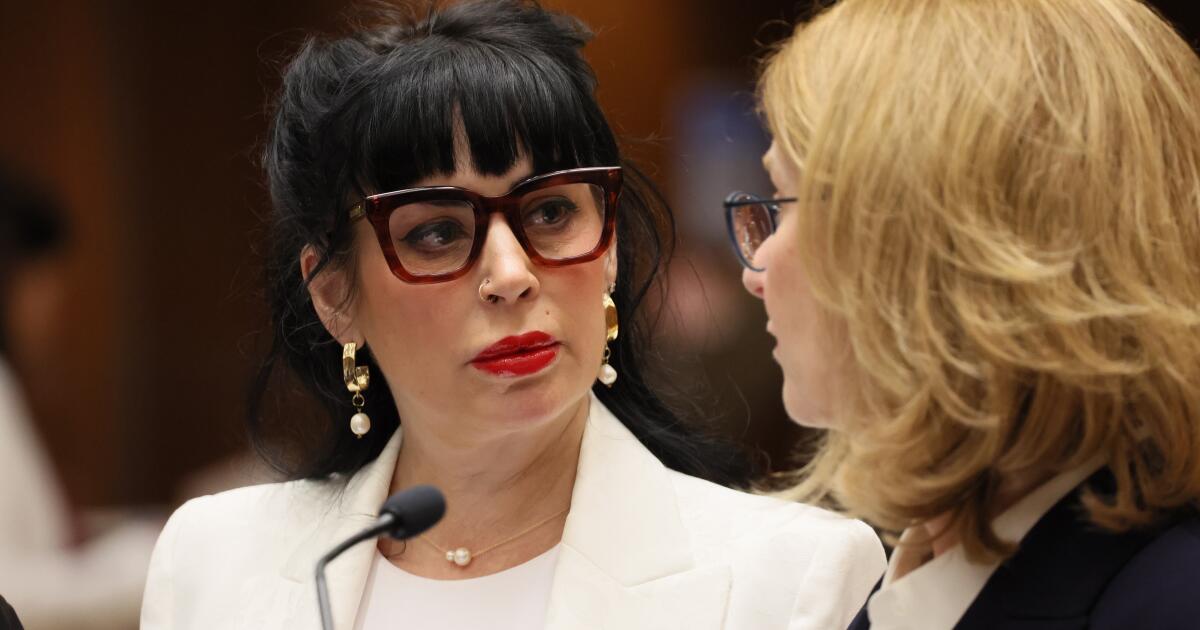
For the second time in recent months, the civilian commission that oversees the LAPD has overruled Chief Jim McDonnell in a police shooting, concluding that officers were in the wrong when they shot at Jillian Lauren, an author and the estranged wife of Weezer bass player Scott Shriner.

McDonnell wrote in a report made public Thursday that two officers were justified in using deadly force against Lauren, 52, who pointed a gun and fired at officers during a standoff in the backyard of her Eagle Rock home last April.

But the Police Commission took the rare step of going against McDonnell’s recommendation, finding fault with the shooting and concluding that the officers made serious tactical mistakes.

Although the five-member panel is the final authority on whether a police shooting is in or out of policy, the chief has final say on officer discipline. Such decisions are rarely made public because of state police privacy laws.

The incident began at about 5:20 p.m. on April 8, 2025, when police responded to a request for help from the California Highway Patrol in tracking down three suspects wanted in a hit-and-run crash. Officers Joshua Wolak and Dorian Zhou joined in the search, along with several others from the nearby Northeast patrol station.

Body-worn camera footage released by the department showed Wolak, Zhou and a CHP officer standing on a retaining wall next to a fence that separated a neighbor’s home from Lauren’s property. The LAPD video shows Lauren, wearing a purple Weezer T-shirt and black tights, walk around the yard with a black handgun, looking around as though she were on high alert.

Police said that officers yelled at Lauren to drop her gun for several minutes, before she shot a round in their direction. Wolak then fired seven rounds, while Zhou shot five from a distance of roughly 50 feet.

Lauren was not connected to the hit-and-run incident, authorities said. Audio from a 911 call by one of Lauren’s neighbors indicated that Lauren believed she was being fired at by armed suspects, who had been spotted running through neighboring properties.

After the shooting, Lauren retreated into her home, where she stayed for about an hour until an officer called her personal assistant, who was also inside. She was later taken to an area hospital with a gunshot wound to her left arm, police said.

During his interview with internal investigators, Zhou said he saw Lauren raise the handgun at a 45-degree angle, “rack” the slide to chamber a round and fire at officers. In response, he said, he fired five rounds, aiming at her center mass.

He responded that he stopped firing “because I lost sight of her.”

The commission voted unanimously to rule the officers’ decision to shoot out of policy. Officials typically do not publicly discuss the rationale for reaching certain decisions.

Both the commission and the chief were critical of the command decisions of Sgt. Albert Hoang at the scene, noting his failure to ensure that the officers involved were interviewed and the fact that he didn’t notify his higher-ups about the shooting until three hours after it occurred.

The civilian panel also diverged from McDonnell in assessing the tactical mistakes made by Hoang and the two officers. In his report, McDonnell found that the differing tactics used by CHP and LAPD only contributed to the confusion in what was already a fraught situation.

McDonnell wrote that he wants to develop protocols to ensure that if a similar incident were to arise “the other agency should be directed to disengage from the tactical portion of the incident or, as practicable, placed in a position and role that minimizes the co- mingling of tactics.”

In a 4-1 vote, the commission also decided that the officers’ decision to draw their weapons did not comply with LAPD policies — another rare finding.

Lauren was initially arrested on suspicion of attempted murder of a peace officer, a charge that carries a lengthy prison sentence, then later charged with assault and negligent discharge of a firearm. In December, a Los Angeles County Superior Court judge granted her diversion due to mental health issues, sparing her potential jail time.

The bestselling author of “Everything You Ever Wanted,” she filed for divorce from her husband in December in Los Angeles County Superior Court. In her petition, she cited “irreconcilable differences” but did not list an official date of separation. The two married in November 2005 and share two teenage sons.

Before the confrontation with police, Lauren had been recovering from cancer treatment and a hysterectomy in March.

Times staff writer Alexandra Del Rosario contributed to this report.
Source link

8 convicted on terror charges in shooting at Texas ICE site

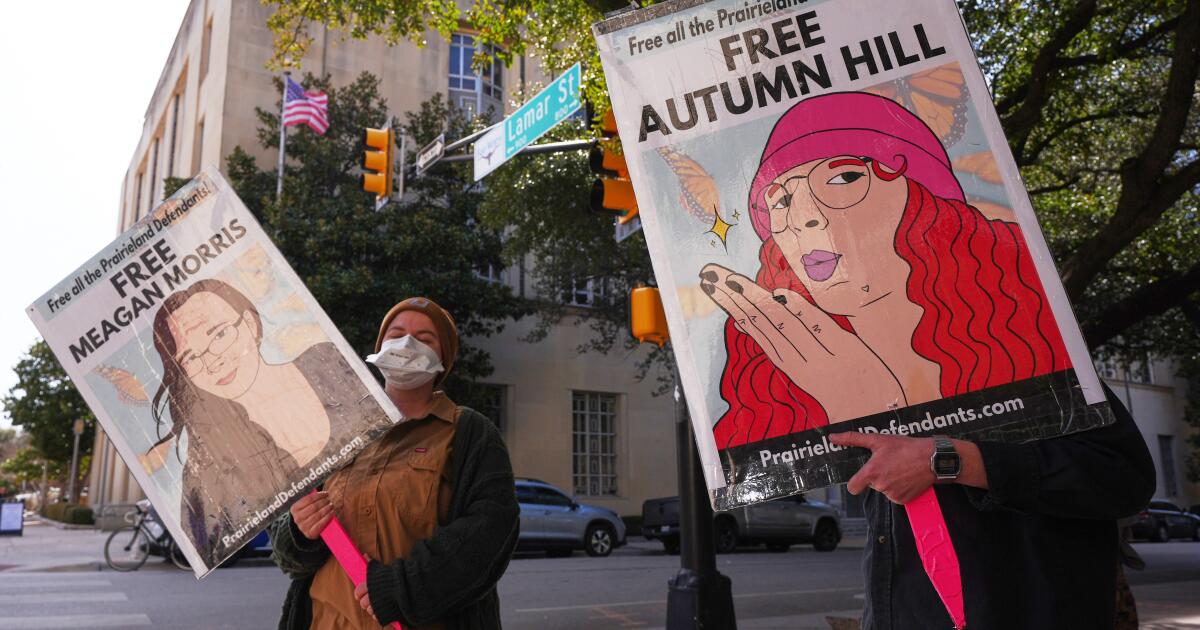
A federal jury Friday convicted nine people — eight on terrorism charges — over a shooting at a Texas immigration facility that federal prosecutors tied to antifa, the decentralized far-left movement that has become a target of the Trump administration.

One person was also found guilty of attempted murder after prosecutors say he opened fire last summer outside the Prairieland Detention Center outside Fort Worth, wounding a police officer. The Justice Department called the violence an attack plotted by antifa operatives, but attorneys for the accused denied that characterization, saying there were no antifa associations and that there was merely a demonstration with fireworks before gunshots broke out.

U.S. District Judge Mark Pittman, an appointee of President Trump, presided over the nearly three-week trial in Fort Worth. It was closely followed by legal experts and critics who called the proceedings a test of the lengths the government can go to punish protesters.

FBI Director Kash Patel had said the case was the first time charges of providing material support to terrorists had targeted people accused of being antifa members.

“Today’s verdict on terrorism charges will not be the last as the Trump administration systematically dismantles Antifa and finally halts their violence on America’s streets,” U.S. Atty. Gen. Pam Bondi said in a statement.

Short for “anti-fascists,” antifa is not an organization but rather an umbrella term for far-left militant groups that confront or resist neo-Nazis and white supremacists at demonstrations.

Protesters denied having antifa ties

Defense attorneys told jurors that there was no plan for violence on July 4 outside the facility in Alvarado.

Of the nine defendants on trial, eight faced the charge of providing material support to terrorists, among other charges. The ninth defendant, Daniel Sanchez Estrada, was charged with corruptly concealing a document and conspiracy to conceal documents. He was found guilty of both.

Sanchez Estrada’s attorney, Christopher Weinbel, said he can’t believe jurors “came to this conclusion.” Weinbel said his client had deployed as a member of the U.S. Army several times and he’d hoped what he sacrificed for the country “meant something.”

“But I feel like it turned its back on justice with this. … The U.S. lost today with this verdict,” Weinbel said.

Prosecutor Shawn Smith told jurors during closing arguments that the group’s actions — including bringing firearms and first aid kits and wearing body armor — were all signs of nefarious intent. He said they practiced “antifa tactics” and were “obsessed with operational security.”

Attorneys for the defendants have said that there was no planned ambush and that protesters who brought firearms did so for their own protection — in a state with very lenient gun laws.

A test of 1st Amendment rights

The terrorism charges followed Trump’s order last fall to designate antifa as a domestic terrorist organization. Those charges did not require a tie to any organization, and there is no domestic equivalent to the State Department’s list of foreign terrorist organizations. That’s in part because organizations operating within the United States are protected by broad 1st Amendment rights.

Critics of the Justice Department’s case have said the outcome could have wide-reaching effects on protests.

“That opposition is something that the government wants to squash, so a case like this helps the government kind of see how far they can go in criminalizing constitutionally protected protests and also helps them kind of intimidate, increase the fear, hoping that folks in other cities then will think twice over protesting,” said Suzanne Adely, interim president of the National Lawyers Guild, a progressive legal group.

Trial focused on shots fired

Attorneys for the defendants have said most protesters began leaving when two guards from the center came outside. That was before any shots were fired.

Prosecutors said Benjamin Song, a former Marine Corps reservist, yelled, “Get to the rifles,” and opened fire, striking one police officer who had just pulled up to the center.

Though it was Song who opened fire, prosecutors charged several other protesters with attempted murder of an officer and discharging a firearm, but they were found not guilty. The prosecution had argued that from the group’s planning, it was foreseeable to those others that a shooting could happen.

The officer who was shot, Alvarado Police Lt. Thomas Gross, testified that when responding to the scene he saw a person clad in all-black with their face covered and carrying a rifle. He told jurors he was shot with a round that went into his shoulder and out of his neck.

Song’s attorney, Phillip Hayes, told jurors during closing arguments that there wasn’t a call to arms before Gross arrived on the scene and “aggressively” pulled out his firearm. Hayes suggested that Song’s shots were “suppressive fire” and that a ricochet bullet hit the officer.

Leading up to the trial, several people pleaded guilty to providing material support to terrorists after being accused of supporting antifa. They face up to 15 years in prison at sentencing.

Some of them testified for the prosecution, including Seth Sikes, who said he went to the detention center because he wanted to bring some joy to those held inside.

“I felt like I was doing the right thing,” he said.

Stengle writes for the Associated Press. AP writer Jim Vertuno in Austin, Texas, contributed to this report.

Source link

Sparks’ Rickea Jackson asks court for protection from James Pearce Jr.

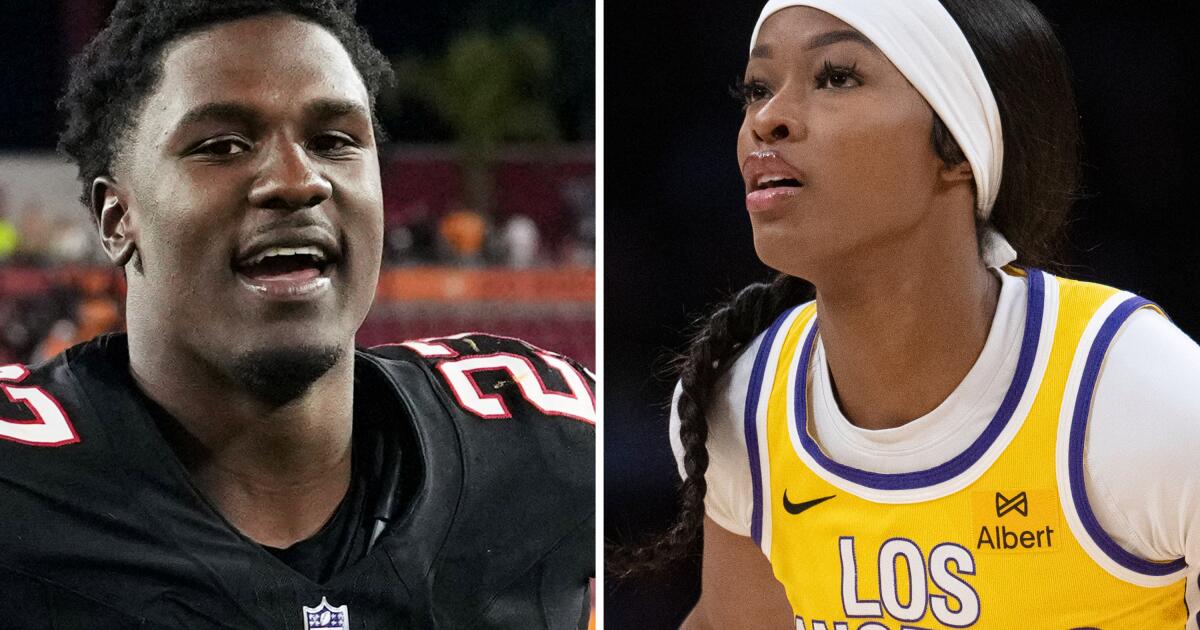
Stating that she fears for her life, Sparks forward Rickea Jackson has filed a petition for protection against her ex-boyfriend, Atlanta Falcons edge rusher James Pearce Jr.

Miami-Dade (Fla.) County Judge Heloiza Correa granted Jackson’s initial request for protection Feb. 9, and a permanent injunction hearing is set for April 21. Pearce is under order not to have contact with Jackson or come within 500 feet of her home or place of employment.

“James has threatened to kill me, James has threatened to harm me, James has threatened to injure me, James has threatened to place a bag over my head, and James has verbally and physically abused me on more than one occasion,” Jackson wrote in her statement to the court.

Jackson, 24, also filed notice with the court that she is willing to testify against Pearce. Her original petition for injunction for protection against dating violence — essentially a restraining order — was filed two days after Pearce’s arrest Feb. 7 for allegedly ramming his Lamborghini SUV into her car more than once, and doing the same to a police car in Doral, Fla.

Pearce, 22, faces felony charges of aggravated battery with a deadly weapon, aggravated stalking, aggravated battery and fleeing from a police officer. He also faces a misdemeanor charge of resisting an officer and nine traffic violations.

“Mr. Pearce maintains his innocence and urges the public to understand that while allegations have the power to shape a narrative, that it is hardly the full, complete story,” Pearce’s attorney, Jacob Nunez, told AP shortly after the arrest. “We look forward to vigorously defending our client.”

In a court filing, Jackson said that she broke up with Pearce weeks before the incident that led to his arrest. She said Pearce offered her $200,000 to remain in a relationship with him and that his behavior toward her became increasingly alarming. According to ESPN, at least seven other 911 calls to police ⁠in the months before the Feb. 7 incident reported Pearce to be stalking or harassing an unnamed girlfriend.

A police report says the relationship between Jackson and Pearce began three years ago when both were star athletes at Tennessee.

Pearce was taken by the Falcons in the first round of the 2025 draft with a pick acquired from the Rams. The 6-foot-5, 243-pound edge rusher finished third for AP Defensive Rookie of the Year after recording 10.5 sacks.

Jackson was a first-round pick of the Sparks in 2024. The 6-2 forward emerged as a star in her second season, picking up MVP votes after averaging 14.7 points, 3.2 rebounds and 1.7 assists.

“She’s a smooth person, smooth athlete, smooth basketball player,” Sparks coach Lynne Roberts said in 2025. “She makes hard things look really easy … she makes things look effortless, and I know they’re not.”

The relationship between Jackson and Pearce became volatile in January when the Falcons star admitted in a police report obtained by ESPN that he thought Jackson was cheating on him.

The Feb. 7 incident was described in Jackson’s court filing and a police report. Jackson was attempting to get away from Pearce, who followed her in his car, tried to open her car door at a stop and slammed into her car more than once while she tried to enter the Doral Police Department parking lot “because I knew James was going to hurt me,” Jackson said.

An officer pulled a gun on Pearce and ordered him to get on the ground. However, Pearce jumped back into his car. The officer attempted to open the door, but Pearce shut it and drove away, his car clipping an officer’s left knee.

Police gave chase and Pearce crashed at an intersection before fleeing on foot. Officers said that they caught up with him and he resisted arrest. He was released after posting a $20,500 bond.

Source link

Jan. 6 plaque honoring police officers finally installed at Capitol

Visitors to the Capitol will now have a visible reminder of the violent attack against the building on Jan. 6, 2021, and the officers who fought and were injured defending it that day.

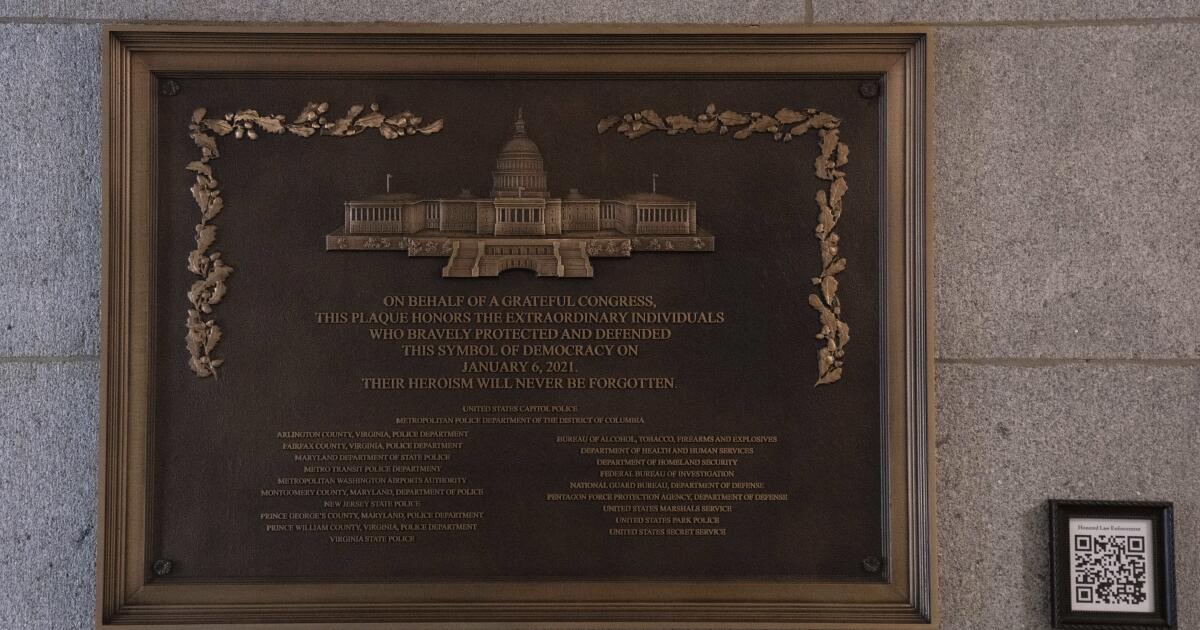
Steps from the Capitol’s West Front, where the worst of the violence occurred, workers quietly have installed a plaque honoring the officers, three years after it was required by law to be erected. The plaque was placed on the Senate side of the hallway because the Senate voted unanimously in January to install it after House Speaker Mike Johnson (R-La.) had delayed putting it up. Many Republicans had balked at installing the plaque.

“On behalf of a grateful Congress, this plaque honors the extraordinary individuals who bravely protected and defended this symbol of democracy on January 6, 2021,” the plaque says. “Their heroism will never be forgotten.”

The Washington Post first reported the installation of the plaque, which was witnessed by a reporter about 4 a.m. Saturday.

Sen. Thom Tillis (R-N.C.) led the effort to install it as he commemorated the fifth anniversary of the attack and insurrection and described his memories of hearing people break into the building. “We owe them eternal gratitude, and this nation is stronger because of them,” he said of the officers who were overwhelmed by thousands of President Trump’s supporters before eventually pushing them out of the building.

The mob of rioters who violently pushed past police and broke in were echoing Trump’s false claims of a stolen election after the Republican was defeated by Democrat Joe Biden in the 2020 presidential election. The crowd stopped the congressional certification of Biden’s victory for several hours, sent lawmakers running for safety and vandalized the building before police regained control.

Five police officers and four protesters died as a consequence of the violence. More than 140 officers from the U.S. Capitol Police, the Metropolitan Police Department and other agencies were injured.

The fight to have the plaque installed came as Trump returned to office last year and the Republican Congress has remained loyal to him. The president, who has called Jan. 6 a “day of love,” on his first day of his new term granted pardons or commutations to nearly 1,600 people convicted or charged in the rioting.

Trump was impeached and criminally indicted for his role in the insurrection. The Senate did not convict him, and the felony charges were dropped after he was reelected in November 2024.

Congress passed a law in 2022 that set out instructions for the honorific plaque listing the names of officers “who responded to the violence that occurred.” It gave a one-year deadline for installation, but the plaque never went up.

After more than a year of silence — and a lawsuit by two of the officers who fought at the Capitol that day — Johnson said at the beginning of the year that there were technical problems with the statute and the plaque could not be erected.

Tillis went to the Senate floor shortly afterward and passed a resolution, with no objections, to place the plaque on the Senate side.

One of the officers who sued, Metropolitan Police Officer Daniel Hodges, said the lawsuit would continue. Hodges, who was crushed by the rioters in the heavy doors steps away from where the plaque is now displayed, said Saturday that the overnight installation was a “fine stopgap” but that it was not in full compliance of the law. The original statute said that all of the officers’ names should be listed, among other technical specifications.

“The weight of a judicial ruling would help secure the memorial against future tampering,” Hodges said. “Our lawsuit persists.”

Jalonick and Mascaro write for the Associated Press. AP writer Allison Robbert contributed to this report.

Source link