X-62A Toting Infrared Search And Track Pod Used Its AI ‘Brain’ To Autonomously Intercept An ‘Enemy’ T-38
The U.S. Air Force’s X-62A test jet was able to use its artificial intelligence (AI) driven ‘brain’ to autonomously spot and track other aircraft in flight, and then move to intercept them, in recent testing. On top of this, the AI ‘agent’ on the X-62A performed these tasks by leveraging data from an infrared sensor pod slung underneath the aircraft. The tests demonstrate exactly the kind of autonomous air-to-air combat capabilities the Air Force is hoping to gain from its first batch of operational Collaborative Combat Air (CCA) drones.
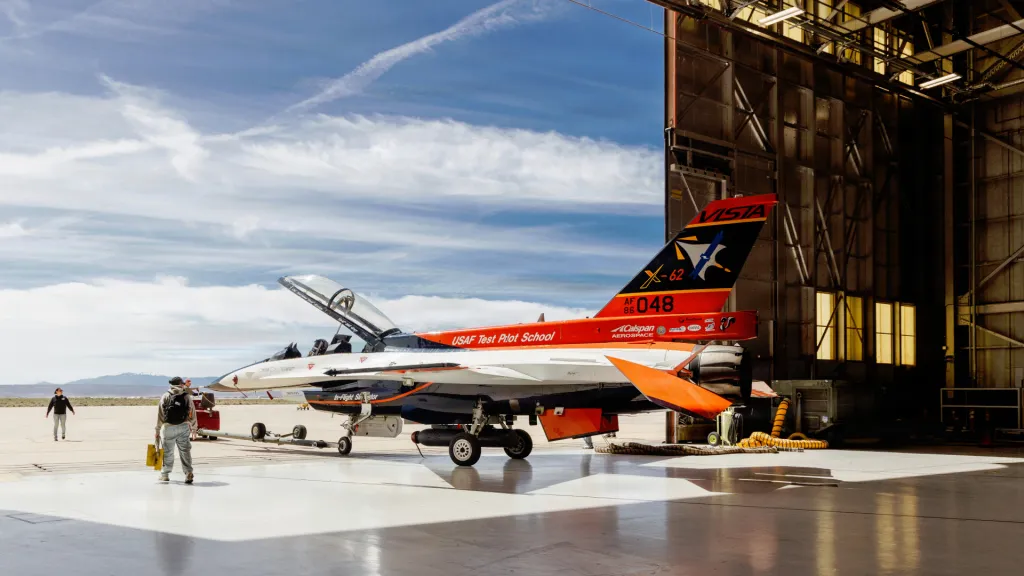
The Air Force and Lockheed Martin shared details about the new testing involving the X-62A, which is a uniquely modified F-16, today. The U.S. Air Force Test Pilot School (USAF TPS), Lockheed Martin’s famed Skunk Works advanced projects division, and other unmanned “industry partners” supported what is described variously as a “closed‑loop AI combat test” and a demonstration of “autonomous AI sensor-to-vehicle control.” The X-62A, which started life as a two-seat F-16D Viper and is also known as the Variable Stability In-flight Simulator Test Aircraft (VISTA), is assigned to the USAF TPS. The Air Force also nicknamed this particular test effort Have Heat.

“Leveraging Lockheed Martin’s Infrared Search and Track Legion Pod, during the HAVE HEAT program, the X-62 VISTA platform demonstrated the ability of AI agents to ingest live infrared sensor data, directing the X-62 to autonomously intercept an airborne target in real time,” according to a release from the Air Force’s 412th Test Wing at Edwards Air Force Base in California.
“An artificial intelligence (AI) agent used targeting information from an operational sensor to execute successful air intercepts against a live target,” a separate release from Lockheed Martin also explained. “Across eight flights, the X-62 Variable In-flight Simulation Test Aircraft (VISTA) executed 27 AI-controlled intercepts.”
A T‑38 jet trainer was used as the live target during the tests, per Lockheed Martin.
The Air Force has clearly been building up to tests like Have Heat for years now. The service, together with General Atomics, has notably used the latter company’s MQ-20 Avenger drone equipped with this same pod to demonstrate autonomous target detection and tracking capabilities in the past.
As an aside, it is also worth noting here that Legion Pod has been in active operational use on crewed Air Force fighters for some time now. This reflects a separate renaissance that infrared search and track (IRST) capabilities have been seeing across the U.S. military. IRSTs are especially valuable for helping spot stealthy targets with features designed to reduce their radar cross-sections since they detect and track infrared emissions. By extension, IRSTs are also immune to radio frequency electronic warfare jamming. As passive sensors, they do not emit their own signals that could alert a target to the fact they are being tracked, either. IRSTs can still be used to cue or otherwise be linked to other sensors, including active electronically-scanned array radars. Fusing data from multiple sources can provide higher fidelity tracks of multiple targets, as well as improved situational awareness overall.

Legion Pod Flies on F-16
The Air Force, together with various industry partners, including Lockheed Martin, General Atomics, Shield AI, Anduril, and others, have also made other important strides in autonomous air combat capabilities in recent years. This includes a ground-breaking mock dogfight between the X-62A and a crewed F-16 back in 2024.
What Have Heat has now demonstrated is the ability of an autonomous platform to use its own closed data loop to directly prosecute an aerial intercept of a physical aircraft. It also showed that the parties involved could move “AI testing from simulated target data to real-time, on‑board sensor streams, mirroring the data environment pilots will face in future high-stakes engagements,” Lockheed Martin’s press release notes.
This all speaks to a core challenge in the development of advanced autonomous aircraft: situational awareness limitations. While the aforementioned simulated dogfight in 2024 was a breakthrough event, the Air Force subsequently disclosed that the X-62A and the F-16 had been directly exchanging data the entire time. This, in turn, underscored the difficulties of ensuring an autonomous platform can safely operate closely together with friendly aircraft, let alone engage a non-cooperative hostile threat, as TWZ explored in detail at the time. The Air Force, as well as other branches of the U.S. military, have been open about the need to overcome these hurdles and the difficulties of doing so.

It is also important to note that the commercial and military aviation sectors have been developing and fielding ever-more advanced automated ‘sense and avoid’ systems for crewed aircraft for decades now. This technology has already been working its way into the uncrewed aviation realm. However, at least so far, the main focus has been on flight safety in controlled airspace rather than dynamic air combat operations over hostile territory where threats and other hazards could emerge unexpectedly.
“Our autonomous agents consumed classified infrared search and track feeds and executed combat‑critical maneuvers in real time. This achievement marks a decisive advance toward delivering AI‑augmented air dominance for the United States,” Ron Fehlen, Vice President and General Manager of Lockheed Martin Skunk Works, stressed in a statement today about Have Heat.
“Our ability to provide reliable sensor data is critical, but the real advantage comes when that data can connect seamlessly with AI to take action,” Stacy Kubicek, Vice President and General Manager at Lockheed Martin Sensors and Global Sustainment, also said in a statement. “This project demonstrates how sensing and autonomous AI can come together as a force multiplier to make faster, more informed action in complex environments.”
“HAVE HEAT represents a meaningful expansion of avionics capability towards integrated, AI-driven control of multiple sensors and air vehicles for mission autonomy,” Air Force Lt. Col. Joshua Strafaccia, Dean of Faculty for Research at the USAF TPS, said in his own statement. “This bridges a capability gap and positions us to test advanced autonomy faster.”
As mentioned at the start, for the Air Force more specifically, Have Heat is another important stepping stone toward the air combat capabilities the service wants at least from its initial tranche of CCA drones. Using CCAs as forward IRST nodes is clearly a top priority. Putting the passive sensors out ahead of manned platforms, especially in groups, will generate high-quality target data independent of radars that even stealth aircraft cannot hide from. It will also help with survivability of the drones compared to equipping them with radars, but some will likely be equipped that way, as well. With all this in mind, IRST has already been emerging as a key capability for CCA-type programs more broadly, and not just in the United States.
The service’s initial CCA fleet is set to be made up of a mix of General Atomics FQ-42 Dark Merlin and Anduril FQ-44 Fury types. The Air Force is already using pre-production versions of those drones to help develop new concepts of operations and tactics, techniques, and procedures to go with them. This includes an operational test at Creech Air Force Base in Nevada just last month, which TWZ was first to report.


The Air Force does still see human operators at least being on the loop for the foreseeable future, especially to authorize lethal attacks. The service’s F-22 Raptors are in line to be the first airborne controllers for operational CCA drones. At the same time, the exact command and control schema can be expected to evolve as autonomous capabilities continue to advance, and human operators gain more trust in those platforms to perform their assigned tasks.
All of this is directly intertwined with tests like Have Heat to expand what the autonomous packages for those uncrewed aircraft are capable of doing. The X-62A has been especially deeply involved in this work for years now. The aircraft itself has been receiving new upgrades specifically to expand its own autonomous and other capabilities. The Air Force’s press release on Have Heat today also touched on another recent effort called Have Holidays, which focused on rapid testing of new software and hardware. Have Heat and Have Holidays were conducted in parallel.
“HAVE HOLIDAYS saw simultaneous integration and evaluation of a wide suite of modular technologies into the X-62’s Enterprise Open Mission System Architecture computer,” according to the Air Force’s release. “This included the integration of a non-prime, third-party autonomous agent onto the X-62, testing of enhanced safety rules to prevent autonomous vehicles from violating user-established operational limits, and further chip integration for advanced sensor exploitation.”

TWZ has previously explored in detail the importance of rapid, iterative testing in the development of new AI-driven autonomous capabilities, including in the virtual realm. Lockheed Martin says that it was able to complete “full integration and ground test of the agents” used in Have Heat in just three months using its “‘Supermassive’ AI agent generation capability.”
“This system-of-systems test served as critical technical risk mitigation on the design and development of logistics and integration frameworks required to maximize flight opportunities post-MSU, paving the way for broader government, academic, and industry partnerships,” the Air Force’s release today also added.
MSU here is the larger Mission Systems Upgrades plan for the X-62A. The MSU effort is currently working toward the integration of Raytheon’s PhantomStrike radar onto the aircraft, as well as other new “sensor and computing capacity” and “modern network data communications” capabilities, per the Air Force. The addition of PhantomStrike, a lower-cost lightweight active electronically-scanned array radar, is particularly significant and will give the test jet another important boost in situational awareness, as you can read more about here.

PhantomStrike: Next generation radar superiority
“X-62 is continued proof that an agile, dedicated team can rapidly advance Department of War initiatives through intentional collaboration,” Air Force Col. Maryann Karlen, Commandant of the USAF TPS, said in a statement today. “Accomplishing these significant milestones is a direct reflection of the adaptability and warfighter focus personified by all members of the school.”
Beyond the unique VISTA aircraft, the Air Force has also been modifying six other F-16s to help support advanced autonomy work as part of Project Viper Experimentation and Next-Gen Operations Mode (VENOM). The service announced the start of actual flight testing involving Project VENOM jets last month.

The Air Force has also been making use of a variety of other crewed and uncrewed aircraft, including the aforementioned MQ-20 Avenger, to support autonomy testing and otherwise help lay the groundwork for its future CCA fleets, as well. The service has been closely coordinating with the U.S. Marine Corps and the U.S. Navy on this work, and all three services have a formal agreement to develop a common command and control architecture for future CCA-type drones. The Air Force has also been working to bring in foreign allies and partners into its CCA program, starting with the Netherlands.

The Air Force is now hoping to begin fielding its first operational CCAs by 2030. In the meantime, tests like Have Heat utilizing the X-62A and other platforms will only become more important to help build the foundation for the air combat capabilities those drones will provide on day one.
Contact the author: joe@twz.com