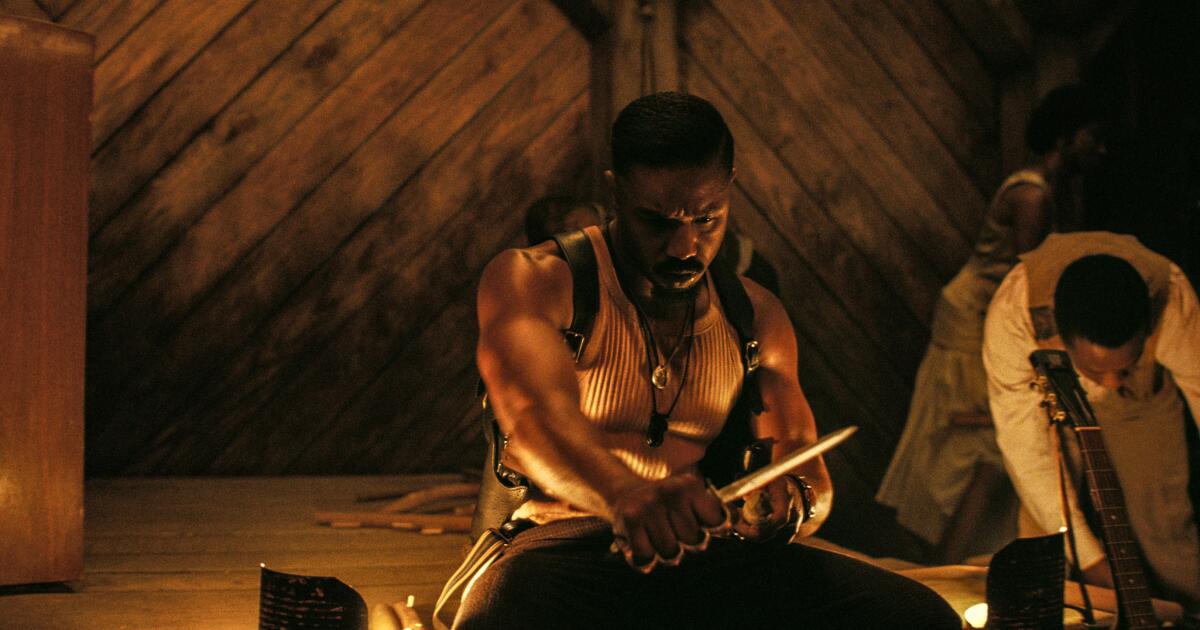
Writers Guild Awards 2026 nominations include ‘Sinners,’ ‘One Battle’
The awards momentum for “Sinners” and “One Battle After Another” continues to build.
Ryan Coogler’s historical vampire horror and Paul Thomas Anderson’s comedic political thriller were among the nominees for the 78th Writers Guild Awards announced Tuesday. Both films were also nominated in their respective writing categories for the 2026 Oscars.
Along with “Sinners,” the original screenplay nominees include the spy thriller “Black Bag” (David Koepp), the parental psychological dramedy “If I Had Legs I’d Kick You” (Mary Bronstein), the ping-pong picture “Marty Supreme” (Ronald Bronstein & Josh Safdie) and the multi-perspective mystery horror “Weapons” (Zach Cregger).
Joining “One Battle After Another” in the adapted screenplay category are the alien comedy “Bugonia” (Will Tracy), the gothic monster movie “Frankenstein” (Guillermo del Toro), the Shakespeare tragedy “Hamnet” (Chloe Zhao & Maggie O’Farrell) and the period piece “Train Dreams” (Clint Bentley & Greg Kwedar).
The television contenders included past nominees such as “Andor,” “Severance” and “The White Lotus” on the drama side, as well as comedies “Abbott Elementary” and “Hacks.” New series being recognized include “The Pitt,” “The Studio,” “The Chair Company,” “Pluribus” and “Task.”
The winners will be announced at concurrent ceremonies in Los Angeles and New York on March 8. The L.A.-based show will be hosted by comedian Atsuko Okatsuka and streamed live on the WGA West’s YouTube channel.
Screenplay nominees
Original screenplay
“Black Bag,” David Koepp
“If I Had Legs I’d Kick You,” Mary Bronstein
“Marty Supreme,” Ronald Bronstein & Josh Safdie
“Sinners,” Ryan Coogler
“Weapons,” Zach Cregger
Adapted screenplay
“Bugonia,” Will Tracy (based on the film “Save the Green Planet,” written and directed by Jang Joon-hwan)
“Frankenstein,” Guillermo del Toro (based on “Frankenstein; or, the Modern Prometheus” by Mary Shelley)
“Hamnet,” Chloe Zhao & Maggie O’Farrell (based on the novel by Maggie O’Farrell)
“One Battle After Another,” Paul Thomas Anderson (inspired by the novel “Vineland” by Thomas Pynchon)
“Train Dreams,” Clint Bentley & Greg Kwedar (based on the novella by Denis Johnson)
Documentary screenplay
“2,000 Meters to Andriivka,” Mstyslav Chernov
“Becoming Led Zeppelin,” Bernard MacMahon & Allison McGourty
“White with Fear,” Andrew Goldberg
Television, streaming and news nominees
Drama series
“Andor” — Tom Bissell, Dan Gilroy, Tony Gilroy, Beau Willimon
“The Pitt” — Cynthia Adarkwa, Simran Baidwan, Valerie Chu, R. Scott Gemmill, Elyssa Gershman, Joe Sachs, Noah Wyle
“Pluribus” — Vera Blasi, Jenn Carroll, Vince Gilligan, Jonny Gomez, Peter Gould, Ariel Levine, Gordon Smith, Alison Tatlock
“Severance” — Adam Countee, Mohamad El Masri, Dan Erickson, Mark Friedman, Anna Ouyang Moench, K.C. Perry, Megan Ritchie, Erin Wagoner, Beau Willimon, Wei-Ning Yu
“The White Lotus” — Mike White
Comedy series
“Abbott Elementary” — Quinta Brunson, Ava Coleman, Lizzy Darrell, Riley Dufurrena, Justin Halpern, Joya McCrory, Chad Morton, Morgan Murphy, Brittani Nichols, Rebekka Pesqueira, Kate Peterman, Brian Rubenstein, Patrick Schumacker, Justin Tan, Jordan Temple, Garrett Werner
“The Chair Company” — Zach Kanin, Gary Richardson, Tim Robinson, Marika Sawyer, Sarah Schneider, John Solomon
“Hacks” — Genevieve Aniello, Lucia Aniello, Paul W. Downs, Jess Dweck, Ariel Karlin, Andrew Law, Carolyn Lipka, Joe Mande, Aisha Muharrar, Pat Regan, Samantha Riley, Jen Statsky
“The Rehearsal” — Nathan Fielder, Carrie Kemper, Adam Locke-Norton, Eric Notarnicola
“The Studio” — Evan Goldberg, Alex Gregory, Peter Huyck, Frida Perez, Seth Rogen
New series
“The Chair Company” — Zach Kanin, Gary Richardson, Tim Robinson, Marika Sawyer, Sarah Schneider, John Solomon
“The Pitt” — Cynthia Adarkwa, Simran Baidwan, Valerie Chu, R. Scott Gemmill, Elyssa Gershman, Joe Sachs, Noah Wyle
“Pluribus” — Vera Blasi, Jenn Carroll, Vince Gilligan, Jonny Gomez, Peter Gould, Ariel Levine, Gordon Smith, Alison Tatlock
“The Studio” — Evan Goldberg, Alex Gregory, Peter Huyck, Frida Perez, Seth Rogen
“Task” — Brad Ingelsby & David Obzud
Limited series
“The Beast in Me” — Howard Gordon, C.A. Johnson, Ali Liebegott, Daniel Pearle, Gabe Rotter, Erika Sheffer, Mike Skerrett
“Black Rabbit” — Zach Baylin, Sarah Gubbins, Kate Susman, Andrew Hinderaker, Stacy Osei-Kuffour, Carlos Rios
“Death by Lightning” — Mike Makowsky
“Dying for Sex” — Sheila Callaghan, Harris Danow, Madeleine George, Elizabeth Meriwether, Kim Rosenstock, Sasha Stewart, Sabrina Wu, Keisha Zollar
“Sirens” — Bekah Brunstetter, Dan LeFranc, Colin McKenna, Molly Smith Metzler
TV & streaming motion pictures
“The Best You Can,” Michael J. Weithorn
“Deep Cover,” Derek Connolly & Colin Trevorrow
“The Life List,” Adam Brooks (based on the novel by Lori Nelson Spielman)
“Swiped,” Bill Parker & Rachel Lee Goldenberg and Kim Caramele
Animation
“Abe League of Their Moe,” Joel H. Cohen (“The Simpsons”)
“Don’t Worry, Be Hoopy,” Lindsey Stoddart (“Bob’s Burgers”)
“It’s a Beef-derful Life,” Lizzie Molyneux-Logelin & Wendy Molyneux (“The Great North”)
“Parahormonal Activity,” Loni Steele Sosthand (“The Simpsons”)
“Scared Screenless,” Bill Odenkirk (“Futurama”)
“Shira Can’t Cook,” Mehar Sethi (“Long Story Short”)
Episodic drama
“7:00 A.M.,” R. Scott Gemmill (“The Pitt”),
“A Still Small Voice,” Brad Ingelsby (“Task”)
“Charm Offensive,” (“Pluribus”)
“Execution,” Eric Tuchman (“The Handmaid’s Tale”)
“Got Milk,” Ariel Levine (“Pluribus”)
“Reunion,” Mara Brock Akil (“Forever”)
Episodic comedy
“A Call from God,” Mohammed Amer & Harris Danow (“Mo”)
“Pilot’s Code,” Nathan Fielder, Carrie Kemper, Adam Locke-Norton, Eric Notarnicola (“The Rehearsal”)
“Prelude,” John Carcieri, Jeff Fradley, Danny R. McBride (“The Righteous Gemstones”)
“The Promotion,” Seth Rogen & Evan Goldberg & Peter Huyck & Alex Gregory & Frida Perez (“The Studio”)
“The Sleazy Georgian,” Megan Amram (“Poker Face”)
“Worms,” Ayo Edebiri & Lionel Boyce (“The Bear”)
Comedy/variety series – talk or sketch
“The Daily Show,” Head Writer: Dan Amira; Senior Writers: Lauren Sarver Means, Daniel Radosh; Writers: David Angelo, Nicole Conlan, Devin Delliquanti, Zach DiLanzo, Jennifer Flanz, Jason Gilbert, Dina Hashem, Scott Hercman, Josh Johnson, David Kibuuka, Matt Koff, Matt O’Brien, Joe Opio, Randall Otis, Zhubin Parang, Kat Radley, Lanee’ Sanders, Scott Sherman, Jon Stewart, Ashton Womack, Sophie Zucker
“Have I Got News for You,” Head Writer: Mason Steinberg; Writers: Jim Biederman, Daniel Chamberlain, Jodi Lennon, Michael Pielocik, Jill Twiss
“Last Week Tonight with John Oliver,” Senior Writers: Daniel O’Brien, Owen Parsons, Charlie Redd, Joanna Rothkopf, Seena Vali; Writers: Johnathan Appel, Ali Barthwell, Tim Carvell, Liz Hynes, Ryan Ken, Sofía Manfredi, John Oliver, Taylor Kay Phillips, Chrissy Shackelford
“Late Night with Seth Meyers,” Head Writer: Alex Baze; Supervising Writers: Seth Reiss, Mike Scollins; Closer Look Supervising Writer: Sal Gentile; Writers: Jermaine Affonso, Bryan Donaldson, Matt Goldich, Jenny Hagel, John Lutz, Seth Meyers, Amber Ruffin, Mike Shoemaker, Ben Warheit, Jeff Wright
“Saturday Night Live,” Head Writers: Alison Gates, Erik Kenward, Streeter Seidell, Kent Sublette; Senior Writer: Bryan Tucker; Supervising Writers: Dan Bulla, Will Stephen, Auguste White, Celeste Yim; Writers: Steven Castillo, Michael Che, Mike DiCenzo, Jimmy Fowlie, Sudi Green, Martin Herlihy, John Higgins, Steve Higgins, Colin Jost, Allie Levitan, Ben Marshall, Lorne Michaels, Jake Nordwind, Ceara O’Sullivan, Moss Perricone, Carl Tart, Asha Ward; “Weekend Update” Head Writer: Pete Schultz; “Weekend Update” Writers: Rosebud Baker, Megan Callahan-Shah, Dennis McNicholas, Josh Patten, KC Shornima
“They Call It Late Night with Jason Kelce,” Writers: Andy Blitz, Kevin Dorff, Jon Glaser, Tami Sagher
Comedy/variety specials
“82nd Annual Golden Globes,” Written by Barry Adelman, Nefetari Spencer, Mike Gibbons, Brian Frange, Sean O’Connor, Alex Baze, Bob Castrone, Chris Convy, Anna Drezen, Jess Dweck, Noah Garfinkel, Lauren Greenberg, Ben Hoffman, Ian Karmel, Andrew Law, Mike Lawrence, Jon Macks, Bonnie McFarlane, Chris Spencer, Matt Whitaker
“The Daily Show Presents: Jordan Klepper Fingers the Pulse: MAGA: The Next Generation,” Written by Ian Berger, Devin Delliquanti, Jen Flanz, Jordan Klepper, Zhubin Parang, Scott Sherman
“Marc Maron: Panicked,” Written by Marc Maron
“Conan O’Brien: The Kennedy Center Mark Twain Prize for American Humor,” Written by Jon Macks, Chris Convy, Lauren Greenberg, Skyler Higley, Ian Karmel, Sean O’Connor
“SNL50: The Anniversary Special,” Written by James Anderson, Dan Bulla, Megan Callahan Shah, Michael Che, Mikey Day, Mike DiCenzo, James Downey, Tina Fey, Jimmy Fowlie, Alison Gates, Sudi Green, Jack Handey, Steve Higgins, Colin Jost, Erik Kenward, Dennis McNicholas, Seth Meyers, Lorne Michaels, John Mulaney, Jake Nordwind, Ceara O’Sullivan, Josh Patten, Paula Pell, Simon Rich, Pete Schultz, Streeter Seidell, Emily Spivey, Kent Sublette, Bryan Tucker, Auguste White
Quiz and audience participation
“Celebrity Jeopardy!,” Head Writer: Robert Patton; Writers: Kyle Beakley, Michael Davies, Terence Gray, Amy Ozols, Tim Siedell, David Levinson-Wilk
“Jeopardy!,” Writers: Marcus Brown, Buzzy Cohen, Michael Davies, John Duarte, Mark Gaberman, Debbie Griffin, Jim Rhine, Michele Loud, Robert McClenaghan, Amy Ozols, Billy Wisse
Daytime drama
“Beyond the Gates,” Writers: Sara A. Bibel, Jazmen Darnell Brown, Ron Carlivati, Susan Dansby, Cheryl L. Davis, Christopher Dunn, Robert Guza Jr., Gregori J. Martin, Lynn Martin, Danielle Paige, Judy Tate, Michele Val Jean, Teresa Zimmerman
“General Hospital,” Head Writers: Elizabeth Korte, Chris Van Etten; Writers: Cathy LePard, Emily Culliton, Nigel Campbell, Suzanne Flynn, Charlotte Gibson, Kate Hall, Stacey Pulwer, Ryan Quan, Louise Rozett, Scott Sickles, Micah Steinberg
“The Young and the Restless, Associate,” Head Writers: Jeff Beldner, Marla Kanelos, Dave Ryan; Writers: Susan Banks, Amanda L. Beall, Marin Gazzaniga, Rebecca McCarty, Madeleine Phillips
Children’s episodic, long form and specials
“The First Snow of Fraggle Rock,” Matt Fusfeld & Alex Cuthbertson
“Stay Out of the Basement: Part I,” Rob Letterman, Hilary Winston (“Goosebumps”)
“Merry Giftmas,” Halcyon Person
“I Play Dodgeball with Cannibals,” Craig Silverstein, Rick Riordan (“Percy Jackson and the Olympians”)
“When We Lose Someone” Sean Presant (“Tab Time”)
Short form streaming
“The Rabbit Hole with Jimmy Kimmel,” Jimmy Kimmel & Jesse Joyce
“Sesame Street YouTube: Take a Moment with Jonathan Bailey,” Andrew Moriarty
Documentary script – current events
“Syria After Assad,” Martin Smith (“Frontline”)
“The Rise and Fall of Terrorgram,” Thomas Jennings and A.C. Thompson (“Frontline”)
“The Rise of RFK Jr.,” Michael Kirk & Mike Wiser (“Frontline”)
“Trump’s Power & the Rule of Law,” Michael Kirk & Mike Wiser (“Frontline”)
Documentary script – other than current events
“Change, Not Charity: The Americans with Disabilities Act,” Chana Gazit (“American Experience”)
“Clearing the Air: The War on Smog,” Peter Yost & Edna Alburquerque (“American Experience”)
“Forgotten Hero: Walter White and the NAACP,” Rob Rapley (“American Experience”)
“Matter of Mind: My Alzheimer’s,” Jason Sussberg
“Mr. Polaroid,” Gene Tempest (“American Experience”)
News script – regularly scheduled, bulletin or breaking report
“Devastating Flooding in Texas,” David Muir, Karen Mooney and Dave Bloch (“World News Tonight with David Muir”)
“The L.A. Wildfires,” David Muir, Dave Bloch and Karen Mooney (“World News Tonight with David Muir”)
News script – analysis, feature or commentary
“Eye on America: Coldwater Creek,” Cait Bladt
“Gaza, Hannah Arendt, and The Banality of Evil,” Basel Hamdan
“Mysterious Russian Deaths,” Michael Rey, Cecilia Vega, Oriana Zill de Granados (“60 Minutes”)
“Remembering Palestinian Journalists Killed by Israeli Forces,” Lisa Salinas
“Uphill Battle,” Richard Buddenhagen, Kay Lim, Lesley Stahl (“CBS News Sunday Morning”)
Digital news
“Altadena Residents Know Their Community Is Worth Rebuilding. Can They Protect Its Legacy?,” Taiyler Mitchell
“American Siberia,” Alexander Sammon
“An Isolated Boarding School Promised to Help Troubled Girls. Former Students Say They Were Abused,” Sebastian Murdock and Taiyler Mitchell
“How Cassie’s Lawsuit Against Diddy Galvanized A Movement of Survivors,” Njera Perkins and Taiyler Mitchell
“Trump Sent Them to Hell. Now He’s Erasing Them Altogether,” Matt Shuham and Jessica Schulberg
Radio/audio nominees
Radio/audio documentary
“Episode 2: A Game of Telephone,” Heather Rogers, Rachel Humphreys, Colin McNulty (“Camp Swamp Road”)
“Jerry Lewis’ Lost Holocaust Clown Movie,” Max Freedman (“Decoder Ring”)
“Why Women Kill,” Mary Harris and Elena Schwartz (“What Next”)
Radio/audio news script – regularly scheduled, bulletin or breaking report
“ABC News Radio Top of the Hour News,” Robert Hawley
“CBS World News Roundup,” Paul Farry and Steve Kathan
“Hasan Piker Knew Charlie Kirk,” Mary Harris and Madeline Ducharme (“What Next”)
Radio/audio news script – analysis, feature or commentary
“How Will We Feed Our Neighbors?,” Mary Harris and Anna Phillips
“The Life and Legacy of Jimmy Carter,” Gail Lee
“We Made a Memecoin,” Lizzie O’Leary, Evan Campbell and Patrick Fort
On-air promotion
“Behind the Crown: King & Conqueror EPK,” Molly Neylan
“CBS Comedy,” Dan Greenberger