SK hynix shares plummet despite record earnings

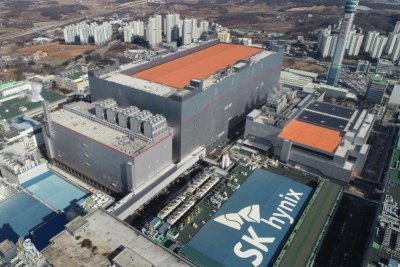
Memory chip facilities operated by SK hynix in South Korea. The company’s share price has plunged over the past month despite posting record earnings. Photo by SK hynix
SEOUL, July 30 (UPI) — South Korea’s SK hynix posted record earnings in the second quarter of this year amid the AI boom. However, shares of the world’s No. 2 memory chipmaker have continued to plunge on the Seoul bourse.
The company noted Wednesday that it logged sales of $55.1 billion and operating profit of $42.1 billion during the April-June period. Revenue more than tripled from a year ago, while profit increased more than sixfold.
“Driven by sustained demand growth from expanding AI infrastructure investments, high-performance products for AI servers led price increases, enabling the company to surpass its previous record set in the prior quarter,” SK hynix said in a statement.
“With major tech companies increasing their AI infrastructure investments, additional supply requests continue to mount. As these investments are supported by revenue generated from AI services, the momentum in memory demand is expected to persist,” it added.
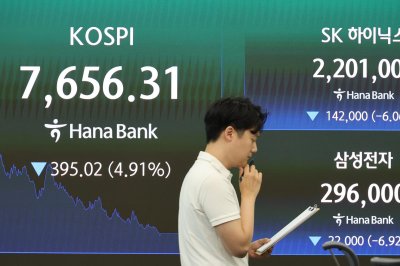
Despite the stellar performance and solid outlook, its shares have struggled to find their footing on the Korea Exchange. They fell 14.65% on Monday before dropping another 9.61% on Wednesday and 5.64% on Thursday.
Since reaching a record high in late June, SK hynix’s market capitalization has fallen by more than half in just over a month. This came after its shares had surged more than tenfold in the year through late June.
Observers attribute the bearish run to a combination of factors, including lower-than-expected earnings, concerns over the sustainability of the AI boom and the emergence of Chinese competitors such as recently listed CXMT.
Although SK hynix chalked up a record bottom line in the previous three months, the figure came in about 5% lower than the market consensus. There are also questions over whether SK hynix has secured sufficient long-term agreements, or LTAs, with customers to reduce uncertainty about future earnings.
“The market remains skeptical about LTAs, so we believe it will take time for confidence to build,” NH Investment & Securities analyst Ryu Young-ho said in a report, reducing his target price for SK hynix by 17.1%.
Other brokerage houses, including Shinhan Securities, Hanwha Investment & Securities, and Samsung Securities, also followed suit.
“We revised down our operating profit estimates for SK hynix for 2026 and 2027 by 7% and 9%, respectively, to reflect a more conservative price outlook,” Shinhan Securities analyst Kim Hyung-tae said in a report, cutting his target price by 35.7%.
However, some experts remained optimistic, raising their target prices on expectations that SK hynix shares will eventually rebound.
“The main reason second-quarter operating profit fell short of the market consensus was that DRAM price growth was weaker than expected,” Korea Investment & Securities analyst Chae Min-sook said.
“However, this was caused not by slowing demand, but by the postponement of some shipments, which should instead contribute to improved earnings in the third quarter,” Chae added, raising the target price by 24%.
DB Securities came up with a similar view.
Leveraged ETFs tied to memory chipmakers
Also at the center of controversy are leveraged exchange-traded funds, or ETFs, linked to individual stocks. They debuted in late May and are tied to the shares of the country’s two blue-chip companies, Samsung Electronics and SK hynix.
Investors have complained of heavy losses. Samsung, the world’s top memory chipmaker, has also seen its share price plummet in recent weeks.
Against this backdrop, critics argue that the new products have amplified market volatility by encouraging short-term speculative trading. Over the past two months, KOSPI circuit breakers have been triggered repeatedly by sharp market swings.
Because these products magnify both gains and losses, they tend to attract retail investors seeking quick profits, potentially leading to larger price swings during periods of market uncertainty, according to experts.
During a parliamentary session on Wednesday, lawmakers summoned top financial officials to criticized the leveraged products and the market slump.
“The government has encouraged people to sell their real estate and invest in stocks. But after the stock market crashed, retail investors ended up suffering heavy losses,” Rep. Park Jun-tae from the main opposition People Power Party said.
In response, Financial Services Commission Chairman Lee Eog-weon promised to do everything possible to minimize market-related volatility but failed to present specific measures.
“South Korean equities have been buoyed by the strong performances of memory chipmakers. But the rally overshot because of a few factors, including the debut of the single-stock 2x leveraged ETFs,” economic commentator Kim Kyeong-joon, formerly vice chairman at Deloitte Consulting Korea, told UPI.
“Once market sentiment turned bearish, the leveraged ETFs accelerated the market’s decline. The problem is that the products cannot simply be abolished because doing so would create even greater market disruption,” he added.