Playhouse

‘Purpose’ arrives at Geffen Playhouse with its Tony-winning Broadway cast intact

The family drama is a distinct American genre— one at which playwright Branden Jacobs-Jenkins excels. His 2013 show, “Appropriate,” about a prominent Arkansas clan that discovers old photos tying their deceased paterfamilias to a Jim Crow era lynch mob, won a Tony Award for best revival two years ago. Jacobs-Jenkins soon topped that by winning the 2025 Pulitzer Prize along with a Tony for best drama for his next play, “Purpose,” which unfolds during a snow day in the Chicago home of a prominent civil rights leader named Solomon Jasper.

That production is making its Los Angeles premiere at Geffen Playhouse, beginning Wednesday and running through Dec. 20. The Broadway and Steppenwolf Theatre Company production features the same Tony-nominated and Tony-winning team as it had in New York, including director Phylicia Rashad and actor Kara Young, who won a Tony for best featured actress for her portrayal of Aziza, a social worker who ends up in the middle of the family conflict at the heart of the play.

“I feel like we’re always using family as a metaphor. It’s always a stand-in for some American crisis,” Jacobs-Jenkins said in a recent Zoom interview from New York. “This is something I discovered when I was working on ‘Appropriate,’ every major family drama you can think of is animated in some way by anxieties of race and class. Ultimately, this is your tribe and you gotta figure out where your tribe’s value lives and what challenges that tribe’s value.”

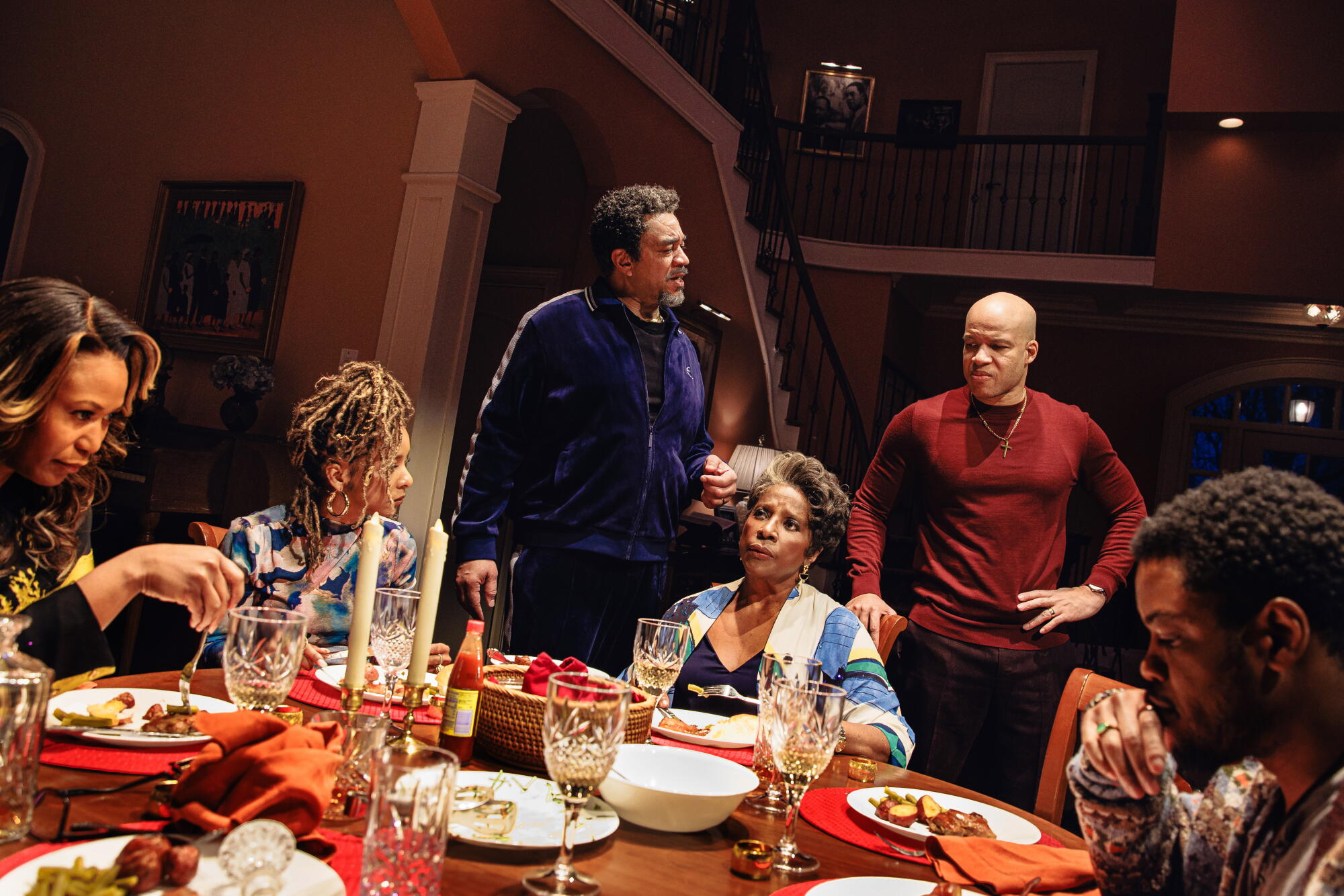
The “Purpose” tribe was inspired by an array of prominent political families, but the one most commonly referenced by audiences is that of civil rights icon Jesse Jackson. Like Jackson, Solomon (Harry Lennix), is a former clergyman and old-school activist, while his son, Solomon Jr. (Glenn Davis), is a disgraced politician fresh from serving prison time for mishandling campaign funds. Junior’s estranged wife, the bitter and often hilariously caustic Morgan (Alana Arenas), wants nothing to do with any of them, while her mother-in-law Claudine (LaTanya Richardson Jackson), pilots the family through trying times. Observing with a jaundiced eye is Naz (Jon Michael Hill), a nature photographer and narrator of the chaotic weekend as it unfolds. Along for the ride is his friend Aziza, expectant mother of his child conceived through artificial insemination.

The cast of 'Purpose' during a 2025 Broadway performance of the play

The original Broadway cast of “Purpose” is returning for its debut at Geffen Playhouse.

(Marc J. Franklin)

For Jacobs-Jenkins, inspiration came from the work of Arthur Miller, which prompted him to ask why there were no family dramas in the American canon centering Black people of status. It inspired a deep dive into political histories, which led to the realization that no Black political dynasty has endured beyond two or three generations.

Chicago’s Steppenwolf Theatre commissioned the play after the success of “Appropriate,” stipulating that Jacobs-Jenkins use two actors from its ensemble. This led to the casting of Hill, Davis and Arenas. Jacobs-Jenkins noted that he was also required to write the play in the company’s house style: muscular realism.

“As we worked together over the ensuing years and various workshop settings, the story and the family began to emerge,” he said. “When I was in rehearsals for the revival of ‘Appropriate’ on Broadway, a lot of the writing was happening then.”

The central action of the play takes place during a dinner foreshadowed by Naz telling the audience to “Buckle up!” It’s a lengthy scene that introduces long-standing points of friction between characters — Junior’s plan to revive his career by publishing his mother’s letters, the platonic parental arrangement between Naz and Aziza, Solomon’s discontent with Junior, and Morgan’s discontent with all of them.

LaTanya Richardson Jackson, from left, Kara Young, Glenn Davis and Jon Michael Hill in "Purpose."

LaTanya Richardson Jackson, left, Kara Young, Glenn Davis and Jon Michael Hill in the Broadway / Steppenwolf Theatre Company production of “Purpose,” which makes its L.A. premiere at Geffen Playhouse.

(Marc J. Franklin)

“A really important site of a family cohering is that dinner table. So I always find it’s incredibly satisfying on stage,” said Jacobs-Jenkins, acknowledging a nod to the dinner scene in another well-known family drama, “August: Osage County.”

“Everyone’s days are stacked, and that’s where the story gets wrestled out of how the family is moving forward,” he said.

Rashad’s turn as pill-popping family matriarch, Violet Weston, in “August: Osage County” suitably prepared her for directing the dinner drama in “Purpose.”

“There’s certain things that will happen within the scene, whether an actor turns to the left or the right, who you’re speaking to, whether someone is seated in a way that lifts them up higher,” Rashad said of the physically static yet dramatically compelling sequence. “I study the play very carefully, but I’m always hearing something new, no matter how many times I’ve read it. I’m looking to see what comes naturally to the actors. And that kind of informs the direction that I’ll give.”

A woman poses for a portrait in a white shirt against a black background.

Phylicia Rashad is directing Branden Jacobs-Jenkins’ Tony Award-winning play, “Purpose” at the Geffen Playhouse.

(Evan Mulling / For The Times)

When Jacobs-Jenkins finished writing “Purpose,” he felt he had composed, “a high tragedian drama.” But once it hit the boards, the theater filled with laughter.

“I don’t think of myself as a comic writer in that I don’t think in terms of joke structures and comic structures,” he said, shaking his head, noting the many situations that elicit laughter. “I really just try to make illusions of people that feel real. I try to make room for all those kinds of audience responses in the work just because it’s ultimately about connecting to the viewer.”

Much of the humor isn’t on the page but in the performances, like when Aziza chides Naz for concealing the historic relevance of his family and then, realizing their prominence, cries, “Oh, my God!” With hands on her stomach — and her future baby who will carry the same genes — she widens her eyes and repeats the line.

“You don’t always have to tell actors exactly what to do, especially when you’re working with people who are creative and inquisitive, and who like to take risks and try things. Some gestures seem very natural for an actor. But if you change actors, you might get something different,” said Rashad, who has won two Tonys for her acting and made her Broadway directorial debut with “Purpose.”

Best known for playing Clair Huxtable on the 1980s sitcom “The Cosby Show,” Rashad has received six Emmy nominations and is currently in HBO’s “The Gilded Age.” She won an NAACP Theatre Award for directing Center Theatre Group’s 2014 production of “Joe Turner’s Come and Gone” at the Mark Taper Forum, and she’ll be returning to CTG next spring to direct August Wilson’s critically acclaimed “Fences”.

A man poses with an Emmy Award.

Branden Jacobs-Jenkins poses in the press room with the award for best revival of a play for “Appropriate” during the 2024 Tony Awards.

(Evan Agostini / invision/ AP)

Riding high on accolades for “Purpose,” Jacobs-Jenkins recently announced his next play, “Grass,” starring Daniel Kaluuya in his New York stage debut at the Park Avenue Armory in February. A news release describes it as “equal parts fantasia, memory play, and morality play…a surreal meditation on the limits of personal, ancestral, and national identity amidst social upheaval.”

Despite being at the height of his career, Jacobs-Jenkins expressed some trepidation about staging a show in the cavernous, 55,000-square-foot Armory. “A mother and son take a road trip through the South and kooky stuff happens. So, it’s a road play,” he paused, a nervous grin spreading across his face. “We’ll see if I pull it off.”

‘Purpose’

Where: Gil Cates Theater at Geffen Playhouse, 10886 Le Conte Ave., L.A.

When: 7:30 p.m. Wednesdays-Thursdays, 8 p.m. Fridays, 2 and 8 p.m. Saturdays, 1 and 6:30 p.m. Sundays. (Check for exceptions.) Ends Dec. 20

Tickets: $57 – $249 (subject to change)

Contact: (310) 208-2028 or geffenplayhouse.org

Running time: 2 hours and 50 minutes, with one intermission
Source link

‘Passing Strange’ premieres in L.A. at Pasadena Playhouse

Twenty years after its world premiere in Northern California — and subsequent success on Broadway and in London — “Passing Strange,” the quintessential L.A. coming-of-age musical, is finally arriving in Southern California, staging its long-awaited area premiere at Pasadena Playhouse on Sunday.

Exactly why it has taken so long for this acclaimed, Tony Award-winning show — much of it set in the heart of Los Angeles — to come here is something its creators, the artist and singer-songwriter, Stew, and Heidi Rodewald (along with this writer) have been scrutinizing since 2009, the year after it opened to critical acclaim on Broadway.

“Passing Strange” tells the story of a young, artistic “Youth” (that’s actually his name in the show) who rejects his single mother and the “Black, middle class dream” of 1970s Los Angeles in favor of leaving home to find “The Real,” an elusive state of mind and authenticity he craves.

The reasons “The Real” took so long to land in its hometown began to make sense during a recent group Zoom with the “Passing Strange” brain trust, including Stew, Rodewald and its new director Zhailon Levingston.

“At my age, at this point, I think it is absolute poetry that this gentleman [Levingston] is the one who brings it to our hometown,” said Stew, pointing to a serendipity of timing.

A director sits in a rehearsal.

Director Zhailon Levingston sits outside before a rehearsal of “Passing Strange” at the Pasadena Playhouse. Levingston recently won a Tony Award for directing, “Cats: The Jellicle Ball.”

(Carlin Stiehl / For The Times)

Levingston is the 32-year-old theatrical wunderkind who won this year’s Tony Award for best director, for the groundbreaking revival of “Cats” on Broadway by re-imagining the long-running ‘80s smash as a ballroom drag competition.

Getting Levingston to do this revival of “Passing Strange” as his immediate follow-up to “Cats: The Jellicle Ball” is a coup for Pasadena Playhouse’s Artistic Director Danny Feldman. Feldman calls Levingston a rare talent, who’s “generous and fearless.” Or as Stew says more bluntly: “Zhailon’s got the receipts. … it’s the right time because it’s him. We made this play for him — literally, I don’t mean figuratively — because me and Heidi don’t make work necessarily for the contemporary time, we make it for the future.”

One of the main themes of “Passing Strange” is how knowledge is awkwardly handed down from one generation to another. In a key scene, the narrator describes a mentor, Franklin, whose words and wisdom wash over Youth “like a Bach fugue creeping out of a cheap car stereo.” In conversation together, Stew and Levingston (the former is twice the latter’s age) seem entirely in sync, having both clearly absorbed the show’s mantra: “Just ask the song.”

Actors rehearse a musical onstage.

Actors rehearse “Passing Strange,” which is based in downtown L.A. but has never been produced in Southern California until now.

(Carlin Stiehl / For The Times)

Stew says he learned the virtues of “asking the song” while casting the original production at Berkeley Repertory Theatre in 2006. The show would go on to play 165 performances on Broadway, but it wasn’t a traditional book musical — it played more like a cabaret or rock experience. “When we had everybody audition, they had to sing a punk rock song,” Stew recounts. “That was the fast track to figure out if they could do what we needed, or not.”

That original Berkeley cast, including Eisa Davis, Daniel Breaker, Rebecca Naomi Jones and Coleman Domingo, won the 2008 Obie Award for ensemble at New York’s Public Theater before transferring to Broadway. That cast was a big part of the show’s success, so much so that Levingston calls them “the Avengers of Black talent.”

Spike Lee filmed the show’s penultimate night at the Belasco Theater. In 2010, PBS broadcast it as part of “Great Performances,” which is how a then 15-year-old Levingston learned about “The Real.”

“My grandmother’s bedroom had a TV and that was kind of my refuge as a kid. I happened to turn on PBS,” Levingston recalls, “and it just so happens that was the night that they were airing ‘Passing Strange.’ I wasn’t looking for it. I just clicked on the television, and the opening credits were happening. I stayed glued. I didn’t leave. I didn’t pee. I just watched it.”

Levingston was hooked. “It became my favorite show ever,” he says, “I had two birthday parties designated to my friends watching it.”

Two people pose for a portrait.

Composer Heidi Rodewald and writer Stew attend the premiere and panel discussion of “Passing Strange” during the 2009 Tribeca Film Festival at Directors Guild Theater on May 2, 2009, in New York City.

(Amy Sussman / Getty Images)

But more importantly, it made him ask questions. “I then went to school the next day. … I got a dictionary and I looked up every word I didn’t know. I looked up every reference I didn’t know,” Levingston says. “I didn’t know who James Baldwin was. I didn’t know who Josephine Baker was. I didn’t know the significance of the Berlin Wall. I had never been out of the country, let alone Louisiana.”

None of the creators of “Passing Strange” would wince at the musical being described as a “bildungsroman,” or a classic coming-of-age story. Its title is derived from Shakespeare’s “Othello,” and the show earned Joycean comparisons, including to “A Portrait of the Artist as a Young Black Man,” from critics.

“Passing Strange” pokes fun at the pretensions of youth, how a young person can know every indie rock album or French New Wave film and still be clueless about their own emotions and need for family. The truth and timelessness of Stew’s story — about a boy in the 1970s wanting to escape what he sees as L.A.’s “fishbowl of philistines” resonated so much for Levingston that he was inspired to escape his own fishbowl (Louisiana) for a life in Los Angeles, where he enrolled in AMDA College of the Performing Arts in Hollywood.

He lived in L.A. for four years, before making his name in theater back east. He had never dreamed of directing “Passing Strange,” saying, “it felt like too ‘full circle’ to actively pitch myself as the director.” But when he took a meeting with Pasadena’s Feldman: “I mentioned ‘Passing Strange,’ kind of as a secret menu option.”

Two actors onstage.

Britton Smith, left, and Tanerélle in a rehearsal for “Passing Strange” at the Pasadena Playhouse.

(Carlin Stiehl / For The Times)

Feldman loved the idea, and now “Passing Strange” is here. Asked during a recent rehearsal whether he’s deconstructing or re-inventing the show as he did “Cats,” Levingston replied with an emphatic no.

“I didn’t want to put it on the moon … or create some kind of other, concept approach to ‘Passing Strange,’ that would make it too corny. The concept has to be the people,” he said.

Inspired by Stew, Levingston looked for actors with a punk vibe, because he “wanted a company that understood what it meant to lead a band, even if you’re not the Narrator or Stew, I wanted the authenticity of that kind of swagger.”

Ty Taylor plays Stew in the revival, along with a whole new cast. During a recent rehearsal, it was uncanny how these performers look and sound so different — yet still carry the same fiery sense of invention as the actors who created the roles. It was also moving to see that Stew and Rodewald’s Tony Award-winning book still delivers laughs and pathos two decades on. Their show about passing the torch of cultural enlightenment hasn’t lost its edge — even as it is being handed off to another generation.

Actors rehearse a musical onstage.

Actors rehearse “Passing Strange” at the Pasadena Playhouse. The rock musical has played on Broadway and is staging it’s Southern California premiere at the Pasadena Playhouse.

(Carlin Stiehl / For The Times)

During the Zoom interview, Rodewald noted that the show’s original director, Annie Dorsen, gave them the confidence “to not try to please everyone,” to just make something they thought was cool.

“And then we went, and we did it,” Stew adds, “and now it’s perfect that it’s happening here. It’s the right director. It’s the perfect cast.”

In this way, the show has not only come home to Los Angeles, but it has also come full circle.

“I was talking to a cast member the other day, and I was like, ‘I just try to make theater that my friends like.’ But now I feel like I’m trying to make this show as a thank you letter to Heidi and Stew,” Levingston said, as he sat in the house seats at the Playhouse during rehearsal.

Indeed, rather than re-imagining “Passing Strange,” Levingston dug down to the show’s roots, when Stew and Rodewald traveled from gig to gig as musicians. “One of my earliest images thinking about the show,” Levingston says, “is that I wanted it to feel for the audience as if a bus tour of artists from a band backed up here and just dumped everything from the road onto the stage because the tour schedule said we had to be in Pasadena tonight.”

Will L.A. at long last embrace “The Real” or is this revival of “Passing Strange” looking to move to New York or elsewhere?

“Just ask the song,” Levingston says with a smile.

“I did not do this show because I had some long runway vision of how to take it from Pasadena to Broadway or Chicago,” he says, “but obviously, I want everyone in the world to see it.”

Levingston then mentions the number “Arlington Hill,” which is about being torn between where you come from and where you want to be.

Levingston quotes from the scene, “The Narrator looks back and says to Franklin, ‘Thank you, Brother’…’I want to say thank you for giving me this fugue.’ ”

He then gestures to the theater around us, “That’s the intention here.”

‘Passing Strange’

Where: Pasadena Playhouse, 39 S. El Molino Ave., Pasadena

When: 7:30 p.m. Wednesdays and Thursdays; 8 p.m. Fridays; 2 and 8 p.m. Saturdays; 2 p.m. Sundays. Ends Nov. 29.

Tickets: Start at $40

Running time: 2 hour, 30 minutes (with one 15 minute intermission)

Source link