planting

Ex-OpenAI employee accused of planting device has Saudi backing: Prosecutor | Business and Economy News

US federal prosecutors allege the defendant was in frequent contact with unnamed member of royal family.

An ex-OpenAI engineer accused of planting a recording device in an executive conference room at the AI company appears to have received considerable support from the Saudi government, United States prosecutors have said in a court filing.

Federal prosecutors allege that the defendant, Abdulrahman Alfozan, 35, was in frequent communication with an unnamed member of the Saudi royal family and that a Saudi military official paid for a one-way plane ticket for Alfozan’s wife and young son to return to Saudi Arabia after his arrest, according to the court document, made public late on Sunday.

Recommended Stories

list of 4 itemsend of list

Prosecutors made those allegations as they asked a federal judge to keep Alfozan in US custody to await trial, arguing he is a flight risk. Alfozan, a Saudi national and lawful permanent resident in the US, is scheduled to appear in federal court in San Francisco later on Monday.

The case has highlighted security challenges around sensitive AI research as companies and governments compete fiercely for an edge in the transformational technology.

“The defendant went to significant lengths to create customized, encrypted recording devices to secretly record highly sensitive meetings involving senior OpenAI personnel and executives, high-level business counterparts, and government officials, all while communicating with individuals of significance in Saudi Arabia and pursuing opportunities in — and making plans to travel to — Saudi Arabia,” prosecutors wrote in a detention memo.

The Saudi government media office did not immediately respond to a request for comment. A lawyer for Alfozan did not immediately respond to a request for comment.

The lawyer, William Pernik, previously asked for Alfozan to be released from custody, subject to conditions including location monitoring and surrendering his passport, and said Alfozan had spent the last 15 years in the US and had applied to become a citizen.

The lawyer said a planned trip by Alfozan to Saudi Arabia this month was booked before he was under investigation and was for “family and immigration reasons”, according to a court filing.

Investigation remains active

US prosecutors charged Alfozan last week with using an electronic device to intercept oral communications. Alfozan plugged a recording device into the back of a television in an executive conference room at one of OpenAI’s San Francisco buildings, according to a criminal complaint.

Meetings involving government officials took place in the conference room around the time the device was installed, according to the prosecutors’ detention memo.

Prosecutors said the investigation remains active and additional charges could be brought against Alfozan.

A member of the Saudi royal family sought to recruit Alfozan for an AI-focused role in Saudi Arabia, writing in one message, “Saudi needs you more then [sic] the US!” Alfozan replied, “100,” according to messages cited by prosecutors.

Before his arrest, Alfozan was scheduled to fly to Riyadh during a planned two-month parental leave. His wife told investigators that she and their son planned to move permanently to Saudi Arabia and that Alfozan eventually intended to join them, according to prosecutors.

In an Arabic-language interview on the Identity Capital podcast last month, Alfozan said that he visits Saudi Arabia three or four times a year, follows developments there and advises or mentors Saudi startups.

He said meeting Prince Mohammed bin Salman, then deputy crown prince, during a 2016 gathering with young Saudi tech workers in Silicon Valley persuaded him to learn at a top tech company before bringing those skills back home.

While Alfozan was working at Facebook, he and other Saudis in Silicon Valley formed a consulting initiative that linked Saudi public- and private-sector organisations with expertise in big data, the internet of things and machine learning.

OpenAI previously said it discovered the device on September 30 and referred the matter to the FBI.

Al Jazeera has reached out to the Saudi embassy for comment.
Source link

Saudi national charged with planting a listening device at OpenAI offices | Espionage News

United States federal agents have arrested a Saudi national and charged him with planting a hidden audio recording device in a conference room at the California offices of OpenAI, where he was working as an engineer.

Abdulrahman Alfozan, 35, had been working at the AI company since ⁠July 2025, the US Department of Justice said in a statement on Tuesday.

Recommended Stories

list of 2 itemsend of list

OpenAI discovered the device plugged into a USB port behind a television in an executive conference room at one of its San Francisco buildings on September 30, according to a criminal complaint filed by the Federal Bureau of Investigation (FBI).

Following the discovery, the company placed a camera in the room, which captured Alfozan entering last week and checking behind the television where the listening device had been installed, the FBI alleges.

The case highlights growing security concerns around sensitive AI research as companies and governments compete for the best talent and technology with the potential to alter regional economic and strategic dynamics.

Who is Abdulrahman Alfozan and what is he charged with?

Alfozan has been a legal permanent resident of the US since September 2020.

According to a LinkedIn profile in his name, he studied at ⁠the Massachusetts Institute of Technology (MIT) and the University of California, Berkeley. He previously worked at Meta and Microsoft, it said.

Before he joined OpenAI, he was a venture partner at Raed Ventures, headquartered in Riyadh in Saudi Arabia, which invested “in seed and early-stage startups in Saudi Arabia and MENA”.

Al Jazeera could not independently verify the details mentioned in this LinkedIn profile.

Alfozan made his first court appearance on Tuesday on a charge of “using or endeavouring to use an electronic, mechanical, or other device to intercept oral communications”.

It was not immediately clear if he has legal representation. He is expected to return to court on October 19.

If convicted, Alfozan faces up to five years in prison, a $250,000 ⁠fine, and three years of supervised release.

What happened at OpenAI?

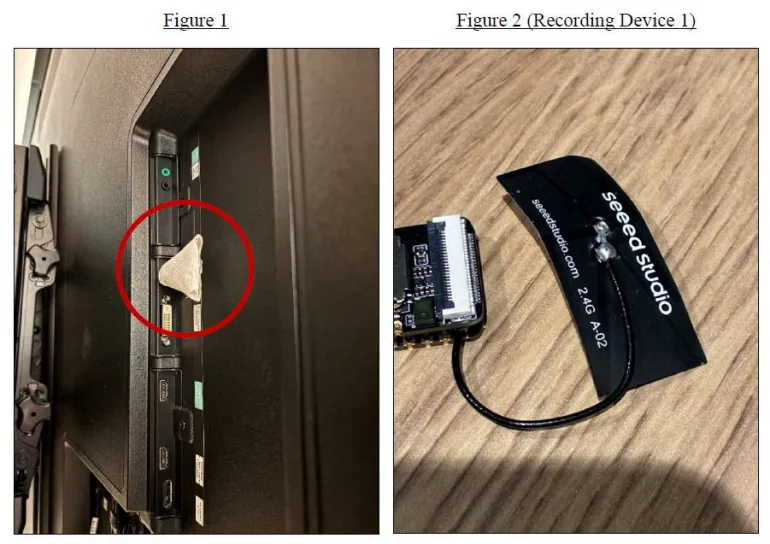
The FBI says a thumb-sized device with a microphone, and which ‌could connect to a camera, had been concealed in toilet paper and placed behind a television set in the conference room. It was installed around September 28, the FBI said. Its stored data was encrypted and inaccessible. Investigators later found a similar device in Alfozan’s personal bag.

In a post on X, OpenAI said it had evidence that the employee intended to place other listening devices throughout sensitive areas of its offices to secretly record meetings.

“At this time, we have no indications of this individual inappropriately accessing or exfiltrating model weights, source code, or customer data. The employee was ⁠terminated,” the company said.

The FBI complaint also alleges that Alfozan used an AI productivity tool to make multiple inquiries about the company’s building addresses, meeting rooms, meeting-room capacities and calendars, despite not having the authority to access these spaces or participate in meetings there.

“This alleged attempt by a Saudi national to steal sensitive communications from OpenAI was taken extremely seriously. Theft of intellectual property involving cutting-edge super intelligence technology poses a serious threat to our national security,” Attorney General Todd Blanche said in a statement on X.

A device, which the US Justice Department says is a hidden audio recording device installed in an OpenAI executive conference room by Abdulrahman Alfozan, a Saudi national employed as an engineer at the AI company, at a location given as San Francisco, California, US, in this combination handout photo released October 13, 2026. US Department of Justice/Handout via REUTERS THIS IMAGE HAS BEEN SUPPLIED BY A THIRD PARTY
A device, which the US Justice Department says is a hidden audio recording device installed in an OpenAI executive conference room by Saudi national Abdulrahman Alfozan [File: US Department of Justice handout/Reuters]

Hasn’t OpenAI been accused of helping to spy on civilians?

In an X post by OpenAI explaining how its own systems were used to trap Alfozan, the company said: “Our security program is designed to protect against a wide range of threat actors, from insider risks to cybercriminals to nation states, and this case is an example of how AI can help address these sophisticated security threats.”

But AI technology is used not only to catch spying, but conversely, to engage in it as well.

In February 2025, an investigation by The Associated Press found that US tech giants had enabled Israel to track and kill people in Gaza and Lebanon through AI and computing services. The AP reported that the Israeli military had bought advanced AI tools from tech companies including OpenAI, the maker of ChatGPT, through Microsoft’s Azure cloud platform, to assist with surveillance.

OpenAI denies having a relationship with the Israeli military.
But OpenAI also faced criticism when it signed a deal with the US Department of Defense in February this year to supply its technology to the US military for use in classified settings, including intelligence gathering. OpenAI’s competitor, Anthropic, refused to sign the same deal unless the Pentagon barred mass surveillance of Americans.

There have been several incidents in which OpenAI models have gone “rogue” by independently breaking out of a testing environment and then hacking into other organisations and even government sites, leading to calls for stronger regulations against unchecked AI surveillance.

Source link

Saudi-born engineer for OpenAI arrested for planting listening bug | Science and Technology

OpenAI says it discovered a hidden recording device in one of its offices, wrapped in toilet paper and tucked behind a television. The company says it used its AI models to help trace the device to a Saudi engineer who allegedly planted it. Al Jazeera’s Alan Fisher reports from Washington DC.

Source link

S Korea demands apology over DMZ blasts as N Korea denies planting mines | United Nations News

South Korea calls for a formal apology from North Korea over the DMZ explosion that injured three soldiers.

South Korea’s military has demanded an apology from North Korea over landmine explosions earlier this month in the border zone between the two countries that wounded three soldiers.

Three South Korean soldiers were injured in two explosions on September 21 near the military demarcation line in the western section of the Demilitarized Zone, a heavily fortified border buffer zone between the Koreas that is commonly known as the DMZ.

Recommended Stories

list of 3 itemsend of list

Kang Hyunwoo, the South Korean joint chiefs of staff’s director of operations, said the military “strongly urges” North Korea to apologise for the blasts and take “responsible measures” to prevent a recurrence.

“This is a clear violation of the Armistice Agreement and undermines the spirit of existing inter-Korean agreements; it must be stopped immediately,” he said on Wednesday, adding “we strongly urge an apology and responsible measures”.

Defence Minister Kang Shin-chul said South Korea would consider unspecified “corresponding measures” if a complete investigation confirms the North was responsible.

Kim Yo Jong, the sister of North Korean leader Kim Jong Un, said the South Korean assessment is a “conspiratorial farce” and accused Seoul of making groundless claims to create a pretext for provocation against Pyongyang.

She also criticised the South for broadcasting warnings and firing warning shots at North Korean troops conducting front-line fortification work, adding “our soldiers have never crossed the border”.

“If the [South Korean] military gangsters fire at our soldiers carrying on the permanent project for the southern border, not warning shots, our border units will take immediate and merciless retaliatory action,” she said.

The United Nations Command said on Wednesday it had “identified an active Democratic People’s Republic of Korea (North Korea’s) anti-personnel mine on the ROK side of the Military Demarcation Line”, in a joint investigation with Seoul’s military.

“Based on the findings of the investigation, UNC determined that an Armistice Agreement violation occurred,” it added.

The UN Command is a US-led multinational military force charged with overseeing the armistice agreement that halted fighting in the Korean War and administers the southern side of the DMZ.

Source link