Planes

New airport rule comes into force but there’s 1 thing holidaymakers keep forgetting

Travellers are being caught out by new rules at certain UK airports, as people are reminded to check their airport’s regulations before flying to prevent upset and delays

As the cold, bleak winter drags on, many Brits are counting down the days until they can jet off on their summer holidays. But a major new airport rule change is catching some travellers off guard – and starting their trips with unnecessary stress when they realise they’ve got it wrong.

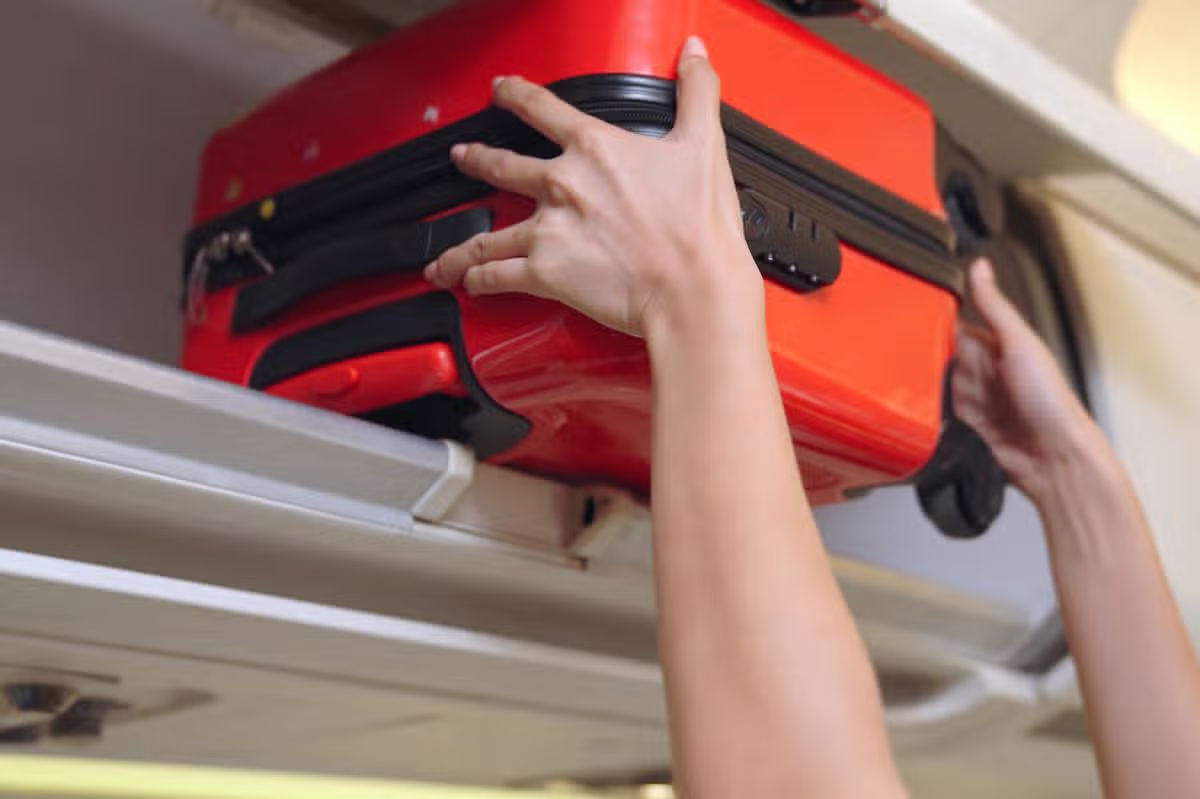
As of January, passengers flying from certain UK airports can now carry up to two litres of liquids in their hand luggage, replacing the long-standing 100ml limit, thanks to new CT scanners. In a statement, Heathrow Airport said: “Passengers travelling through all terminals at Heathrow no longer need to remove liquids or electronics from their hand luggage, or juggle plastic bags at security.

“The UK’s hub has become the largest airport in the world to fully roll out next-generation CT (computed tomography) security scanners – a move that promises faster queues, less stress and a smoother start to journeys for millions of travellers.”

UK airports that have ditched the 100ml rule

  • Belfast International
  • Belfast City
  • Birmingham
  • Bristol
  • Edinburgh
  • London Gatwick
  • London Heathrow

However, the change has not been rolled out across every airport – with many still sticking to the 100ml rule and requiring liquids to be removed and placed in clear plastic bags.

UK airports still enforcing the 100ml rule

  • Aberdeen
  • Bournemouth
  • Cardiff
  • East Midlands
  • Glasgow International
  • Glasgow Prestwick
  • Inverness
  • Isle of Man
  • Leeds Bradford
  • Liverpool
  • Luton
  • London City Airport
  • Manchester
  • Newcastle
  • Newquay
  • Norwich
  • Southampton
  • Southend
  • Stansted
  • Teesside

Exemptions still apply for essential medicines, baby food, and milk, as well as special dietary requirements.

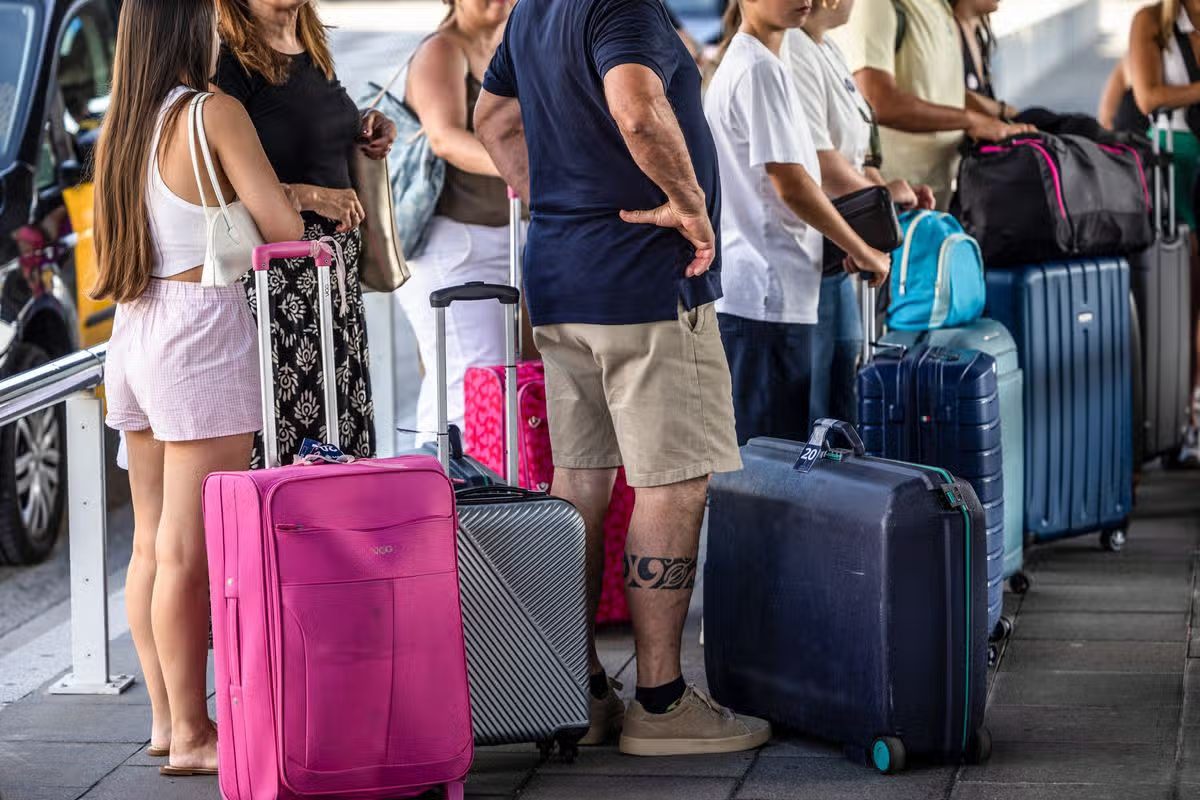
Travellers are being urged to check their departure airport’s rules before flying – especially ahead of the busy Easter holidays – to avoid delays or having items confiscated at security.

Reacting to the change, one traveller flying from Gatwick Airport wrote on Reddit: “Makes the journey just that little bit less stressful. Leave everything in your bag – laptop too.”

Another added: “Edinburgh is the same, which is really handy.”

A third explained: “This is because a new generation of scanners is being rolled out that allows more liquids and means you don’t have to remove laptops – but only a few airports have them so far.”

However, not everyone is convinced.

One user said: “This change is useless until all major airports follow suit. It’s fine on the way out, but if your return airport still has the old rules, you end up throwing things away. It also causes confusion, especially when different London airports have different rules. It should be all or nothing.”

Another added: “I’ve been travelling with just carry-on for years now and wouldn’t go back. There’s something freeing about not carrying full-size toiletries when you only need a small amount.”

Source link

Major airline launches ‘lay flat beds’ for economy passengers with mattress and pillows

Providing extra comfort for their economy passengers, a major airline that flies from the UK to more than 340 destinations, is set to launch seats that turn into a ‘flat bed’

A major airline flying to popular holiday destinations from the UK is introducing economy seats that transform into a ‘flat bed’.

United Airlines, which flies from the UK to more than 340 destinations worldwide, will launch a new dedicated row of three economy seats that can transform into a “lie-flat mattress-like space”. It will give passengers more room on long-haul flights while flying in economy.

The new seats will be individually adjustable with leg rests that fold up to a 90-degree angle, so travellers can either stretch out while watching a movie or use it as a bed to catch a restful night’s sleep. Passengers will be treated to a “custom-fitted mattress pad, specially sized blankets, extra pillows” as the seats adjust into a flat bed after takeoff.

READ MORE: Airline plunges into liquidation after 19 years with no more flightsREAD MORE: ‘I travelled world for 6 years but cold little UK beach town hits different’

Children in the dedicated row will also receive a plush toy and a family travel kit as part of the additional amenities. The airline noted that the launch of the ‘United Relax Row’ will be ideal for families with young children, couples and solo travellers who would like more space.

After United Airlines shared the news on X, formerly Twitter, it was met with enthusiasm from travellers. One commented: “This is brilliant and I bet everyone is going to copy it.”

“Much needed. United is innovating faster than anyone”, a second said. A third added: “This is a brilliant and thoughtful idea to make customers feel more comfortable. Well done!”

“Gamechanger for travelling with small kids”, another traveller noted. “Brilliant, you have hooked me for many years but with this may be I am now double hooked. This is super helpful especially on those night European routes,” one more said.

Once launched, the initiative will be a first for a North American airline offering this type of seat and comfort for economy passengers. United Airlines flies from the UK to popular holiday destinations such as New York, LA, Chicago and Orlando.

The United Relax Row is expected to launch in 2027, with plans to offer the extra space on more than 200 of its Boeing 787 and 777 widebody aircraft by 2030. There will be up to 12 United Relax Row sections on each plane, located between United Economy and United Premium Plus.

United’s Executive Vice President and Chief Commercial Officer, Andrew Nocella, said: “As a leading premium airline, we’re committed to delivering new, industry-leading experiences for all of our customers – and the United Relax Row is the perfect example of that. Customers travelling in United Economy on long-haul flights deserve an option for more space and comfort, and this is one way we can deliver that for them.

“United is the only North American airline offering a product like the United Relax Row and is one of the many reasons why we’re continuing to win brand loyal customers.”

For more information or to check flights with United Airlines, you can visit their website.

Do you have a travel story to share? Email webtravel@reachplc.com

Source link

Woman finds ‘secret compartment’ in plane toilet and contents are brilliant

A woman who found a secret compartment in a plane toilet was left gobsmacked by what she found inside – as some said other public toilets should do the same

Your next flight might be concealing some vital items in a “secret compartment” within the toilet. We’re all aware that air travel can be an uncomfortable affair. You’re squeezed onto an aircraft alongside a host of strangers and informed you can only bring a small bag containing all your essentials – and you’re likely to overlook something important.

While nothing will truly enhance the experience unless you splash out thousands of pounds for first class, one woman on social media has revealed that a hidden door in the bathroom could hold something which at least makes the journey tolerable for some passengers.

Rhonda Abdalla, from Florida, US, was travelling on a Southwest Airlines service from Tampa to Houston, Texas, en route to Las Vegas, when she unexpectedly started her period. She consulted a flight attendant who pointed her towards a small compartment in the aircraft toilet, which was stocked with tampons and sanitary towels.

The woman admitted she had no clue the compartment existed, and suspected other women would be equally unaware, so she turned to Threads to share the discovery and spread awareness.

She posted: “I’m a girls’ girl, so I have to share. Ladies! Did you know there’s a secret compartment in the airplane bathroom that has tampons and pads if you need them?! Because nobody wants to be caught off guard at 35,000 feet.”

Speaking to Newsweek, Rhonda revealed the flight attendant instructed her to take as many tampons as required, and even thoughtfully disclosed she had additional supplies if the stock in the lavatory proved insufficient.

Rhonda detailed that whilst the compartment does feature a sign indicating it can be opened, it “isn’t very noticeable”, so she believes she never would have considered looking there had the flight attendant not informed her about it.

Southwest Airlines has confirmed that sanitary products are something they ensure are stocked on all aircraft for any passenger who might require one urgently.

They told Newsweek: “Sanitary products are available on all Southwest aeroplanes in all lavatories. These items are supplied in case a customer needs one. Whilst we do supply them, they are not a relatively high-use item.”

Both flight attendants and passengers have reacted to Rhonda’s social media post, with numerous people expressing gratitude for her sharing the information, whilst others mentioned they always carry spare tampons for circumstances like hers.

One flight attendant commented: “The amount of times someone has come up to me in tears because on top of a stressful travel day, they started their period and all their products are in their checked bag. Baby, I got you. Tampons, chocolate and a glass of wine will be brought to your tray table immediately.”

Another contributed: “And if you don’t find them in the lavatory, ask a flight attendant. We always have some on board!” One grateful passenger responded: “That’s actually a really useful travel tip! Appreciate you sharing that with everyone.”

Rhonda later expressed her satisfaction at the positive feedback to her post, as she believes it’s important for everyone to be aware of the resources available to them when needed.

She stated: “The response has been really positive, and I’m glad it’s helping spread awareness. Getting your period mid‐flight is already stressful, so knowing there are resources available makes a big difference.”

However, it’s worth noting that some airlines may not stock sanitary products in their lavatories. You can always enquire with a flight attendant who may be able to assist, but it’s advisable to always carry a few emergency tampons or pads – either for your own use or to help someone else in need.

Source link

Corridor for Brits’ holidays is shrinking and is now just 50 miles wide

A crucial 50-mile airspace route through Azerbaijan has become vital for European travellers as Middle East airspace restrictions impact millions of passengers

The flight corridor that dictates whether vast numbers of passengers can reach their destination is getting narrower.

32,432. That’s the number of Middle East flights that have been scrapped since Israel and the US began bombing Iran at the end of February. The tally of affected passengers now runs well into the millions.

Whilst the daily cancellation figure has now dropped considerably to 11% per day, according to analytics firm Cirium, the knock-on effects of the disruption are still being experienced and will continue for some time.

One way the conflict has and will continue to affect travel is by constricting flight corridors. Now, many European holidaymakers are dependent on a roughly 50-mile route spanning three countries.

The flight corridor over Azerbaijan is one that numerous commercial aircraft have been using to travel from Europe to Asia since early March, when the country closed portions of its airspace following drone strikes the Azerbaijani authorities claim had been launched from Iranian territory, reports the Express.

READ MORE: Chessington confirms it’s opening huge new £50million Minecraft World in 2027

Author avatarMilo Boyd

Prior to the Iran war, the Azerbaijan path was 100 miles wide at its narrowest points, owing to the Russian invasion of Ukraine to the north. It is now 50 miles wide, with airspace to the south closed off by the Azerbaijan authorities.

Almost three weeks into the Iran war, this route through Azerbaijan, Georgia and Turkey is one of just two available for a majority of long-haul flights between Europe and Asia. The alternative route passes through Saudi Arabia and Egypt. The shortage of accessible airspace is fuelling rivalry amongst airlines competing for routes. It is also rendering air travel more costly and environmentally harmful.

Prior to 2022, flights linking much of Europe and Asia travelled over Russia, via the “Siberian Corridor.” That was regarded as one of the most direct ways to connect the two continents.

Following Russia’s invasion of Ukraine, Western airlines were denied access to the airspace. Now a flight from northern Europe, which would have passed directly over Russia, must take a lengthier route either over the North Pole or around the Black Sea. This can tack on roughly three hours to a nine-hour journey, consuming thousands of pounds more jet fuel and emitting dozens of tonnes more CO2e into the atmosphere.

The alternative route from Europe to Asia that is presently available takes passengers south, via Egypt, Saudi Arabia and the United Arab Emirates. Whilst it is returning to capacity following weeks of disruptions and cancellations, the escalating conflict in Iran means its viability in the long or medium term remains uncertain.

Dubai International Airport is typically one of the globe’s busiest travel hubs, averaging approximately 1,200 departures and landings daily. It, like numerous airports in the region, is still functioning considerably below its standard capacity. This is partly due to the aerial battles taking place overhead. On Friday, the UAE government reported that it had intercepted 338 ballistic missiles, 15 cruise missiles, and 1,740 drones since February 28, Forbes reports. Despite these efforts, at least eight people have been killed in the UAE, and over 150 have been injured.

Ian Petchenik, the communications director for the flight-tracking site FlightRadar24, fears that the narrowing of flight corridors and the uncertain status of major travel hubs is driving up the cost of plane tickets. He told the New York Times: “At some point, we get to the point where airlines have to make the decision: Is this route still economically viable? Is this a route that we can continue to operate long term within these parameters?”

Mr. Petchenik characterises the flight corridor above Azerbaijan as “a very narrow strip of land.”

To increase the number of planes that can fly on a restricted flight corridor, air traffic controllers instruct aircraft to fly at varying altitudes – effectively spreading them out.

However, according to Graham Wild, a senior lecturer of aviation science and technology at the University of New South Wales in Australia, this can trigger other problems. Planes flying at lower altitudes are more vulnerable to weather and turbulence and also consume more fuel, as the air is denser. Extended flight times and the potential for diversions also present staffing challenges for pilots and flight crews.

Source link

‘I’m a travel expert — never eat this popular airport snack before taking off’

Certain types of snacks can make your flight experience very uncomfortable.

Anyone planning to jet off this Easter or beyond is being advised to steer clear of a very common airport snack before boarding. Plane food isn’t everyone’s cup of tea, and it’s not always on offer during shorter flights, so grabbing something beforehand is vital.

However, travel experts at Ski Vertigo have warned that one particular type of food can make lengthy flights feel even more drawn-out, causing a lot of discomfort. They say the main culprit is the “grab-and-go” salty snack many travellers purchase at the gate, such as pretzels, crisps or salted nuts, as it can leave passengers feeling bloated, thirsty and uncomfortable once the cabin doors shut. Aircraft cabins are extremely dry, which can worsen dehydration.

Low humidity at cruising altitude can leave you feeling dried out, which is why water is frequently the best option in the air. But salty snacks can make matters worse, since foods packed with sodium can prompt the body to retain fluid, contributing to puffiness and swelling – especially in the feet and ankles during longer journeys.

That “tight shoes” sensation is typical after remaining still for hours, but what you eat can influence how uncomfortable it becomes. NHS guidance related to swelling often highlights reducing salt intake as part of managing fluid retention.

Alex Dyer, Head of customer success at Ski Vertigo, said: “People buy a salty snack because it’s quick and it feels harmless, but on a flight it can leave you chasing water and feeling heavy. If you already get puffy ankles or feel rough when you fly, it is worth skipping it.”

Airports also promote last-minute purchases, and salty snacks are dotted everywhere near the checkouts. A packet eaten just before boarding is more likely to take effect when you’re buckled into your seat with limited opportunity to move about, especially if the seatbelt sign is illuminated, reports the Express.

Experts say the key thing is to drink water before and throughout the flight, and reduce caffeine and alcohol where possible, as dehydration can make travel feel more difficult.

For passengers wanting something to snack on, the experts recommend opting for choices that aren’t as salty, like a banana or a cereal bar. Checking the label can be useful, because many ‘snack size’ products are still packed with salt.

The professionals added that the aim is not to ban treats, but to steer clear of the type that makes the cabin feel more uncomfortable, adding: “If you want the easiest flight, skip the salty snack before take-off, choose a sealed drink, and you will usually feel better by the time you land.”

Source link

Passport holders told to stop wearing 1 item of clothing to travel on planes

Passport holders have been urged to avoid wearing a common item of clothing when flying. When travelling on planes, there are certain items you should never wear

Every day, thousands of individuals globe-trot, but passport holders are now being advised to steer clear of a certain popular garment. When jetting off to sunnier climes, it’s only natural to adjust your wardrobe accordingly and prepare for the balmy weather; however, there’s a particular item you should avoid donning when boarding a plane.

You might be surprised to learn that your choice of attire can significantly influence both your travel experience and your safety. That’s why travellers are being urged to refrain from wearing this specific item when embarking on a flight in future, and it’s advice everyone would do well to heed.

The issue was recently spotlighted by Polly Ann, who goes by the handle Travel with Polly Ann on Instagram, and regularly imparts valuable travel tips to her multitude of followers. Unbeknownst to many, certain items of clothing are best stowed away in your suitcase when flying.

Polly Ann enumerates several garments she personally avoids, but one stands out as crucial from a travel safety perspective. It could have serious implications in the event of an emergency.

She divulged what people need to know in a frank post. It’s advice worth heeding, as it could greatly affect your travel experience.

Imparting wisdom to passport holders, she stated: “Things never to wear on a plane. Open-toed shoes.

“Sandals and open-toed footwear are discouraged because aircraft floors and bathrooms aren’t very clean and they don’t protect your feet in case of an emergency.

“Offensive clothing. Anything with profanity, lewd graphics or offensive messaging could lead to being asked to change or even denied boarding under some airline dress codes.”

She proceeds to mention several other items she’d steer clear of but, regarding safety, footwear is particularly crucial. Whilst they’re not typically prohibited on aircraft, travellers are actually discouraged from wearing sandals.

There are several reasons why it’s advisable to avoid them when flying. You might never have considered they can actually present hazards.

Why should they be avoided?

Experts generally recommend passengers avoid wearing sandals or open-toed footwear on flights due to safety risks during an emergency evacuation, the possibility of foot injuries from falling objects and hygiene issues.

If you do choose to wear them, it’s recommended you also wear socks. There are multiple reasons behind this guidance.

During an emergency, such as an evacuation, sandals can slip off, making it challenging to run or walk across harsh surfaces like tarmac, broken glass or wreckage. Additionally, aircraft floors are frequently dirty and chilly, meaning wearing sandals leaves your feet vulnerable to bacteria.

Aeroplanes are typically cold, and feet have a tendency to swell during lengthy flights, rendering the footwear increasingly uncomfortable. You may also be required to remove sandals at security checkpoints, which could extend your time getting through the airport.

Hence, it’s simpler all around if you refrain from wearing them. There are a few reasons why they could land you in a bit of trouble.

Source link

Passengers told ‘never use seat back pocket on planes’

American Airlines pilot Captain Steve Scheibner has shared crucial travel tips for passengers – warning them to avoid the seat back pocket he calls a “black hole of despair”

An airline pilot has issued a stark warning to passengers never to stash their personal belongings in the rear pocket of plane seats for one straightforward reason.

Captain Steve Scheibner is an American Airlines pilot widely recognised by his huge YouTube following as Captain Steeeve. He revealed the advice in a recent video where he offered a string of travel tips for air travellers.

He regularly encounters people at the agent’s desk because of their use of the rear pocket during their journey, experiencing a “fingers crossed” situation where they face “diminishing” chances.

Captain Steve labelled the pocket the “black hole of despair” and cautioned people against placing anything valuable in it whilst they’re flying unless they “don’t ever want to see it again”.

He stated: “Stop putting personal items in the seat back pocket in front of you. If you want to lose it and never see it again, put it in that dark hole that is the seat back pocket in front of you.”

Captain Steve revealed he’d encountered numerous passengers who’d disembarked the aircraft but abandoned personal items in the seat pocket, and were subsequently unable to return to the flight to retrieve them.

He continued: “If the airplane is still at the gate, fingers crossed that somebody who cares can go out there and find the thing that you left in that seat back pocket.

“But the odds are diminishing with every minute that ticks by after you leave that seat and you leave it in that black hole of despair. So, my friends, do not put your personal items in that seat back pocket, unless of course, you don’t ever want to see it again.”

This comes as reports suggest budget airline passengers could soon experience a peculiar new way of flying – standing-only seats. The novel upright seats, allegedly designed for flights lasting under two hours, would allow passengers to lean rather than sit.

Initially unveiled by Italian company Aviointeriors back in 2018, the ‘Skyrider’ seats would enable airlines to “increase the passenger number by 20%”, resulting in “increased profits”, according to a company spokesperson.

They also maintained that the seats would provide an “increased upright passenger position” whilst ensuring “adequate comfort”. Nevertheless, one expert believes the seats could pose a challenge regarding “perception”.

Dr Akhil Bhardwaj, a former engineer and senior lecturer at the University of Bath’s School of Management, told the Express that such a development would demand “very strict oversight”.

Dr Bhardwaj stated: “The idea of a flying bus that packs passengers might seem appealing, but it might undermine the perception of how the industry thinks about safety. At the very least, such a move requires a very strict oversight and a very clear explanation to the flying public why this is safe.”

Source link

Flight attendant’s 4 personal rules she follows on planes – and why you must do the same

She warned she’s seen ‘diabolical things’ on planes

An experienced flight attendant with 11 years under her belt has divulged her personal tips for ensuring the best possible experience when travelling by plane. She cautioned that she’s witnessed some truly “diabolical things” during her time in the air.

Not everyone enjoys flying. It can be expensive, exhausting, and even anxiety-inducing.

With this in mind, one expert has shared her own set of guidelines that she adheres to whenever she takes to the skies. In a video posted on TikTok, flight attendant and US reality TV star Charity Nelms stated: “These are things that you’re not doing on an aircraft that you should do.

“I’m an 11-year flight attendant and I do all of these things when I travel on my own personal time because I’m an expert. This ain’t my first Rodeo.”

Content cannot be displayed without consent

Wiping seatbelts

If you’re the type to bring antiseptic wipes on board, you might be focusing your efforts in the wrong place, according to Charity. She explained: “Number one, you guys all come on board with your little Clorox wipes and your little disinfectants, and you start wiping everything down: that little tray table in front of you, the back of the seat.

“I don’t really get why you’re wiping the back of the seat, because if you’re wearing clothes, nothing really touches that.”

Instead, she advised: “What you should be wiping, that nobody wipes is that seatbelt. The metal part, because everybody touches it.

“And also you should be wiping the fabric part of the seatbelt because everybody pulls on that. The amount of throw up, baby vomit, bodily fluids, liquids that have spilled, random stuff that end up on those seatbelts.

“Wipe them down. I do.”

Wearing full-length trousers

This is the most effective way to avoid direct contact with your seat. She went on: “Second thing you’re not doing is you’re not wearing full pants [trousers].

“I am letting you know from a flight attendant, the amount of things I have seen on the seat.Wear pants. Shorts, skirts, dresses – absolutely not. Wear full pants.

“None of your skin should be touching that seat. I don’t care if you come on board and you disinfect it. Nope, nope, nope.

“Wear full pants. Trust me, I have seen some diabolical things.”

Hand hygiene

According to Charity, cabin crew can tell if you haven’t washed your hands after using the in-flight loo. “Third thing that none of you are doing, you are not washing your hands after you use the lav,” she stated.

“You’re also not flushing the toilet. Did you know that your flight attendants know if you flush the toilet and wash your hands?”.

“We literally know from outside. You’re also not closing the door when it comes to using the lavatory.

“This is what you do. Flush the toilet, you wash your hands, you come out and you close the door with your elbow. Please start doing that.”

Footwear

She encouraged travellers to keep their footwear on when using the lavatory. “Fourth, and also having to do with the lav, you’re not wearing shoes,” Charity stated.

“It is never, ever water on the floor in the lav. And your socks are like two big sponges.”


Source link

Brits urged never to pack plug adaptors in checked luggage

A travel expert has shared important advice for British holidaymakers about packing plug adaptors in carry-on bags instead of checked luggage to avoid ruining your trip

When preparing for a short or long-haul journey, there’s an important reason why you ought to think twice about stowing plug adaptors in your checked luggage. Taking to TikTok, The Points Guy – whose mantra is “spend smarter, travel better” – highlighted the items you should “never put in your checked bag”, with plug adaptors featuring prominently on the list.

He pointed out that this everyday essential is far better suited to your carry-on bag, as checked luggage runs the risk of going astray. Beyond that, if you’re travelling to distant destinations, there’s also the chance that tracking down an appropriate plug adaptor could prove challenging – even within the airport itself.

Another everyday must-have (particularly if you’re heading somewhere sunny) is sunscreen, which is likewise best tucked into hand luggage.

Further items worth considering for hand luggage include a spare change of clothes, toiletries, eyewear, and medication.

The travel expert explained: “You may be able to get a doctor to call in your prescription, but that becomes trickier if it’s a weekend or a holiday or if your medication doesn’t allow for refills before the previous prescription runs out.”

Any precious belongings, such as jewellery, cash, and items of sentimental significance, are also ideally packed into hand luggage, space permitting.

This is down to the risk of luggage going missing, being pinched, or mistakenly grabbed by another passenger at the baggage carousel.

Following the travel advisory, people rushed to the comment section on the TikTok video. One user commented: “Everything important goes into my carry-on. Meds, contacts, electronics in particular.”

A second traveller added: “I only have clothing and shoes in checked bags. Everything else is in my carry-on.”

Whilst another remarked: “Scary that this has to be explained to people.

Source link

World’s longest flight is over 12,000 miles as passengers in their seats for 29 hours

The mammoth journey is now flown twice a week and spans three continents

The world’s longest flight record was set last year with the launch of a new 29-hour route. It is now the longest in the world, spanning almost 20,000km, which is 12,427 miles.

The route is so long that the plane even needs to stop off to refuel. Passengers are in their seats for over a day as the plane travels from Shanghai, China, to Buenos Aires, Argentina.

It is flown twice a week by China Eastern Airlines. Due to the distance, the plane stops at Auckland Airport, New Zealand, to refuel.

Staff also get swapped around whilst at the stop, yet the passengers carry on. At almost 20,000km, the route is used to ship supplies between China, New Zealand and South America, as well as passengers.

It was launched on December 4 last year. The route from China to Argentina takes more than 25 hours, while the return leg takes an additional four.

Ensure our latest lifestyle and travel stories always appear at the top of your Google Search by making us a Preferred Source. Click here to activate or add us as your Preferred Source in your Google search settings.

“This new route fills the gap in direct flights between Shanghai and major South American cities,” China Eastern Airlines said at the time of the first flight.

“It opens a ‘southbound corridor’ connecting opposite ends of the Pacific and reshapes air travel between three continents.” The staggering journey sees passengers board a jumbo 316-seat Boeing 777-300ER.

Before the launch of the route last year, the quickest available journey from Shanghai to Buenos Aires took 31 hours. It involved non-direct flights with a layover.

It is a popular route, as more than 55,000 people born in China live in the South American country, according to data from Simply Flying.

Data also showed that 96,000 passengers flew between China and Buenos Aires in the 12 months to September 2025, before the new route existed.

The flight has set the record for the longest commercial flight route in the world, yet it can’t secure the world’s longest direct flight route title because it makes a stop.

The title of the longest non-stop flight is currently held by Singapore Airlines. It takes 19 hours to travel from Singapore to New York.

However, it isn’t set to hold the record for long as Qantas is set to launch a new non-stop route next year. It is planning a 22-hour nonstop flight from Sydney, Australia, to London in 2027.

Thanks to a 20,000-litre fuel tank, the plane wouldn’t need to stop to refuel. It will travel 10,573 miles and has been labelled “the final frontier of long-haul travel” by Qantas.

Source link