Planes

Cabin crew reveal why they use ‘secret code’ when greeting passengers on board

A Wizz Air flight attendant explained why cabin crew greet passengers and revealed that they use ‘secret codes’ when everyone is boarding

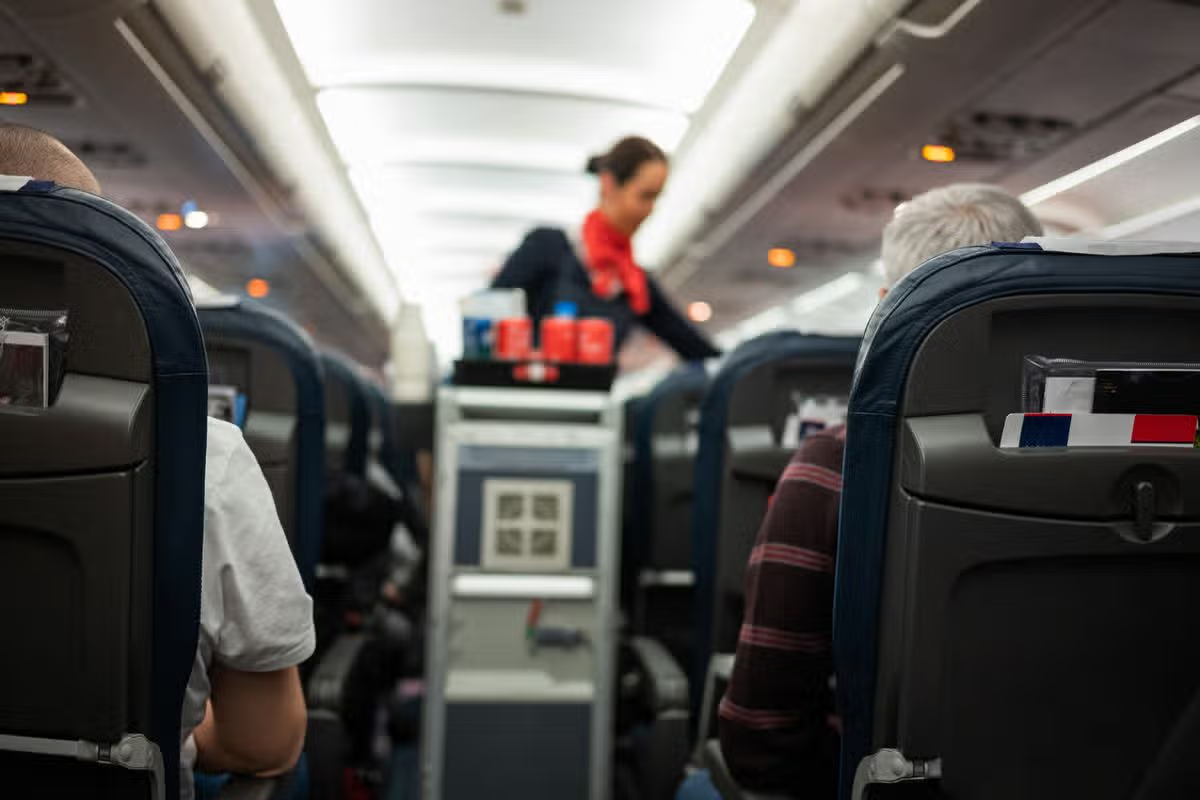
A cabin crew instructor has revealed that flight attendants often use a ‘secret code’ when greeting passengers. As most travellers know, it’s common to be greeted by cabin crew when boarding a flight. Whether you’re excited for your holiday or a nervous flyer, it’s reassuring to be met by a friendly face and know there’s help available as you find your seat and get ready for takeoff.

While crew members enjoy welcoming passengers on board as part of their service, there’s another important reason passengers are greeted at the door, and it might surprise some. Gabriel Randone, a Wizz Air Cabin Crew Instructor, told the Mirror that flight attendants are trained to greet passengers as part of their safety measures.

He explained that cabin crew complete a “mental scan of passengers” to ensure that everybody is fit to fly. What’s more, he says cabin crew are taught a secret acronym that they check during the process.

While Gabriel couldn’t reveal all of the details, as the acronym is not shared with passengers, he did explain what cabin crew would be looking for. For instance, cabin crew will check whether anyone appears aggressive or intoxicated. They’ll also keep an eye out for any medical conditions that could prevent someone from flying. “The goal is safety,” Gabriel said.

Any passengers seated near the emergency exit rows will also spot cabin crew hanging around in the area for similar reasons, Gabriel said. The instructor explained that the crew are trained to assess passengers, as some “categories of passengers” can’t be seated next to the emergency exit.

While many passengers might try to book the emergency exit rows, as they are classified as extra-legroom seats, Wizz Air’s website makes it clear that they are not suitable for all passengers.

The airline’s website states: “For safety purposes, regulations prohibit passengers under 16 years old, overweight passengers, individuals with special needs, expectant mothers, and those travelling with infants (under two years old) from occupying Extra Legroom or Front Row seats.”

Passengers seated in these rows must be able to open the exits in case of an emergency, and they receive a briefing that makes this clear. This protocol is so important that if nobody books the seat, the cabin crew will find a volunteer to move there.

“Sometimes, because the flights might not be fully booked, there would be no one close to the emergency exits”, Gabriel explained. “So what we need to do is to select someone who we call an ABP, an able-bodied person, and select them and to move them close to the emergency exits so that they can help out in case of an emergency”.

In the event of an emergency, the passenger would need to detach the safety cover from the door and pull a lever to open it. As Gabriel explained, every second counts in an emergency. “In an emergency, our priority is to get you out as quickly as possible,” he said. “We only have 90 seconds to evacuate a full cabin with 239 passengers.”

You can find out more about Wizz Air’s routes on wizzair.com.

Source link

Four U-2S Spy Planes Would Be Restored In Bill That Would Save The Dragon Lady Fleet

Members of Congress are again moving to block the U.S. Air Force from retiring all of its U-2S Dragon Lady spy planes. This time, legislators also want to compel the service to “fully restore” four of the iconic aircraft through heavy depot maintenance, which would bolster the fleet’s operational capacity. The Air Force continues to argue that the high-flying Cold War-era jets are too vulnerable to support future high-end fights and should be supplanted by a mix of space-based and other capabilities. This would presumably include a classified stealthy high-altitude drone, commonly (and unofficially) referred to as the RQ-180, or an evolution thereof, which first emerged publicly just earlier this year.

Yesterday, the House Appropriations Committee released a draft defense spending bill for the 2027 Fiscal Year. It includes a provision that would prevent the Air Force from retiring more than two U-2Ss in that fiscal cycle. The Air Force currently has 23 of these aircraft in inventory, including three two-seat TU-2S trainers.

One of the Air Force’s three TU-2S trainers. USAF

A summary of the proposed legislation also says it includes “$81 million for U-2 programmed depot maintenance to fully restore four aircraft.” The current operational status of the aircraft in question is unclear. This is included under the umbrella of $335.3 billion in total funding for operation and maintenance (O&M) accounts across the services that the draft bill would appropriate for Fiscal Year 2027.

Programmed depot maintenance for any aircraft is an intensive process that essentially involves a full tear-down and detailed inspection. Paint and other coatings are typically stripped and reapplied. Upgrades and modifications are often worked into depot maintenance cycles given the extensive work already being done.

U-2 Dragon Lady Maintenance thumbnail

U-2 Dragon Lady Maintenance


The Air Force’s proposed budget for the 2027 Fiscal Year completely zeroes out the line for U-2 O&M, to include depot maintenance, reflecting the service’s desire to retire the fleet. An annual force structure report the Pentagon released in May concisely outlines the current argument for retiring the remaining U-2Ss.

“The Air Force will retire the entire 23-ship U-2 fleet, as the platform is no longer viable for future high-end conflicts,” the force structure report says. “Continued operation presents significant safety, logistical, and financial risks that outweigh the platform’s remaining utility in contested environments.”

“This decision allows for the strategic reallocation of fiscal resources to fund more critical, high-priority service requirements and accelerate modernization efforts in other key areas,” it adds. “Continuing to operate the U-2 fleet would require a significant investment to address systemic issues, including diminishing manufacturing capacity, material shortages, and safety risks inherent in the aging platform.”

A U-2 seen taking off from an undisclosed location in the Middle East in 2010. USAF

Questions about the continued relevance of the U-2 in the face of an ever-expanding global air defense threat ecosystem are not new. Near-peer competitors like China and Russia, as well as lower-tier potential adversaries like Iran, continue to develop and field more capable air defense systems and expand their anti-access and area denial bubbles. This, in turn, has threatened to push the U-2 further and further from the areas where it would be tasked to collect.

On top of all this, the U-2s are aging and becoming more costly to operate and maintain. The U-2S models in service today were upgraded from earlier variants that began their service careers in the 1980s.

As noted, this is not the first time the Air Force has tried to retire its remaining U-2s, citing operational and sustainment-related factors. In response, Congress has repeatedly intervened in the past few years to at least block full divestment of the fleet over persistent concerns about the aerial intelligence, surveillance, and reconnaissance (ISR) capability and capacity gap that might result.

The Dragon Lady continues to offer a unique ISR platform that can fly higher than any other operational non-orbital platform, crewed or uncrewed, the U.S. military has, at least from what we know today. This, in turn, means that the aircraft can bring imaging, signals intelligence, communications payloads, and other sensors up to those altitudes, giving them particularly good fields of view. From this perch, aircraft can use a slant angle to peer deep into denied areas while still flying international airspace and further away from potential threats. The use of the U-2 to gather intelligence about a Chinese spy balloon that soared over parts of the United States and Canada in 2023, which involved flying above it, offered a particularly public demonstration of the value of the aircraft’s high-altitude capabilities.

A view of the Chinese spy balloon soaring over the United States in 2023, as seen from the cockpit of a U-2. USAF

Each Dragon Lady can also carry a wide array of different sensor systems simultaneously, as well as communications packages, further increasing its flexibility. The U-2Ss have the ability to be readily deployed to forward locations globally and conduct long-duration sorties, as well. The latter points have been especially relevant in comparison to known existing ISR satellite constellations that are constrained by their orbits and can only offer relatively short-term coverage over a specific area. We will come back to this in a moment.

A now-dated graphic that still gives a good sense of the array of different sensors the U-2 can carry. US Military

It is worth noting here that the Air Force’s Dragon Lady fleet also has a long history now of providing valuable ISR support outside of traditional combat operations. Last year, the service confirmed U-2Ss were supporting the enhanced border security mission along the United States’ southern boundary with Mexico. The aircraft have been used to support counter-narcotics operations over the years, as well as humanitarian assistance and disaster relief missions. NASA also operates a pair of ER-2 aircraft, another version of the Dragon Lady, as high-flying scientific research platforms.

A U-2 collected this image of wildfires in California in 2007. National Guard Bureau

The Air Force has been hinting for years now at the existence of advanced aircraft in the classified realm that could help fill gaps left by the retirement of the U-2, and also be more survivable in very high-threat environments. This has now been further underscored by the emergence of the ‘RQ-180,’ or a related stealthy design, in Greece earlier this year, the likely capabilities and roles of which TWZ explored in a detailed feature in April. At the same time, we have raised still unanswered questions in the past about how many of any such drones might actually be in service and what kind of operational capacity those fleets might provide.

The U.S. military is also pushing ahead with the development and fielding of new space-based ground and air surveillance capabilities. This includes work toward the fielding of new satellite constellations that could provide game-changing persistent coverage globally, as you can read more about here. Despite steady progress, including on-orbit testing of prototypes, there are still questions about when any of these new assets in orbit will be fully operational. The U.S. Space Force recently announced it is now targeting 2028 for the “early” fielding of at least some of these new space-based surveillance capabilities.

The draft defense spending bill from the House Appropriations Committee does still have to be finalized, and then brought in line with companion legislation in the Senate. Both chambers of Congress then need to pass the bill before it can be sent to the President’s desk to be signed into law. There are many opportunities along the way for major changes to be made to the bill.

That being said, Congress has consistently blocked Air Force efforts to fully retire the U-2 in recent years. Another potential reprieve, which would also demand the service take steps to bolster the operational capacity of the remaining fleet, has now appeared on the horizon.

Contact the author: joe@twz.com

Joseph is TWZ’s Deputy Editor, helping to oversee the site’s highly experienced and dedicated team, while also writing informative and impactful defense and national security content. He lives right in the thick of it in the Washington, D.C. area.


Source link

‘Disgusting’ passengers called out for cutting toenails and drying underwear in-flight

Airline passengers took to Reddit to complain about some of the most disgusting things they’d seen passengers get up to on a plane, and many agreed their habits were best left in the privacy of their homes

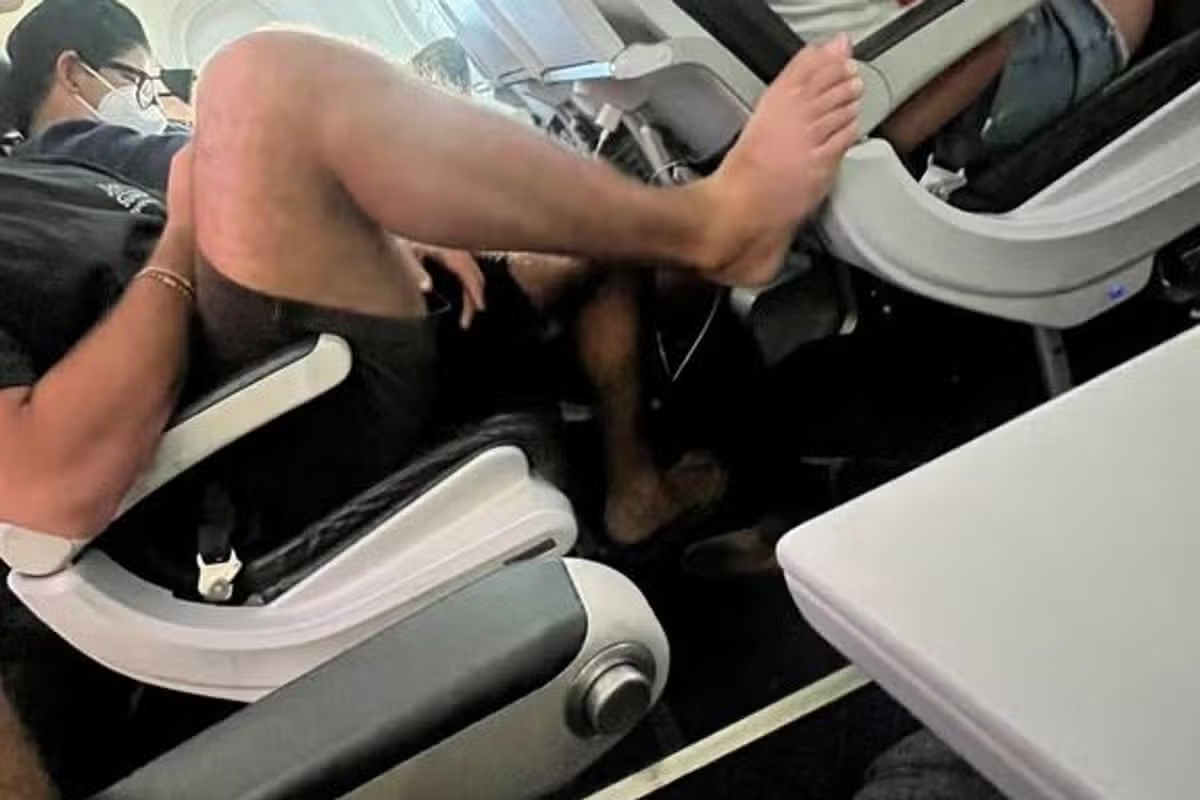
Being trapped in a metal tube at 30,000 feet seems to bring out the worst in people, and despite sharing a small space with dozens of others, some people treat the plane cabin like their personal living space.

A thread on Reddit’s AskUK titled “Worst thing you seen on a plane? What do you think is just not acceptable?” brought in over 200 responses, with holidaymakers keen to call out bad behaviour they’d seen onboard. And there were definitely some common themes among the complaints.

The original poster started the ball rolling, writing: “For me, it was that the lady sitting next to me was picking her toenails!” and many agreed lack of shoes was a huge etiquette breach. “I was sat next someone yesterday who took off their shoes and socks as soon as the opportunity allowed. They even went to the toilet barefoot.”, claimed one poster.

They added: “It wasn’t just the fact they were barefoot it was the general hygiene, e.g.: coughing and sneezing without covering, etc. They had me on edge the whole time thinking “right… I’m catching whatever disease they’ve absorbed through the soles of their gross feet.””

In a similar thread, posters complained about passengers doing tasks more suited to their private bathroom: “I don’t like it when people clip their toenails. I’ve seen it 3 times. Twice a row across from me and other time in my same row.”, said one. While another posted: “My wife and I were sitting in 1C and 1D. The guy in 1B pulled out dental floss after the meal and started going at his mouth like he was giving himself a root canal. Full on two handed flossing right in his seat.”

Another said: “I try to be kind and understanding of the difficulties and lack of facilities on this, but, a woman changed her baby’s ‘filled’ nappy in the middle of the cabin… twice. The stench roamed right through that B777.”

Content cannot be displayed without consent

Instagram account @passengershaming has amassed over 1.3 million followers thanks to its hilarious posts that highlight some of the worst behaviour on planes. In one classic reel, a woman was seen using the overhead air vent to dry the crotch of her knickers. The viral video was captioned: “PRO TRAVEL TIP: Airplane air vents aren’t for drying underwear Kthx!”

Other examples posted to the account over the years include a woman using a foot file to remove hard skin, and a man opening a can of tuna on a plane for a snack, seemingly unperturbed about the smell in a confined space.

While the examples above are mostly harmless, if disgusting, behaviour, recently there have been calls to create a national database for abusive passengers, which would allow airlines to share information on disruptive passengers and restrict their access to flights.

According to the BBC, Department for Transport officials will be meeting later this month to discuss the proposals, and the database would likely be a collaboration between the government and the airline industry.

Have a story you want to share? Email us at webtravel@reachplc.com


Source link

Ryanair issues ‘fuel update’ as changes being made to flights

The airline shared an update for passengers in a post on social media

Ryanair has shared a ‘fuel update’ for passengers. The airline shared the news on social media, explaining that it is making changes to flights. Posting on YouTube, Ryanair shared an overview of its plans to improve flights over the coming years.

The video was titled: “Pathway to net zero carbon emissions goal.” As part of the changes, the airline said flights will produce less noise and require less fuel, among other benefits. Ryanair describes itself as Europe’s largest airline group.

In the post, Ryanair told customers: “We’ve developed a pathway to achieve our net-zero carbon emissions goal by 2050, which aligns with the Paris Agreement and the aviation industry’s Destination 2050 initiative. Ryanair’s pathway aims to show incremental progress in decarbonising in line with EU climate targets are possible.”

In the video, the airline highlighted key areas of change. Ryanair started by discussing the benefits of new technology, such as 210 ‘game-changer’ aircraft, which deliver 16% less fuel usage and 40% less noise.

Ryanair also shared how sustainable aviation fuel can reduce lifecycle emissions by 80%. As well as how measures, such as single-engine taxiing and dynamic flight planning, can improve efficiency.

On its website, Ryanair shared further details for passengers interested in its plans. The airline said 32% of its carbon-emission reduction targets would come from technological and operational improvements, 34% from increased use of sustainable aviation fuel, 10% from the Single European Sky initiative, and 24% from offsetting and similar measures.

Ryanair’s website says: “We have teamed up with Trinity College Dublin to put in place a number of innovative actions to accelerate the use of sustainable aviation fuel (SAF). By appointing best-in class researchers, we’ll achieve our goal of powering 12.5% of our flights with SAF by 2030.”

Destination 2050 describes itself as an industry alliance committed to climate-neutral European aviation. The website says: “We believe that together, policy-makers and the industry we can make net zero CO2 emissions happen by 2050. European aviation is committed to play its part and ensure that air transport can continue to grow sustainably in the future.

“By 2030, net CO2 emissions from intra-European flights would be reduced by 55% compared to 1990 levels through a combination of fleet renewal, sustainable aviation fuel (SAF), operational improvements and the EU Emissions Trading System (ETS) –in line with the new EU climate goal for 2030.”

Why is CO2 bad for the environment?

Carbon dioxide (CO2) is a greenhouse gas that holds heat in the Earth’s atmosphere. Although it is essential for maintaining the planet’s warmth, human actions have led to a significant increase in its levels, intensifying the greenhouse effect and causing global warming, severe weather events, and ocean acidification.

Source link

Huge changes to flight rights from free seats for kids to hand luggage fees (but only on some planes)

Family with suitcases in airport.

THE EU is in the midst of making huge changes when it comes to air travel and all of them will greatly benefit passengers.

These include no extra fees, better compensation rights and families heading on holiday can sit together at no extra charge – but now we’re out of the EU, the new rights will only carry weight for Brits on certain flights.

Changes to travel rules in the EU means families no longer have to pay to sit together Credit: Alamy
Collage of travel items including a plane, sunscreen, passport, suitcase, and plane tickets, advertising The Sun's travel Instagram account.

The new regulations were agreed by the EU Council and Parliament yesterday, making it the first overhaul in over 20 years and will come into play in 2027.

Some of the biggest changes include allowing families to sit together at no extra cost, as well as passengers having a free personal item to take onboard.

There also won’t be penalties for missing one leg of a booking, and hand luggage costs will be shown upfront in the fare.

There will also be a ban on additional fees for alterations like name correction.

JUST THE TICKET

Bag UK’s CHEAPEST Drayton Manor tickets & little-known tips on best rides


CHEAP DATE

Our fave cheap European destinations with flights under £20 & hotels from £24pp

It will be easier for passengers to get money back for delays or cancellations too.

Airlines will need to immediately acknowledge a claim and then reply within 30 days.

For those who experience delays, there is a right to assistance which includes refreshments every two hours of waiting time, a meal after three hours, internet access and phone calls.

When passengers need overnight stays, they should be given the hotel free of charge and get free transport from the airport to the accommodation and back.

After a cancelled flight or denied boarding, passengers who choose to reroute must be given an alternative journey within three hours.

This all sounds great doesn’t it? Well, there is some bad news – this won’t count for all British travellers leaving the UK.

The new rules will only count on certain flights leaving the UK Credit: Alamy

As a result of Brexit, British holidaymakers won’t necessarily benefit from this as in some cases their flights will fall under passenger rights called UK261.

Whereas for those living in the EU, the new regulations count for all.

For Brits heading on holiday, taking advantage of these EU changes will depend on the route and the airline.

For example, a flight leaving the UK for Malaga with Ryanair will fall under EU rules as Ryanair is an EU airline.

The Malaga to UK return leg will also be under the EU rules – on the return journey, it doesn’t matter if the airline is EU or non-EU, because the flight departs from the EU.

Along with Ryanair, the likes of Wizz Air, easyJet and Lufthansa are all EU-airlines so the new rules automatically count for Brits on both journeys to EU countries.

There will however, be a gap on flights leaving the UK on a non-EU airline.

On EU operated airlines like Ryanair – the new EU rules will apply to Brits on both legs Credit: MoreISO

For example, if a British passenger flies from London to Madrid on a UK airline like British Airways, that outbound leg would remain under UK261 rules rather than the new EU regulations.

But the return would fall under the EU rules because it departs from Madrid in the EU.

So Brits heading on holiday will only get the new benefits if they are travelling on EU-covered flights.

They will not get them automatically on all flights from UK airports.

UK-airlines like British Airways, Virgin Atlantic and Jet2 won’t fall under the new EU rules.

But these do have their own guidelines and policies regarding families sitting together and luggage costs.

AirAdvisor CEO Anton Radchenko, a renowned aviation lawyer, added: “This agreement is a meaningful step forward for European passengers, and it throws the position of UK travellers into sharp relief.

“For the first time since Brexit, we are looking at a real divergence in the
everyday rights of passengers flying from the UK versus those flying
from the EU.

“The headline compensation amounts remain broadly aligned,
but on the things passengers deal with on every single trip, being
penalised for a missed leg, paying to sit next to your own child,
comparing fares that hide the cost of a bag, EU travellers are about
to pull ahead, and UK travellers are at risk of being left behind.”


Source link

Jet2’s message to all passengers flying with soft-sided suitcases

The airline offered a reminder to passengers who should check the advice before travel

Jet2 has guidance for all passengers travelling with soft-sided luggage. The airline has an important travel reminder on its website, which shares ‘top tips before travel‘ for all customers. The guidance highlights the importance of checking that baggage is strong and suitable for use before travel.

While many passengers use soft-sided suitcase, Jet2 wants customers to be aware they can be vulnerable. Highlighting the message on the advice page, the airline said: “Please ensure your baggage is strong and fit for purpose, to protect the contents and to withstand the normal baggage handling process.

“Soft sided cases and handles, wheels and locks can be particularly vulnerable.” Nonetheless, many customes might still choose to travel with soft-sided suitcases.

Regardless of their choice, passengers are asked to make sure they label all of their luggage carefully. Jet2 says: “Label each piece of baggage with your name, flight number, and phone number.”

When packing, customers are urged to ensure any important documents and items are packed inside their hand luggage. This includes any essential medications and cash. “Never pack cash, valuable items, perishable goods, important documents or essential medications in your checked baggage,” the advice stated.

Passengers are also urged to add a name tag to their bags and ensure all zips are closed before travel. Jet2’s guidance says: “Secure your baggage and ensure all pockets and zips are fully closed. Please note that the security authorities in some countries may open your bags without you present to make any necessary checks.

“At check-in, each item of checked baggage will be given a destination tag showing your flight number. Do not get rid of your checked baggage receipts (if given) until you pick up all checked baggage at your destination airport. Never carry unidentified items on behalf of other people.

“Take care when claiming your baggage at your destination, as many suitcases look the same. It is best to always check the name on the baggage tag.”

For passengers in need of new luggage, it could be worth browsing high street retailers, such as Dunelm, Primark, Home Bargains, B&M, or TK Maxx. Luggage options typically include both hard-sided and soft-sided suitcases and bags.

While some passengers might prefer to use soft-sided bags because they offer more flexibility than other suitcases, hard-sided suitcases could be preferable when you’re transporting fragile items.

Source link

Airports that choose not to recognise ‘Sunflower Lanyards’ as of June 2026

People with hidden disabilities tend to use this as a way of making others aware

Travel can be made easier for some people living with an invisible disability or health condition by wearing a ‘Sunflower Lanyard’. Hundreds of airports around the world recognise it and what it may mean for some passengers – but not every airport is the same.

The Sunflower Lanyard isn’t recognised everywhere. Although many airlines and airports around the world support it, some international airports and locations ask you to use their own specific hidden disability programs or badges to get access to special fast-track lanes, priority boarding, or customised assistance.

Employees at participating venues are trained to recognise the lanyard and offer specific help, such as using simpler language, giving you extra time to process information, or guiding you to a quieter space. But, not every part of the world will instantly recognise or understand the lanyard.

On the Hidden Disabilities Sunflower website, it says: “It’s a misconception that people living with a disability don’t want to, or can’t travel. They do and they can. Globally, one billion people live with some sort of disability, and while some experience a disability that is visible, for many it is not visible.”

The system is designed for any condition that isn’t immediately obvious to others, including conditions like neurodivergence, mental health, sensory impairments, and chronic conditions, to name a few. The lanyard does not reveal your specific medical condition or disability.

What parts of the world accept and follow the Sunflower system?

According to the Hidden Disabilities Sunflower website, hundreds of airports and airlines do recognise the lanyards. As of April 2026, the number was around 325 – but checking the specific airport’s accessibility page can give more details such as finding out if staff can provide free Sunflower lanyards and where to collect them.

Because the lanyard operates on an “opt-in” basis for businesses, an airport will not recognise it unless its staff have been explicitly trained to do so. Holiday hotspot Spain made headlines because its airport authority (Aena) rolled out its own alternative system.

Most other non-participating airports simply do not recognise the lanyard at all, instead of replacing it with a local version. Outside of a few specific exceptions (such as Singapore Changi, Tokyo Haneda, and select major airports in India), the scheme is not widely adopted or understood by security staff across Asia and Africa.

What isthesystem

The Hidden Disabilities Sunflower lanyard system is an initiative that allows people to discreetly let others know that they have a non-visible disability and may need additional support, time, or help. Wearing the bright green lanyard that features yellow sunflowers indicates to trained staff that you have a hidden condition.

Anyone who feels they have a non-visible disability can use the lanyard. You do not need to show medical records or a doctor’s letter to get or wear one.

The system is designed for any condition that isn’t immediately obvious to others, including conditions like neurodivergence, mental health, sensory impairments, and chronic conditions, to name a few. For more information, click here.

Source link

‘Entitled passenger stole my plane seat then did the unthinkable’

A woman has shared her shock after an ‘entitled’ stranger stole her pre-booked plane seat – sparking an argument onboard as she tried to claim back what she’d paid for

When arriving at the airport, travellers cannot wait to board their flight and jet off on their well-earned holiday. But one woman’s much-needed getaway started with friction when a stranger stole her plane seat and refused to give it up.

Taking to Reddit, she explained how she pre-booked a window seat on the plane, 27A, but when she arrived at her row, there were two women already sat down. She said: “I politely told them I had 27A, and one of them goes, ‘No, this is 27C the window seat. 27A is the aisle.’ “I was a bit confused, so I double checked after sitting down briefly in the aisle seat, and asked a flight attendant. She confirmed that 27A was in fact the window seat.

“So I go back and explain that to the woman, nicely, and her response was, ‘For f***’s sake, what are you so desperate to sit by the window for?'”

Wanting to avoid an argument, she told her that she’d pre-booked that specific seat on purpose and kindly asked her to sit in the one assigned to her.

She added: “She snaps back, ‘We all paid for it’, and still refuses to move.

“At this point the flight attendant is right there witnessing everything and says, ‘It’s her seat if she wants to sit there, she will.’

“Only then did the woman finally move, but the attitude the whole time was unbelievable. No apology, no basic respect, just pure entitlement.

“Honestly, I don’t get how people can act like that over something so straightforward. If it’s not your seat, just move. It’s not that deep.”

Commenting on her post, one user said: “It’s rude and it is not allowed. You sit in the correct seat period. They just wanted to take your seat. That’s where the flight attendants come in and say move it.”

Another added: “I remember when they said people had to sit in their assigned seat so they could be identified in an accident.”

A third chimed in: “People need to learn that doubling down on mistakes is wrong and stupid.”

One more person said: “I hope you didn’t need to leave your seat during the flight. I bet she’d b**** about that!

Source link

The hidden WWII airport cafe where you can watch planes take off with a pint

The Aerodrome Cafe with outdoor seating.

SITTING in a cafe with a cuppa and a slice of cake is already a nice way to spend an afternoon, but imagine if you could watch planes take off at the same time…

Well, there is one spot you can actually do this from and it is less than 12 miles from London.

At Elstree Aerodrome Cafe you can sit and watch planes take off Credit: Google maps
The small cafe sits right next to Elstree Aerodrome which dates back to World War II Credit: Google maps

The Aerodrome Cafe at Elstree in Hertfordshire, sits right next to Elstree Aerodrome, meaning you can tuck into breakfast while watching planes take off and land.

The small cafe is open seven days a week between 9am and 4pm and serves breakfast and lunch, as well as snacks.

And when the weather is warm and bright, you can even grab a beer for £5.30 and be closer to the action by sitting outside.

But in the colder months don’t worry, because inside there is a log burner to keep it cosy.

Read more on travel inspo

TRAVEL TIP

The £2.99 SIM hack that can save Brits HUNDREDS abroad


CHEAP BREAKS

UK’s best 100 cheap stays – our pick of the top hotels, holiday parks and pubs

Visitors can enjoy breakfast, lunch or snacks at the cafe Credit: Google maps

The cafe was opened by husband and wife duo Jean-Luc Sainlo and Colleen back in 2021.

Jean is even a Michelin-trained chef and the cafe makes its own pizzas as well as afternoon tea and roasts on a Sunday.

One recent visitor said: “I come here with the family now and again and it’s always a lovely day out.

“I’ve seen adults and children alike be delighted watching the planes and helicopters after meals.

The cafe has both indoor and outdoor seating too Credit: Google maps

“A few yards down the road is Aldenham Country Park, so once you’ve eaten and enjoyed the planes you can head over there if you prefer a more woodsy atmosphere.”

The aerodrome dates back to World War II where it was used as a base to repair Wellington bomber planes.

If you did visit today, you’d most likely see small two or four-seater planes, helicopters or potentially some vintage planes taking off.

Though, if you are really lucky, you might see some stars as the aerodrome has previously been used for a Mission Impossible film, as well as James Bond Spectre.


Source link

Flight attendant says phone rule people break makes her ‘jump out of her skin’

A flight attendant has said she can’t stand it when passengers break one common phone rule, as it could actually be quite dangerous for the pilot and other passengers

When boarding a plane, there are several things passengers are required to do to ensure their own safety and that of fellow travellers. Once everyone has taken their seats, cabin crew will deliver safety information that must be listened to, and it’s frequently essential that you take their warnings seriously.

If you’re someone who flies regularly, you may believe you no longer need to absorb this safety information as you’ve encountered it numerous times before. But one cabin crew member on social media has insisted it’s always crucial that you remain attentive, as flouting the rules could result in injury, disruption to the aircraft, and possibly harm to your own possessions.

Yasmeen, a flight attendant working out of Los Angeles, posted a video on TikTok from a recent flight, revealing she was left stunned by what one passenger was doing while the aircraft was airborne.

The cabin crew member was travelling as a passenger on this occasion, but explained that her professional experience means she understands just how risky it can be to disregard the rule that the other traveller was so openly flouting.

In the footage, Yasmeen revealed that another passenger seated across the aisle had received a phone call mid-flight and proceeded to answer it with the phone on loudspeaker, allowing everyone within earshot to listen in on their conversation.

Content cannot be displayed without consent

Not only is blaring your phone on speaker thoughtless when crammed into a confined space with dozens of other passengers, but you’re meant to switch your mobile to aeroplane mode upon boarding, which blocks all signal and prevents you from making or taking calls.

Yasmeen said: “As a flight attendant, I’m actually about to jump out of my skin.”

Viewers of her clip were split, though. Some insisted they’d never dream of leaving their phone on during a flight, while others claimed they’ve “taken full Zoom calls” on planes previously, suggesting it shouldn’t be a problem.

One person said: “I just don’t understand. With all this technology, and supposedly we went to the moon, but we can’t use our phones on the plane?”

Another added: “I don’t understand what some of y’all don’t understand. You are NOT supposed to be making phone calls while in the air!”

A third wrote: “I’ve taken full Zoom calls on the plane. It’s not against the rules to be on a call.”

Why do phones need to be on aeroplane mode when flying?

Phones, tablets, and other wireless-enabled devices should be switched to aeroplane mode as a safety measure. According to the Federal Aviation Administration (FAA), any device that emits radio waves has the potential to interfere with navigation and radar systems, as well as disrupt pilots’ headsets.

The extent to which mobile phones impact aviation technology hasn’t been thoroughly researched, but pilots have reported hearing background noise and interference from handsets while in the air, particularly during landing. This could prove distracting to pilots at a critical stage of the flight, so it’s advisable to simply keep your phone on aeroplane mode throughout.

Failing to switch your phone to aeroplane mode is unlikely to bring the plane down, but even if it doesn’t irritate your pilot, it could also result in unnecessary strain on your own device.

Ways not putting your phone on aeroplane mode can affect you include:

  • Severe battery drain: Your phone will be working overtime to try and find a signal in the air by attempting to connect to towers on the ground, which can drain your battery.
  • Costly roaming charges: On international flights, flying over multiple countries and having your phone connect to their towers could land you with hefty roaming fees that you weren’t prepared to pay.

Source link

Canada chooses Swedish early warning planes rather than US model | Business and Economy News

Canada has announced plans to buy a fleet of early warning planes from Sweden’s Saab rather than a competing option from Boeing as it seeks to reduce its reliance on the United States.

Prime Minister Mark Carney said on Wednesday that Canada would opt for Saab’s GlobalEye, which is based on Bombardier’s Global 6500 jet. Boeing’s E-7 Wedgetail plane – which has suffered from delays and cost overruns – had also been in contention.

Recommended Stories

list of 4 itemsend of list

“With a suite of advanced sensors and mission systems, Saab’s GlobalEye will be a key resource for the Canadian Armed Forces to detect and deter threats across the Arctic,” Carney told a defence conference in Ottawa.

The Prime Minister pledged in March that Canada would take full responsibility for protecting its vast Arctic territory, after relying for decades on a partnership with the US to monitor its more than 4.4 million square km (1.7 million square miles) of land and sea, a territory larger than India.

Carney’s Liberal government last year announced plans to ramp up defence spending. The US and other allies had complained for years that Canada was not meeting longstanding NATO targets on military expenditure; Carney announced in March that Canada hit that target of spending 2 percent of its GDP on defence last year.

In a statement, Saab said it planned to invest in research and development work in Canada as part of any deal.

Although Carney did not give details of the fleet size or the cost of a potential contract, military officials had earlier said they were looking to buy six early warning aircraft.

Philippe Lagasse, associate director of international affairs at Ottawa’s Carleton University, said Canada’s decision to buy the GlobalEye planes was “an important test case for the Carney government’s policy of pivoting away from American military capability”.

He said in a statement that the decision confirms Canada’s relationship with Sweden, a new NATO ally that has also been eager to strengthen its ties to the Canadian military.

Canada has previously said it wants to work more closely with the Nordic countries in the Arctic on defence and other issues, in a global environment in which the US has become a less reliable partner.

“GlobalEye is already creating jobs in Canada, and working with the Canadian supply chain. This decision ties our two nations even closer together,” Swedish Prime Minister Ulf Kristersson said in a social media post.

Saab is also in the running to sell Canada some of its Gripen fighters.

Canada has a deal to buy 88 F-35 jets from Lockheed-Martin, but last year, after the US slapped tariffs on key Canadian imports, Carney asked the military to probe whether it could cut back the order and buy some planes from another manufacturer.

Carney later told reporters Ottawa would make a decision on the fighter fleet in due course and declined to comment when asked whether the military would be operating two jets.

Last week, a Pentagon official, speaking after Washington suspended planned biannual defence talks with Canada, said the delay in making a decision on the F-35s showed how Ottawa was prioritising politics over defence issues.

Still, Lagasse of Carleton University said he expected Canada would ultimately decide to stick with a fleet of F-35 jets rather than splitting the fleet by buying some Saab Gripens.

“If the government was determined to buy Gripens, I would have expected them to make the announcement alongside this [GlobalEye] decision,” he said.

Trade tensions

The announcement came amid ongoing trade tensions between US and Canada after US President Donald Trump slapped tariffs on Canada after taking office last year, alongside multiple comments threatening to annex the country and make it the 51st state of the US.

Historically, nearly 80 percent of Canada’s exports have been to the US. While the vast majority of those were protected under the USMCA, the trade agreement between the two countries that also includes Mexico, that is now due for a review, which starts on July 1, and Trump has said the US does not really need that deal.

While the US has announced bilateral talks with Mexico, there has been no mention of Canada.

Deputy US Trade Representative Jeffrey Goettman will lead bilateral talks in Mexico City on Thursday and Friday focused on “economic security and rules of origin for key industrial goods,” the department said in a statement on Wednesday.

USTR said the US and Mexico will hold a second round of negotiations in Washington on June 16-17, focused on agriculture and “a level playing field,” with a third set of talks in Mexico City scheduled for the week of July 20.

The first Trump administration held trilateral negotiating rounds with both Mexico and Canada to create the existing USMCA, which replaced the 1994 North American Free Trade Agreement in 2020.

But so far, there have been few discussions between US Trade Representative Jamieson Greer and his Canadian counterpart, Canada-US Trade Minister Dominic LeBlanc, since early March, and no formal launch of a US-Canada negotiating process.

Source link

The common travel item that is forcing planes to divert

POWER banks have been banned from hold luggage for a decade – but some passengers are still not following the rules.

In one case, a plane was recently diverted when a power bank was found charging in the hold, and experts say these problems are ‘on the rise’.

Portable power banks are a common travel item – but there are strict airline rules Credit: Getty
Since 2016 power banks have been banned from hold luggage Credit: Alamy

Follow The Sun’s award-winning travel team on Instagram and Tiktok for top holiday tips and inspiration @thesuntravel.

While they’re ideal for travellers to charge phones and devices – battery powered charging banks are causing chaos for airlines.

The lithium in portable chargers mean that they pose a risk of overheating and even catching fire.

As a result, there has been a ban on having power banks in hold luggage since 2016.

TRAVEL TIP

The £2.99 SIM hack that can save Brits HUNDREDS abroad


TOP PARKS

The MEGA UK holiday parks with water worlds, Wetherspoons and more – from £3 pp

Airlines ask passengers to take portable power banks in hand luggage, but they strictly can’t be used in-flight.

However, not everyone is following the rules.

Just a few days ago, an easyJet flight was forced to divert when a passenger informed crew during the flight that the portable charger was in the hold of the aircraft.

The flight had been heading to London Luton from Hurghada in Egypt but had to land in Rome as a ‘precaution’.

The airline said the captain had decided to divert “in line with safety regulations”.

The flight touched down safely at Rome Fiumicino and was rescheduled to the following day.

Power banks must be in hand luggage only and not used in-flight Credit: Alamy

Sadly, travel experts say the situation is likely to get worse.

Jonathan Nicholson from the Civil Aviation Authority (CAA) said that incidents involving power banks are “certainly on the rise” as portable chargers grow in popularity.

The CAA said “more awareness” was needed as portable chargers carry “serious risks” of overheating or catching fire.

Jonathan Nicholson urged travellers to follow a “basic set of international rules” when it comes to power banks.

The first is to always take them with you on board the aircraft, not in checked luggage.

The other is to only take a maximum of two power banks per passenger.

When on board the aircraft, don’t use them and “absolutely do not charge the power bank itself because that’s when they become really hot and most susceptible to having an issue”.

A number of airlines have since banned the use of power banks in the cabin as well, after an airline fire last year resulted in the plane being destroyed.


Source link

Jet2 summer holidays travel update for anyone with flights booked

Jet2 summer holidays travel update for anyone with flights booked – The Mirror


reach logo

At Reach and across our entities we and our partners use information collected through cookies and other identifiers from your device to improve experience on our site, analyse how it is used and to show personalised advertising. You can opt out of the sale or sharing of your data, at any time clicking the “Do Not Sell or Share my Data” button at the bottom of the webpage. Please note that your preferences are browser specific. Use of our website and any of our services represents your acceptance of the use of cookies and consent to the practices described in our Privacy Notice and Terms and Conditions.

Source link

Japan unveils ‘fastest ever’ passenger jet 2.5x speedier than Concorde

They simulated flight conditions at Mach 5, which is roughly five times the speed of sound and far faster than the iconic Concorde ever reached during its time in the air

A Japanese organisation is working on a hypersonic jet that could travel two and a half times as fast as Concorde.

In a test carried out by the Japan Aerospace Exploration Agency (JAXA), researchers installed an experimental aircraft inside a ramjet engine testing facility at JAXA’s Kakuda Space Center in Miyagi Prefecture, Interesting Engineering reports.

They simulated flight conditions at Mach 5, which is roughly five times the speed of sound.

The trial was a big success, validating the aircraft’s thermal protection system, control surfaces, and ramjet combustion performance under extreme hypersonic conditions.

Do you have a travel story to share? Email webtravel@reachplc.com

READ MORE: Holidaymakers endure THREE HOUR waits at Dover amid EU passport control chaosREAD MORE: Tourists name Europe’s ‘unfriendliest’ cities saying people were ‘unbelievably rude’

Such tests are crucial for the legitimacy of such an aircraft, as temperatures surrounding the aircraft can soar close to 1,000 °C at that speed.

The next phase of the program might involve mounting the experimental aircraft onto a sounding rocket or similar launch vehicle for a real-world Mach 5 flight demonstration, it has been reported.

Japan’s hypersonic research efforts are part of a bigger global race to develop ultra-high-speed transportation systems. If the JAXA plane makes it into the air, it could cut the flight time from Tokyo to the US down to two hours. Currently, it takes around half a day to make the journey on a typical commercial aircraft.

The aircraft would do this, in part, by rising to very high altitudes of around 17 miles, more than double that of a conventional aircraft.

A Mach 5 hypersonic passenger plane would fly at about 3,300 mph, roughly six times faster than a normal plane.

The supersonic Concorde passenger jet operated until 2003, but its speed topped out at about Mach 2. It’s maximum recorded speed was 1,400mph.

As exciting as the aircraft is, it’ll be a long time before it’s up in the air, and even longer before anyone is flying in it.

Hideyuki Taguchi, a professor at the Tokyo University of Science, told Mainichi: “Developing a conventional aircraft typically takes about 10 years. Since the development of hypersonic passenger aircraft requires two stages of demonstration — an experimental aircraft followed by a passenger aircraft — we hope development can be completed in about 20 years.”

Tetsuya Sato, a professor at Waseda University, added: “This result is still only a first step. Our dream is to connect it to a flight demonstration.”

JAXA is far from the only organisation attempting to launch a commercial super or hypersonic aircraft.

Recently, key milestones include NASA’s X-59 experimental aircraft and Boom Supersonic’s XB-1, both of which successfully completed test flights to overcome noise and efficiency hurdles.

Source link

Pilot’s wife urges passengers to stop booking 1 seat to travel on planes

A pilot’s wife has urged passengers to stop booking a certain seat to travel on planes. Laurie said it’s vital people avoid it if they want a smooth and comfortable journey

If you’re going to listen to advice from someone about travelling abroad, one person you should pay attention to is probably a pilot’s wife. After all, they know all the dos and don’ts when it comes to air travel and making the most of your holidays.

This is why Laurie, known as travelby_laurie on TikTok, is happy to offer advice whenever she can, and she recently turned her attention to the worst seats to book to travel on planes. According to her, there are particular rows you need to avoid to ensure your journey is executed as comfortably and smoothly as possible.

She’s not the only pilot’s wife to have made such a confession either. Previously, another woman opened up about the task she needs to complete every morning.

In the clip, Laurie said: “Do not sit in these seats the next time you’re flying in an airplane. Number one, the obvious seat to avoid is the very last row of any airplane, because they do not recline.

“There are two other reasons to avoid that back row seat. Number one, because you’ll be last off the airplane.

“Number two, if you have a connecting flight, where you are catching another airplane in that airport, to get to your final destination, avoid being in the back of the plane.

“The airlines do not tell you that 50 minutes is not enough time to connect to another flight but they are still going to allow you to book them.”

Content cannot be displayed without consent

She also noted she doesn’t ever want to sit in the row that’s in front of the exit row. This is because the exit row may not recline, and the seat in front of the exit row also often does not recline.

This is an aviation safety measure put in place to ensure the seatbacks don’t block the aisle and impede a rapid evacuation in an emergency. However, even though the rule can be imposed for a reason, Laurie noted journeys can already be “uncomfortable”, so it’s best to do your research before booking a seat to see which areas are more comfortable.

If you have a lengthy flight ahead, these spots are probably best avoided. It’s worth noting that some airlines in America include row 13 in their fleets; however, several other airlines around the world often omit the number entirely to accommodate passenger superstitions about bad luck.

What you need to know

While some people avoid the row directly in front of an emergency exit row, as these seats typically have their recline mechanism disabled, there’s something else most people need to consider. Booking a seat at the back of the plane could be more problematic for passengers.

Usually, people tend to avoid them because seats often do not recline, are located directly next to noisy lavatories and galleys and will leave you feeling the most turbulence. As well as this, sitting there will take you longer to deplane, which means you may have limited meal options as service starts from the front.

Even though the very back row can sometimes be cheaper or less crowded on off-peak flights, the general consensus points to several major drawbacks. If you have a connecting flight, it could also cause issues too, as you may be last to get off the plane.

This is why Laurie generally advises against it. It’s a nugget of travel wisdom you may not have known before.

Source link

Ryanair passengers advised to remove 1 item of clothing before travelling on planes

Little you may know, passengers travelling with Ryanair should obey by a certain rule when on planes. As soon as you board, it’s wise to remove a key item of clothing

It’s reached that time of year when many of us are travelling more; however, if you usually fly with Ryanair there’s a rule you may not be aware of. It turns out, when you board a plane, you’re advised to remove a certain item of clothing as the airline says it shouldn’t be worn during key times.

The travel tip was recently shared online by a woman known as Sarah Geissler who alluded to the rule in a light-hearted way. Even so, she drew attention to something a lot of people may not be aware of when they’re jetting off on holidays, and this is that a certain item of clothing should be removed on flights.

It’s not the only travel advice of its kind to be shared either. Just weeks ago, Ryanair also urged passengers to stop packing one item in their hand luggage.

She shared a clip of a sign on a plane seat, which seemed to show that heels are not permitted to be worn. Over the top of the clip, she wrote: “No heels allowed on your Ryanair flight.”

Sarah also teased that this was “bad news for baddies”, but it actually put a spotlight on something important. When it comes to air travel, there are some important things you need to be clued up on, but it’s not as simple as it seems.

Content cannot be displayed without consent

Indeed, while there are rules you need to follow about wearing heels when flying with Ryanair, this doesn’t mean you can’t wear them when at the airport. There are actually vital guidelines you should follow, especially in case of an emergency.

What you need to know

Even though people aren’t banned from wearing heels when travelling with the airline, it is highly recommended that they avoid doing so. Heels significantly increase your risk of tripping in the cabin and can puncture the inflatable emergency evacuation slides.

For safety reasons, cabin crew will instruct you to remove your heels prior to going down an escape slide in an emergency. This is why it’s best to remove them before boarding a plane, and perhaps slip into something more comfortable.

Even better, you could avoid wearing them in the first place. During an emergency, you must remove all high heels before going down the slide.

To ensure a swift escape, flight attendants suggest slipping them off before sliding, should an emergency ever occur. If one took place, passengers are also advised to leave their hand luggage behind.

In the footage shared online, the video also showed you shouldn’t wear glasses or smoke in such an emergency either. It’s a topic that’s got people talking on Reddit in the past.

One person said: “Heels can damage an escape slide, and I’d guess that glasses, ear rings and false teeth could be ripped out during impact. Hence, get them off before the event.”

Another noted: “My theory. Remove glasses, dentures. They may come loose and become lost (so, put them in a pocket).

“Remove high heels (especially important if you leave the plane via slide). Remove ear buds or headsets (so you can hear emergency instructions).”

A third also suggested: “The point is not to wear pointy things when coming down the inflatable slide in order not to make holes in it.”

Source link

Jet2 ‘back to normal’ update after major disruption for passengers on flights

Passengers were told to bring their own food and drinks on board after a fire caused a supply disruption

Jet2 has released a fresh update for passengers after many were informed that certain services would be unavailable on their flights. Earlier this week, it emerged that Jet2 had suspended food and drink services and in-flight retail for passengers on selected routes.

At the time, the airline stated it was dealing with an ‘operational issue’ that was ‘outside its control’. The disruption was reportedly triggered by a major supply chain disruption following a fire at Jet2‘s Retail Operations Centre in Middlewich.

The warehouse is reportedly responsible for stocking all catering carts. Consequently, the airline was forced to suspend all food, drink, and Jet2shop retail services on the affected flights.

This meant some passengers were unable to purchase snacks, soft drinks, alcohol, hot beverages, or duty-free items from the cabin trolley. Pre-booked meals were scrapped, and those who had paid in advance for a hot meal or snack deal did not receive their order.

In a fresh update, sent to the Liverpool Echo today (May 15), a Jet2 spokesperson said: “Due to an operational issue outside of our control, there was limited food and drink available to buy on board on Sunday, May 10. We are pleased to say that, since then, customers have been continuing to enjoy our award-winning flights and can choose from a wide selection of food and drink onboard.”

Content cannot be displayed without consent

They added: “Our full in-flight retail and food and drink offering will be completely back to normal in the coming days.” Jet2 has also confirmed it is automatically processing refunds for all pre-booked catering back to the original payment method.

While the problem persisted, travellers were advised to bring their own food, drinks and snacks on board, after clearing airport security. However, passengers are prohibited from bringing hot coffee, tea, or hot food from the airport terminal onto the plane. A statement on the Jet2 website states: “You can’t bring hot food or hot drinks onboard our planes for safety reasons.”

At the time, many people turned to social media to find out more about the ‘operational issue’ and to alert fellow passengers. On X, one passenger with the username @BigDogStaff wrote: “@Jet2tweets just had an email and a text message to say there will be no food or drinks available for our five hour flight.”

Jet2 responded: “Hi there, we sincerely apologise for any inconvenience caused by our food and drink services and in-flight retail by unavailable on your flight. Sadly, this is due to an operational issue outside our control. (1/2).”

The airline went on to say: “You are welcome to bring snacks and soft drinks purchased in the terminal onboard with you, but for safety reasons, hot drinks cannot be brought on board. If you have any further questions, feel free to let us know. ^Ellie (2/2).” On the Facebook group, Jet2.Com and Jet2holidays Customer Service and Support, a user asked: “What is happening with no food or drink on Jet2 planes? Just had an email about no food or drink on the planes tomorrow, any idea what happening?”

In the comments, one person wrote: “Been on lots of posts – supply issues due to a fire in a warehouse apparently- just get something in the airport to take on board with you.” Another added: “Just arrived in Greece via Jet2, we pre-ordered hot food but got an email saying it was limited. There was no food, drinks, snacks, and no duty-free trolley, all we got was water.”

A third commented: “Someone I know is flying tomorrow, and they were told this evening that there would be no food, including pre-booked. Maybe it depends on the airport or route.”

In a separate Facebook post, another user warned: “Just a heads up. A friend who is travelling from Leeds tonight has received this. So it may be the same on the return journey.” They shared a screenshot of what appears to be a text message from Jet2.

The message reads: “Due to an operational issue outside of our control, there will be no food, drink or Jet2shop available to buy on board your flight. Unfortunately, this also means that any pre-booked food or drink items will not be available, and we will automatically arrange any refunds for these.

“You are welcome to bring snacks and soft drinks purchased in the terminal (after security) on the flight with you, but for safety reasons, hot drinks cannot be brought on board. We are very sorry for any disappointment this may cause.”

A separate Facebook post by UK travel agency Camel Travel states: “Heads up for those flying with Jet2 at the moment. A fire at Jet2’s Retail Operations Centre in Middlewich on Wednesday has impacted the availability of food and drinks on some flights.”

What seems to be a screenshot of an email sent by Jet2 is also featured. It states: “We will process the refund right away to the payment card used when you booked – but like all refunds these days, it could take three to five working days for the funds to reach you. We’re sorry if you don’t receive any pre-booked items. Our friendly Cabin Crew are looking forward to welcoming you on board and will ensure you have a lovely flight.”

Source link

‘I’m a flight attendant and love it when customers do 5 simple things’

Plane etiquette can be a contentious topic but one flight attendant has shared five of the “basic” passenger habits she always “absolutely loves” to see people doing on board

A flight attendant has shared her top five “basic” habits she “absolutely loves” to see passengers doing while flying. Plane etiquette can be a hot topic, with many passengers holding strong opinions on what’s appropriate and polite behaviour – be it whether it’s acceptable to recline your seat or not, whether you’re obligated to swap seats if asked to by a stranger with a small child, and much more.

Playing loud audio, kicking the seat of the passenger in front of you, or ignoring the instructions of the flight crew are all seen by reasonable people as unacceptable ways to act while on board. Still, some passengers are guilty of engaging in unpleasant and unwanted behaviour.

Keen to shed some light on the positives displayed by people when travelling on a plane, one flight attendant took to TikTok with a simple video showing her working behind the scenes and sorting food and drinks out while on a flight.

In overlay text written over the top of the footage, she penned: “My top five favourite things passengers do on a plane”.

In the caption, she elaborated on this and said: “Top 5 things passengers do that I absolutely love:

  • “1. When you take your headphones out as I walk up to your row

“Instant respect. You see me. I see you. We’re already besties.

  • 2. When you actually pay attention during announcements

“I promise I’m not just talking to hear my own voice.

  • 3. When you give a smile and a genuine ‘thank you’

“You have no idea how far that goes at 30,000 feet

  • 4. When you keep your shoes on

“Especially in the lavatory. We all know that floor is not holy water.

  • 5. When you treat the plane like it’s not your personal living room

“It’s someone’s workplace. And someone else’s ride home.”

She added: “It’s really that simple. Kindness + awareness + basic hygiene = elite passenger status.”

In the comments section, people were keen to share their thoughts. One person said: “Soooo actually basics and human behaviour”.

Content cannot be displayed without consent

To which, another replied: “So sad so many people are selfish, rude and ignorant”.

A third said: “Blows my mind people don’t genuinely thank the crew when getting off a flight or after they bring you something”.

And a fourth commented: “When I’m getting off the plane and looking at people’s mess they leave, it makes me mad so I can only imagine how you feel”.

While the majority of TikTok users agreed with the flight attendant’s views, some did take issue with one point – the contentious issue of taking shoes off on a plane.

One TikTok user said: “I’m down for everything except shoes on at my seat. I’m so sorry I have to take them off”.

Another agreed: “Anymore than a four hour flight and the shoes are coming off and slippers going on”.

And someone else added: “I think shoes off is okay as long as you’re not barefoot and put them back on when you leave your seat. And if you travel a lot, nobody is listening to that nonsense – sorry. Everything else 1000%”.

Others stressed the importance of showing your appreciation to flight attendants.

Source link

Boy, 8, showered with gifts and free Jet2 flights after what he did on Manchester flight

Phoenix Rose and his dad James intervened to calm a disruptive passenger whose behaviour threatened to divert the Jet2 plane, which was travelling from Izmir, Turkey to the UK

An eight-year-old boy praised for calming a disruptive passenger on a plane has been showered with gifts from around the country and even overseas.

Phoenix Rose and his dad James have even been rewarded with free flight vouchers after their actions on the Jet2 plane prevented it from being diverted. Since James, 42, insisted his son is the “real hero”, the little boy has received thank you cards and presents from strangers.

James, of Salford, Greater Manchester, has been gifted with a games console from a stranger in The Netherlands, a Lego set, football kits and vouchers for toys among other presents. He said he thought it “was like Christmas Day” when he saw the gifts.

When a woman began shouting on the flight from Izmir, Turkey, Phoenix leapt into action, speaking to her, sitting next to her and then spending hours showing her his football cards, singing and asking about her family. It calmed her and the holiday flight did not need to divert.

READ MORE: Simon Calder gives surprising verdict on summer travel chaos fears as 13,000 flights axedREAD MORE: Ryanair boss Michael O’Leary wants to BAN early morning pints before boarding flights

Speaking about the reaction to his intervention, Phoenix said: “It has been brilliant.” His dad told BBC Radio Manchester Phoenix now intends to give the presents away to children less fortunate than him.

James added: “When the first gift came, we thought it was nice for someone to do that, but since then it’s been parcel after parcel.

“One of the things he wants to do is give the stuff away, so if people are in financial hardship or they know someone who might want one of these presents then they can get in touch. What Phoenix now would like is for people to stop sending things, and if you’ve got money just donate it to charity.”

Phoenix wants his story to help others. He encouraged others to be kind if they experience similar issues on aircrafts. His father said the woman was “almost trying to smack the stewardesses”. However, at James’ request, cabin staff moved the passenger to a seat between him and his son, where Phoenix “bounced into action”.

Phoenix, a Manchester United fan, was thanked personally by the pilot. Jet2 praised the boy’s actions. In a statement, the company, which flies 120 carriers to 80 destinations, said: “I want to say a massive thank you to you both on behalf of everybody at Jet2. What you did was absolutely fantastic.”

Source link

Wetherspoons boss Tim Martin hits back at Ryanair after Michael O’Leary’s alcohol attack

Tim Martin has spoken out after Ryanair boss Michael O’Leary claimed drinking booze at UK airports, such as London Heathrow, should be banned before a certain time

The boss of JD Wetherspoons has hit back at the Ryanair CEO’s claims alcohol shouldn’t be served at UK airports in the early hours of the morning.

Tim Martin, who founded his pub chain in 1979, said Michael O’Leary’s suggestion would require passengers being breathalysed at airports. He described the plan as “an overreaction”.

But Mr O’Leary, boss of the budget airline, had claimed an average of nearly one flight every day is diverted due to disruptive passengers fuelled by booze. The 65-year-old businessman said these tourists often drink in bars at airports for hours before they board their planes, and called on a ban on serving booze at airport bars in the early hours of the morning and a two-drink limit thereafter.

Mr Martin, though, has said: “A two-drink limit would be extraordinarily difficult to implement, short of breathalysing passengers, and would, in our opinion, be an overreaction — especially since many of the problems stem from incoming flights. It is in everyone’s interests to have good behaviour at airports and on flights.”

READ MORE: Mum raves about ‘family friendly’ Wetherspoons nestled around stunning bluebell forestREAD MORE: Seaside town with UK’s shortest pier and arcades ‘paying out big’

Mr Martin, 71, also told The Times it had “never been suggested” its customers cause disruption on flights. JD Wetherspoon told the newspaper that pubs in airports were “highly supervised” with strict policies preventing excessive alcohol consumption.

Airside bars in the UK are not required to follow restrictions on opening hours which apply to other venues selling alcohol. Being drunk on a plane is a criminal offence in the UK and can be punished by a fine of up to £5,000 and two years’ imprisonment.

But alcohol can be served on flights, including those of Ryanair, and there have been no calls on this practice. This, coupled with alcohol consumption at airports, has led to a number of incidents of disruption recently.

A man was, for instance, jailed for becoming abusive, causing widespread alarm throughout the Ryanair aircraft on which he was travelling from Poland to Bristol.

And, on Thursday, Ryanair welcomed the decision by a court in France which it said found two passengers guilty of causing disruption onboard a flight from Stansted to Ibiza that was diverted to Toulouse in May last year. The pair received a combined penalty of more than 10,000 euros (£8,640) and received suspended prison sentences of up to 10 months, according to the airline.

Speaking earlier this week, Mr O’Leary shared his plans. The father of four had said: “I fail to understand why anybody in airport bars is serving people at five or six o’clock in the morning. Who needs to be drinking beer at that time? There should be no alcohol served at airports outside [those] licensing hours.”

Source link

Ryanair’s ticket rule people born in 2010, 2014 and 2024 have to comply with

Families need to be aware of how this could impact their flights home

Certain young people going on holiday with Ryanair this year could find themselves in trouble if they are booked to fly with the wrong ticket type. It can happen to anyone born in 2010, 2014, or 2024. Ryanair divides its passengers into four categories when assigning seats on planes: adults, teens, children, and infants.

The airline is clear online about who qualifies for specific ticket types when they are travelling abroad with the budget carrier. Outlining the policy online, Ryanair says: “For the purpose of defining our passenger types, adults are over 16 years of age, teens are between 12 and 15 years of age, children are between two and 11 years of age, and infants are those under two years of age.”

This applies from the “date of flight departure”. If families are heading abroad and celebrate a birthday, they need to be aware of how this could impact their flights home. Anyone born in 2010, 2014, or 2024 must comply with the rules.

If a child turns two, 12 or 16 between leaving the UK and returning home, they cannot be booked onto Ryanair flights without potentially facing extra charges. It is important for parents to be aware of this before booking their next holiday – or act now if the plans are already in place.

Ryanair adds: “If an infant turns two years of age or a child turns 16 years of age during your trip, you should purchase two one-way flights rather than a return ticket. You may then connect the bookings by contacting us.”

In terms of pricing, teens (aged 12-15) are treated the same as adults for pricing. They may, however, lose any free seat selection that is offered to under-12s.

The airline has a section on its website for customers who have already made a booking and need to change their passenger type. Changing passenger types may incur fees, and it is generally better to update this to avoid issues at boarding.

Generally, swapping a child or teen ticket to an adult is free when done online, but child passengers will lose their free seat selection privileges and have to pay for a new seat when ageing out of the free under-12s seating offer. The cost of doing this varies, depending on the flight service and the newly selected seat.

In other Ryanair news, the budget airline is selling flights to Spain that are “cheaper than buying dinner”, which is great news if you’re looking for a budget holiday. The travel news was recently drawn to the attention of Spain Explore on Instagram, as they were keen to alert people to the deals.

The page claimed the airline has announced routes to Barcelona that are “cheaper than dinner”. After making a quick check, you’ll see that some flights from the UK are pretty reasonable.

Source link

Ryanair boss Michael O’Leary wants to BAN early morning pints before boarding flights

Michael O’Leary, who has served as Ryanair CEO since 1993, said his airline is being forced to divert flights almost daily because of drunken, aggressive passengers

Airport bars should stop serving alcohol early in the morning, the boss of Ryanair says.

Michael O’Leary, who has served as Ryanair CEO for more than 30 years, claimed his airline is being forced to divert flights almost daily because of drunken, aggressive passengers. He said these tourists often drink in bars at airports for hours before they board their planes.

Pubs in airports do not currently need to follow the same licensing rules as bars outside these environments do. Mr O’Leary, 65, believes changing this will support his airline and others because it would help cut out aggressive behaviour in the skies.

The businessman said: “I fail to understand why anybody in airport bars is serving people at five or six o’clock in the morning. Who needs to be drinking beer at that time? There should be no alcohol served at airports outside [those] licensing hours.”

READ MORE: Ryanair passenger jailed for mid-air tirade after downing doublesREAD MORE: Drunk teacher attacked easyJet flight attendant on plane in front of his kids

A man was recently jailed for becoming abusive, causing widespread alarm throughout the Ryanair aircraft on which he was travelling from Poland to Bristol. Stephen Blofield’s case is one of several recent examples of passengers behaving aggressively after consuming alcohol.

According to The Times, Mr O’Leary has been calling for a two-drink per-person limit “for many years” and accused airports of “profiteering” off the troublesome travel ritual and “exporting the problem to the airlines”.

But father-of-four Mr O’Leary, from Kanturk, County Cork, stressed Ryanair is “reasonably responsible” with their drinks, rarely serving a passenger more than two drinks onboard. He insisted, though, drug use has entered the alcoholic mix too, worsening the issue as passengers then “want to fight”.

Footage recently emerged of a “shocking and frightening” brawl which broke out aboard a Jet2 flight from Antalya, Turkey to Manchester. The dramatic exchange, during which two people were seen grabbing at the phone and another passenger’s face culminated in airline bans for two of the people involved.

Mr O’Leary says he takes a similarly strict approach with his company, and has reminded passengers it is a criminal offence to be drunk on an aeroplane anyway, punishable by up to two years in prison and a hefty fine. Threatening and abusive passengers can be further prosecuted, as well as facing large compensation fees and prosecution in the country where the aircraft is forced to land.

It is reported flights from Britain to Ibiza, Alicante and Tenerife have been particularly problematic. Last year, a former soldier who sexually assaulted four Jet2 cabin crew during a flight to Tenerife was jailed. Joseph McCabe groped and slapped the buttocks of two flight attendants before grabbing a third around the waist and attempting to hug a fourth. The dad of two, from Glasgow, had been given for his drunken conduct on the plane.

Source link