SAN DIEGO — The Dodgers entered the late innings Monday in an unenviable position: trailing the Padres, whose biggest strength is their bullpen.
“When they have a lead they don’t relinquish it too often,” manager Dave Roberts said after the Dodgers’ 1-0 loss Monday. “You know the numbers — when they’re ahead in the seventh inning they don’t lose. You do have to be a little more aggressive and capitalize when you do get those chances.”
Including Monday, the Padres are 20-2 when leading after six innings, 21-1 when leading after seven, and they have a perfect 22-0 record when leading after eight.
Even when Padres closer Mason Miller got off to an uncharacteristically wild start in the ninth inning Monday, the Dodgers failed to capitalize.
He walked Freddie Freeman and Kyle Tucker on nine pitches. And the next three batters — Will Smith, Max Muncy and Andy Pages — all have proven their ability to do damage in clutch moments.
But it was Miller on the mound, a rare reliever who could actually challenge for the Cy Young Award.
“In this kind of series, you know you’re going to have close games,” Freeman said after the game. “And we just couldn’t get it done.”
Miller got out of the jam with a fly out, strikeout and ground ball, and notched his league-leading 15th save.
Shohei Ohtani dives back to first base in the fourth inning.
(Tony Ding / Ap Photo/tony Ding)
“We still had really good at-bats,” Freeman said. “There’s a silver lining to it. Scoring off Mason is going to be really hard to do. It’s going to take one of those kinds of innings where you can maybe walk a couple of guys and get a bloop. Not much squaring up going on against him.
“But we had an opportunity, maybe with him throwing a lot of pitches might make him be down next game. You just try to have little wins.”
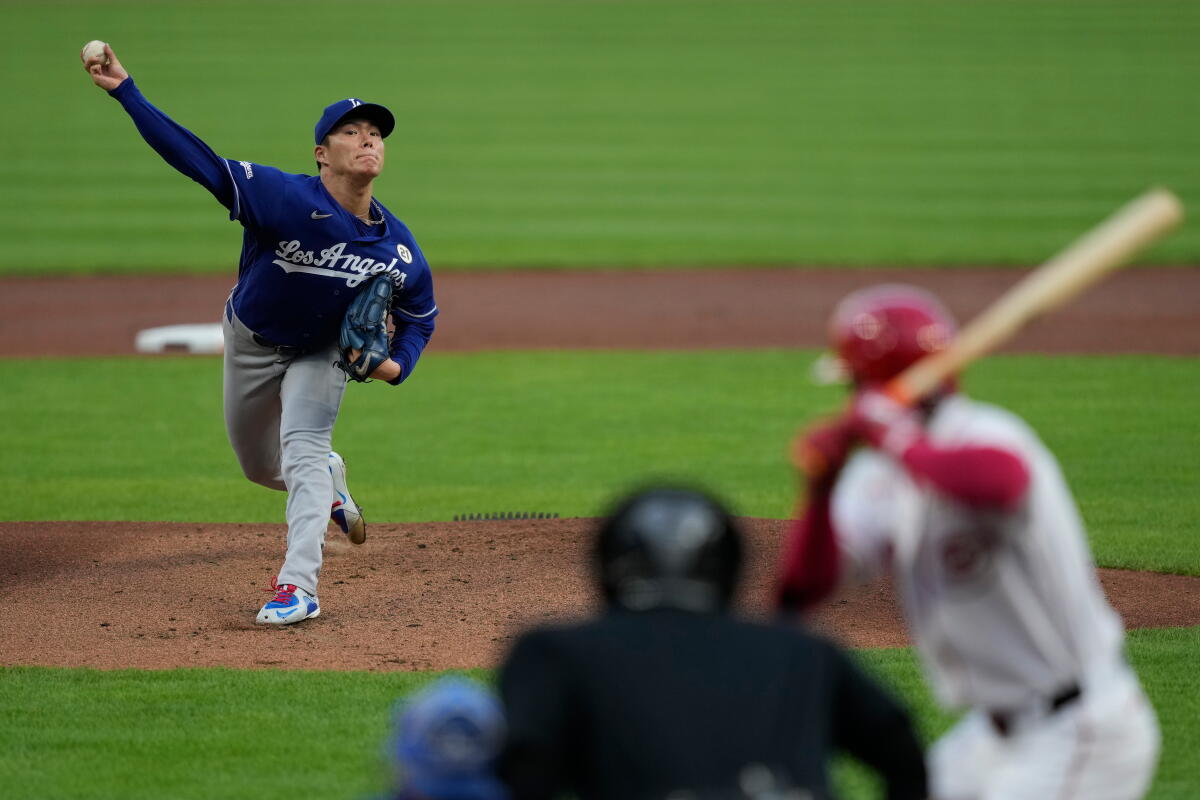
The Dodgers could also avoid him by claiming a lead. On Monday, Dodgers starter Yoshinobu Yamamoto held the Padres to three hits and one run — Miguel Andujar’s first-inning homer.
But the Dodgers’ offense, which scored 31 runs in a three-game series against the Angels, only managed four hits off Padres starting pitcher Michael King, and only one in the first five innings.
“You’re trying to cover realistically 30 inches,” Freeman said. “Because you have ball-to-strike pitches — you’ve got backdoor sliders that are starting as balls coming back, you’ve got front-door sinkers for lefties. So it’s not just the whole plate you’re worried about; you’re going to worry about a whole lot of different things. … He had all of it working tonight.”
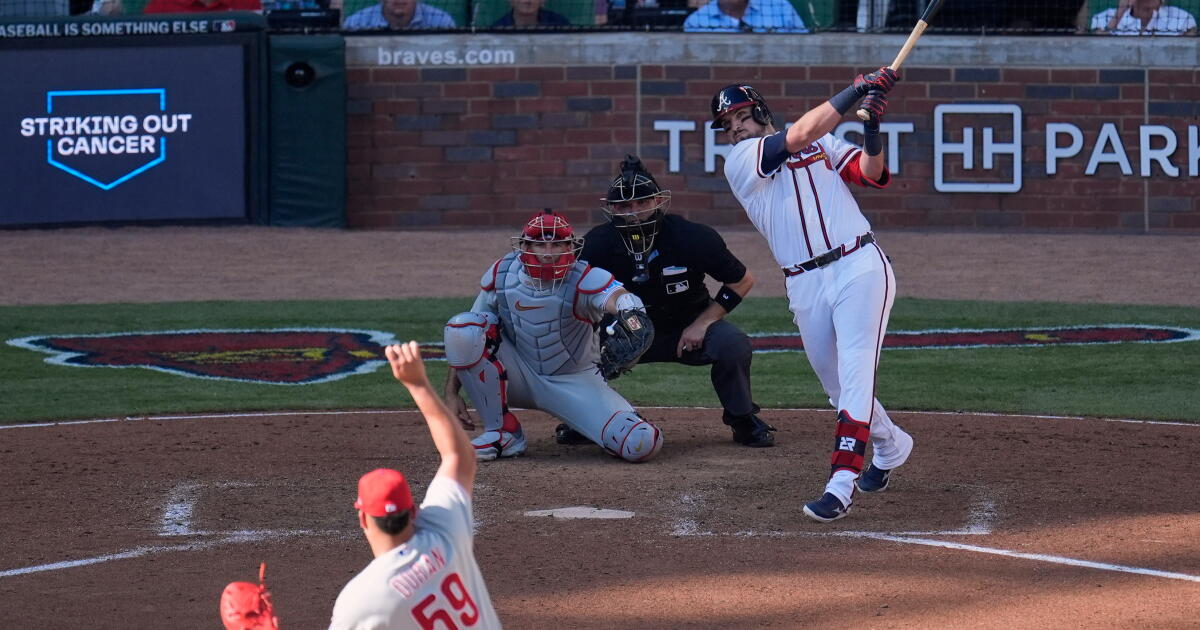
The Dodgers finally strung some hits together in the sixth. With two outs and Hyeseong Kim on first, Shohei Ohtani beat out a swinging bunt, and the throw from Padres catcher Rodolfo Duran zipped past first base.
Kim, who took off from first on contact, rounded third hard but slammed on the brakes when third base coach Dino Ebel held up the stop sign.
“It’s kind of the timing of it, where [Fernando] Tatis [Jr.] came up with the ball, and Dino’s got to make the decision,” Roberts said. “You don’t know that he’s not going to come up with it clean. At that point in time, to be quite honest, Dino had the best view of the runner coming in, Kim, and where they were at on the field. So it’s one of those things, I’m definitely not going to second guess it.”
Kim was stranded there.
Then in the eighth, he again made it to third on a single from Ohtani with two outs. And again, he got stuck 90 feet away from tying the score.
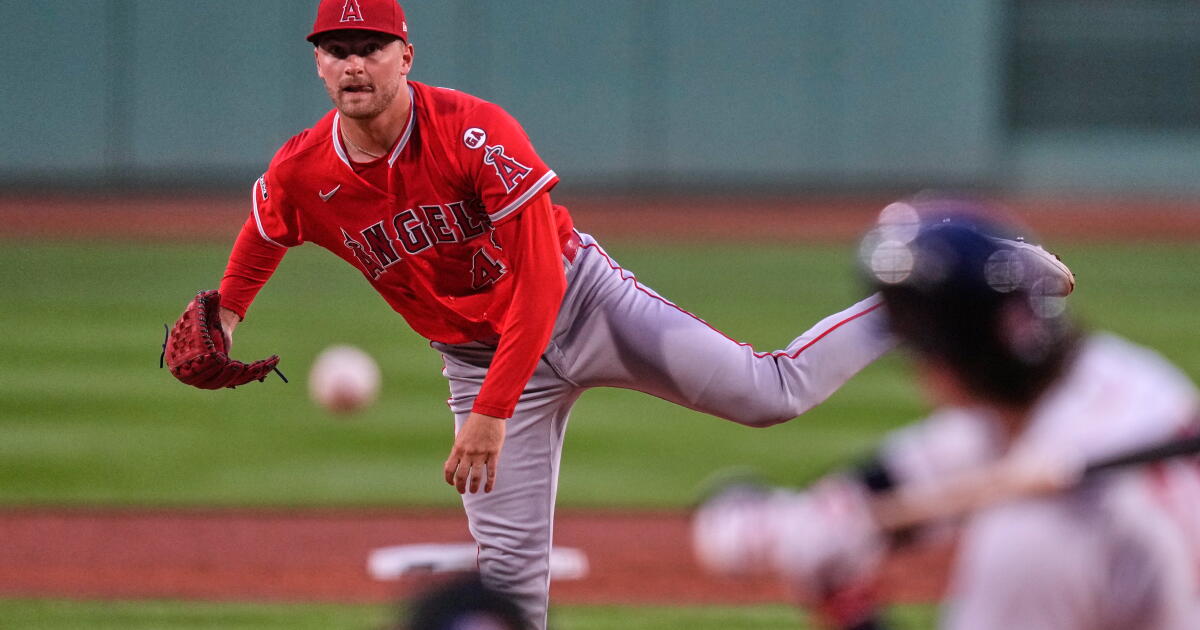
Adam Frazier singled, leading off the ninth inning for the first hit against Athletics starter J.T. Ginn, and Zach Neto followed with a two-run homer that gave the Angels a 2-1 victory Monday night.
Neto drove a 2-0 sinker 413 feet to center field, stunning Ginn and the A’s while ending a six-game losing streak for the Angels. It was their third walk-off win this season.
Ginn (2-2) struck out 10 and issued one walk on 105 pitches. He also hit Neto with a pitch in the sixth.
The right-hander was perfect through 4 1/3 innings and came within three outs of the first major league no-hitter since Shota Imanaga combined with two Chicago Cubs relievers for a 12-0 win over Pittsburgh on Sept. 4, 2024.
Lawrence Butler had a pinch-hit RBI single in the top of the ninth that drove in Zack Gelof for the first run of the game, but the Angels rallied to win despite getting outhit 7-2.
Walbert Ureña tossed six scoreless innings for the Angels, giving up four hits and striking out four. Ryan Zeferjahn gave up the first run of the game and walked the bases loaded, but Chase Silseth (1-0) worked out of the jam by getting slugger Nick Kurtz to ground into a game-ending double play.
Kurtz’s fifth-inning double extended his on-base streak to 41 games, tying Eddie Joost (1949) for the sixth-longest in A’s history. Kurtz is also tied with Kyle Schwarber last year for the longest in the big leagues across the last four seasons.
The referee blew the whistle a few minutes before 5 p.m., on April 26, to kick off the second half of a football game. The players re-emerged on the field, and the spectators once again gathered to witness the second round of the Guyaku Local Championship Football League in the Sabon Gari area of Guyaku, a small community in the Gombi Local Government Area (LGA) of Adamawa State, northeastern Nigeria.
Just minutes into the match, another sound pierced the air across the football pitch, but it wasn’t the referee’s whistle this time. It was sporadic gunshots that alerted the players and the spectators that something terrible was about to unfold.
The gunshots continued from different directions, their sound drawing closer. As the confused crowd tried to make sense of the situation, some armed men arrived at the football field on motorcycles. They opened fire on the crowd, and in that instant, people scrambled for safety, while others fell dead on the pitch.
Within minutes, Istifanus Hassan, an eyewitness who narrowly survived the attack, said that everywhere was thrown into chaos as screams and smoke filled the air.
“We ran into the bushes, but they [terrorists] followed people with their motorcycles and were shooting them in the bush,” he recalled. Although he survived, Istifanus said what he witnessed while hiding in a nearby bush that evening may haunt him forever.
The terrorists burnt down houses, motorcycles, shops, and a church. They also looted at least three grocery shops and a chemist. “They used motorcycles to pack the items after killing the shop owners. They packed all the items and burnt the shops down,” he said, adding that they made away with medicines as well.
The terrorists looted a chemist and left with all the medicines, leaving behind an empty store. Photo: Hamman Basmani.
“I watched my community members and relatives fall dead to the ground. The men were targeted and shot in the head, and the women were spared,” Istifanus said.
But not every woman survived the attack. Other residents told HumAngle that all the women captured by the terrorists were left unharmed, but two women lost their lives in the incident. Their deaths were attributed to stray bullets.
One of the deceased was 28-year-old Sintiki Dimas, who went to the football pitch to sell snacks to spectators. As a petty trader, Sintiki relied on selling local snacks like kuli-kuli to support herself and her younger siblings.
Her mother, Bata Dimas, said Sintiki was killed while trying to flee, adding that her daughter’s trade was a great source of support to her eight younger siblings and the rest of the family.
The other woman, who also lost her life in the attack, was fleeing with her toddler strapped to her back when a bullet hit and killed her. “The baby was also shot on his leg, but he’s currently receiving treatment,” an eyewitness, who asked not to be named, told HumAngle.
The attack continued for hours.
By the following day, the Islamic State West African Province (ISWAP), a Boko Haram breakaway, had claimed responsibility for the assault. The attack, which killed at least 33 residents and injured seven others, happened barely two months after ISWAP attacked a military base in Hong, a nearby local government area.
Residents say it exposed longstanding security gaps in the border community, triggered fresh displacement, and revived fears of a return to the deadly years of insurgent violence that have devastated the region.
The first attack in a decade
It is not the first time terrorists have invaded Guyaku, but it is the first time since 2015, when the Boko Haram insurgency was at its peak in Adamawa. Then, “they burnt almost the entire village to the ground that year, but luckily, we all fled, and no one was harmed,” said Hamman Basmani, the Wakili (community leader) of Guyaku.
By 2016, most residents who had fled the area had returned and resumed their usual activities.
Guyaku is an agrarian community, and residents – over a thousand of them, according to Hamman – mainly rely on farming for survival. Since the 2015 attack, he said, the residents had lived peacefully until the recent incident.
Guyaku sits near the border between Borno and Adamawa states. Map illustrated by Mansir Muhammed/HumAngle.
While other residents returned to Guyaku after the 2015 incident, Barnabas Benaiah was among those who did not. He relocated to Hong with his nuclear family, while his extended family remained in Guyaku.
“I’m not currently staying in Guyaku, but I’m always there,” he said, meaning that he visits regularly. He added that he feels attached to his hometown, which is why he stayed in a neighbouring town.
When ISWAP attacked Guyaku in April, Barnabas lost three family members. Two were his brothers, and the other was his niece. “They [his brothers] all had families and had left behind pregnant wives,” he told HumAngle.
Get our in-depth, creative coverage of conflict and development delivered to you every weekend.
Subscribe now to our newsletter!
Barnabas noted that the attack in Guyaku was tactical.
“They were after men,” he said, echoing testimonies from other residents. “Mostly young men, so they targeted spots where these men could be found, such as the football pitch, local joints, and front yards. They shot the men in the head, and when they encountered women, they told them to walk away because they had nothing to do with them. The women who died were hit by flying bullets.”
A recent academic study on gendercide in the Lake Chad insurgency found that such patterns have appeared in previous ISWAP and Boko Haram attacks, where adult men are often perceived as potential fighters, vigilantes, informants, or collaborators with the state.
Residents say the terrorists pursued residents who ran towards neighbouring communities and killed them, while also looting valuables, such as motorcycles. “They went to a commercial charging store and packed all the phones from there. They were still looting shops when soldiers from Garkida town arrived, so they abandoned some of the items and ran,” Barnabas said.
Tela Bala, Kwari, Kwana, and other communities within Guyaku were also affected. “[Several] people from these communities have now fled to urban centres,” he added.
Istifanus remained in the bush until the gunshots ceased. He came out and joined other residents in recovering dead bodies. Most of the corpses were found at the football pitch, while some were recovered in front of houses and across the street.
“The corpses I saw and counted that day were up to 28, but I couldn’t stay to continue identifying the bodies,” he recounted. “I became emotional and left.”
Hamman, the community leader, told HumAngle that other bodies were recovered in the bushes and roads leading to other villages days afterwards. He said that 33 bodies were found; 30 of them were men, and most were young.
Map showing hotspots of terror activities in towns neighbouring Guyaku. Illustrated by Mansir Muhammed/HumAngle.
Guyaku sits in Adamawa’s northwestern region. It is about 20 km from the border with Borno State and less than 15 kilometres from Kwapre, Banga, Larh, and Dabnz Kinging communities, each of which has been abandoned due to Boko Haram attacks over the years.
Guyaku, along with these border communities, falls within known terror hotspots, including forests like Alagarno and towns like Mandaragairu, where terrorists often operate and move through to attack surrounding hinterland communities along the southern Borno-Adamawa border.
In April, HumAngle reported how these abandoned agrarian communities fall within the direct line of influence of terror groups from major enclaves like Sambisa Forest and the other forests connecting local bushes in Adamawa State to those across the border in Borno, allowing them to remain geographically threatened by these groups.
Tale of terror
For residents in these communities, nowhere is safe anymore. During the April 26 attack, 39-year-old Alheri Gabriel was sitting outside his house, playing cards with his friends, when the terrorists rode towards them on motorcycles.
“At first, I was confused, and I thought they were trying to catch a thief because someone was running in front of them. I thought he was a thief, and had I tried to help them catch him, but I noticed they had guns,” Alheri recounted.
Suddenly, the terrorists ordered him to come forward, but he hesitated, and when they pointed a gun at him, he immediately started running as fast as his legs could carry him.
“While I was running, they shot me in the left shoulder, but I didn’t stop. I continued running, and they pursued me with their motorcycles, but I fled into a house and hid there until they lost track of me,” he told HumAngle.
Alheri sustained a gunshot wound to his left shoulder. He underwent surgery but is still unable to move it without pain. Photo: Alheri Gabriel.
He remained hidden while blood continued to gush from his injured shoulder. When the shooting ceased, he staggered into the street and was assisted by other residents. Alheri was first rushed to a hospital in Gombi town, along with other injured people, before being transferred to the Modibbo Adama University Teaching Hospital in Yola, the Adamawa State capital, for further treatment.
Later, he learnt the men he had been playing cards with were all shot and their bodies set ablaze by the terrorists in the front yard.
He underwent surgery on May 1 and is still recovering, but he fears his life will never be the same. “I have a wife and young children. I’m a skilled photographer and a barber, and I don’t think I’ll be able to recover soon or resume work,” he said.
With a family to feed, Alheri hopes to recover soon so he can return to his business. However, something has changed. “I don’t think I’ll return to Guyaku,” he said.
His wife and children have fled to another town, where they are living with relatives.
Empty streets
More than a week after the ISWAP attack, residents – especially women and children – have continued to flee Guyaku despite assurances from the Adamawa State government that security would be strengthened in the area and that justice would be served.
“Only the men are left here, and we are not more than 20,” Hamman said, adding that residents are worried about the security gaps that exist in the area.
During an assessment visit two days after the attack, Ahmadu Fintiri, the Governor of Adamawa State, said, “We are intensifying security operations immediately to restore peace and ensure every resident feels safe in their home again. We will rebuild, and we will remain resilient.”
Grocery shops were looted and then set ablaze by the terrorists who invaded Guyaku. Photo: Hamman Basmani.
Despite those assurances, residents say the security presence in the community has remained inadequate. Although a group of soldiers, local vigilantes, and hunters were stationed there in the early days after the attack, the military officers have since withdrawn.
“The local security team goes round the community, but there is no security post or unit we can report to during emergencies,” Hamman said.
For many residents, however, the absence of formal security is not new. Guyaku has long relied on the local vigilante group for security, but they are poorly equipped to repel major terror attacks. The nearest police stations are in Gombi and Garkida, about a 30- to 40-minute drive away.
The lingering insecurity has also disrupted efforts to bury some of the victims. Barnabas said some of the corpses are yet to be buried as their family members have since fled the area. “A mass burial was scheduled, but no agreement was reached, so individuals began burying their dead, and those whose relatives fled were paired with other victims,” he said. “At the cemetery, we got a call that the terrorists had just been spotted, and that was how the burial rites were abandoned. Everyone fled,” he stated.
Hamman, who continues to lead the community during the crisis, said residents are pleading with the government to deploy more security personnel to the area.
“[They should] send soldiers to join hands with the vigilantes and protect us. If people see security personnel patrolling the area, they will want to come home. But if there are no security personnel, even if the people want to come back home, they will be discouraged.”
Dodgers left-hander Justin Wrobleski had a chance to slam the door shut on the Braves’ second-inning rally. He fielded Sean Murphy’s comebacker, and set his feet to start a would-be inning-ending double play at second base.
Angled up the mound, however, he sailed the throw, which second baseman Alex Freeland wrangled to at least salvage an out.
The way the Dodgers’ offense has been scuffling, however, their 7-2 loss hinged on that four-run second inning.
“It’s just,one half-inning of being pissed off about it, and then you’ve got to keep going back out there and doing your thing,” said Wrobleski, who was charged with seven runs but gutted out a career-high 8⅔ innings. “So yeah, it’s frustrating. It’s annoying because now I look back at it and, yeah, that’s what cost me from having a good outing.”
With the Dodgers’ rubber-match loss, the Braves took sole possession of the best record in the majors. The Dodgers (24-16) dropped the series to the Braves (28-13) after scoring three or fewer runs in each game.
“I thought we turned the corner in Houston,” manager Dave Roberts said. “We kind of got back down a little bit this series. … It’s hard to articulate. There’s some empty at-bats, there’s some early outs that are not just quality outs. There’s the passing the baton to the next guy — and sometimes it just doesn’t happen.”
After Wrobleski cruised through the first inning in just six pitches — first-pitch flyout, four-pitch strikeout, first-pitch groundout — he had an uncharacteristically long second inning.
After striking out Matt Olson, Wrobleski gave up three straight singles for the Braves’ first run. Michael Harris II bunted into the open space on the third-base side to reach base. The other two hits came from Austin Riley and Eli White, both of whom registered exit velocities of over 108 mph, according to Statcast.
Then came Wrobleski’s high throw.
Wrobleski walked the next batter he faced, No. 9 hitter Jorge Mateo, in four pitches, prompting a visit from pitching coach Mark Prior.
Dodgers pitcher Justin Wrobleski pitched 8⅔ innings against the Braves on Sunday.
(Ronaldo Bolanos / Los Angeles Times)
With the bases loaded and facing Mauricio Dubón, Wrobleski hung an inside slider belt high. Dubón roped a grounder down the left-field line for a bases-clearing double.
The four runs Wrobleski gave up in the second were twice as many as he had allowed in his five previous starts combined.
Then he turned the outing around.
“Just bouncing back after that inning there, and just continuing to attack the zone and do what I do,” Wrobleski said. “I play this game with a long-term view and mindset of, in the long run, what works out, and what I know works. And just continue to do that and see how deep I can get into the game each time out.”
Wrobleski retired 16 straight to get through the seventh inning without further damage. Then in the eighth, he gave up a solo homer to reigning NL Rookie of the Year Drake Baldwin.
Wrobleski was back on the mound again in the ninth, a career first, but he gave up another solo homer, this time to Olson.
Wrobleski exited when his pitch count reached 100, drilling Mike Yastrzemski in the helmet with his final pitch. Wrobleski’s seven strikeouts tied his career high.
Dodgers pitcher Justin Wrobleski reacts after giving up a home run to Atlanta’s Drake Baldwin in the eighth inning Sunday.
(Ronaldo Bolanos / Los Angeles Times)
“For him again to go eight-plus was huge as we look out and have 10 in a row coming,” Roberts said.
The Dodgers’ offense again sputtered. In the sixth, they were handed a gift in the form of three straight two-out walks from starting pitcher Bryce Elder, before he was replaced by reliever Robert Suarez.
Max Muncy then drove a deep fly drive to right. But Braves right fielder Eli White caught it, and held on to it as he slammed into the wall, ending the frame.
“‘Who do I gotta pay off at this point?’” Muncy joked, noting the amount of hard contact he has had lately without results. “Next at-bat, I went up there and just said, ‘I’m going to swing straight up. But if I get in the air, they can’t catch it.’ And it kind of worked.”
More than kind of. Muncy put the Dodgers on the board with a two-run home run in the eighth. But it was too little too late.
“I think everyone’s trying to do a little bit more right now,” Muncy said. “We all know as a group that we’re struggling, and that’s just something that everyone’s trying to take on their own shoulder instead of just passing the baton — myself included. Once we get back to everyone just having really good team at-bats, I think things will start clicking for guys without even thinking about it.
“Just a rough stretch, and we’ve got to get through it.”
Betts on track
Mookie Betts celebrates after hitting a double for the Dodgers against the Cleveland Guardians at Dodger Stadium on March 30.
(Ronaldo Bolanos / Los Angeles Times)
Shortstop Mookie Betts (strained right oblique) is expected to be activated and in the lineup Monday, and the Dodgers will have to open a roster spot for him.
Betts’ injury created an opportunity for Hyeseong Kim, who began the season in triple-A. He entered Monday hitting .301 in 28 games, and in a shortstop platoon with Miguel Rojas, he’s shown off his glove.
“I think that he’s done a much better job of controlling the strike zone,” Roberts said. “He’s got the ability to put the bat on the ball, get hits, steal bases, play good defense. And I think he’s done all that.”
Freeland beat Kim in spring training for an opening day roster spot, but even though he has improved at the plate of late, Freeland entered Sunday with a .672 OPS. The Dodgers also have utility player Santiago Espinal, who has logged 34 plate appearances this season.
“Obviously we’ve got a tough decision,” Roberts said. “All of the options potentially for the corresponding move, these guys have done a great job and served a very good purpose for our club. It’s a good problem in the sense of where we’re at. But it’s a potentially tough conversation.”
Roster move
In order to add bullpen help, the Dodgers called up right-hander Wyatt Mills. Mills was a non-roster invitee in spring training, after signing a minor-league deal with the Dodgers last August. Mills, who underwent Tommy John surgery in July 2023, last pitched in the majors in 2022.
He was the only Dodgers reliever who pitched in Sunday’s game, allowing two hits.
In a corresponding move, the Dodgers optioned Paul Gervase, who threw three innings Saturday in the Dodgers’ 7-2 loss to the Braves, to triple-A Oklahoma City. And they transferred closer Edwin Díaz (elbow surgery) from the 15-day IL to the 60-day in a procedural move. Díaz isn’t expected to return from the IL until after the All-Star break.
1 of 2 | The demolition of the East Wing of the White House is seen in November 2025 in Washington, D.C. While President Donald Trump has touted the construction of a ballroom on the site as privately funded, a bill proposed by Republicans this week calls for $1 billion in taxpayer money for security upgrades. File Photo by Bonnie Cash/UPI | License Photo
May 5 (UPI) — Senate Republicans have released an immigration enforcement package that includes $1 billion in taxpayer money earmarked for President Donald Trump‘s massive ballroom project at the White House — a project the president has widely touted as being fully funded by private donors.
That $1 billion is to be used for security improvements to the 90,000-square-foot space, including “security adjustments and upgrades, including within the perimeter fence of the White House Compound to support enhancements by the United States Secret Service relating to the East Wing ModernizationProject, including above-ground and below-ground security features,” the bill says.
Since a shooting at the White House Correspondents’ Dinner in late April, Republicans have said the ballroom is needed for presidential security. Trump administration court filings on the plan from early April say the project will be able to withstand drone attacks and include a bomb shelter and underground medical facilities, NBC News reported.
“Congress has rightly recognized the need for these funds,” White House spokesperson Davis Ingle said in a prepared statement Tuesday. “Due in part to the recent assassination attempt on President Trump at the White House Correspondents’ Dinner, the proposal would provide the United States Secret Service with the resources they need to fully and completely harden the White House complex, in addition to the many other critical missions for the USSS.”
This $1 billion is part of a reconciliation bill that Congress plans to pass with only Republican votes, CNN reported. The full package contains about $70 billion for U.S. Immigration and Customs Enforcement and border patrol. Democrats have earlier blocked such funding without reforms, including requiring judicial warrants and banning officers from wearing masks.
Trump has long said the ballroom project, which is expected to cost $300 million to $400 million, is a gift to the nation from private donors with “not one penny” of government funds to be used, NBC News reported. The president demolished the White House’s East Wing without congressional approval for the project, a move that’s drawn ongoing legal challenges.
Last week, after the Correspondents’ Dinner incident, the Department of Justice asked a court to dismiss a lawsuit by the National Trust for Historic Preservation that challenged the ballroom plans. DOJ officials said “there is no better example of why this ballroom is necessary.”
Senate Democrats say they’ll try to force a vote to strip the $1 billion in ballroom money from the bill, which is expected to be voted on later in May.
In just five starts, José Soriano’s season with the Angels has gone from good to great — to historic.
Soriano pitched two-hit ball into the sixth inning of the Angels’ 8-0 victory over the Padres on Friday night, ending San Diego’s eight-game winning streak with yet another dominant outing by the Angels’ right-handed Dominican ace.
Soriano (5-0) has an ERA of 0.28 after allowing just one run in his first 32 2/3 innings this season. He leads the majors with 39 strikeouts while allowing only 11 hits, and he’s tied with Milwaukee’s Aaron Ashby for the lead with five wins.
Except for occasional control problems, Soriano has been overwhelming every lineup he faces — and Drake Baldwin’s first-inning homer for Atlanta on April 6 is still the only run he has allowed all season. His 17-inning scoreless streak is the second-longest in the majors this season, and opponents are batting .104 against his 0.73 WHIP — both the best in baseball.
Angels ace José Soriano delivers to the plate during the fifth inning of a win over the San Diego Padres at Angel Stadium on Friday.
(Jayne Kamin-Oncea / Getty Images)
“It’s like a hot knife through butter,” Angels slugger Jo Adell said. “It’s pretty crazy. It’s really special, and he’s a special talent. He’s always had the stuff to compete at this level, and he’s doing what an ace does. Whatever he’s done, just keep doing it.”
And after five straight dominant starts, Soriano has reached rare company.
The most recent pitcher to allow one earned run or fewer in each of his first five starts in a season with at least 15 total innings pitched was the Dodgers’ Fernando Valenzuela in 1981, when he won the NL Cy Young award in his groundbreaking rookie season. Walter Johnson also did it in 1913 — and nobody else.
Soriano is also the only pitcher in major league history to go at least five innings while yielding one or fewer earned runs and three or fewer hits in each of his first five starts to a season.
“I just feel confident to keep pitching like that,” Soriano said. “I believe in my catcher, and we’re on the same page. I think that’s a big part of the results we’re having.”
While Soriano dazzled his previous two opponents with back-to-back, 10-strikeout outings over 15 combined innings to win the AL Player of the Week award, he actually didn’t overwhelm the Padres’ veteran lineup.
San Diego drew four walks and forced Soriano to throw 99 pitches. The Padres loaded the bases in the third before Soriano got Jackson Merrill to ground out, but San Diego eventually chased him with a single and a walk with two outs in the sixth.
“The thing that impressed was that to us, he had to grind a little bit tonight,” Angels manager Kurt Suzuki said. “I think that’s the maturity showing up, where he’s learning how to pitch — and I say this lightly — without his best stuff. He learned how to navigate a great lineup over there without his best stuff … and it was pretty incredible. You can’t say enough.”
Soriano has a 99-mph fastball and a sinker that ranks among the best in baseball, but he’s also mixing in a curve that has flummoxed his opponents. The combination has been too much for any opponent through his first five starts.
“Knowing him from the past, you always thought of the high-90s sinker, and then he comes in breaking out the curveball,” Padres manager Craig Stammen said. “That pitch was very impressive from the dugout. Gave our guys trouble at the beginning. It’s really hard to lay off that pitch, and it complements his sinker. He did a great job tonight mixing his pitches. … He’s just a really good pitcher.”
Dodgers right-hander Shohei Ohtani had navigated the Mets lineup without much trouble until the fifth inning. But he’d also been holding back a little something.
“I can’t go full throttle the whole time,” Ohtani said through interpreter Will Ireton after the Dodgers’ 8-2 victory Wednesday. “But considering where the game was at that point, I felt like I just really had to go full throttle and make sure I’m considering the game situation.”
The Mets had just scored their first run of the game — ending Ohtani’s streak of innings without an earned run at 32 ⅔, the longest of his career — and cut the Dodgers’ lead to one.
So he unleashed a 100.2 mph fastball past Tommy Pham, and then 100.3 mph. Pham foul-tipped both and had some choice words with himself on the way back to the dugout.
“He has a little extra gear when he needs it,” manager Dave Roberts said. “I’m sure he was frustrated about giving up a run, and then came back and really went after Pham.”
That strikeout was one of 10 Ohtani had in a performance that was dominant, regardless of the first mark on his previously spotless ERA.
Holding the Mets to one run through six innings, Ohtani logged double-digit strikeouts in a regular-season start as a Dodger for the first time, matching his effort in Game 4 of the 2025 National League Championship Series against the Brewers.
Shohei Ohtani pitches against the New York Mets.
(Robert Gauthier/Los Angeles Times)
Roberts said he’d been considering pulling Ohtani after the fifth inning started going sideways.
Ohtani had faced just one over the minimum through the first four innings he pitched. Then in the fifth he issued two walks before giving up a run-scoring ground-rule double to Mets designated hitter MJ Melendez on a line drive into the right-field corner.
Roberts changed his mind after Ohtani steamrolled Pham and got Francisco Lindor to line out to escape the inning without further damage.
“Just added a little more intensity after they scored a run,” Ohtani said. “But overall it felt really nice and easy and loose throughout the whole outing. So I think that’s the reason why I threw a little harder.”
Good thing Roberts sent Ohtani back out, too. He struck out the No. 2 through 4 hitters in the Mets’ batting order, all on different pitches.
The two-way phenom only had one job to worry about Wednesday.
For the first time since 2021, he was not also in the lineup as a hitter while pitching.
“If it weren’t for the hit by pitch [Monday], he would’ve been DHing and pitching tonight,” Roberts said before the game.
Ohtani was hit in the back of his right shoulder by a 94-mph sinker on Monday. Though that didn’t prevent him from serving as the designated hitter the first two games of the series, the Dodgers wanted to lighten the load Wednesday.
“Just feeling what gives him the best chance to stay loose during the outing, feel good,” Roberts said. “There’s still some soreness in there. When he’s hitting, there’s a component that he’s in the cage getting ready to hit, and if we can take that off his plate and just focus on one thing tonight, we felt — training staff, pitching coaches, myself — we just felt it was the best thing for him. So, once I told him, he completely understood.”
Dalton Rushing rounds the bases after an eighth inning grand slam.
(Robert Gauthier/Los Angeles Times)
When asked what Ohtani’s initial reaction had been, Roberts widened his eyes in an impressively accurate impression of one of Ohtani’s patented facial expressions.
“I was a little bit surprised,” Ohtani said after the game. “But it made sense hearing what he had to say.”
The next time Ohtani takes the mound, he is expected to also hit. But Roberts didn’t rule out again having Ohtani just pitch if a similar situation arises again.
“It’s something I’m going to keep an eye on if it makes sense, but not just kind of do it proactively,” Roberts said. “It’s something that’s … got to make sense to not have your best hitter not in the lineup.”
To account for Ohtani’s absence in the batting order Wednesday, Kyle Tucker moved up from No. 2 to leadoff, and Dalton Rushing served as the DH.
The Dodgers scored all eight runs via the long ball: a two-run shot from Hyeseong Kim, his first home run of the season, a solo blast from Teoscar Hernández, Rushing’s first career grand slam, and a solo homer from Tucker.
“We had a really good DH hit today,” Ohtani said of Rushing, who also hit a double.
Dodgers closer Edwin Díaz was available Wednesday, for the first time since Friday. But the Dodgers’ five-run eighth inning eliminated the save situation. Instead, right-hander Kyle Hurt made his first major-league appearance since 2024. He gave up a run and had three strikeouts.
Jackie Robinson Day
The Dodgers’ celebration of Jackie Robinson Day began with the annual reflection at the Jackie Robinson statue, with both teams in attendance. Speakers included Robinson’s granddaughters Sonya Pankey Robinson and Ayo Robinson, Roberts, and Bob Kendrick, the president of the Negro Leagues Baseball Museum.
“We make the rather bold assertion that Jackie’s breaking of the color barrier wasn’t just a part of the Civil Rights movement,” Kendrick said in his speech, “it was the beginning of the Civil Rights movement.”
He broke down the timeline: Robinson debuted with the Dodgers in 1947, years before the Supreme Court ruled on Brown vs. the Board of Education (1954) or Rosa Parks refused to give up her seat on a bus in Montgomery, Ala. (1955). The Rev. Martin Luther King Jr. was still a student at Morehouse College.
“If you don’t believe that one individual can indeed invoke change, you have to look no further than right here,” Kendrick said, pointing to the statue of Robinson. “Because what he did was incredibly difficult, under some of the most harsh circumstances you could ever imagine.”