pioneers

Cycling in the tracks of Britain’s camping pioneers from Oxford to Surrey | Camping holidays

Skylarks call out a cascading trill as I pedal between the pink and white hawthorn blossoms that make my path look like a May Day parade. I’m on the outskirts of Oxford, a city I thought I knew well, yet as I follow the National Cycle Route 57 on the e-bike I’d picked up in Jericho, it feels as though I’ve discovered a secret passageway.

This year the Camping and Caravanning Club (CCC) turns 125 – and I’m celebrating with a 60-mile cycling and camping trip, leaving from the city where the organisation was born and heading to Walton-on-Thames to stay at one of the oldest campsites in the CCC network.

The CCC began life as the Association of Cycle Campers before becoming the club it is today. It all started when founder Thomas Hiram Holding, already a keen camper, was visiting his friend Rev EC Pitt-Johnson’s Oxford home in 1901 and they decided there was enough demand and interest in the hobby to form a club. They elected each other president and secretary respectively and the rest, as they say, is history.

Thomas Hiram Holding, founder of the Camping and Caravanning Club. Photograph: CCC archive

Back then, Holding had a “safety cycle” – not dissimilar to a modern-day bike, which replaced the tricky-to-master penny farthing. He proudly invented much camping gear, too, from early lightweight tents and folding poles to cycle touring bags. “Holding understood the health and wellbeing benefits people gained from camping,” explains Jo Cartwright, archivist at the CCC, when I tell her my e-bike plan, “so I think he would’ve embraced any new form of transport.”

While all-singing, all-dancing motorhomes and caravans are ubiquitous these days, and along with pre-pitched glamping options are squeezing the space left for regular campers, the CCC assure me that humble tents are very much still welcomed on its sites. So with mine firmly stowed on my e-bike, I set off, deciding to break my journey with an overnight stop at Bella Vista Camping in Radnage, a family-run club site that sits on the Chiltern Cycleway.

Quiet roads lead me east from Oxford toward Wheatley and Thame, where I stop at the Old Fisherman to grab a sandwich and coffee, before continuing on the Phoenix Trail (part of Route 57), its straight lines a nod to its former life as the disused railway track to Princes Risborough. Red kites replace skylarks as I glide on the easy track away from any road traffic, passing the old station building at Bledlow and going under the former railway bridge and past the abandoned platform where Towersey Halt stop, closed since 1963, would have been.

Before he started the Association of Cycle Campers, Holding’s method of camping – after a childhood wagon trek on the prairies of North America had him hooked – was by canoe in Ireland. That was until a friend of his in England announced that he and his wife were planning to spend a week camping by tandem bike in Britain, and asked him to come to help with attaching his kit to the frame – after which he wrote, “We succeeded,” and declared in his book, Cycle and Camp, published in 1897, “There was something in it.”

The writer cycling beside the Thames. Photograph: Phoebe Smith

While more people arrive in motorhomes than by bike these days, I’m pleased to see that Bella Vista Camping still has a huge field for tents, next to a paddock of Soay sheep and alpacas, and there are hot showers and proper toilets in a big mess tent.

After dinner at the Crown Pub, just a five-minute walk away, and a quiet night’s sleep while my bike battery charged, I am ready for the next part of my cycle tour to Walton-on-Thames. Opened in 1913, the Walton CCC campsite was described in a Golden Jubilee Souvenir booklet from 1963 as a place full of “homemade tents, bamboo poles, hurricane lamps and wood fires”.

Curious at what I’d encounter now, I leave the highs of the Chilterns and Route 57 to bear south on country lanes that skirt the edge of High Wycombe, through the busy streets of the Thames-side towns of Marlow and Cookham, and on narrow cycle paths between Maidenhead and Eton. When I stop for lunch at the Crocus cafe in Dorney, I’m amazed at how curious people are about my set-up. I feel a little like Holding, showcasing another way of holidaying in Britain.

Windsor Great Park is an unexpected highlight – its easy roads contrasting starkly with the quite hairy gravel tracks I descend into Egham. But then designated bike lanes through Staines and Chertsey see me ticking off my remaining miles with ease.

A final treat is a ferry crossing over the Thames at Shepperton to Weybridge – fitting given that the very first campsite in the CCC network used to sit on one of the islands here (it closed in 1909).

Given that the Walton campsite has no facilities, it’s primarily frequented by motorhomes and caravans that have their own chemical toilets. I’ve brought my own eco-friendly option, though, in the form of a Poopaloo dry-powder toilet. My pitch was next to a small hut filled with sepia photographs of tents from 100 years ago.

That night I read Holding’s The Campers Handbook, published in 1908, and chuckle at the description of the correct attire for female cycle campers including a skirt “that finishes three inches off the ground, with no slippery lining to avoid catching on the knickerbockers”.

The writer swaps land for water in Walton-on-Thames. Photograph: Phoebe Smith

The next day, without a knickerbocker (or skirt) in sight, I undertake one of Holding’s favoured activities: canoeing. Swapping pedals for oars, thanks to owner Andy of Hampton Court Paddle Sports, which is located just a 10-minute (3-mile) cycle from my tent, I spend most of the day on the water, sightseeing at a slow pace, stopping for falafel at Mezzet Box (beats the fried herring and boiled trout of Holding’s day), and ending with a drink at the Anglers, built on these banks in 1870, my canoe tied up beside my table.

Things have undoubtedly changed for campers over the past 125 years. The tents – A-frames and “wigwams” made of silk – have been swapped for nylon tunnels with inflatable poles, campervans have overtaken bicycles, and even, at Walton, the Thames itself has been rerouted so that it no longer sweeps by the pitches. But not all change is bad. Back then, strict gender rules meant that, as a lone woman, I wouldn’t have been permitted to do this trip, never mind in leggings. And an e-bike made the whole experience (and hills) much more enjoyable.

Holding called cycle camping a “power” that helped popularise camping – and the CCC’s membership reflects that, having grown from its initial 150 to more than 300,000 households. And though camping using a bicycle is now a minority pursuit, after my weekend tracing old routes and visiting the first campsite, I like to think that within the secret passageways of towns and cities, there are those of us who realise that the best journeys are still powered by pedals and curiosity.

eBike hire was provided by Bainton Bikes in Oxford (e-bikes from £65 for 3 days). A pitch was given by Bella Vista Radnage (from £19 a night) and Walton-on-Thames campsite (from £20 for two nights members, £35 non-members). Annual CCC membership from £56.95
Source link

Dodgers show courage, honor LGBTQ+ pioneers Glenn Burke, Billy Bean

Let’s go Dodgers. High fives all around.

Because this time, with the newest historical exhibit at Dodger Stadium, the team got it right.

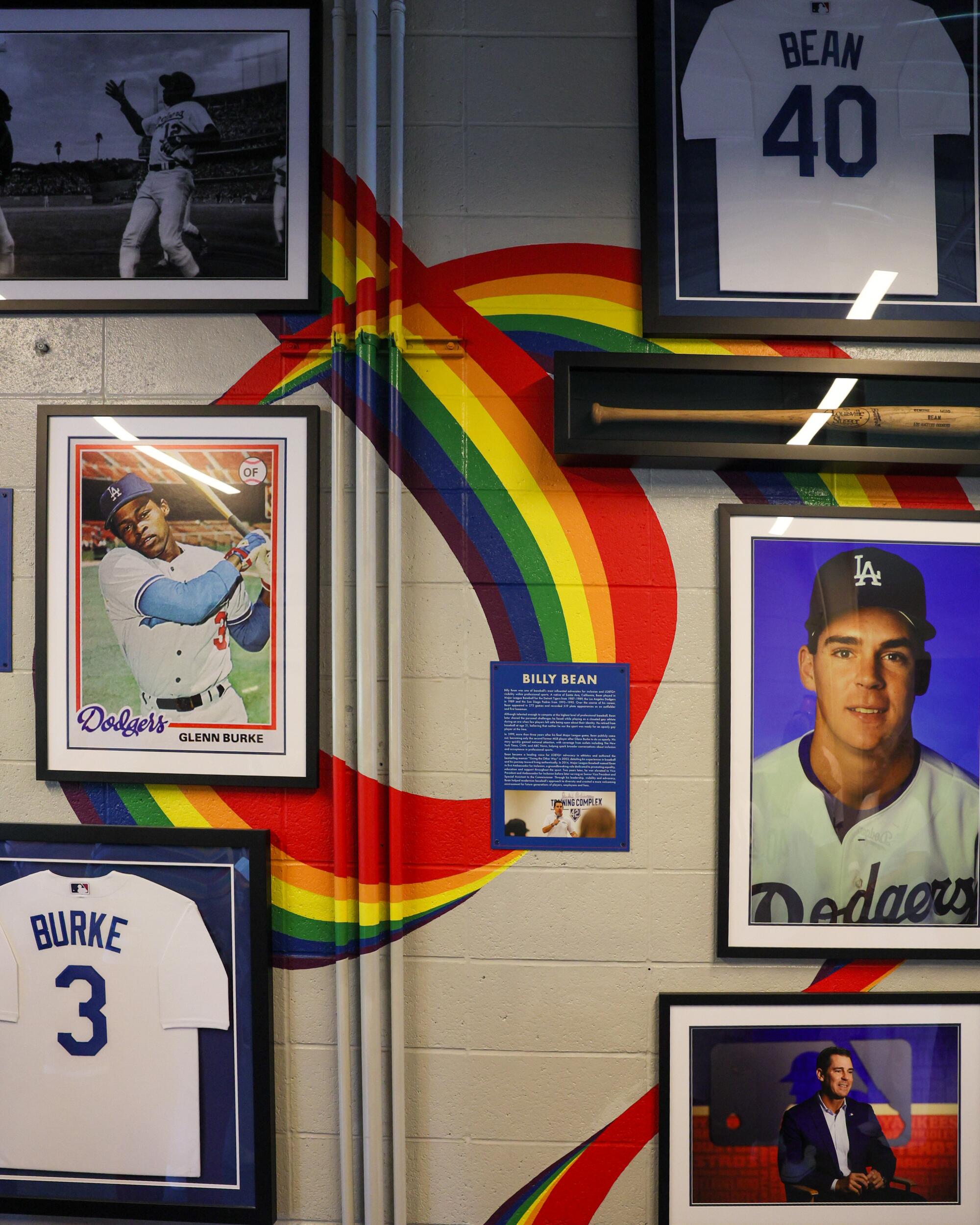
Amid all the historical installations and tributes in the open-air museum that is the Centerfield Plaza, and just a few feet from a Fernando Valenzuela mural, a new display honors Glenn Burke and Billy Bean, two former Dodgers outfielders who were the first and second professional baseball players to come out as gay.

It’s not a fleeting mention on Pride night, it’s a permanent record. A static reminder of progress made — and still to be made. And a much-deserved thank-you.

A wall inside Dodger Stadium features photos honoring former Dodgers and LGBTQ+ pioneers Billy Bean and Glenn Burke.

A wall inside Dodger Stadium honors former Dodgers and LGBTQ+ pioneers Billy Bean and Glenn Burke.

(Ronaldo Bolanos/Los Angeles Times)

“It’ll be here tomorrow, it’ll be here on the weekend and if you come next month, it’ll be here,” said the Dodgers’ team historian Mark Langill, who pointed to a spot just down the hall where in 1976 he was an 11-year-old getting Burke’s autograph.

Baseball is steeped in such history. The personal, the statistical, the societal. And the Dodgers’ is incomplete without their stories — Burke’s and Bean’s.

But the Dodgers have not, of course, always gotten this stuff right.

In 1978, they did Burke wrong, trading him — he believed — after management learned he was gay.

In his three seasons in L.A., Burke had proved himself a capable reserve outfielder who was popular with his teammates.

As far as we know, in 1977, he was the first guy to initiate a high five — spontaneously reaching above his head to slap hands with Dusty Baker after the home run that made Baker the fourth Dodger, along with Ron Cey, Steve Garvey and Reggie Smith, to hit at least 30 home runs that season, a MLB first.

Glenn Burke, left, goes to give a high-five to teammate Dusty Baker after Baker hit a home run in 1977.

Glenn Burke, left, goes to give a high-five to teammate Dusty Baker after Baker hit a home run in 1977. It is believed to be the first instance a high five was exchanged.

(Los Angeles Times)

There’s a fantastic photo of the historic high five included in the tribute to Burke and Bean, which is situated on a hallway wall beneath the left-field bleachers, beside the “Dodger Dugout” augmented reality photo booth.

Burke was also the first guy in that Dodgers clubhouse to crack a joke when the team needed it, his former teammate Rick Monday said.

“When called upon, he could play really well,” Monday said before the Dodgers took the field against the Angels on Friday, when the Dodgers and many of their rainbow-sporting fans celebrated the team’s 13th annual LGBTQ+ Pride Night. “And when we needed a moment of levity, Glenn was not afraid to come forward and put a smile on people’s face.”

But shortly before he died of AIDS in 1995 at 42, Burke published an autobiography, “Out at Home,” in which he described the team’s management being “afraid of my sexual orientation, even though I never flaunted it. To this day, the Dodgers deny trading me because I was gay. But it was painfully obvious.”

“Oh, what he had to deal with and keep it hid,” said Joyce Burke-Henderson, one of Glenn’s sisters at Friday’s pregame unveiling, where family members of both players gasped and cried and cheered the installation’s reveal.

“But as time went on, people did know. And then I think he came to the point where he just didn’t care and he just told it like it was.”

Joyce Henderson, sister of Glenn Burke, speaks about her brother during a ceremony honoring the former Dodger.

Joyce Henderson, sister of Glenn Burke, speaks about her brother during a ceremony honoring the former Dodger and LGBTQ+ pioneer at Dodger Stadium Friday.

(Ronaldo Bolanos/Los Angeles Times)

Burke came out in 1982, three years after playing his 225th and final big league game, in an Inside Sports article, “The Double Life of a Gay Dodger.”

“We just appreciate that now people are opening their eyes and just trusting in the Lord,” Burke-Henderson said Friday, “that things will go forward and work out and everybody will be loved regardless of their situation.”

The Dodgers first honored Burke in 2022, at their ninth Pride Night.

The next season, they made a mess of the Pride festivities, inviting and uninviting and then reinviting the Sisters of Perpetual Indulgence, a group known for its work in support of AIDS patients and whose members dress in drag, as nuns.

In 2023, the Dodgers also invited Bean — who was MLB’s senior vice president for Diversity, Equity and Inclusion. He appeared in a pregame ceremony on the field while protesters gathered outside the stadium.

Bean died the next year, at 60, 11 months after being diagnosed with acute myeloid leukemia.

Greg Baker, husband of the late Billy Bean, wipes away tears during a tribute honor Bean as a LGBTQ+ pioneer.

Greg Baker, husband of the late Billy Bean, wipes away tears during a tribute honor Bean as a LGBTQ+ pioneer at Dodger Stadium on Friday.

(Ronaldo Bolanos/Los Angeles Times)

Once a Northeast Santa Ana Little Leaguer, Bean became valedictorian at Santa Ana High, played for Loyola Marymount and went on to appear in 272 big-league games — including 51 for the Dodgers in 1989 — before abruptly walking away from baseball in 1995.

It got to be too much, he’d explain later, continuing to hustle to keep his baseball career afloat while keeping his sexuality secret, acutely aware of the blowback he’d get if it got out.

“For nine years,” he told the New York Times, “I felt as though I had one foot in the major leagues and one on a banana peel.”

“When he left baseball suddenly, I knew something was wrong,” Bean’s mother, Linda Kovac, said Friday, pausing to wipe away tears. “He was playing very well, it wasn’t like he was kicked out or anything. And it just didn’t make any sense.”

When Bean finally told his family he was gay, in 1996 — three years before clueing in an unsuspecting public via a Miami Herald article — none of his loved ones blinked. That included his stepfather, Ed Kovac, the homicide cop and former Marine who’d had a partner on the force who was gay.

“He worked with someone that he respected, side by side, on criminal cases,” Linda said. “We’re still friends with that guy.”

Linda and Ed Kovac, parents of Billy Bean, hold hands in front of a tribute dedicated to their son at Dodger Stadium.

Linda and Ed Kovac, parents of Billy Bean, hold hands in front of a tribute dedicated to their son at Dodger Stadium on Friday.

(Ronaldo Bolanos/Los Angeles Times)

Knowing someone — or of someone — who is gay or lesbian has long tended to dispel falsehoods and quell fears that might exist.

“One of the most important things any one of us can do in our community is be out, to be proud,” said Greg Baker, Bean’s husband. “The fact that someone can be out in a world that typically doesn’t have a lot of role models of the same ilk, it’s a brave thing to stick your neck out. It’s also very important.”

And it’s not a surprise, Baker said, that more athletes aren’t out in sports like baseball. Not with Gallup polling released last week telling us that with public acceptance of same-sex marriage and relationships in the U.S. has flattened after two-plus decades of growing support — down from 71% to about 65%.

“I want to thank the Dodgers organization,” Baker said. “It’s brave of them in this day and age to spotlight someone in our community when other organizations are trying to erase us.”

The Dodgers have done the opposite, putting up a permanent marker. A long time coming, a tribute to last.

Source link