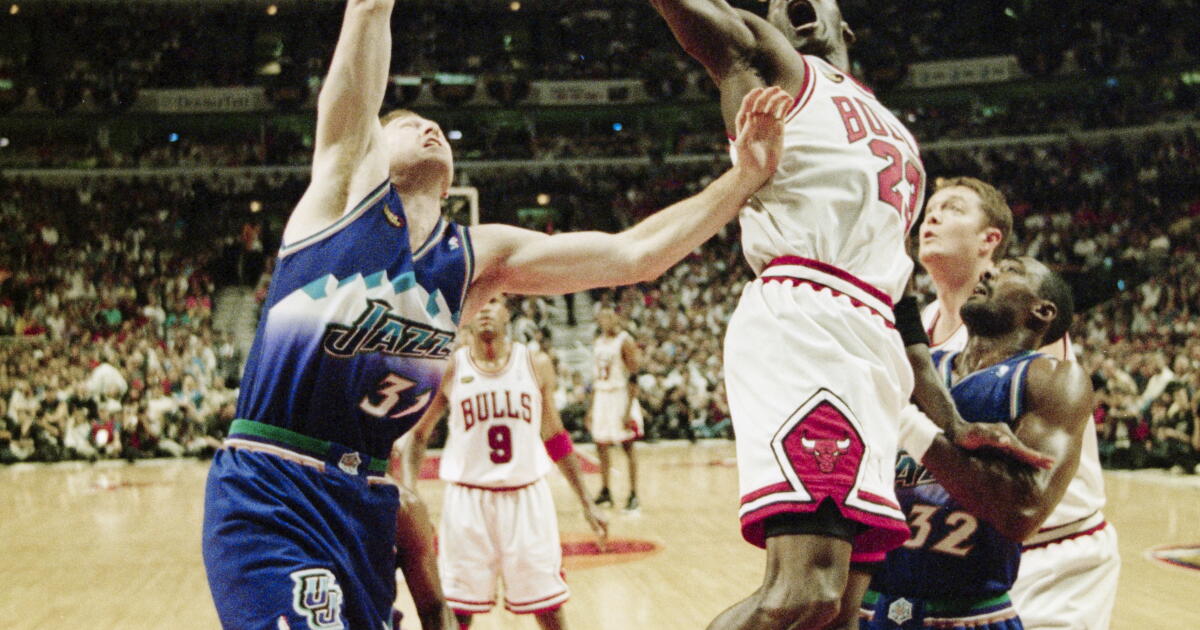
An autographed Chicago Bulls jersey worn by Michael Jordan during Game 2 of the 1998 NBA Finals was privately sold to a Miami real estate investor for $14 million, an auction house announced Monday. The price is believed to be the highest ever paid for basketball memorabilia.
A game-worn red road jersey was purchased by Ron Firman, according to Philadelphia-based Hunt Auctions. Jordan wore it June 5, 1998, while scoring 37 points in the Bulls’ victory over the Utah Jazz. The Bulls went on to win the series in six games, giving Jordan his sixth and final championship.
This is the third Jordan jersey from the 1998 Finals that has sold for more than $10 million. Jordan’s Game 3 white home jersey was auctioned in September for $12.26 million and his Game 1 red road jersey was sold at auction for $10.09 million in 2022.
“While Michael Jordan’s importance within the sports memorabilia marketplace has long been established, it has now escalated to an elite asset class more typically reserved for iconic works of art,” said David Hunt, president of Hunt Auctions, in a statement.
Firman’s X account describes him as a “Commercial Real Estate Co. Principal. Partner in private co. who’s trading is comparable to a hedge fund’s. Rare Vintage Sports Memorabilia Collector.”
His most recent post came Nov. 29, 2022, and features a signed photo of Joe DiMaggio belting a single in the seventh inning of the 42st consecutive game he recorded a hit in 1941, setting an American League record. DiMaggio extended the streak to 56 games, a Major League record that still stands.
Firman also recently set a record by spending $3 million for a 1951 Mickey Mantle first-generation photo used as the basis for Mantle’s celebrated 1952 Topps rookie card. Now Firman owns another piece of legendary memorabilia. The Bulls’ 1997-98 season was the subject of the “Last Dance” documentary series released in 2020.
“Michael Jordan was an incredibly talented player who is admired around the world,” Firman said in a statement distributed by Hunt Auctions. “I’m very excited about the purchase.”
The only game-worn jersey publicly to fetch more than $14 million was worn by Babe Ruth when he supposedly called his shot before hitting a home run against the Chicago Cubs at Wrigley Field in Game 3 of the 1932 World Series. That jersey sold for $24.12 million in 2024 at Heritage Auctions, setting a world record for the most expensive piece of sports memorabilia. It appreciated more than 25 times from the $940,000 it went for in 2005.
“In our opinion, and 36 years of market experience, Babe Ruth and Michael Jordan stand above all others in the history of American sports,” Hunt said. “The record-setting price achieved for the related Michael Jordan jersey is yet another corroborative result as to the significance of Jordan within the industry and popular culture.”
The leader of the world’s biggest band is nervous.
“I think I revised this speech about 10 times, but somehow the more I worked on it, the more confused I became, like always,” said K-pop star and BTS rapper RM on Tuesday at a preview of a show he has co-curated at San Francisco Museum of Modern Art called “RM x SFMOMA: Between You and Me”
Three years ago, RM held an anonymous show in South Korea, but this is the first proper exhibition he has staged. For many of his fans — some of whom wait outside the museum trying to get a glimpse of him — his favorite activities, including museum-hopping, bicycling and being out in nature, come as no surprise. There is even a word for it: “namjooning,” a play on the singer’s first name, Namjoon. But still, the exhibition is the rare chance to view RM as a serious art collector; someone who values Korean identity in art but also loves works from many genres, eras and countries.
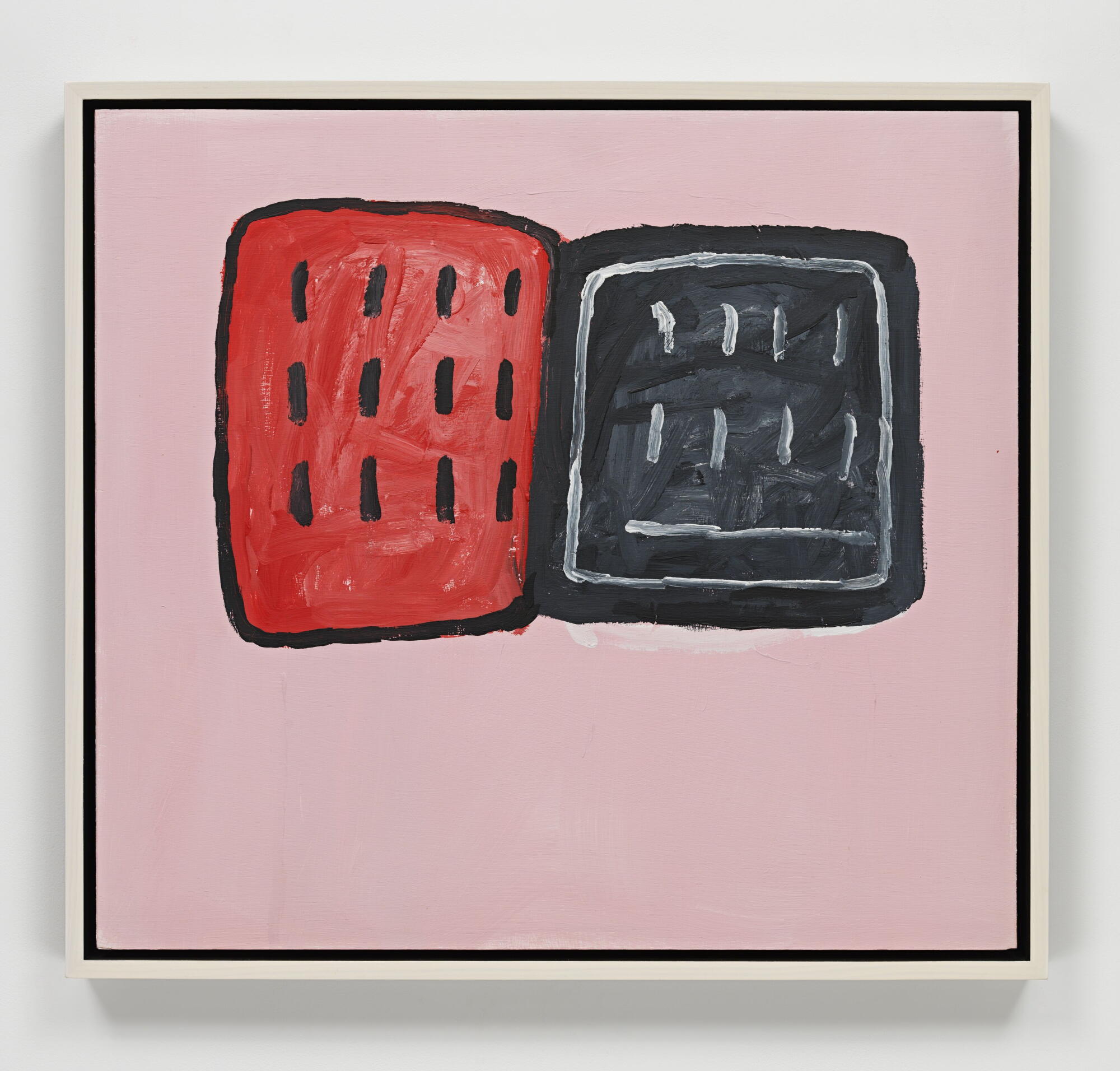
Philip Guston, Untitled (Red and Black Book), 1969; from the collection of RM.
(The Estate of Philip Guston / Hauser & Wirth)
Dressed in a gray T-shirt, dark collared shirt and leather pants, RM’s hair is a light burnt sienna color matching the fur of the stylized tiger on the screen behind him. From a 17th century painting by Lee Won-chan, it’s from his personal collection of more than 400 artworks. For this exhibition, 142 pieces owned by RM will be shown alongside 36 works from SFMOMA for a total of 178 works on display.
RM sees “Between You and Me” as an introduction to his inner life and reflection of contrasting aspects of his personality, whether as a public figure interacting with his adoring fans or an erudite intellectual and avid reader with a reputation as a clumsy and lovable goofball.
RM was on a hiatus from BTS and on the cusp of beginning his mandatory military service in South Korea when SFMOMA first approached him for the project two years ago. As it came to fruition, he sought to answer two main questions when contemplating which works of his collection to share with the public.
Does the artwork move him deeply? And, if the work is from a noncontemporary artist, does the piece have something to communicate in 2026?
“In an age where everything is consumed so fast,” RM explained, “I believe the attitudes of some of the past artists can resonate even more deeply today.
“I’ve always dreamed of seeing different places, times, boundaries and backgrounds all mixed together in harmony,” he continued. “It could be a mess because I’ve never formally studied, and I’m not a ‘curator, curator,’ but in any field sometimes an outsider can bring in a new breeze.”
Wonwoo Lee, “Candy,” 2023; from the collection of RM
(Wonwoo Lee / PKM Gallery)
It’s not RM’s first time working with a museum. In 2023, he partnered with Los Angeles County Museum of Modern Art to provide guided audio narration for “The Space Between: The Modern in Korean Art”.
At SFMOMA, RM was joined in his effort by two co-curators: SFMOMA project manager América Castillo and assistant curator of painting and sculpture Hyoeun Kim.
Kim, who has long championed Korean artists internationally, was particularly impressed with the diversity of Korean art that RM has amassed, including its “remarkable range.”
“His collection began with 6th century works, moved through the Joseon Dynasty, and continued to major Korean modern and contemporary art. It spans nearly 1,500 years,” Kim said during the preview.
The show is arranged in eight parts and begins with a large white wall at the entrance with the title of the show scrawled in RM’s handwriting. Handwritten touches are found everywhere — “Plz take it in with your eyes and heart” is scribbled on the floor in both English and Korean. The wall text for each piece, which also includes a QR code for audio narration, is composed by RM in both languages.
An inscription on the floor of an SFMOMA exhibit curated by RM of BTS features RM’s writing as part of the wall (and floor) text.
(Christine Terrisse.)
Guests will also receive a zine-style pamphlet with the same homespun appeal explaining each of the eight sections in RM’s words alongside a diagram of the room.
“Blue Water” centers the work of Kim Whanki, the late globe-trotting abstract artist and the first RM says he “fell for.” In addition to Whanki and works by Vija Celmins and Tony Feher, some RM fans might recognize one of Roni Horn’s glass cylinder sculptures from a now-archived Instagram post where it was casually displayed in RM’s apartment.
There’s even a room filled with especially eclectic pieces called “i don’t know..but i like it.” By way of explanation, RM said, “Sometimes I don’t really know why I collected all these things.”
The last room, “Umber” or “Dasaek” (referring to the color of Korean rice fields) might be the most meaningful to the singer. It features works by the late artist Yun Hyong-keun, for whom RM has a particular personal affinity. The cover for his debut solo studio album, “Indigo,” depicts Hyong-keun’s 1972 painting “Blue,” and the album’s lead track, “Yun,” a collaboration with Erykah Badu, kicks off with recorded dialogue from the artist.
Back in 2018, around the same time RM began his art journey with not much formal training in art history, co-curator Castillo began her career with SFMOMA.
At the time, she was in awe of the power of art to connect with people, but frustrated that more people from unconventional backgrounds weren’t being given opportunities to curate major shows, thereby shaping the stories told. Her work on this exhibition is part of a continuing mission to bridge the art world and the ordinary person.
Chang Ucchin, “Road,” 1986, from RM’s collection.
(Chang Ucchin Foundation / Seoul Auction)
This mission guided her through the process of selecting works by famous artists from SFMOMA’s collection to contextualize RM’s pieces from lesser-known but equally important names.
“The first time we pulled a list on the SFMOMA side, we had like 500 options we then dwindled down,” she said in an interview while standing in the “Umber” room. “There were some artworks and specific artists that we knew from the get-go we wanted to be in the show. We wanted them to have a moment. Mark Rothko was definitely one of them.”
The sole Rothko piece in SFMOMA’s collection, “No. 14,” (1960) is featured in one of the final rooms in the exhibition. Adjacent to it is “untitled” (1986-90) by Hyong-keun. In the exhibit pamphlet, RM notes that Hyong-keun’s paintings are often compared to Rothko’s, but “their darkness is not the same.” “To my eyes, if Rothko’s darkness is one that ‘opens’ then Yun’s is the darkness that remains after he endured everything he possibly could,” he writes.
As RM steps into the spotlight of the art world, he is learning to become comfortable with the uncomfortable in-between spaces he occupies. “I started this with an innocent heart. As I’m standing here talking to you, I still feel like I’m always drifting and floating somewhere, ” he said, adding that the feeling comes when he’s in the U.S. but also when he’s in his hometown of Seoul. “It’s not a very pleasant feeling. I think I’ve leaned on art a lot because of that feeling.”
Before the preview, BTS fans, called the ARMY, passed out small gifts to the press, and afterward donors lined up for a special reception. RM’s mother, father and sister even arrived to celebrate, but he didn’t have much time to hang around. He was scheduled to depart for Bogotá, Colombia, to join his bandmates on the Latin American leg of their ARIRANG stadium world tour.
It is time to leave the quiet of the museum for the roar of the crowd.
“RM SFMOMA: Between You and Me” opens to the public on Oct 3, and runs through Feb.7, 2027. For more information visit sfmoma.org
Actor D’Arcy Carden stopped by early, beating the cadre of guests crowding the main plaza beneath the now-famous oculus of the 300,000-square-foot Ma Yansong-designed building. A Stormtrooper drove by on a flatbed truck, shortly before R2-D2 greeted visitors in the courtyard, wearing an official staff badge. (The line for a selfie with the droll droid stretched as far as the eye could see.) Museum leaders have long said that “Star Wars” artifacts account for about 7% of the 100,000 square feet of gallery space, but one worker quipped 90% of opening-day attendees likely had a vested interest in the franchise.
This proved true, for the most part: Many visitors clearly knew and loved “Star Wars,” and Princess Leia buns and Yoda ears abounded. (Two Padmé Amidalas ran into each other, and according to a restaurant worker, one brave soul showed up in “Star Trek” gear.)
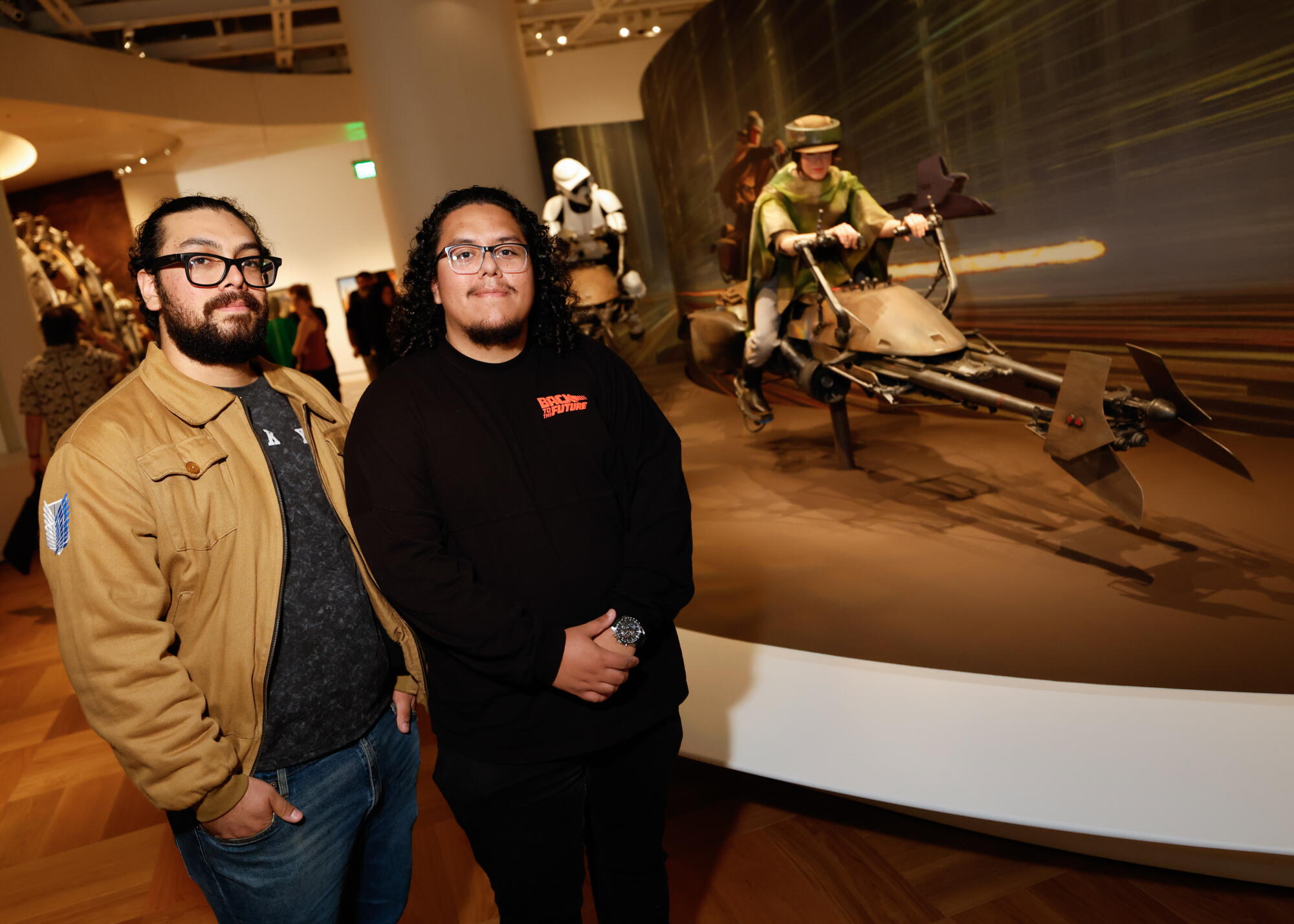
David Perez, 27, (right) donned his “Back to the Future” gear, hoping to see art from the movie. But he and his brother Carlos Perez, 28, (left) were quite pleased with the “Star Wars” artifacts in the Cinema section.
(Carlin Stiehl / For The Times)
Still, the museum, as its famous co-founder George Lucas has repeatedly said, is about more than just one story, however beloved. That sentiment cropped up repeatedly in interviews, too: Early guests seemed to believe the museum’s brochure, which notes that the galleries are about the “narrative art” of illustrating stories.
Co-founders Lucas and businesswoman Mellody Hobson (also Lucas’ wife) gave remarks early Tuesday to the first 100 visitors, consisting of students from USC, Los Angeles Technology Center, Otis College of Art and Design and Los Angeles City College, who were all handed free tickets.
A yellow Naboo N-1 Starfighter hangs above the education lobby, across from the main plaza, guarding the research library.
(Carlin Stiehl / For The Times)
“I’ve spent more than 50 years collecting the work of artists who don’t always get their due — illustrators, cartoonists, muralists, painters — because I believe their images are as vital as any other art form,” Lucas said. “They deserve to be in a museum.”
“This is a museum of the ‘people’s art’ — the images are illustrations of the beliefs we live with every day,” said Hobson, “and for that reason, this art belongs to everyone.”
Later that day, The Times asked visitors to share their impressions of a museum that, until now, has lived largely in the imaginations of fans and in abundant social media posts online. The museum has drawn loads of applause but also plenty of criticism, mostly for its lack of context via wall text, and for displaying art that not everyone agrees should be elevated.
Do the people love the “people’s art”?
Responses have been edited for length and clarity.
Alden Chang and his wife flew 6,800 miles from Taiwan to thank George Lucas for creating the “Star Wars” films and franchise. Chang told The Times that he also wrote an academic paper examining “Star Wars” fan culture in Taiwan.
(Carlin Stiehl / For The Times)
Alden Chang, 32, green product engineer from Taiwan
You flew all the way from Taiwan, just for this?
Chang: Yeah, halfway across the world to meet George Lucas and Miss [Mellody] Hobson.
Did you get to meet them?
Chang: Yeah, I just shook hands with them this morning. It’s like a dream come true.
How long ago did you and your wife get here,and how long are you staying?
Chang: For eight days. We came here on Sept. 18.
Is this the highlight of the trip?
Chang: Sure. [Laughs.] It’s my main mission and my main goal.
(Later, in an email, Chang told The Times that he also wrote an academic paper examining “Star Wars” fan culture in Taiwan.)
Friends Robert Meier, left, and Marc Downing used to work as ushers at the Music Center together. Growing up, Marc rode his bike where the Lucas Museum now stands.
(Carlin Stiehl / For The Times)
Marc Downing, 71, retired, from Exposition Park and Robert Meier, 70, educator, from Highland Park
Downing: I go to all the museums. This was the newest museum, so I had to come and see this.
How does this compare to the other L.A. museums?
Downing: This is ultra modern, ultra space-future. I’m glad the museum is here; highly recommend it. And I’m proud that it’s in my city, and I’m glad that it’s in the neighborhood that I grew up with.
What made you want to be a member of the museum, Robert?
Meier: It’s giving to the neighborhood. I’ve admired George Lucas — I used to have a relative in Marin County, and growing up, we’d go to lunch, and I’d see George Lucas and his family. We’d be at the same restaurant together.
Downing: Well, speaking of this neighborhood: This used to be a parking lot. I remember it very well. And I used to come here and ride my bike in this neighborhood as a kid.
C.S. Lee sits on a bench at the south viewpoint of the museum, gazing out onto the sculpture garden below. “This is why you live in Southern California. This is why you live in L.A.: for days like these.”
(Carlin Stiehl / For The Times)
C.S. Lee, 54, actor, from Koreatown
Lee: “Star Wars” was the very first movie I ever saw in my life as a 4-year-old when I immigrated here from Korea. We landed in Hawaii, in Waikiki Beach. Our family friends took us to a drive-in movie cinema place, and they said, “You want to come see a movie?” And it was “Star Wars” and “King Kong,” double billing. And my mom said when I saw the screen, my eyes popped out of my head because I’d never seen a movie before.
How do you think “Star Wars” impacted how you saw narrative and story?
Lee: I think I carried that all through my life: the story of “Star Wars.” I was like, “Oh, the good guys won!” And it was such an uplifting thing for me to hold on [to] all these years.
What did you think about the rest of the museum?
Lee: It’s so beautifully done: all the curves, all the light. You got the wind coming through the trees that they planted. I mean, honestly, I was just looking out, thinking to myself, “Wow, this is why you live in Southern California. This is why you live in L.A.: for days like these.”
The view of the sculpture garden and grounds beyond that C.S. Lee was contemplating from the south viewpoint.
(Carlin Stiehl / For The Times)
What about the building itself?
Lee: We rarely get to see architecture like this. But I think it’s good for people to see the artistry and the imagination of what people can build.
Janet Jacobs, 62, architect and Hanjin Jacobs, 25, audio equipment manufacturer technician, mother and son on a family trip from Portland (pictured at the top of the story)
I see you’re wearing a “Star Wars” T-shirt.
Janet: Yes, I am — actually from 1977.
Wow, really?
Janet: Yeah, I’ve had it for that long [laughs].
What was your overall takeaway from the museum?
Janet: I know George Lucas wanted to create this museum in a different way, like he didn’t have a sequence of events or a roadmap, he just wanted people to experience it the way they wanted to, so that’s all great. We do wish some of the things were explained a little more. Like, I know who Ralph McQuarrie is; [my kids] do not. So that would’ve been nice. Like in a typical museum, you do have a little blurb.
[My son] brought up a really good point: how ironic it is that it’s about storytelling, but yet there seems to be no storyline.
Andrew Liu, left, and Matthew Haak hang loose in front of a KAWS sculpture. They actually didn’t know it was opening day, but were happy to be there anyway.
(Carlin Stiehl / For The Times)
Matthew Haak, 26, architectural designer, and Andrew Liu, 26, behavioral therapy assistant, both from University Park
Haak: We are not “Star Wars” fans. I haven’t watched a single “Star Wars” movie. I’ve somehow evaded them my entire life.
So, if not for “Star Wars,” why did you come out today?
Haak: I’ve been watching this building being constructed for the past two years. I’m just geeking out over the organic curvilinear forms. Not a single hallway has been straight. And they even have real expensive details, like light coves on the base [of the wall]. All of these things really stand out to me. Also, curved walls like this are so expensive; architects never get a budget to do stuff like that.
I was just surprised: It’s not just “Star Wars” stuff. There’s so much art; it’s so cool.
Nicole Garcia — dressed as Padmé Amidala in her lakeside gown — poses in front of a statue of Princess Leia.
(Carlin Stiehl / For The Times)
Nicole Garcia, 24, cosplayer/costumer from Corona and Veronica Antonucci, 40, administrative assistant from Orange County
So, this might be an obvious question [given their fun outfits], but what brought you guys out today?
Antonucci: This little thing called “Star Wars”!
Garcia: Growing up with “Star Wars,” I always loved all the pieces, knowing that, for example, there’s miniature pieces that look just huge on-screen, and seeing them in-person is just, like, I want to shrink myself down and just be there.
Antonucci: It’s also amazing that it’s not just “Star Wars,” and it’s also so much more that everyone should come out and see.
Is there anything else you were particularly excited to see?
Antonucci: I was really excited to see the Frida [Kahlo]. I didn’t know she was gonna be here, so I think when I saw her, I gasped.
Is there anything else you’d like to add?
Garcia: I just hope the future generations of kids come back to see this, growing up with museums more often, and just learning how to make art — like, physically make art — and be inspired.
Antonucci: Actually, we talked about feeling jealous of all the kids who are going to be here on their school field trips, because we didn’t get to experience this.
Nikki Foster, left, loves a good field trip. She texted her group chat to visit the museum, and her bestie, Shalonda Dean, responded, so they both cleared their calendars for the visit.
(Carlin Stiehl/For The Times)
Shalonda Dean, 47, consulting business founder and president, and Nikki Foster, 45, live event production executive, both from Beverly Hills
Dean: Being a Black woman, I can identify with this little Black girl. Even in 2026, I think this painting depicts a lot of what Black women are going through today, whether it be in the workplace, navigating motherhood, navigating life. And I think this is an example of the barriers that we’re constantly breaking through every day, even today.
Foster: I’ve never seen it in person until now. So when we saw it, we were like, “It’s here, it’s here!” Just to be able to lay our eyes on it, and not have to go to another country, another state — here in Los Angeles. This is divine. It’s a divine day.
“I love meeting people,” Vincent Zabierowski said. “People are my main inspiration. I’m very lucky I get to be in a place where people want to be, and people want to soak up all that creative energy and just experience art.”
(Carlin Stiehl / For The Times)
Vincent Zabierowski, 23, host at the Skywalker Grill and freelance illustrator, lives near Downtown L.A.
As an artist yourself, what are your favorite pieces in the museum?
Zabierowski: I love a lot of the things that are in the graphic novel collection, like the Jack Kirby, the Garfields. My favorite is the Art Nouveau artist Alphonse Mucha. The Diego Rivera mural, that one was really amazing — and just the history here, having it be in L.A.
How does your work as an illustrator inform how you see these pieces?
Zabierowski: When I was going through it with some of my co-workers, I would [ask] “Do you know why they use a blue pencil?” And it’s because, when you take a photograph or a scan, that blue pencil disappears. So it was just really cool to see the behind-the-scenes and understand.
So seeing those blue pencil marks tells you that a piece is real?
Zabierowski: A person made it! I feel like a lot of people see artwork in textbooks, or they see artwork on their phones, or they see artworks on posters, and it takes a lot of skill and intelligence and training to be able to do those pieces of artwork.