phoenix

First C-130J For Navy’s New E-130J Phoenix II Ballistic Submarine Communications Fleet Delivered

The U.S. Navy has taken delivery of the first C-130J-30 Hercules airframe destined to become an E-130J Phoenix II, the service’s next-generation aircraft for maintaining communications with its nuclear ballistic submarines. The aircraft will now undergo extensive mission-systems integration before it can begin testing for the Take Charge and Move Out (TACAMO) mission.

Lockheed Martin handed over the newly built aircraft at its facility in Marietta, Georgia, on October 15. The delivery marks the start of the transition from the Navy’s aging E-6B Mercury fleet to the turboprop-powered E-130J, which is intended to provide a survivable communications link between national leadership and U.S. Navy nuclear ballistic missile submarines, including the ability to send them orders to launch strikes while they are submerged.

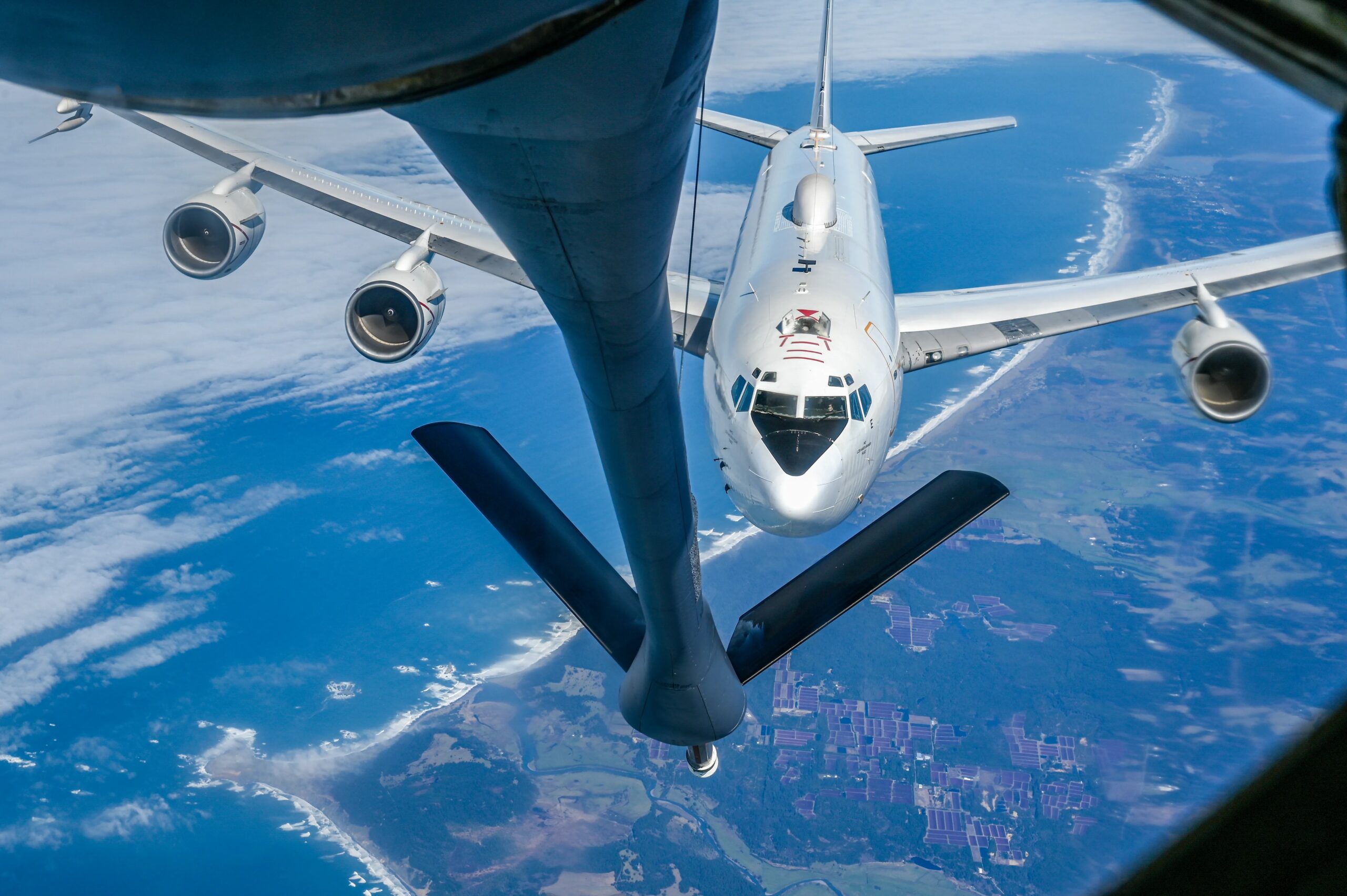
An E-6B Mercury assigned to the Strategic Communications Wing 1 at Tinker Air Force Base approaches a KC-135 Stratotanker assigned to the 92nd Air Refueling Wing during an aerial refueling mission over Oregon, Feb. 28, 2025. Aerial refueling capabilities are essential for strategic and tactical operations as well as humanitarian relief efforts in support of Air Mobility Command, U.S. Transportation Command and Department of Defense priorities. (U.S. Air Force photo by Airman 1st Class Megan Delaine)
An E-6B Mercury assigned to the Strategic Communications Wing 1 at Tinker Air Force Base approaches a tanker during an aerial refueling mission over Oregon, Feb. 28, 2025. U.S. Air Force photo by Airman 1st Class Megan Delaine

“Today’s delivery from the historic Marietta line represents far more than a new airframe; it marks the foundation of our future strategic deterrence posture,” Capt. Roger Davis, program manager for the Navy’s Airborne Strategic Command, Control, and Communications program office (PMA-271), said in a statement.

“Through our close partnership with Lockheed Martin and our industry team, we are ensuring our nation maintains an unshakeable communications lifeline to our ballistic missile submarine fleet.”

Capt. Roger Davis, left, Airborne Strategic Command, Control and Communications program manager (PMA-271), presents a ceremonial key to Capt. David Gardner, commodore of Strategic Communications Wing 1 (SCW 1), during the C-130J-30 delivery ceremony Oct. 15, 2026 in Marietta, Georgia. The symbolic handover marks the transition of the new airframe into the next phase of mission-system modification, ground testing and developmental flight testing, laying the foundation to field the future E-130J “Phoenix II.” (Photo courtesy of Lockheed Martin by Thinh D. Nguyen)
Capt. Roger Davis, left, Airborne Strategic Command, Control and Communications program manager (PMA-271), presents a ceremonial key to Capt. David Gardner, commodore of Strategic Communications Wing 1 (SCW 1), during the C-130J-30 delivery ceremony Oct. 15, 2026 in Marietta, Georgia. Photo courtesy of Lockheed Martin by Thinh D. Nguyen

The aircraft is the first of three C-130J-30s initially procured by the Navy in September 2024. It will be transferred to Northrop Grumman, the E-130J program’s prime contractor and mission-systems integrator, for conversion. Collins Aerospace is providing the very low frequency (VLF) communications system, a key component of the TACAMO mission.

TACAMO aircraft provide a means for the president, secretary of defense, and U.S. Strategic Command to communicate with nuclear forces, including submarines submerged at sea. The mission is designed to preserve the ability to transmit emergency action messages even if conventional communications infrastructure is disrupted or destroyed.

The E-6B accomplishes this in part through a long, trailing wire antenna that enables VLF transmissions to submerged submarines. The E-130J will receive a comparable system as part of its conversion.

Hardening against the effects of electromagnetic pulse (EMP), which occurs during the detonation of nuclear warheads, is another key requirement for these planes.

A sneak peak at the first C-130J-30 Super Hercules aircraft being built by Lockheed Martin Corp. for the U.S. Navy’s E-130J program. This aircraft – the first of three – is slated to be delivered to the government in 2026 for modification into an E-130J Engineering Development Model. The E-130J, formerly called E-XX, will be the successor to the E-6B Mercury for the Take Charge and Move Out (TACAMO) mission, which connects the president, secretary of defense and U.S. Strategic Command with the United States’ nuclear triad. The U.S. Navy’s Airborne Strategic Command, Control and Communications Program Office (PMA-271) is leading the TACAMO Recapitalization Program and is scheduled to award the Engineering and Manufacturing Development contract during the first quarter of 2025. (Photo by David L. Key, Lockheed Martin)
The first C-130J-30 being built by Lockheed Martin Corp. for the E-130J program. Photo by David L. Key, Lockheed Martin

The Navy plans to acquire 31 E-130Js, nearly doubling the 16 E-6Bs currently in service. That total includes six developmental aircraft and 25 production examples, although it remains unclear how many of the developmental aircraft will ultimately be available for operational use.

The larger planned fleet should provide additional aircraft to support training, maintenance, and operational demands. However, the transition also brings technical challenges. The Government Accountability Office (GAO) has previously warned that integrating the specialized mission equipment into the smaller C-130J-30 airframe could affect operational availability and create additional engineering and manufacturing difficulties.

Rendering of the U.S. Navy's future E-130J aircraft, which will relieve the E-6B Mercury of the Take Charge and Move Out (TACAMO) mission. (Rendering courtesy of Northrop Grumman Corp.)
Rendering of the future E-130J aircraft. Courtesy of Northrop Grumman Corp.

In the past, TWZ has discussed the potential operational readiness and other trade-offs that could come from selecting a C-130-based platform to replace the E-6B in the TACAMO role. As we wrote previously:

“It’s certainly worth pointing out that the E-6Bs, conversions of what were some of the last and most modern 707 airliners built, were larger and higher performance platforms than the EC-130Qs. The C-130J-30 is certainly a more capable aircraft than the C-130H on which the EC-130Q was based, but it won’t have the base speed and altitude capabilities of an airliner-sized multi-engine jet. Compared to the Mercuries, any TACAMO-configured C-130J-30 would not be able to get on station as quickly, or fly as high, limiting its ability to get above bad weather or establish a better line of sight for its communications systems.”

“At the same time, as the Navy itself has noted, the C-130J-30 platform does immediately open up the ability to use a larger number of air bases, airports, and airfields, including austere ones that the E-6B cannot operate from. This could be very useful in a contingency scenario where an opponent may have destroyed or otherwise rendered unusable many well-established bases, as well as larger secondary dispersal sites, which include large commercial airports. Being able to fly from smaller, tertiary locations could help to ensure that the TACAMO mission continues without significant disruption under such circumstances. This is also true during peacetime, as targeting the TACAMOs on the ground would be much harder if they could easily operate from and sit alert at a much larger number of airports.”

“A C-130J-30 configured for the TACAMO mission would certainly have a mid-air refueling capability, and the Hercules is already a platform that has demonstrated the ability to loiter over particular areas for long periods of time. Unlike the Boeing 707, the C-130J is still in production, as well, meaning that TACAMO aircraft based on this plane would be inherently easier to maintain and support logistically, and may also be easier to convert to this specialized configuration to begin with. As time goes on, the J looks set to increasingly become the default base C-130 model across the U.S. military, as well. Compared to the long out-of-production 707-based E-6, support for the C-130J is already distributed across the U.S. and beyond. Training C-130J crews is even an easier proposition.”

The E-130J also represents a return to the Hercules family for the Navy’s TACAMO mission. The EC-130Q performed the role from 1963 to 1993, before the E-6A Mercury took over. The E-6B subsequently added an airborne command post mission known as Looking Glass, supporting U.S. strategic forces beyond the submarine communications role.

The US Navy operated a fleet of EC-130Q TACAMO aircraft like the one seen here before the arrival of the E-6As. U.S. Navy

The Navy’s current plan is for the E-130J to assume the TACAMO mission, while the Air Force pursues a separate effort to replace the Looking Glass airborne command post capability.

Following its delivery, the first E-130J airframe will enter mission-systems modification, ground testing, and developmental flight testing. The aircraft is not yet an operational TACAMO platform, and further integration and testing will be required before the Navy can begin fielding the new fleet.

The transition is intended to preserve one of the most critical links in the U.S. nuclear command, control, and communications architecture as the E-6B fleet becomes increasingly difficult to sustain.

Contact the author: thomas@thewarzone.com

Thomas Newdick is a staff writer at TWZ, where he covers military aviation, defense technology, weapons systems, and international security. Based in Berlin, Germany, he reports on conflicts, military modernization efforts, and emerging aerospace technologies around the world, with a particular interest in airpower and its role in contemporary warfare. His reporting is informed by deep expertise in modern and historical airpower, particularly in Europe, with a focus on military aviation, air campaigns, and aerospace developments across the continent and beyond.


Source link

How to have the best Sunday in L.A., according to Charles Phoenix

Midcentury pop culture expert Charles Phoenix thinks Long Beach gets a bad rap.

“It is very underrated in the grand scheme of all of Southern California, but there is a lot to see and do there,” says the Ontario native, who uses the word “time-honored” repeatedly when describing his favorite attractions in the seaside community. “I often refer to it — under my breath — as the New Jersey of Los Angeles. It doesn’t get much respect, yet it’s loaded with attractions.”

In Sunday Funday, L.A. people give us a play-by-play of their ideal Sunday around town. Find ideas and inspiration on where to go, what to eat and how to enjoy life on the weekends.

When he isn’t gushing over Long Beach, the humorist and author hosts nostalgic slideshows and double-decker open-air bus tours of Midcentury architecture during Modernism Week in Palm Springs. His next event, “LosAngelesland,” is a lively retro slideshow featuring vintage Kodachrome slides taken by Los Angeles locals and tourists in the 1950s and ’60s. The show is scheduled for Oct. 17 during Modernism Week’s October festival in Palm Springs and a Halloween-themed version on Oct. 24 at the Anaheim Fall Festival. Phoenix will also present “Disneyland: Live Retro Slide Show Celebrating the Original Magic Kingdom in the 1950s & ’60s!” at the Hilbert Museum in Orange on Oct. 18.

Phoenix lives in a Midcentury Modern home in Claremont, but he’s always happy to spend a day in Long Beach. His ideal Sunday includes eating clam chowder-topped biscuits at a floating restaurant, shopping for vintage treasures along 4th Street Retro Row, cruising around Naples in an electric Duffy boat and ending the day at a classic diner from 1939.

“There’s more to do in Long Beach,” he says. “I could keep going, but there’s only so much space in this column.”

This interview has been lightly edited and condensed for length and clarity.

8 a.m.: Wake up early and say thanks

When I wake up, I usually have nonfat yogurt, chopped walnuts and one or two types of fresh fruit. Then I walk through my house, and whatever room I walk in first — either the living room or the den and say, “I love you, house.” Those are the first words I speak out loud.

10 a.m.: Drive to the coast for lunch on a floating restaurant

We’re going to start at the only floating restaurant I know of in the Western United States, the Chowder Barge. It stands out on its own, although it’s a bit tricky to find, so it’s a good thing we have GPS or we might never get there. It’s a little bit tiki, a little bit pirate and a little bit seafarer. There’s always an old wizard-like man sitting in the corner with a long beard that reaches the floor. When you’re on the barge and a boat passes by, you can feel it. The best thing there is their fried clams and clam chowder, which you can eat in a bowl or use the chowder as gravy. For breakfast, you could have biscuits topped with clam chowder instead of gravy. It’s the best clam chowder ever. If you want fried clams on top of the biscuits, that’s incredibly delicious. They also have an open-faced hamburger covered with clam chowder and fried clams or just clam chowder.

The place has a deep soul, and everything there is unique and time-honored.

1 p.m.: Go vintage shopping on Retro Row

Next I would go shopping on 4th Street, a.k.a. Retro Row, which is absolutely, in no uncertain terms, the best vintage shopping street in the Western United States — probably the Eastern and Midwestern as well. There are three stores there that I concentrate heavily on. The first is Sneaky Tiki Boutique, which is the destination of all destinations for what I wear all spring and summer and fall — vintage Hawaiian shirts from the ’50s and ’60s. They’re not Hawaiian shirts unless they’re made in Hawaii. Nobody has a better supply than Sneaky Tiki. I mean nobody.

A couple of doors down is another world-class vintage store, Meow. Meow is an institution in the world of vintage clothing, shoes and accessories. And it’s absolutely a spectacular themed environmental extravaganza, as is Sneaky Tiki. There are all kinds of vintage in there. So it is a feast for the senses and your wardrobe and accessory needs.

And then for your Midcentury home decor needs, there’s Xcape Modern. They’ve been there for probably 30 years, and it’s a little mumbo jumbo as far as the way it’s all laid out. It’s a little messy, but they have incredible Midcentury furniture and home decor, including patio items. It’s a spectacular, well-curated collection.

3 p.m.: Explore Rancho Los Alamitos

After that, I’d take a quick late-afternoon scamper around Rancho Los Alamitos. It’s really special, and it’s free, F-R-E-E, free. It’s this gorgeous, time-honored place; basically, you’re walking back into time. The family started building it in 1790 and finished in 1834. I love to look around and walk through the layers of time. The house is beautiful. The barn is beautiful. There are animals there too. It reminds me a little bit of old-timey Knott’s Berry Berry Farm. Chickens walk around, and it just has, again, this deep soul, layers of time, mature garden. And it’s impeccably kept, impeccably groomed. You can spend 20 minutes walking around there or you could spend four hours. And of course, the garden is absolutely out of this world.

It’s its own little world. It doesn’t know the rest of the world exists, which is the kind of place that I really, really love — a place that’s true to itself, time-honored and lost in its own wonderland. You know, it’s just so special to be able to escape to such a rarefied environment.

5 p.m.: Go for a ride on a Duffy Boat in Naples

From there, get ready for my favorite thing to do in Southern California: taking a Duffy Boat ride around Naples. I always rent from Anchors Away. The boats remind me of the Jungle Cruise at Disneyland. Most are white and blue, but a couple of years ago, around the time of the Barbie movie, they added some bright pink ones. You can pay a little extra for the pink boats, but the blue and white ones are just as fun. The boats seat about eight to 10 people, and you rent them for two hours and just cruise around. The canals are much bigger than those in Venice. They give you a map and two hours to enjoy the water. I usually drive the boat while my friends bring drinks, cookies, snacks and whatever they want to drink. I had no experience before my first time, but it’s easy and relaxing. It’s never crowded, the homes are beautiful, and of course, I always wear a captain’s hat.

8 p.m.: Late–night snack at a 1939 diner

After that, even if we’ve already had plenty to eat and drink, we usually end up at one of my favorite diners, Harbor House Cafe, on Pacific Coast Highway in Sunset Beach. It’s been open since 1939. So we drive a couple of miles down PCH, pile into the Harbor House and finish the day with whatever we want — dessert, more dessert, onion rings or a milkshake. It’s our spot to unwind. The onion rings are especially good. It’s an easy, time-honored place, just like everywhere I love to go. I like to soak in the history. After we leave, everyone heads home, and I drive back up the 605 Freeway to Claremont.


Source link