Phil

The L.A. Phil premieres Gerald Barry’s wacky ‘Salome’

Gerald Barry is today’s rare opera composer with a draught-dry wit. Is there such a thing as a soaking wet wit, the opposite of the parched variety, because he has that, too. He is Irish. He has some Beckett in him. And a helping of Oscar Wilde.

At the behest of British composer Thomas Adès, the Los Angeles Philharmonic has given, over the past 20 years, the U.S. or world premieres of four Barry operas in its Green Umbrella new music series, all conducted by Adès. The first, “The Triumph of Beauty and Deceit,” seemed to take zaniness to outlandish operatic extremes, which led to the orchestra commissioning the next three. “The Importance of Being Ernest” and “Alice’s Adventures Underground,” in 2011 and 2016 respectively, proved each funnier and more outrageous musical spectacle than the last.

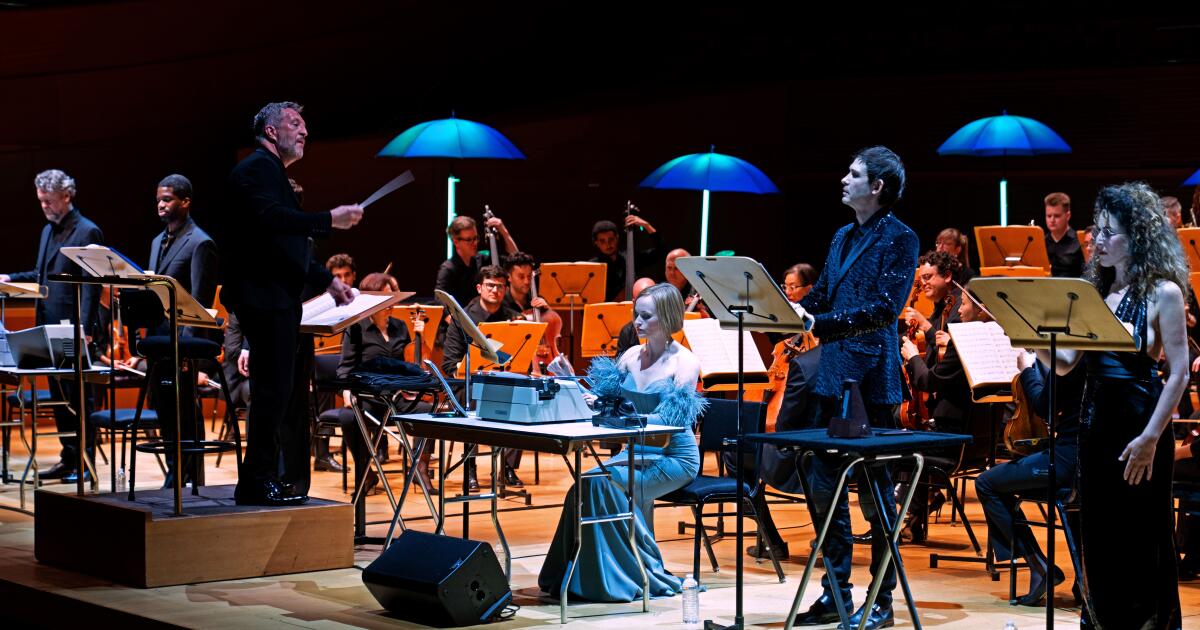
On Tuesday night, the L.A. Phil New Music Group and a cast of extraordinary singers gave the U.S. premiere of “Salome” at Walt Disney Concert Hall. Here we go again.

The description by the composer (who is also his librettist) can hardly be bettered. He has cut Wilde’s play by about half. And, in that half, explored another less knowable side of the moon represented by Richard Strauss’ well-known “Salome,” which helped usher in 20th-century operatic modernism. Barry says his “Salome” is “an opera of voyeurism, the moon, French, God, punishment of sin, misunderstanding, sex, the metronome, suicide, hysteria, hunger, blood, typing, speaking correctly, sterility, ‘The Blue Danube,’ fever, art, Wilde, dreaming, beheading, Frankenstein, kissing.”

No nudity, though, and no dance. Salome is a typist. Her dance of the seven veils is sexy typing.

Barry begins where Wilde begins and Strauss (who follows the original play closely) with a pair of soldiers in Herod’s court peering at the moon, one moonstruck by the beauty of Herod’s daughter Salome. Salome has other ideas. She’s taken, perversely, with John the Baptist, imprisoned in a cistern and prophesying doom for the decadent, Godless heathens, Salome in particular. All of this readily registers on Barry’s Dada-absurdity meter.

Even so, Barry has an oracular outlook. He goes in for proclamatory melody, each note an event, when punched out by brass and lower string like hammering spikes in the ground. Harmonies can be raw. There is a Stravinskyan quality, but nothing is ever predictable.

The orchestral introduction to “Salome” is like that. But it gets screwy fast. Other than Salome, the characters are not named, rather treated as types. John the Baptist is The Prisoner. Herod and Herodias are The King and The Queen. All have some Alice in a different wonderland about them.

The Prisoner could be straight out of a Godard film. He speaks only French (Wilde’s play was first published in French in 1893). He speaks more than he sings and finds outrage everywhere he looks. The surtitles intentionally refrain from translating much of what he says, leaving the audience to rely on his loony spoken tone and loony tunes to carry meaning. His way of impatiently rebuffing Salome’s inappropriate advances is to give her singing lessons.

That’s the last thing she needs. Her part, like that of Alice in Barry’s previous opera, is enlivened by delightfully squeaky high notes in unexpected places. She’s Barbie with exceptional smarts and grotesque sexual fantasies. Soprano Alison Scherzer, who has starred in Barry’s other operas and in Adès’ “Powder Her Face,” is spectacular.

Everyone is odd. The half-crazed King, magnificently sung by the ever-disruptive Timur, lusts after Salome by speaking and singing at different speeds he selects on a metronome, as he entices her to type for him. When she first refuses, the King has everyone sing “The Blue Danube,” because that’s what you do when Salome won’t sexy type for you.

Sara Hershkowitz’s wildly contemptuous Queen adds further soprano glory. The baritone, Vincent Casagrande, a marvelously cantankerous Prisoner, tells us only sick people dream, and of course everyone on stage automatically enters a dream state.

The shock of Wilde’s play, amplified in Strauss’ opera, is the sheer horror of Salome demanding as a reward for her striptease the decapitated head of the prophet, whose bloody lips she desires to kiss. In this case, her typing, which is accompanied by the two soldiers (Justin Hopkins and Karl Huml) on their own typewriters, leads to a dismemberment Frankenstein-style. The ghoulish ending is not unhappy.

Barry’s score remains as uncanny as his sense of drama. He plays with our senses of normality. He frequently uses the instrumentalists in the chamber orchestra like theatrical characters. The ensemble contradicts the singers but also eggs them on. Adès, who has his own unpredictably whimsical side, conducts as though he had written the score himself and shares his pleasure with every delightful effect.

The premiere of “Salome,” intended for 2021 in Disney, was disrupted by the pandemic. The first performance, then, became a staging in Magdeburg, Germany, last year. Barry said Tuesday in the pre-concert Upbeat Live that he is often happier with concert performances, like at this Green Umbrella. He has good reason.

The magic of this “Salome” is its transcendence of silliness into acceptance. When presented without theatrical aspect but as a private process of the imagination, it becomes a lavishly lovable antidote to our too often accepting the world’s absurdity only as dooms-scrollable tragedy.

Source link

How to have the best Sunday in L.A., according to Phil Rosenthal

Phil Rosenthal likes to sit at the counter of Max & Helen’s, the diner he recently opened with acclaimed chef Nancy Silverton, and chat with people while they eat.

“I sometimes feel like the mayor of Larchmont,” Rosenthal says over the phone as he greets diners who notice him at the counter. “When people come in and realize I’m involved, they’re always surprised to see me. It’s a bit like being at Disneyland and running into Goofy.”

In Sunday Funday, L.A. people give us a play-by-play of their ideal Sunday around town. Find ideas and inspiration on where to go, what to eat and how to enjoy life on the weekends.

Rosenthal is probably best known for creating the popular TV show “Everybody Loves Raymond” and hosting Netflix’s “Somebody Feed Phil,” which is moving to YouTube in 2027, but he is more than just a famous foodie. He’s now touring the country for his live show, “An Evening With Phil Rosenthal,” and he recently published his second children’s book, “Just Try It! Someplace New!,” which he wrote with his daughter Lily. (They’ll sign books at Barnes & Noble at the Grove on March 14.)

“The book series started when my daughter called and said, ‘Kids love your show. Why don’t you do a kids’ book?’ “ he says, before adding with a laugh: “I told her, ‘Yes, if you’ll do it with me.’ That’s a dad trick to get more time with your daughter.”

Rosenthal believes stories about kids feeling nervous or afraid to try new things connect with both children and adults. “When you write a kids’ book, you realize that it is not just a kids’ book,” he says. “It’s really a book for everyone.”

Although he travels a lot, Rosenthal likes to spend Sundays close to home. He enjoys walking his dog Murray to Larchmont Village and hosting movie night with friends at his place in Hancock Park.

Here’s what his perfect Sunday in L.A. looks like, with lots of good food along the way, of course.

This interview has been lightly edited for length and clarity.

7:45 a.m.: Coffee with Murray and neighborhood friends

Every Sunday morning, I walk my dog Murray to Larchmont Village and stop at Go Get Em Tiger. It’s our daily ritual. Over time, we’ve built a great community there, and I always invite others to join us. We sit outside, talk and have become close friends. I usually post a photo of Murray on Instagram each day. He’s a rescue mutt, and I like to joke he’s part Pyrenees, part psychopath.

9 a.m.: Shop for produce at the Larchmont Village Farmers’ Market

After about an hour, I head across the street to the Larchmont Village Farmers’ Market, which is held on Wednesdays and Sundays. I usually pick up some fruit for the house. It’s a great community spot.

9:30 a.m.: Breakfast at Max and Helen’s

Next I walk down the street to Max and Helen’s, the diner my family opened. I’m about to order the L.E.O., which is Gingrass Smoked salmon lox, three eggs and onions. So if I sound like my mouth is full, you’ll know why.

One of my favorite things on the menu is the sourdough waffle Nancy [Silverton] created, topped with butter mixed with maple syrup. I also love the hot chocolate, and the tuna melt is a special, more romanticized version of the classic. If you eat there every day, it’s smart to pick something healthy, like I’m having today — high protein and no carbs.

11 am: Browse titles at a neighborhood bookstore

I love visiting Chevalier’s Books, the oldest independent bookstore in Los Angeles. I’ve been going there since I moved to Los Angeles from New York in 1989. It’s just two doors down from the diner and feels like our community bookstore.

Noon: Hit the gym

Afterwards, I walk home and fit in a workout. I have to exercise every day because I eat a lot. If I didn’t walk everywhere, I’d probably weigh 300 pounds. My gym is simple — just some weights and a bench — but it works for me. Since I travel often, I stick to a routine I can do anywhere.

1 p.m.: Enjoy a surprising meal at a Michelin-noted restaurant

If I weren’t hosting movie night, I’d love to stop by République. It’s an amazing place, maybe the best restaurant in L.A. Every menu is great. I usually eat just about anything there, and sometimes I ask them to surprise me. It’s an all-day restaurant and I’ve gone for breakfast, lunch and dinner. Their egg dishes are excellent, the burger is top-notch and the roasted chicken, which is cooked over an open fire in the kitchen, is superb. I often let the chef decide what to bring me, especially when I’m with a group. It’s fun to be surprised and try shareable dishes.

I also really enjoy Connie and Ted’s in West Hollywood, Michael Cimarusti’s casual spot. The seafood is just as good as it is at Providence, his fine dining place. Their fresh Maine lobster roll is excellent, and they have the best oysters in L.A. It’s pretty awesome. Check before you head over there, though, as I’ve heard it’s for lease.

3 p.m.: Go for a hike

I used to hike more before I started traveling so much, but I still enjoy it. After all, this is L.A. While other places deal with bad weather, we get to be outside. I love hiking in Runyon Canyon and Griffith Park. It’s great to make the most of the outdoors here.

6 p.m.: Movie night and Pizzeria Mozza at home

On Sundays, we host movie nights at home. We have a dedicated screening room, a wood-burning pizza oven in the kitchen and a chef from Pizzeria Mozza, who comes over to make pizza. The best part is that someone connected to the film often joins us. Sometimes we watch new movies, other times old favorites. Aaron Sorkin came for “The Social Network,” and when we screened “Tootsie,” Elaine May, Dustin Hoffman and Bill Murray joined us. We usually have about 25 to 30 people.

I really love my neighborhood and the people in it. One of the best things about traveling so much is that it makes you appreciate home even more.


Source link