petrol

Trump says he will suspend petrol tax amid soaring US fuel prices | Energy News

Senator Hawley plans legislative action supporting President Trump’s bid to waive the petrol tax amid rising consumer costs.

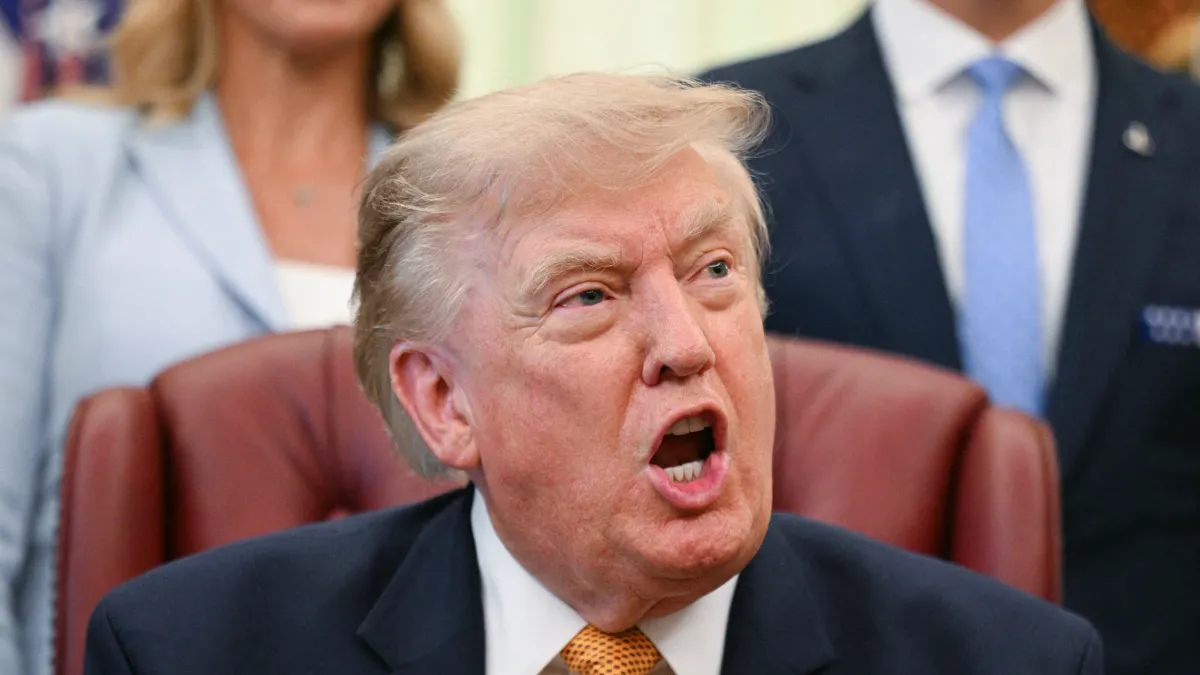
United States President Donald Trump said he will cut the 18-cent federal tax on petrol to offset surging prices that have continued to soar after his comments that the US ceasefire with Iran is on “life support”.

On Monday, Trump said he would suspend the petrol tax, but did not specify an end date.

Recommended Stories

list of 4 itemsend of list

“Yup, we’re going to take off the gas tax for a period of time, and when gas goes down, we’ll let it phase back in,” Trump told CBS News.

Trump later told reporters that he would waive the tax, which generates $2.5bn in funds used for US roadway infrastructure, “till it’s appropriate”.

The US administration hinted at the idea on Sunday, when US Energy Secretary Chris Wright told the NBC News programme Meet the Press that the White House was considering suspending the tax.

While the Republican president claimed he would waive the tax, that is not within the White House’s authority. Suspending a federal tax requires an act of the US Congress.

However, key Trump ally Senator Josh Hawley, a Republican from Missouri, said on the social media platform X that he would introduce legislation on Monday to do that.

In March, Senator Mark Kelly, a Democrat from Arizona, proposed suspending the tax until October.

“I anticipate it would pass, but there could be a procedural delay. It also suggests that President Trump doesn’t see a quick end to the reduced volumes and is trying to cushion the American consumer,” Rachel Ziemba, adjunct senior fellow at the Center for a New American Security, told Al Jazeera.

“The impact could be greater in states that have also reduced their own petrol taxes and could reinforce differentiation between petrol prices by region.”

US states also tax petrol, with Indiana, Kentucky and Georgia moving to make cuts to give consumers some relief at the pump.

Petrol prices have continued to climb since the initial strikes of the US-Israel war on Iran on February 28. The average price for a gallon (3.78 litres) of regular petrol is $4.52, according to the American Automobile Association, which tracks daily petrol prices, compared with $2.98 when the strikes first began.

However, news of the stumbling ceasefire has sent oil prices surging. Brent crude futures were up $3.17, or 3.13 percent, at $104.46 a barrel, while US West Texas Intermediate crude was at $98.32 a barrel, up $2.90, or 3.04 percent. Brent reached a session high of $105.99 and WTI hit a peak of $100.37.

On Wall Street, stocks for oil and gas giants are trending upward. Shell was up 1.6 percent in midday trading, Exxon rose 3.1 percent, BP gained 2 percent, and Chevron climbed 1.7 percent.

Airline bailout?

Trump was also asked by CBS on Monday whether a bailout was planned for the airline industry, which has taken a hit since the war on Iran began.

The president told the outlet that a bailout had not “really been presented” and that “the airlines are doing not badly”.

However, earlier this month, budget carrier Spirit Airlines ceased operations after 34 years. Court documents said the airline shut down because of “recent geopolitical events resulting in a massive and sustained increase in fuel prices”.

That comes as other major US carriers raise prices. In April, United Airlines said it would raise fares by 20 percent amid a surge in jet fuel costs.

Source link

Which countries have seen the highest petrol prices since the Iran war? | US-Israel war on Iran News

Motorists around the globe are already feeling the impact of the United States and Israel’s war on Iran, with fuel prices sharply rising since the war began.

In the US, a gallon of regular petrol that averaged $2.94 in February now costs $3.58, marking a 20 percent increase, according to data from AAA Fuel Prices, a retail fuel price tracker from the American Automobile Association (AAA).

While each US state sets its own petrol prices, several states have surpassed $4 per gallon, with California exceeding $5 per gallon, the highest level it has been in more than two years.

Which countries have the sharpest petrol price increases?

According to data analysed from Global Petrol Prices, a data platform that tracks and publishes retail energy prices across approximately 150 countries, at least 85 countries have reported increases in petrol prices following the initial attacks on Iran by the US and Israel on February 28. Some nations announce price changes only at the end of each month, so higher prices are expected for many others in April.

Vietnam recorded the highest petrol price increase of nearly 50 percent, rising from $0.75 per litre of 95-octane on February 23 to $1.13 on March 9. Laos follows with a 33 percent increase, then Cambodia at 19 percent, Australia at 18 percent, and the US at 17 percent.

The table below shows the countries that have increased petrol prices at the pumps.

Asian countries pay the biggest price

Asia is disproportionately dependent on the Strait of Hormuz for the delivery of its oil and gas, which has been effectively closed since the start of the war. The strait joins the Gulf – also referred to as the Persian Gulf and the Arabian Gulf – to the Gulf of Oman and is the only passage for the region’s oil producers to the open ocean.

INTERACTIVE - Strait of Hormuz - March 2, 2026-1772714221

Japan and South Korea are among the most vulnerable, importing 95 percent and 70 percent of their oil from the Gulf, respectively.

Both East Asian nations have enacted emergency measures to stabilise their energy markets. On March 8, Japan instructed its oil reserve sites to prepare for a potential release of strategic reserves. The next day, South Korea introduced a maximum price cap on petrol and diesel for the first time in 30 years.

In South Asia, the impact of the war is more severe than in East Asia because countries like Pakistan and Bangladesh have much thinner financial buffers and smaller strategic reserves.

In an attempt to conserve energy, Bangladesh‘s government has ordered all public and private universities to close immediately. In Pakistan, government offices will now operate a four-day workweek, while schools have closed, and a 50 percent work-from-home policy has been enacted to save fuel.

In Europe, the Group of Seven finance ministers convened an emergency meeting to discuss rising prices, with French President Emmanuel Macron raising the possibility of releasing 20-30 percent of emergency strategic reserves to ease the pressure on consumers.

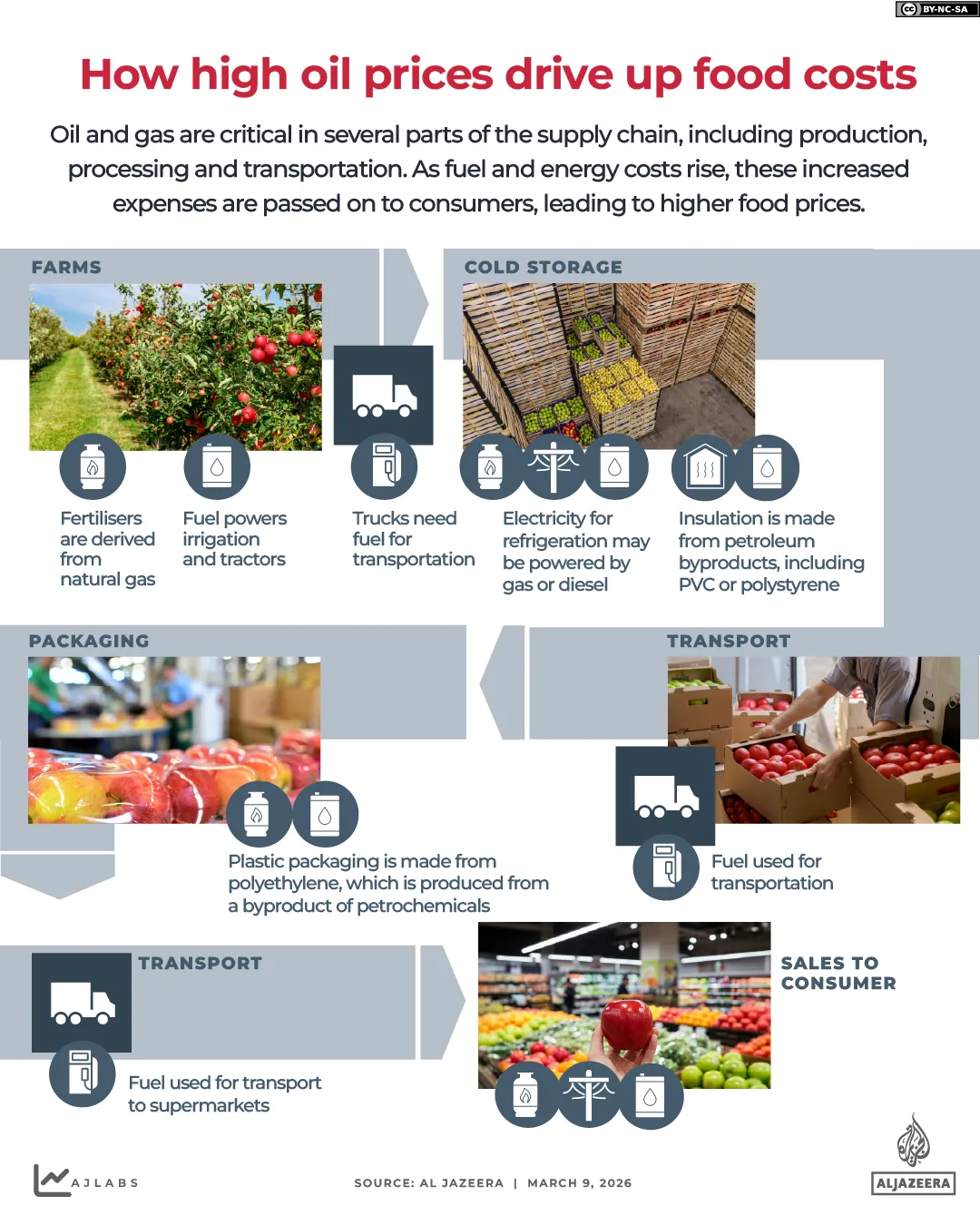
How high oil costs drive up the price of food

Oil prices and food prices move in lockstep, with energy prices affecting every stage of the food supply chain, from the fertilisers used in the fields to the trucks that carry food from field to supermarket shelf.

Rising oil prices also directly affect shipping and the cost of transport.

“The lifeblood of the global economy is transport,” economist David McWilliams told Al Jazeera. “It’s getting stuff from A to B – it’s a logistics problem, a supply chain problem, and ultimately transportation is the energy of the global economy.”

Fears of stagflation – increasing inflation and rising unemployment, which major oil shocks have historically summoned – are rising. Economists point to the crises of 1973, 1978 and 2008 as evidence that every significant spike in oil prices has been followed, in some form, by global recession.

In lower-income countries, where populations spend a far greater share of their income on food and import large quantities of grain and fertiliser, rising oil prices could rapidly translate into food shortages.

Interactive_Cost_OilPrices_Food-1773140062

What products are made from oil and gas?

Oil and gas are used for far more than just fuel. They are raw materials for thousands of everyday products.

Plastics, including water bottles, food packaging, phone casings and medical syringes, are all derived from crude oil.

Crude oil is also the hidden ingredient in synthetic fabrics such as polyester, nylon and acrylic, which are used to make everything from sportswear to carpets. It also underpins the cosmetics industry, as it is used to make products such as petroleum jelly (Vaseline), lipsticks and concealers.

Household items also rely on oil-based ingredients, with laundry detergents, dishwashing liquids, and paints all derived from petroleum products.

The global food supply is essentially built on natural gas in the form of fertilisers, used to enhance crop yields and ensure that food production can meet demand.


INTERACTIVE-CRUDE OIL-USED-MARCH 9-2026-1773138980

Source link