petition

U.S. appeals court sides with Trump administration on detaining immigrants without bond

The U.S. can continue to detain immigrants without bond, an appeals court ruled on Wednesday, handing a victory to the Trump administration’s crackdown on immigration.

The opinion from a panel of the 8th Circuit Court of Appeals in St. Louis overturned a lower court ruling that required that a native of Mexico arrested for lacking legal documents be given a bond hearing before an immigration judge.

It’s the second appeals court to rule in favor of the administration on this issue. The 5th Circuit in New Orleans ruled last month that the Department of Homeland Security’s decision to deny bond hearings to immigrants arrested across the country was consistent with the Constitution and federal immigration law.

Both appeals court opinions counter recent lower court decisions across the country that argued the practice is illegal.

In November, a district court decision in California granted detained immigrants with no criminal history the opportunity to request a bond hearing and had implications for noncitizens held in detention nationwide.

Under past administrations, most noncitizens with no criminal record who were arrested away from the border had an opportunity to request a bond hearing while their cases wound through immigration court. Historically, bond was often granted to those without criminal convictions who were not flight risks, and mandatory detention was limited to recent border crossers.

In the case before the 8th Circuit, Joaquin Herrera Avila of Mexico was apprehended in Minneapolis in August 2025 for lacking legal documents authorizing his admission into the United States. The Department of Homeland Security detained Avila without bond and began deportation proceedings.

He filed a petition seeking immediate release or a bond hearing. A federal judge in Minnesota granted the petition, saying the law authorized detention without bond when a person seeking admission is not clearly and beyond a doubt entitled to being admitted. The judge found this was not the case for Avila because he had lived in the country for years without seeking naturalization, asylum or refugee status and thus wasn’t “seeking admission.”

Circuit Court Judge Bobby E. Shepherd wrote for the majority in a 2-1 opinion that the law was “clear that an ‘applicant for admission’ is also an alien who is ‘seeking admission,’” and so Avila couldn’t petition on these grounds.

Circuit Court Judge Ralph R. Erickson dissented, saying that Avila would have been entitled to a bond hearing during his deportation hearings if he had been arrested during the past 29 years. Now, he wrote, the Circuit Court has ruled that Avila and millions of others would be subject to mandatory detention under a novel interpretation of “alien seeking admission” that hasn’t been used by the courts or five previous presidential administrations.

The American Civil Liberties Union, which is representing Avila, didn’t immediately return an email message seeking comment.

Atty. Gen. Pam Bondi hailed the ruling, writing in a social media post: “MASSIVE COURT VICTORY against activist judges and for President Trump’s law and order agenda!”

At question is the issue of whether the government is required to ask a neutral judge to to determine whether it is legal to imprison someone.

It’s based on the habeas corpus, which is a Latin legal term referring to the constitutional right for people to legally challenge their detention by the government.

Immigrants have filed more than 30,000 habeas corpus petitions in federal court alleging illegal detention since Trump took office, according to a tally by the Associated Press. Many have succeeded.

McAvoy writes for the Associated Press.
Source link

Video: $5 to sign a ballot petition with someone else’s name? California launches probe

A video circulating online appears to show signature collectors paying people to sign initiative petitions under other people’s names, according to officials, and now the state has opened an investigation.

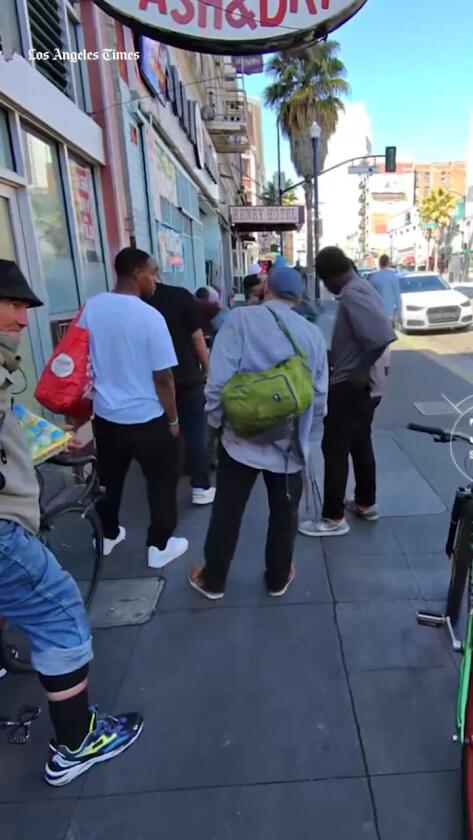
The video, filmed by videographer JJ Smith, shows a long queue leading to a table set up at 6th and Mission streets in San Francisco. A man in line says they are being offered $5 to sign petitions. At the table, where there are lists with the information of apparent registered voters, a woman confirms the payment and — using a highlighter — instructs a person on the name and address that she is supposed to use.

“I get $5 too?” the videographer asks.

“Yeah,” says the woman.

“And what is it?”

“Just sign it,” she says.

  • Share via

Petitions connected to at least three ballot campaigns — including the billionaire-backed effort to thwart California’s proposed billionaire tax — appear in the video.

“I approached some people and asked them what they were there for,” Smith told The Times. “They told me they didn’t know what they were signing for, that they just wanted the $5.”

Smith said he watched the scene for hours and estimated that a few hundred people cycled through the line over roughly two hours.

Those running the table did not ask for anyone’s identification and gave no explanation of what was actually being signed, he said.

The video showed voter data from San Luis Obispo County that was both visible and, as details were spoken aloud, audible in the footage.

The county acted immediately after becoming aware of the video and initiated an investigation through the fraud unit of the California secretary of state’s office, said Erin Clausen, public information officer for the San Luis Obispo county clerk’s office.

Clausen noted that, although voter registration data can be legally requested from county election offices, the data in this case may have been used inappropriately. The county is also planning on reaching out directly to voters who were specifically mentioned or identified in the video, according to Clausen.

“The activity shown in the video, if verified, would violate California election law,” County Clerk-Recorder Elaina Cano said in a formal statement released Wednesday morning.

The secretary of state’s office confirmed it had opened a formal investigation.

“Under California law, it is illegal to give money or other valuable consideration to another in exchange for their signature on an initiative petition,” a spokesperson said in a statement. “ Those who abuse our system will be held accountable.”

The office is working with local officials and encouraged anyone with information to file a complaint.

One political committee, Californians for a More Transparent and Effective Government, confirmed its petitions were among those whose signature gatherers were allegedly paying people to sign and moved quickly to distance itself from the activity.

“Under no circumstance do we tolerate this type of activity in the signature gathering process,” said spokesperson Molly Weedn. “We’ve taken immediate action and have demanded that the signature gathering firm identify these circulators and reject their petitions.” Weedn said the collectors were subcontractors, not campaign employees, and that attorneys were contacting authorities.

That committee is funded by another group, Building a Better California, which was also among campaigns that appeared in the video. The other was for a proposed initiative called the Retirement and Personal Savings Protection Act of 2026. Representatives for the latter two have not responded to requests for comment.

Smith said this was not the first time he had witnessed this type of activity in the area.

“I saw something similar with ballots three days ago,” he said.

The investigation is ongoing. Anyone with information can submit a complaint to the Office of the California Secretary of State or contact their local county elections office.

Times staff writer Seema Mehta contributed to this report.

Source link