My No. 1 pet peeve when people complain about theme parks
Early in life I discovered I had a particular affliction, and that was a proclivity for spending time at theme parks. I only phrase it that way because I understand some may find such a desire peculiar, which has made me particularly attuned to many comments about theme parks, especially those that aren’t positive.
Too hot, too crowded, too expensive or simply geared only for children. And while I’m happy to discuss or debate all aforementioned topics, there’s one particular criticism that I find especially grating: Theme parks are fake.
This is the argument that they are heavily fabricated and designed to elicit an emotional response, or worse, manipulate us. And it’s one I hear time and time again from grown-up peers. Over the years, it’s cropped up from friends. “Why do you go there?” they will say. “Everything is fake.” It’s appeared in books such as Henry A. Giroux’s and Grace Pollock’s scathing “The Mouse that Roared,” which dismisses the parks as presenting an “infantilized” worldview. And I’ve heard it from people I’ve interviewed, such as the USC professor of psychology who told me that theme parks were so fake, they forbade surprises.
The criticism irks me, in part, because of what it implies. By dismissing a Disneyland or a Universal Studios park as “fake,” there’s an implication that something is “more real.” A national park, perhaps, or a dedicated art institution. I adore those types of spaces as well, of course, but there’s an ignorant snobbery to this sort of remark, a thumbing of the nose that seems to argue I should spend some of my free time elsewhere.
This has been on my mind of late for a pair of reasons. One, I recently visited the Lucas Museum of Narrative Art and have been consumed with the discourse surrounding the value of story-driven art. And two, I recently read “Floating Mountains: The Art of Imagining the Impossible” by famed Disney designer Joe Rohde. The book is many things — an impassioned dissection of creative collaboration, a look at Rohde’s 40 years with Walt Disney Imagineering — but it is also a subtle argument that theme parks are vital, artistic spaces.

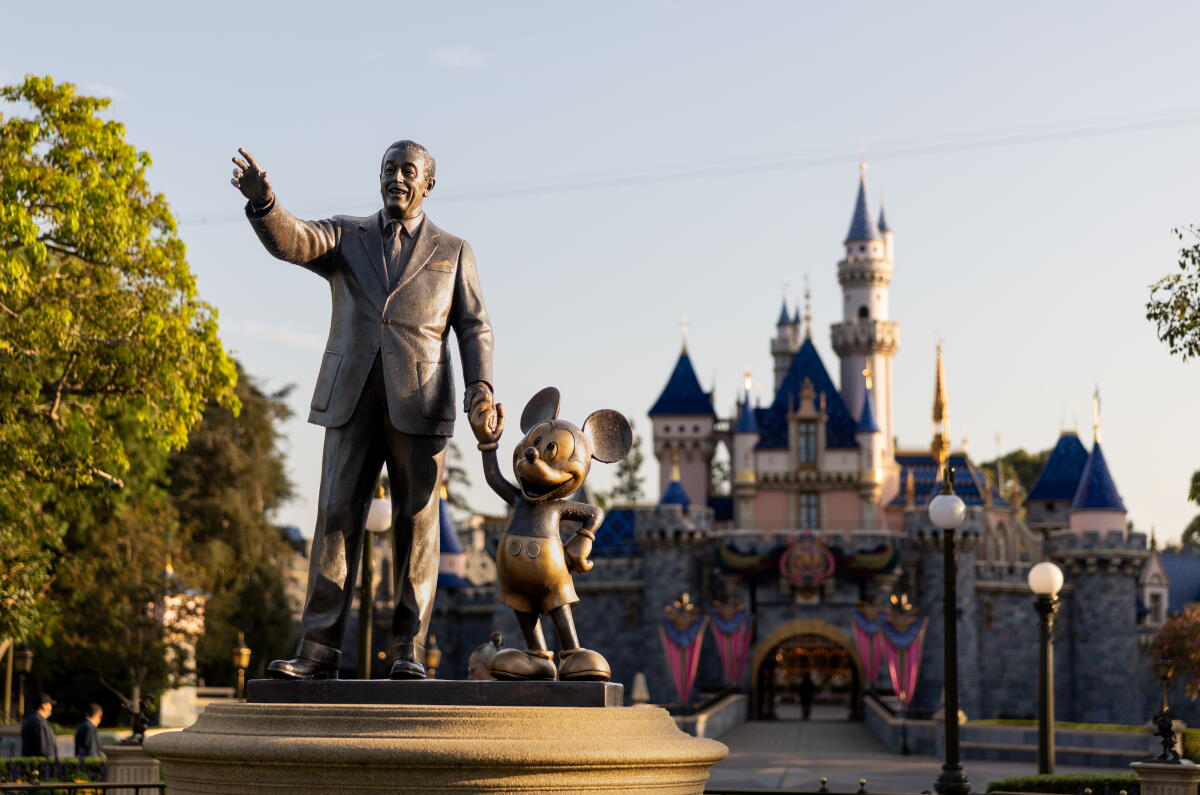
A statue of Walt Disney and Mickey Mouse in front of a very real fantasy castle.
(Christina House / Los Angeles Times)
I agree, and so I decided to bring up my pet peeve while talking to Rohde at the recent all-things-Disney fan convention D23.
“It’s a very odd criticism,” Rohde says of the knock on theme parks as being fake.
“Of course they are not real,” he tells me. “Movies are not real. Theater is not real. It’s like René Magritte, ‘Ceci n’est pas une pipe.’ Of course, a picture of a pipe is not a pipe. I don’t understand why that is an issue. It is a creation. In some cases it is a photo-realistic creation. In some cases it is a stylistic creation. But it is a creation. That’s what makes it a work of art.”
In “Floating Mountains,” Rohde, the primary creative behind the stunning Disney’s Animal Kingdom (second only to the original Disneyland in my mind), documents the myriad of disciplines that must come together to create such spaces. Animal Kingdom is full of real-world details. I can spend days exploring just the Africa section of the park, reading anti-poaching signs and piecing together a story that helps inform the area’s magnificent safari ride.
This is a work of art, albeit a less understood one, for narrative place-making and environmental storytelling are borderline experimental, less common than, say, a book or a film. Place-making requires that we not just take in our surroundings but constantly analyze them for story insights.

Joe Rohde, in 2017, discussing Pandora — the World of Avatar at Disney’s Animal Kingdom in Florida’s Walt Disney World.
(Jay L. Clendenin / Los Angeles Times)
Rohde also notes the degree to which Imagineers are taking influence from real-world spaces in an effort to bring narrative details into the parks, ensuring they appear at once familiar and fantastical. In the case of Animal Kingdom, it was Africa’s Lake Manyara National Park, among many other locales, that gave that park its realistic grit. And when it came to the fully imagined floating mountains of Pandora — The World of Avatar, it was finding inspiration in the Italian Baroque art of Gian Lorenzo Bernini, as seen in the entangled vines descending from the apparently hovering mountains.
Now, I am not someone who argues that a trip to Animal Kingdom is a stand-in for a vacation to Africa. Or that visiting the World Showcase of Epcot is akin to a jaunt around Europe. Or that hanging out in Cars Land is a substitute for a drive down Route 66. And an afternoon slugging pints at Hog’s Head at Wizarding World of Harry Potter is certainly not the equivalent of a day at an authentic British pub. No, what a theme park offers is an artistic interpretation, one that filters the natural world through the stories that define our lives.
Theme parks are not so much an escape from the world but a way to make sense of it. View them with an open mind, and they are an entree into storytelling exploration. This is different to me than, say, a re-creation of the Eiffel Tower being plopped into Las Vegas, which is preying on replication as generic spectacle. Theme parks, of course, can fall victim to this, too, when they utilize signposts or characters from a film as a substitute for innovation (see much of the design of Pixar Pier at Disney California Adventure).

Cars Land in Disney California Adventure was inspired by the scenery and history of Route 66.
(Mark Boster / Los Angeles Times)
France at Epcot’s World Showcase, in contrast, aims to weave a brochure-like tale of the country, to introduce us to culinary and architectural standouts that can inspire us to dig deeper. For some, sure, that’s deeper into their wallets, but World Showcase inspired a young me to be curious about the world beyond the suburban Chicago neighborhood I grew up in.
And purely fantastical creations — at least the ones that are done well — are not just references to things we saw on a movie or television screen. I think of Guardians of the Galaxy — Mission: Breakout! at Disney California Adventure, which is specifically designed as a cartoon-like intrusion, a building meant to clash and call attention to its surroundings. It’s all an effort to heighten the concept that the modern American myth — the superhero film — is work that encroaches, with uplifting exaggeration, on real-world settings.
And even a Disneyland classic such as Pirates of the Caribbean requires deep analytical reframing to properly understand it. Sure, it’s a boat ride with singing robot pirates, but that’s not the reason it has endured for more than half a century. I’ve described the attraction as the template for the perfect theme park ride, one that invites the guest to discover a host of mini stories based upon where riders are directing their focus. It’s a huge influence, for instance, on the world of open-world video games, which allow players to pick a direction and discover a narrative path. It’s anything but fake.

Pirates of the Caribbean is a study in environmental storytelling.
(Christina House / Los Angeles Times)
The criticism that theme parks are fake is a surface one, one that fails to properly meet the medium where it’s at. It’s easy, of course, to look at the nostalgia of a Main Street, U.S.A, and the castle up ahead and to write off Disneyland as a rosy, idealized take on America. This is the undiscerning view, for Disneyland is a presentation of an America that never existed, one disrupted by a castle that also doubles as an extended hand.
Think of it as an ask to use one’s imagination and to be open to play: Theme parks are a wholly unique medium that requires a different set of criticism, one that is looking at architecture and design as a storytelling device. And when one gets on a ride, a theme park expects us to be open to a somewhat abstract form of storytelling. Theme parks are also, at their core, a form of participatory art, inviting us to take on a starring role.
The mechanization of what makes a theme park a theme park is simply too complex, too vast and involving too many people to be dismissed as fake. And let me say that there’s no shame in wanting to be immersed in a world crafted by the hands of many a skilled artist, whether that’s the new David Geffen Galleries at LACMA or the Disneyland Resort.
This week in SoCal theme parks

Concept art for Magic Mountain’s upcoming 2027 coaster Thrill Glider.
(Six Flags Magic Mountain)
- A new coaster coming to Magic Mountain. Six Flags announced that coming in 2027 to its Valencia park will be Thrill Glider, a first of its kind thrill ride designed by coaster manufacturer Vekoma exclusively for Magic Mountain. Riders will board what the park is referring to as “hoverbikes,” essentially bike vehicles designed to simulate a flying sensation by being suspended from the track.
- Scary Farm is upon us. Halloween season is officially in full swing as Knott’s Scary Farm opens Thursday. New this year are two mazes, including one that intermixes a host of vintage animation, as well as a magic show collaboration with the Magic Castle.
- Fast & Furious: Hollywood Drift officially opens. Though it’s been in a soft open phase since late July, Universal Studios Hollywood’s Fast & Furious: Hollywood Drift will be properly open as of Wednesday. This means the coaster has passed its final testing and is ready for daily operation. Here’s everything you need to know about Universal’s fancy new coaster.
- Legoland expands its Halloween event. Brick or Treat at Carlsbad’s Legoland begins on Saturday and it’s bigger than ever in 2026. The family friendly event, for which costumes are encouraged, this year has added Brick or Treat Street, with six life-size monster homes to interact with. Also, be sure to head to the park’s new coaster, the Galacticoaster, which has received a Halloween overlay.
- A Walt Disney exhibition at Forest Lawn. Head to Glendale’s Forest Lawn Museum on Saturday evening for the opening reception of “California Visionaries: The Lives and Legacies of Walt Disney and Hubert Eaton,” which explores the connection between Disney and Forest Lawn Memorial-Parks founder Eaton. The exhibition, which promises concept art, rare Disney sheet music as well as items from early Disneyland attractions, is on display until Feb. 7.
Tell us your stories. Ask us your questions.
Have a theme park tale to share? Whether it was a good day or less-than-perfect day, I would love to hear about it. Have a question? A tip? A fun photo from the parks to share? Email me at todd.martens@latimes.com. I may feature your note in an upcoming newsletter.
Ride on,
Todd Martens
P.S.
Attention readers who are in or near Fillmore: This Saturday is the first-ever edition of the “Time Travel Convention,” a new interactive theatrical experience from Live Action Attractions. Many veterans of the theme park industry worked to bring this event to life, including some who collaborated on the now-shuttered Star Wars: Galactic Starcruiser, colloquially known as the “Star Wars” hotel.
The story: Once a year, time travelers from the distant future head back in time to witness a historic day in small-town America. Players are cast in the role of time travelers, and throughout the day Saturday expect a series of games and costumed characters to interact with. There will be three theatrical moments staged throughout downtown Fillmore beginning at 10:01 a.m.
Register online, and you’ll receive info on where to meet. The event is highly recommended.