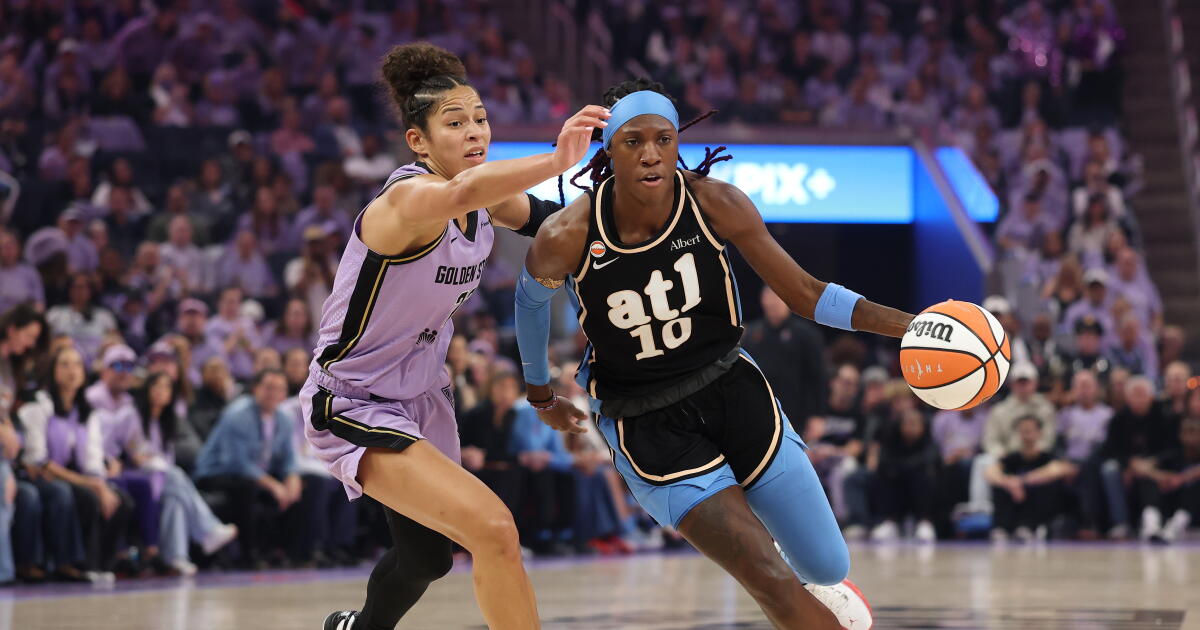
If you need permission to watch “The Permission” — a.k.a. Rhyne Howard of the Atlanta Dream — try to keep her team’s WNBA championship dreams alive, Flavor Flav’s got you covered.
The rapper issued signed permission slips Tuesday on social media for everyone to be excused from work on Thursday to watch Game 6 of the WNBA Finals. The next matchup in the best-of-seven championship series between the Dream and the Golden State Valkyries is set to tip off at 9:30 a.m. Pacific that day, when many people would be at work.
“Thursday is a paid holiday. Because Flavor Flav said so,” Flav, whose name is William Jonathan Drayton Jr., declared on Instagram and Threads. “Everyone should be able to watch Women’s Sports.”
The document, which includes a blank space for fans to fill in their own names, urges bosses to “go ahead and approve that day off” for the “very important” Game 6 of the WNBA Finals.
“You support women’s sports, RIGHT?!” the self-proclaimed “World’s Greatest Hype Man” wrote in the note. “Consider it your contribution to gender equality.”
The Valkyries clinched Game 5 at home at the Chase Center on Monday night 64-55 to move within one game of the team’s first-ever WNBA title. The Bay Area expansion team, led by head coach Natalie Nakase and known for its emphasis on defense, is just in its second season.
Flav’s note echoes the message Valkyries stars Veronica Burton and Kiah Stokes sent after Monday’s win to encourage their fans to tune in to Game 6.
“Call in sick,” Burton said. “I recommend it.”
“Y’all know how to fake a cough,” Stokes added.
Atlanta Mayor Andre Dickens also shared a statement Tuesday on Threads asking employers and educators to “show a little love and extend a little grace” to those who may be cheering the Dream on during their school or work hours.
“Lean into the historic moment, embrace the excitement and let Atlanta show up for Atlanta,” he wrote.
The WNBA announced Monday that Game 6 would be played at State Farm Arena in Atlanta with the earlier start time. The game was originally scheduled for 5 p.m. Pacific but was rescheduled so it could be played in the larger arena. Games 3 and 4 of the series were also moved to the larger venue.
The Dream normally play at the 3,500-seat Gateway Center Arena at College Park. State Farm Arena, which can seat around 17,000 for basketball games, will host all Dream home games starting in the 2027 season.
The matinee timing of Game 6 is because of Atlanta’s NBA team, the Hawks, also being scheduled to play at State Farm Arena on Thursday. The team will face the Cleveland Cavaliers for a regular-season matchup at 5 p.m. Pacific.
“Thank you for your cooperation and for doing the right thing,” Flav wrote.
The multidisciplinary artist rafa esparza was maybe 19 and in the break room of the now-defunct Orchard Supply Hardware in Pasadena when he first found out about the revolutionary art group Asco. It was the early 2000s, and he was working full-time while going to school part-time at East Los Angeles College. He’d bring his homework to his job, and an older colleague, Ignacio, took interest in the books he was reading — mostly about Chicana/o studies and art.
Ignacio grew up in East L.A., and showed esparza a big manila envelope stuffed with incredible sketches and drawings by Glugio “Gronk” Nicandro. Gronk, a friend of Ignacio, was one of the founding members of Asco, which roared to life as an unapologetically Chicano organization in the early 1970s and was made up of East L.A. natives including Patssi Valdez, Harry Gamboa Jr. and Willie Herrón.
Esparza is now among two generations of L.A. Chicano and Mexican artists who have passed the torch that Asco used to blaze its groundbreaking trail. The story of the art group and its descendants, also including Maria Maea and San Cha, is featured in the new documentary, “Asco: Without Permission.” Executive produced by Gael García Bernal and Diego Luna, the film premiered last year at SXSW and arrives on TV for the first time at 7 p.m. Friday as part of PBS SoCal’s “Voces” series (plus PBS.org and the PBS app).
The beginning of a movement
When Asco first coalesced, Gamboa Jr. went to Los Angeles County Museum of Art and noticed a striking absence of Chicano pieces. In the film, he recounts how, after his concerns were dismissed by a higher-up at LACMA, Asco decided to take matters into its own hands. The group came back later that evening and tagged the building with their names (“Spray Paint LACMA,” 1972), effectively reclaiming the entire museum as a work of Chicano art.
1/7
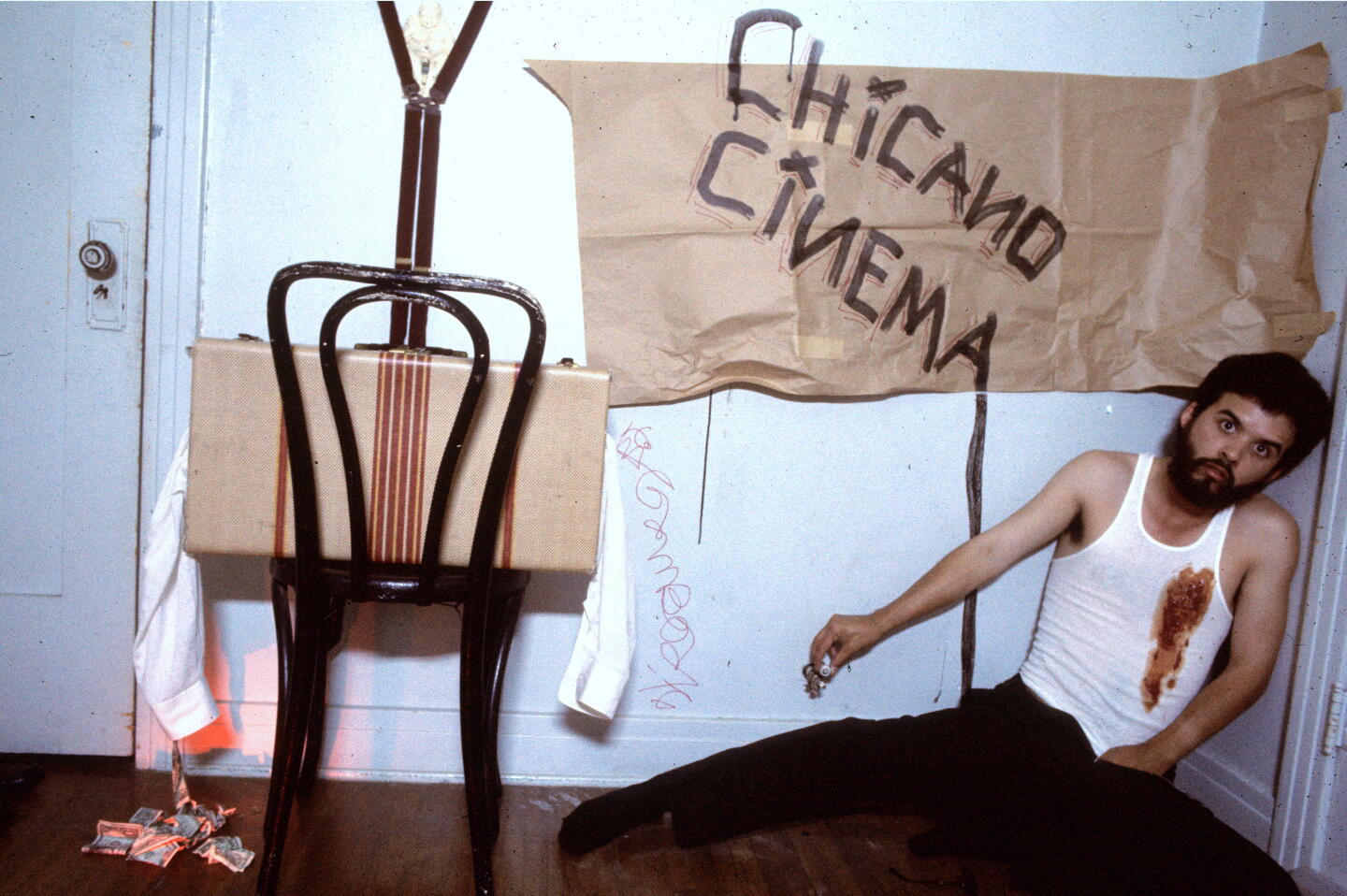
The No-Movie “Chicano Cinema,” starring Harry Gamboa Jr. (Asa Nisi Masa Films / PBS)
2/7
A group shot of the art group Asco. From left to right: Willie Herrón, Gronk, Patssi Valdez and Harry Gamboa Jr. (Asa Nisi Masa Films / PBS)
3/7
Members of the art group Asco pose in Malibu. From left to right: Gronk, Patssi Valdez, Willie Herón and Harry Gamboa Jr. (Asa Nisi Masa Films / PBS)
4/7
Patssi Valdez poses with her golden No-Movie Award, a parody of the Academy Awards, protesting the lack of Latino representation in Hollywood. (Asa Nisi Masa Films / PBS)
5/7
The Asco No-Movie “The Gores (Whittier Blvd + Ax)” (1974). (Asa Nisi Masa Films / PBS)
6/7
The Asco No-Movie “Star” (1980), starring Patssi Valdez. (Asa Nisi Masa Films / PBS)
7/7
A still photo of the Asco performance piece “Birds Wave Goodbye,” from 1972. (Asa Nisi Masa Films / PBS)
Asco’s work remained in relative obscurity — living in local mythology through storytellers like Ignacio — for decades. Then, in 2011, LACMA‘s views evolved and the museum gave Asco its first major retrospective, “Elite of the Obscure.” Documentary writer and director Travis Gutiérrez Senger came across press coverage of the retrospective and felt immediately drawn to the group, connected “on almost a cellular level.”
But it wasn’t until Trump’s first run for presidency and subsequent election, when his language around Latinos and immigrants dangerously sharpened, that Gutiérrez Senger knew in his gut that he needed to make this film now.
What set Asco apart was the fact that it was an art group, not a singular artist, working in tandem to react to social and political realities, including the 1968 East L.A. walkouts, the 1970 Chicano Moratorium, the Vietnam War, police brutality and gang violence.
“I would have never done the film if it wasn’t a collective,” Gutiérrez Senger said. “The thing about art history — and in literature and film — we often canonize individuals. When I saw Asco and it was a group, and they’re [on] the cover of Artforum or at the Whitney … that to me was really, really captivating. And, I thought, also very constructive.
“This isn’t just a group; this is a metaphor for how we mobilize and change,” Gutiérrez Senger remembers thinking.
Art as action
Asco was a fecund ecosystem, as is the close-knit community of contemporary artists following in its footsteps. The documentary recounts the history of the original group while heeding its call to action by collaborating with next-gen artists to carry the tradition forward. In 2023, Gutiérrez Senger curated a pop-up exhibition — featured in the film — alongside Pilar Tompkins Rivas, called “Asco and the Next Gen: An Inter-Generational Celebration of Latinx Art.” “Asco and the Next Gen” included esparza, Maria Maea, San Cha, Ruben Ulises Rodriguez Montoya, Guadalupe Rosales, Gabriela Ruiz and Dorian Wood.
“When you’re deeply collaborating with folks, and you’re in each other’s mediums and you’re sharing thoughts, and you’re thinking together, conceptualizing together, birthing a project together from scratch, you really have to step beside yourself, and understand that this is something that you’re co-creating,” esparza said. “Versus, I think art teaches us to center the single voice, the singular author of an artwork. And my experience of life, of art-making, has been the complete opposite: I think that we’re constantly reflecting each other.”
Esparza’s contribution to that 2023 pop-up was called “Corpo RanfLA: Terra Cruiser” and was originally staged outside the fairgrounds of Art Basel Miami a year prior. The L.A. version took place in the parking lot of an Arts District strip mall. Esparza bounced. He lay in a prone position, arms extended, body ensconced in gold and green lowrider armature, adhered to a blue bike frame, rocking on a 25-cent mechanical ride mechanism. The early connections esparza had with Asco resonated deeply in his relationship to art-making.
“They’re guerrilla, not asking for permission, just doing what they wanted to do with the help of their collective efforts,” esparza said. “That’s an ethos that’s very present in my own performance work, and it’s something that I hold very dear to me. It’s something that I always want to protect, in terms of how the art industry so powerfully commodifies everything you make as artists. I feel like performance still holds this power to really resist that, depending on how we will it into being.”
The interdisciplinary artist Maria Maea (left) and the filmmaker Travis Gutierrez Senger (right), writer and director of “Asco: Without Permission,” pose at Barker Block. Maea is featured in the film, in which she and Gutierrez Senger collaborated on a new “No-Movie,” titled “Pasado/Futuro.”
(Carlin Stiehl / For The Times)
Moving pictures are part of the revolt
Asco also had an interest in film. The art group members didn’t see themselves — or Chicanos or Latinos — represented in Hollywood, so they did it themselves, subverting a movie into a single still photograph that became its own story; an implied narrative. These, featured in the documentary, were called No-Movies.
In addition to the “Asco and the Next Gen” pop-up exhibition, Gutiérrez Senger and the filmmaking team invited multidisciplinary artist Maria Maea, San Cha, musician Fabi Reyna and Mexico City-based Ruben Ulises Rodriguez Montoya to create new No-Movies, also featured in the film, in response to Asco’s original No-Movies.
Maea first learned about Asco through esparza, too. He’s a mentor of sorts to her (they’re part of the same “interlocked brown community,” she says), and they were making adobe bricks together on the banks of the L.A. River for esparza’s 2017 Whitney Biennial installation when he told her the story about the hardware store and the manila envelope.
“They had a finite amount of resources, and they took this cinematic film lens or film camera film and shot these stills,” Maea said. “I think for me, it was so beautiful to see the infinity that could happen in front of it, the story that could happen behind it. It felt like we were just seeing this snapshot of a beautiful cinematic moment.”
The documentary’s new No-Movies are slightly longer, but still snippets of less than five minutes. The main character of Maea’s “Pasado/Futuro” No-Movie, the Being, sprang from the show “L.A. Fonts,” in the artist Alfonso Gonzalez Jr.’s backyard. (“Pasado/Futuro” also includes a group of kids working in a garage, meant to emulate Asco’s own garage origins — and to represent the next next gen. Its cast includes Maea’s younger sister, Ariel-Evelia Tuilaepa Diaz.) The Being is alien, mystical and magical, a migrant finding her way in a new world. (Maea often works with palm weaving, incorporated here, and palms have their own migration story to L.A.)
A still from “Pasado/Futuro,” one of the contemporary No-Movies in the film, featuring Maria Maea as The Being.
(Asa Nisi Masa Films / PBS)
“Something that really intrigued me was their sci-fi aspect of this film,” Maea said of Asco. “Like, they lived in a real world where they were experiencing the Chicano Moratorium, they’re experiencing violence in the streets, and they were also experiencing … the news projected back at them, that they were the issue,” stranger-than-fiction scenarios they synthesized into sometimes-futuristic or dystopian work.
Composer and performer San Cha’s No-Movie, “Luna,” made together with the musician Fabi Reyna, began as a song San Cha had written for a friend who had died; she had had a dream of him on the moon. In collaboration with Gutiérrez Senger, the No-Movie evolved into a piece about a lover, played by Reyna. Now, “Luna” is tender and otherworldly, drenched in the high drama and glamour that San Cha so loves.
San Cha was born in San José, then moved to San Francisco, where she was taken in by the Bay Area drag scene — specifically by her drag mother Per Sia, who’s still there. (San Cha recently relocated to Amsterdam.)
“She is from South-Central, but she studied art, visual art,” San Cha said. “She was a photographer, and she really got into the drag scene, and she was super familiar with Asco. We would do these processions in the Mission, from the Mission to the Castro … and she would always mention Asco in these moments.”
That’s likely because Asco’s early performances, as the art historian and curator C. Ondine Chavoya points out in the film, emphasized procession, mobility, mobilization and occupation, marking sites of political violence. Once San Cha moved to L.A., she found community quickly, too. She met Maea — with whom she made a video, “Coatlicue,” for the Music Center’s For the Love of L.A. program — and later lived with esparza.
“We can’t really perform in a vacuum,” San Cha said. “I can’t imagine doing this by myself, ever.… When I moved to L.A., there’s someone for everything.… And that way I didn’t feel the need to do everything alone. And even though in L.A. it was a little more professional, there’s so many people that are just like family.”
A still from “Luna,” one of the contemporary No-Movies in the film, featuring Fabi Reyna (left) and San Cha (right).
(Asa Nisi Masa Films)
When Gutiérrez Singer first started making this film, he thought that it — and Asco itself — was about saying “f— you” to the systems and institutions and racism that give us asco. (“Asco” means nausea or disgust in Spanish.)
“But at the end of the project, I started looking at the work and myself and the artists I had made the film with, and just seeing this incredible beauty and love,” he said. “And I realized that the power of Asco’s work is ultimately about self-love, and that when you feel that — and you can feel almost a collective sense of self-love as brown people — it gives you incredible potential and strength.”