Sniff and find connection? These hip fragrance gatherings tantalize L.A.’s ‘smellers’
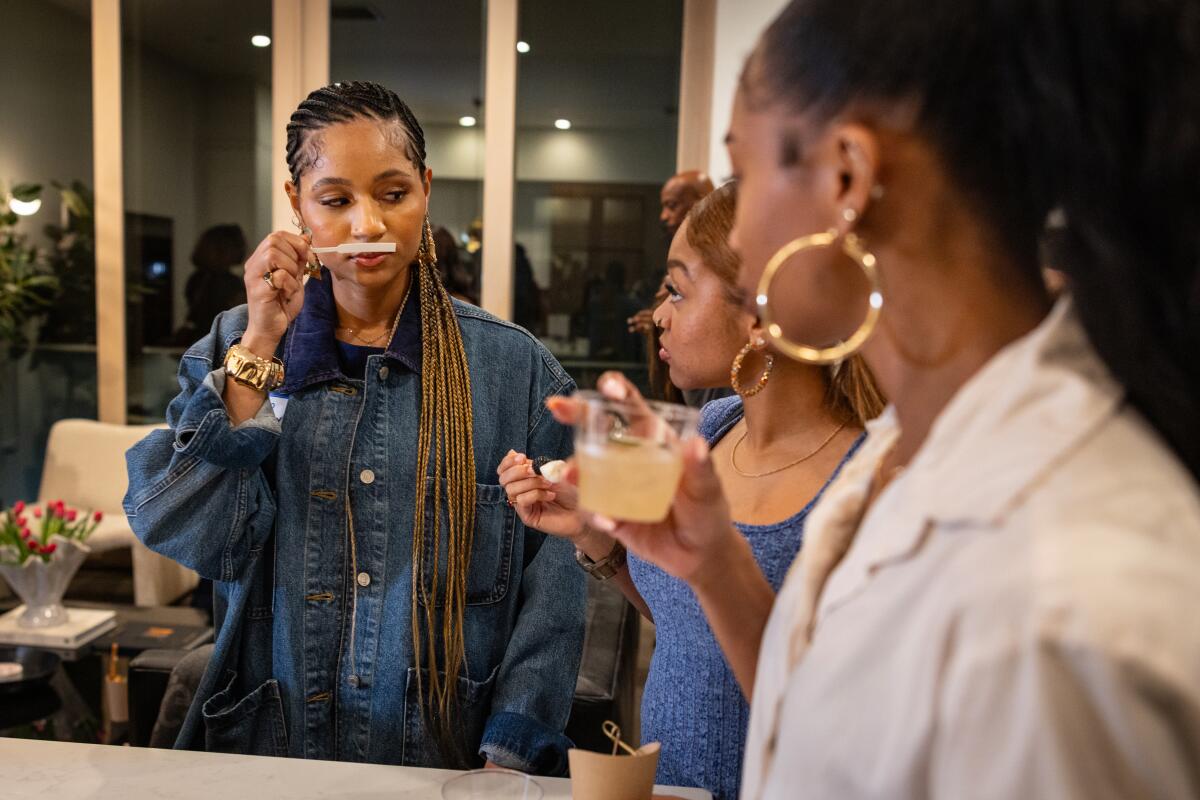
On a Thursday night in West Hollywood, a sleek, multi-level townhome is filled with stylish guests holding fragrance vials the way partygoers cling to cocktails. They raise scents to their noses as they mingle and float through the space.
In one nook, two well-known faces in the fragrance community, Tishni Weerasinghe (@thatbrownperfumegirl) and Chase Chapman (@thescentchase), host stations with their favorite home scents — pre-bedtime spritzes to everyday comforts for working from home — as a small group leans in, asking questions and noting which scents resonate. Inhaling the blend of white musk, floral notes and amber of Rouat Al Musk by Lattafa, a $16 fragrance from Weerasinghe’s collection, attendees oooh and nod in enthusiastic approval.
In another corner, guests try fragrance pairings, scents expertly paired with drinks, letting the aroma and flavors mingle through their senses. Outside on the rooftop, the crowd spills into smaller conversations over refreshments and city views.

Sarah Bowen, co-founder of the Smellers Club, sniffs a fragrance.
This is the Smellers Club. To an outsider, it might seem like a gathering centered around a niche fixation, but within this world, fragrance is much more expansive. Here, it’s a bridge between people, a tool for self-expression, a way to understand your own taste and increasingly, a reason to connect. The night’s gathering is taking place in the home of Daniel Scott and Ronn Richardson, the duo behind the fine home fragrance line Space.
Some guests are simply scent-curious, while others have deep roots in the world of fragrance. One attendee, Jess Blaise, the co-founder of Haitian Spotlight LA, credits her Haitian heritage and the fragrance rituals modeled by her mother for her connection to scent. She recently purchased a bottle of Carnal Flower by Frederic Malle for her personal collection, a luxe tuberose known for its white floral profile and appeal among niche collectors. Of her culture, she explains, “Part of your presentation — of dressing up — is your scent.”

The gathering was hosted in the home of Daniel Scott, left, and Ronn Richardson, co-founders of the home fragrance brand Space. Space offers a range of luxury home fragrances and candles.
Across Los Angeles, fragrance clubs are transforming what was once a solo ritual into something communal. From rooftop gatherings in West Hollywood to casual park meetups further east, these hangouts tap into a growing desire for laid-back, low-stimulation ways to spend time together, offering an alternative to the usual rotation of restaurants, bars and crowded nights out.
Reverie of Scent turns a small nook of Elysian Park into a mini fragrance lounge on Saturday mornings once a month. Founded in November 2025 by Marian Botrous, with support from her husband, Errol, and her sister, Marlene, the club started with just four members at the first meetup. By their sixth gathering this past April, attendance had quintupled, with a mix of regulars and newcomers at every session.
“It’s a huge world,” Botrous says of perfume. “Exploring it together makes it more interesting.”

Fragrance lovers hang out on the rooftop at Smellers Club’s West Hollywood gathering.
At her picnic-like gatherings, attendees show up with blankets, snacks and scents to swap or discuss. With 2-milliliter samples running up to $12, “collecting new scents gets expensive fast,” Bostrous says. “Our meetups make it accessible and fun.”
There’s a mix of casual socializing and structured discussion — conversations have explored the motivations behind wearing fragrance, from seduction to personal comfort, as well as the cultural impact of certain perfumes, like Chanel No. 5 and its connection to Marilyn Monroe and old-school luxury glamour. At one meetup, a member brought in a fragrance called Scentless Apprentice, inspired by the novel “Perfume: The Story of a Murderer” by Patrick Süskind (which Kurt Cobain loved so much that he wrote the Nirvana song “Scentless Apprentice”).
Artist Megan Lindeman, who founded Silverlake Scent Club in August 2025, is also bringing people together to explore scent as a shared social experience. Lindeman says she was inspired by Los Angeles’ broader scent culture and a curiosity about what it would feel like to center smell in a communal setting. The group meets monthly in her Silver Lake backyard, where attendees explore fragrance as both material and memory.
Black Girl Perfume Club was founded in 2023 by Taylyn Washington-Harmon, launching online before expanding into in-person meetups. Across Substack, Instagram and IRL gatherings, it brings together fragrance lovers and newcomers eager to deepen their understanding in an interactive way. “I started the club back when fragrance’s popularity was still pretty niche, and now seeing it move into the mainstream is really exciting,” says Washington-Harmon. As interest grows, she hopes more people will also explore the range of artistry produced by Black-owned fragrance lines.
Back at the house in West Hollywood, people continue to vibe at the event led by Sarah Bowens and Jon Kidd, Los Angeles natives and the duo behind the Smellers Club, launched in January. They’re siblings-in-law who grew up together in the church and are quick to note that their respective partners, Zana and Zion, are unofficial team members and rock-star supporters.

Jess Blaise tests out a scent by Selnu.
Between the both of them, Kidd brings the “fraghead” energy — a name for fragrance devotees who bring a passion and certain fluency of fragrance culture. Bowens, who comes from an events background, heads curation and considers herself more in the beginning stages of her fragrance journey.
When they first started hosting these events, Bowens wasn’t sure how captivating they’d be. “I was like, can people really sit here for hours and talk about fragrance?” she says. She got her answer quickly, watching guests chat, laugh and dive into lively conversations for hours.
Kidd points to wine and book clubs as “event muses” for the Smellers Club. “At a certain point, it stops being about the books or the wine — and for us, even the fragrances,” he says. “It becomes about the people.”

Chase Chapman sets up scents from his personal collection of fragrances for guests to discover at the Smellers Club gathering.
As people navigate adulthood and personal growth cycles, challenging habits and shedding old identities, there are a few underlying questions: Who am I, really? What do I actually like? And what feels good and in alignment with being at ease? Fragrance communities can be a surprisingly grounding place to explore these existential meditations. Bowens, for example, was recently drawn to strawberry-forward Fruits of Love by Dossier, which surprised her since she considered herself someone who didn’t like fruity scents. Such realizations are familiar in the community: You can miss out on something satisfying simply because it doesn’t match your predefined tastes.
Farah Elawamry, a fragrance-focused content creator known as Farah’s Thoughts, has examined fragrance marketing and its ties to rigid gender norms, explaining that “the iris note is always given to women’s fragrances and orris is always given to the masculine fragrance genre, and they’re literally the same note — one is the root, one is the flower.” Once you start diving into the history and psychology of fragrances, she says “you begin to question what you actually like versus what marketing people are telling you to enjoy.”
Compared with the typical nightlife scene in Los Angeles, attendee Shaunt Kludjian says gatherings like these feel more intentional. “This turned out to be better than the clubs in L.A.” he says. “Everyone’s just vibing and connecting over scent.” Kludjian is founder of the Los Angeles candle company Whiff and came to the event to network. Frustrated by traditional candle formats, he launched a line of portable candles packaged in small, tuna-like tins designed to make “home follow you wherever you go.”
As Kidd looks around and watches strangers become friends over a sniff of musk or jasmine, he reflects on part of the magic of the Smellers Club and other fragrance communities.
“Fragrance is a portal to your memory,” he says. “So by coming to something curated that’s a wonderful night, you’re ingraining a memory.”
What started as a question of what smells good has become something else — small moments of recognition between many people who, just hours earlier, had been total strangers. Maybe that’s the point. The bottles will get put away. Everyone will return to their separate corners of the city. But the feeling of being seen, of finding your people — even briefly — sticks with you long after the scents dissipate.