In the spirit of Zeus’ law to be generous toward guests, I’m honored to welcome classics professor Emily Wilson to the land of film criticism. As she’s recently learned, it’s an adventure that sails smack into islands of musky internet trolls and clashes with cinematic and literary titans like Christopher Nolan and Joyce Carol Oates.
Nolan credits the opening line of Wilson’s 2017 translation of Homer’s “The Odyssey” — “Tell me about a complicated man” — as partly inspiring his adaptation of the ancient epic, which, nearly a month into its release, is soldiering toward a billion-dollar box office gross. Symbiotically, Wilson’s edition is now the No. 2 bestselling book in the country. That Wilson’s incendiary essay in the London Review of Books revealed she doesn’t think much of Nolan’s blockbuster struck some as hubris, including Oates, who took to social media to decry the scholar’s “tone of dismissal” and “haughty superiority.”
If you haven’t been following the controversy, Wilson felt that Nolan had flattened the saga by mostly erasing the Greek gods and Odysseus’ wit, lust and thorny contradictions. Oates likened the tone of Wilson’s critique to the “crude language of MAGA folks.” In short: Wilson snuck a 2,700-year-old poem through the gates of mainstream taste — and after that victory, her arrogance left her marooned.
Sounds familiar if you’ve read Homer. Less so if you’ve only seen the film. Wilson is right that Nolan’s movie lacks Odysseus’ egomaniacal brilliance.
I’m here to play peacemaker. Wilson adores Odysseus so much that she has his bow tattooed on her right leg. Frankly, Nolan doesn’t seem to like the wily, libidinous and violent trickster-veteran of the poem — half Rhett Butler, half Rambo in “First Blood” — as much as Wilson or I do. Because if he did, that Odysseus would be onscreen.
But having seen his movie twice, it’s obvious that Nolan is less interested in Wilson’s first line than her fifth: “Tell the old story for our modern times.” That, he’s done. His take on Homer is, as I wrote in my original review, “a moralistic ‘Oppenheimer’ prequel.” For the record, I like it anyway.
Film critics and translators start work in the same place. Step one: What is the artist’s intent? Wilson considered the entirety of Homer’s tale and decided the right word for polytropos was “complicated.” I weighed what Nolan chose to protect, tweak and abandon in his own version and concluded that he wanted to make an action-tragedy about societal decline.
Movies must be measured against their own ambitions. A stoner comedy can’t be graded like a Shakespearean drama (and vice versa). Here’s where Wilson runs aground. She wants to allow Nolan creative freedom, knowing that the Greek playwrights rebooted figures like Odysseus and Medea just like Marvel treats Spider-Man. There’s even a spinoff of the original poem in which Odysseus has kids with Circe.
Yet, storytellers have to protect the core of their characters. Medea must be angry, Spider-Man must be helpful and Odysseus, dang it, must have swagger. Damon doesn’t.
This is why Wilson deserves empathy even if she can’t bring herself to grant Nolan the same grace. As a professor of classics at the University of Pennsylvania, she’ll be on the front line of academics condemned to unteach Nolan’s heavily altered screenplay to students who will arrive quoting it chapter and verse. For decades to come, high school kids — probably even a few high school teachers — are just going to pop in his Blu-ray and call it a day.
Nolan does hit his target, eventually. Yet his script wobbles. He’s made a movie about Odysseus’ remorse for inventing the Trojan horse without a crucial scene: the moment he invents it. We see Odysseus silently stroll the beach outside Troy, but not the pride he must have felt running back to base to pitch an idea that will finish the war and let his allies go home. The emotional arc Nolan wants to trace should start there. The beat’s absence is confounding since Odysseus also needs to appear clever (and never does).
This is what it means to measure a film against its ambitions. Only after we accept that Nolan is solely interested in human mistakes can we gauge his disregard for the Greek gods. I dig that choice — it’s bold — yet still think he flubs it by not replacing the magical powers of Charlize Theron’s Calypso and Zendaya’s Athena with, say, a personality. What a waste of two terrific actors. It’s no wonder Oates stuck up for him. Her novel “Blonde” also stripped the agency from love goddess Marilyn Monroe and its own 2022 movie adaptation launched a thousand hot takes.
There will never be a faithful modern film version of “The Odyssey.” No, not even whatever AI slop Elon Musk claims he’s green-lighted, a project I’m sure will come to fruition as fast as his any-year-now claim that he’s landing on Mars.
The issue isn’t just the poem’s length. It’s that today’s audiences have zero stomach for happy endings about horrible wrongs. We can barely rationalize the slaughter of the suitors. No one wants to watch Homer’s gory scene after that, when Telemachus cruelly orders a dozen enslaved girls to clean up the mess and then executes them too.
Only a seven-and-a-half hour Italian miniseries produced by Dino de Laurentiis in 1968 dares mention that second bloodbath and even in that, the women are hung offscreen after we’ve been assured (fictitiously) that the maids tried to kill them first. (Side note: Dino’s Penelope, played by the mighty Irene Papas, is my favorite.)
Previous movie adaptations of “The Odyssey” soft-pedal or ignore the hero’s postwar PTSD. You catch a glimpse of it in the two-part NBC special from 1997 in which Armand Assante’s Odysseus rescues a Trojan toddler. But mainly, he spends more time hot-tubbing with Vanessa Williams’ Calypso.
That’s not a knock. The ’90s “Odyssey” is as tacky as Caesars Palace but Assante’s smooth-talking horndog is closer to my ideal Odysseus than Damon’s neutered mope. He sleeps with both Calypso and Circe and still earns his tender reunion with Penelope by choosing her beloved wrinkles over those gods’ immortal perfection. (For what it’s worth, Oates is a fan of it too. Wilson has yet to comment.)
Only the two most recent versions — Nolan’s and Uberto Pasolini’s 2024 “The Return,” starring a sinewy Ralph Fiennes — center on Odysseus’ culpability for the carnage of the Trojan War. Damon’s Odysseus is numbed by the massacre of Troy’s civilians; Fiennes’ hates himself for leading the best men of Ithaca to their death, gutting his own community in the heedless destruction of another. I’m tempted to diagnose the current gloom as the result of our own post-9/11 forever wars.
The 21st century has seen enough genocide for Homer to compose a hundred sequels. Only those stubbornly ignorant to the human cost of actual combat would be psyched to bring on more of it. (Just ask the veterans in my family how they feel things are going in Iran.) At the end of “The Return,” when Fiennes stands entrail-smeared before his beloved Penelope, she recoils from the horror of the battlefield brought right into their home.
That interpretation has its flaws too. The middle stretch has a concocted outdoor chase sequence that feels like a clumsy campground slasher. Wilson applauded its “stylish sparseness.” Fair enough. I’d still love to invite her and Nolan and even Oates to a banquet of wine and roasted fowl and have a blast agreeing to disagree. No weapons allowed.
Tell me, Christopher Nolan, when did it first rosy-fingered dawn on you that your favorite type of protagonist — a tormented sinner-hero — was a specialty of the ancient Greeks? Millennia before Matthew McConaughey’s astronaut sobbed over abandoning his family and Cillian Murphy’s Robert Oppenheimer gasped that he had become the destroyer of worlds, the Greeks spun cautionary legends about Odysseus, the Trojan War tactician who outsmarted his own plan to sail smoothly home.
Nolan refuses to tremble before the canon. Grabbing mighty scissors, he cuts and rejiggers Homer and a bit of Virgil to transform these classical texts into his type of tale: one fixated on memory, self-identity, destructive genius and the slippage of time. As ever, it’s light on sex, heavy on wine-dark angst.
Once you endure its opening stretch — an expositional barrage with the pace of an obnoxious cop show — “The Odyssey” ascends as a monument to movie craft with shuddering ships, rough-hewn landscapes and practical monsters who snatch and grab men at random from above like giant skill cranes. Unlike in most mythological tales, the white Corinthian columns have been swapped out for brutal stone architecture. The Parthenon won’t be built for another 800 years; likewise, Athenian democracy is centuries away.
Nolan has anchored his “Odyssey” at the fall of the Bronze Age, a once-great era toppled by wealth-hoarding, diminished trade and climate catastrophes. Fearful of invading marauders, humankind has turned distrustful and stingy, ignoring Zeus’ command to show generosity toward the poor and foreign-born, a cornerstone of faith that would later be repurposed in the New Testament.
Share via
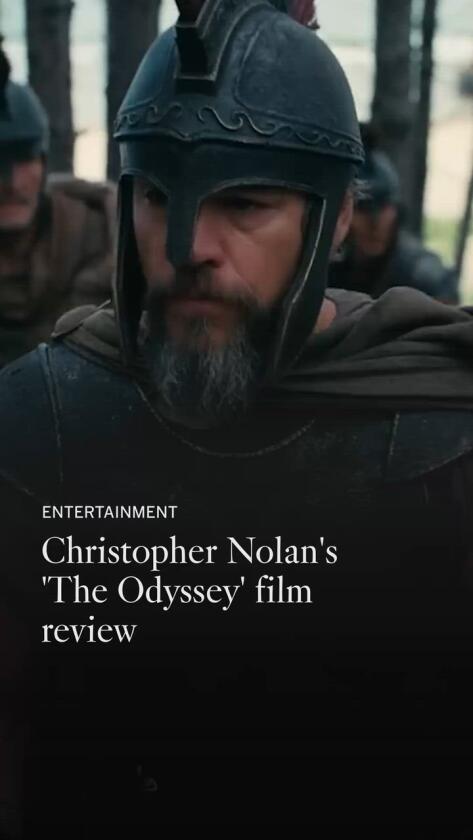
This Odysseus (Matt Damon) is both witness to and wrecking ball of the collapse. Not only does he steal, slaughter and pillage while expecting to be treated with kindness, but he’s also brainstormed the atomic bomb of his day: the Trojan horse, a deceitful invention planted into the sandy beaches of Troy that marks the decline of civilization like the Statue of Liberty in “Planet of the Apes.” Inside this claustrophobic wooden beast, Odysseus and his wild and bloodthirsty Greeks are crammed cheek-to-sandal so tightly that you can’t imagine how they’ll spring into action without first getting a massage. Outside and looking up at it, the pony seems to sneer.
“The Odyssey” is a saga with half a dozen detours and one destination, Ithaca, Odysseus’ kingdom. While he’s been fighting in Troy, his palace has been overrun by men who want to marry his faithful wife, Penelope (Anne Hathaway), and murder his helpless son, Telemachus (Tom Holland). Robert Pattinson’s oily suitor woos Penelope like a “Bachelorette” contestant: “It’s time to live again,” he urges her, certain that Penelope’s vengeful husband won’t come back. Forget that rose, dude, and run away.
Anne Hathaway and Tom Holland in the movie “The Odyssey.”
(Melinda Sue Gordon / Universal Pictures)
After 20 years away — 10 at war, 10 adrift — Odysseus is anxious to reclaim his kingdom. Or is he? Nolan floats a convincing psychological reason why this Odysseus subconsciously believes his duplicitous actions during the war deserve permanent exile from civilization. Although, as is the case with too much of Nolan’s storytelling, he wrongly thinks it’s more interesting to withhold Odysseus’ traumatic hang-up until the ending. The Greeks never tried to confuse the audience in the pursuit of suspense. They delivered their plots arrow-straight to make the dread sting.
Saddled with a silly black beard that eventually goes gray, Damon’s Odysseus is stubborn, overconfident and sacrilegious, but doesn’t bear that much resemblance to the conniving, hypocritical egotist of lore who fretted over his wife’s fidelity while seducing not one, but two, enchantresses, Calypso and Circe. Today’s viewers might demonize Odysseus’ erotic exploits; instead, they’ve been Damon-ized into something innately goodhearted.
The chasteness of Nolan’s version bugs me as it’s insulting he doesn’t trust audiences to grapple with this hero’s moral complexity — and I’m gut-sick that he’s probably right. Plus, it leaves Charlize Theron’s Calypso nothing to do but limply listen to (and medicate) Odysseus like a bored therapist reaching for the lithium. I was hoping for more zest from a blond wearing actual fishnets that could catch sardines.
At least Samantha Morton’s body-horror spin on the witch Circe is terrific. To punish his men for barging into her hut, she digs her fingers inside their skin like clay, remolding them into the swine she claims they are. Her outrage is one of the best ideas in the movie. Likewise, Lupita Nyong’o’s Helen is regal and formidable, but it’s a mistake to double-cast her as Helen’s twin sister, Clytemnestra. The whole reason thousands of men fought a war over the most beautiful woman alive is that there’s only one of them — unless undermining that excuse is the point. (In an aside, we’re told that Benny Safdie’s aloof Agamemnon, hiding under a try-hard scary helmet decorated with a golden spine, really waged it to break up Troy’s trade routes.)
Unlike in Homer or even “Clash of the Titans,” which showed the gods as toga-clad twits toying with mortal lives like action figures, they have little, if anything, to do in this plot. In Homer’s original verse, Athena is as fussy as a stage mother, showing up every few pages disguised as someone mortal to bless both Odysseus and Telemachus with live-action Photoshop filters that make them extra handsome. Here, Holland’s Telemachus gambles Athena is hiding inside half the people he meets until his father chides, “Don’t look for gods in men, you’ll just be disappointed.”
Instead, Nolan balances religion on the spear tip of doubt. The angry sea god Poseidon is reduced to rumors; mighty Zeus withheld to a few well-timed thunderclaps. Even Athena, if that genuinely is whom Zendaya is playing, isn’t that helpful, mostly staring at Odysseus in mute dismay. It’s possible to get to the end of “The Odyssey” and conclude that Nolan doesn’t believe in gods at all. To him, men must be proactive in their own demise. (I’m half-convinced, the way I don’t really swear by the zodiac but nevertheless stopped dating Libras.)
Composer Ludwig Göransson scores the breath-holding assault on Troy to drums that pound faster and faster on our nerves, as does our alarm that Odysseus’ troops aren’t the good guys. Occasionally, Göransson adds a lovely monotone layer of woodwinds or a keening chorus that sounds like the oldest song on Earth.
Conversely, during the talky Ithaca sequences, when the movie is rightly paranoid of losing our attention, the more modern heist-thriller music is flat-out obnoxious, especially in a scene where Odysseus lays out his ruse to infiltrate his house to John Leguizamo’s trusty goatherd, the most lovable man ever introduced throwing a puppy off a cliff. (No, really — it’s the movie’s only outright joke.)
Hoyte van Hoytema’s Imax-framed cinematography is assertive and present, rocking with the stormy waves and peering into the torch-lit darkness where the color palate is as starkly orange and black as an ancient Greek urn. Working with the special effects team, Van Hoytema cloaks the non-digital wizardry of the Cyclops and six-headed Scylla behind naturalistic camera movements and shadows so that, rather than drawing too much attention to themselves, the creatures just feel real. As gray and wrinkled as the bottom of a mummy’s foot, the Cyclops’ face is wonderfully askew, like he was stepped on by someone even bigger than him.
Nolan’s “Odyssey” engraves marvelous images onto the ancient oral poem. One of the most haunting shots is Odysseus sprinting out of Hades chased by an army of the dead who regret following him into battle. In turn, Nolan has sacrificed Odysseus himself to serve his own needs, scrapping the character’s prickly personality to Trojan-horse a message about how empires collapse.
Aghast at the ways of men, he’s dug his own Circe-like fingers into Homer to manipulate the tale into a moralistic “Oppenheimer” prequel. Even Odysseus seems to suspect as much. “Our mistakes will again be forgotten,” Odysseus predicts as the land he loves sails into the Dark Ages while he steers the helm. He’s done unforgivable wrongs. But in that moment, he’s right.
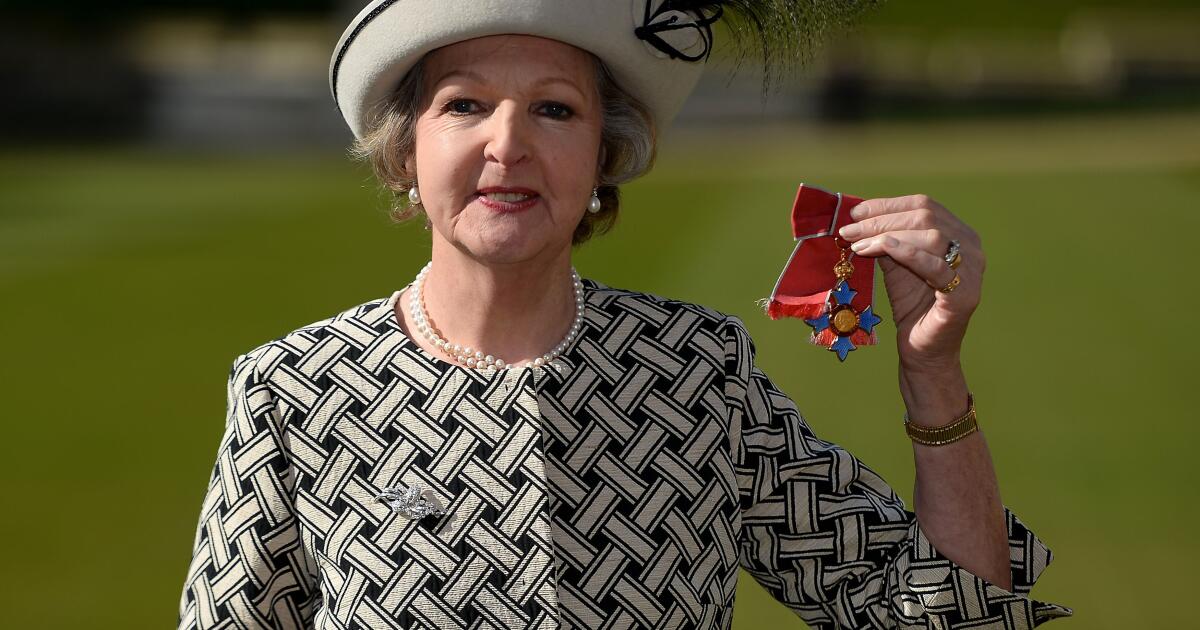
LONDON — Penelope Keith, a comic performer who shone as flinty but lovable upper-crust characters in British sitcoms “The Good Life,” which aired on PBS in the U.S. as “Good Neighbors,” and “To the Manor Born,” has died aged 86.
Keith’s family said Monday that she had been diagnosed with cancer and died at her home in Surrey, near London.
Keith began her acting career onstage and joined the Royal Shakespeare Company in 1963. But she found her greatest fame on television.
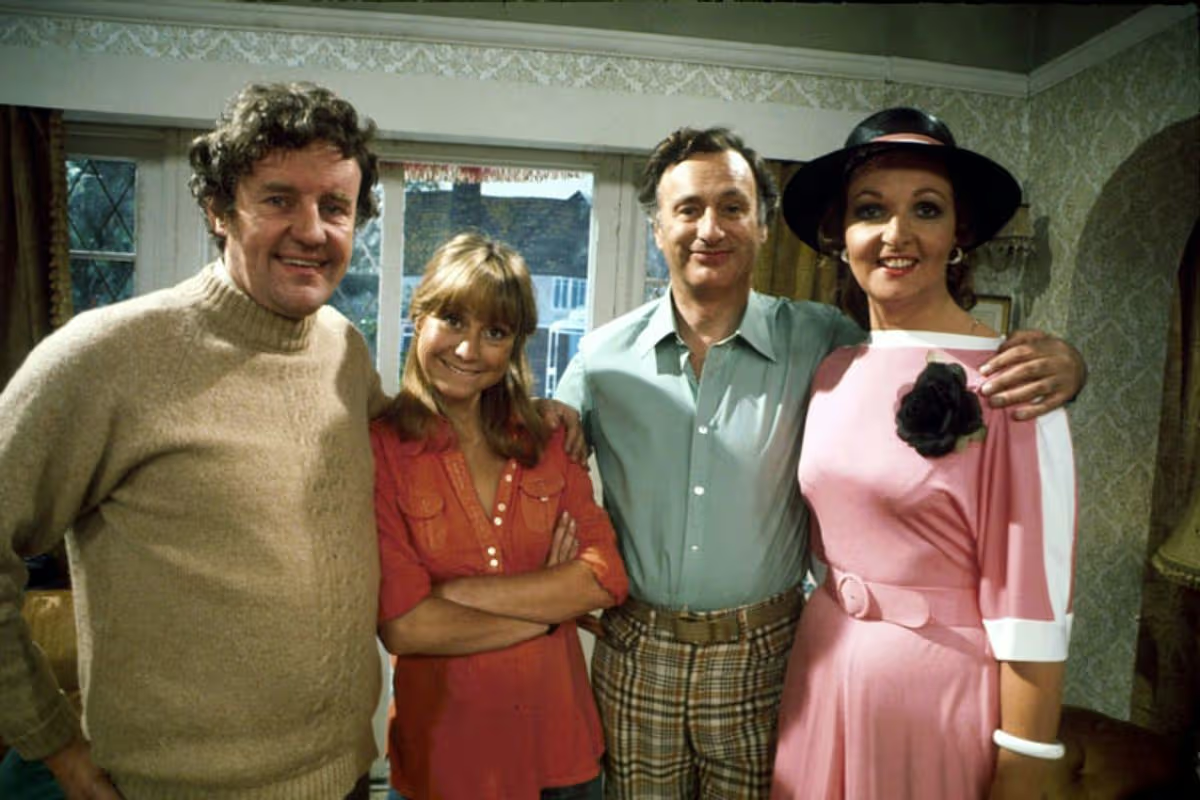
She won a BAFTA Award in 1977 for “The Good Life,” playing Margo Leadbetter, a snobbish suburbanite appalled by her back-to-the-land neighbors Tom and Barbara Good, played by Richard Briers and Felicity Kendal.
Kendal called Keith a “comic genius.”
“She was a joy to know and work with, and she will be much missed,” Kendal said.
Keith displayed a similar mix of imperiousness and deadpan wit in “To the Manor Born,” broadcast between 1979 and 1981 and brought back for a 2007 Christmas special. Keith played cash-strapped aristocratic widow Audrey fforbes-Hamilton, forced to sell her country estate to a nouveau millionaire, played by Peter Bowles, with whom she has a love-hate relationship.
Keith’s velvet tones featured on children’s show “Teletubbies” as the voice of the Bear With Brown Fuzzy Hair and in ads for everything from Pimm’s to Parker Pens. She also presented cozy documentary TV series, including “Penelope Keith’s Hidden Villages.”
Keith continued to perform in stage roles into her 80s. Theaters in London’s West End will dim their lights Wednesday evening in tribute to her.
In 2014 she was made a dame, the female equivalent of a knight, for services to the arts and to charity.
She is survived by her husband, Rodney Timson, and their two sons.
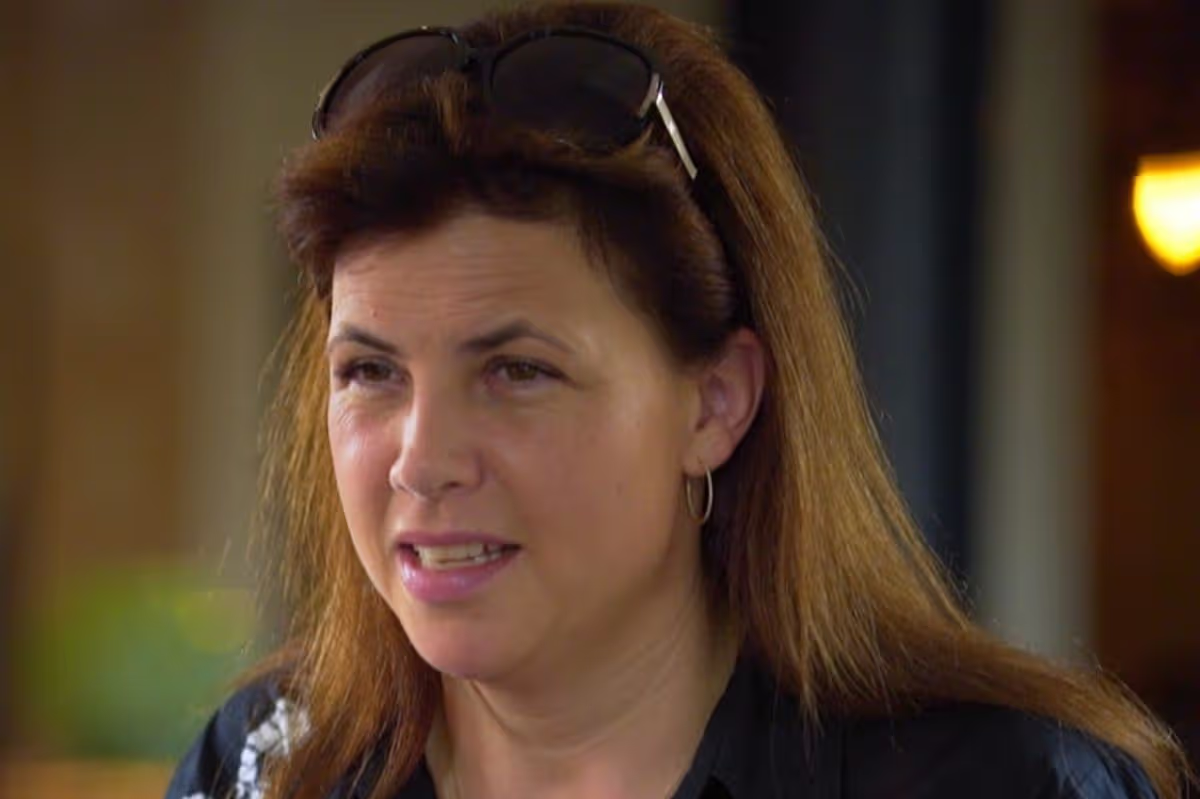
Kirstie Allsopp has lashed out at BAFTA following the death of ‘national treasure’ Dame Penelope Keith over the weekend, following a battle with cancer
12:00, 30 Jun 2026Updated 12:01, 30 Jun 2026
Kirstie Allsopp has hit out at BAFTA over their tribute to Dame Penelope Keith(Image: IWC MEDIA / Channel 4)
“We are deeply saddened to announce that Dame Penelope Keith died peacefully whilst living with cancer at her home in Surrey where she had lived for more than 50 years,” her family said in a statement, adding they were “grateful” for the care and support she received throughout her treatments.
However, after BAFTA issued a tribute to the late actress, Kirstie Allsopp was unhappy that it had chosen to use the word “passing” in its statement. The organisation said on X, formerly known as Twitter: “We’re saddened to learn of the passing of Dame Penelope Keith, aged 86. A familiar face on stage and screen Keith won a BAFTA for her iconic role in the Good Life in 1997 and another for her work in The Norman Conquests and Saving It For Albie in 1978, with a further three BAFTA nominations during her career.”
However, Kirstie was not happy with this tribute. Taking to X in view of her 425,000 followers, she fumed: “It’s ‘death’, Dame Penelope died, she was an absolute national treasure, she lived & worked and was brilliant and then she died. Dame Penelope did not ‘pass’, she was not a car or a bottle of ketchup.”
She later fumed: “When did we move from saying ‘sad to hear of the death of…’ to ‘sad to hear of the passing of’? Is there any way to stop this? We are already bad enough at discussing death in the U.K.”
However, Kirstie’s response was met with mixed responses. One person said: “I think it is a choice of words that different people are comfortable with. You should use what you feel comfortable using and let others use what they prefer. Let’s not judge, it is a personal viewpoint.”
A second added: “Why would you argue with a family about how they express that.” Hitting back at criticism, Kirstie fumed: “The family issued a statement saying that Dame Penelope had ‘died while living with cancer; a particularly elegant way of addressing two issues I felt. I obviously double checked that before telling BAFTA what I felt about their statement.”
She added: “BAFTA is an organisation not a person, and as Dame Penelope’s family statement said she had died, they should have at least reflected their language.” But Jeremy Clarkson was in support of Kirstie, stating: “I loathe ‘passing’. Loathe it’
Paying tribute, Dame Penelope’s family said in full: “We are deeply saddened to announce that Dame Penelope Keith died peacefully whilst living with cancer at her home in Surrey where she had lived for more than 50 years.
“The family is grateful for the care and support she received throughout her treatments, and ask that their privacy be respected at this time.” The Good Life followed the couple Tom and Barbara Good, played by Briers and Kendal, who try to escape the rat race in their suburban house in Surbiton. They try to become self-sufficient, turning their gardens into an allotment and introducing farmyard animals, much to the horror of their neighbours – Margo and her hen-pecked husband Jerry, played by Eddington.
In one of her last TV appearances in October 2025, Penelope fronted The Good Life: Inside Out on U&Gold, looking back on the sitcom’s huge success. Dame Penelope won a BAFTA in 1977 for her role in The Good Life.
BBC viewers paid tribute to Dame Penelope Keith, following her death aged 86, as the broadcaster aired a special episode of The Good Life.
The BBC aired an episode of The Good Life in tribute to the iconic actress(Image: BBC)
BBC viewers have been left “heartbroken” as they paid tribute to an iconic actress.
In a change to scheduled programming, the broadcaster made the decision to honour Dame Penelope Keith with a classic episode of The Good Life on Monday, June 29.
They said she “died peacefully whilst living with cancer at her home in Surrey”.
As fans mourned the To the Manor Born actress and friends paid tribute, the BBC confirmed the Margo Leadbetter actress would be remembered with the episode airing on BBC Two.
From the third series of The Good Life, it followed war breaking out between the Goods and the Leadbetters, “proving there is nothing like a good fight over the fence to cement relationships”.
Jon Petrie, Director of BBC Comedy said: “All of us at BBC Comedy are deeply saddened to hear of the passing of Dame Penelope Keith. She was one of the defining figures of British television comedy.
“Her iconic performance as Margo in The Good Life remains one of the nation’s most beloved sitcom roles and continues to delight audiences today.
“We send our heartfelt condolences to her family, friends and all of those who had the privilege of working with her.”
Watching the repeat episode, one person wrote on X: “Just watched #TheGoodLife on bbc as a tribute to Penelope Keith. Still very good!”
Another said: “Lovely to watch #thegoodlife. it brings back memories of when I was a kid. RIP Penelope Keith.”
A third wrote: “Genuinely had something in my eye as soon as the theme tune came on #TheGoodLife #DamePenelopeKeith Thank you BBC2.”
Someone else said: “I’m indulging in some pre-dinner #TheGoodLife on #BBCTwo in honour of #PenelopeKeith RIP.”
Paying their respects, one person said: “I am shocked and now, heartbroken. … Absolutely love this lady. I’ve watched #TheGoodLife so many times, over the years and it just becomes even more funny each time I watch it – seeing/hearing something that I’ve missed previously… I think another “binge-watch” of “The Good Life” is now due. In honour of the beloved #DamePenelopeKeith.”
Someone else wrote: “Pleasing to see BBC 2 scheduling an episode of The Good Life at 7 this evening, by way of tribute to the wonderfully talented Penelope Keith. Hopefully there will be more in the coming weeks. A Penelope Keith night on BBC 4?”
The statement from Dame Penelope’s family read: “We are deeply saddened to announce that Dame Penelope Keith died peacefully whilst living with cancer at her home in Surrey where she had lived for more than 50 years.
“The family is grateful for the care and support she received throughout her treatments, and ask that their privacy be respected at this time.”
The Good Life is available to watch on BBC iPlayer.