LAS VEGAS — Mitch Marner scored a power-play goal from the high slot at 2:41 of overtime to give Vegas a 2-1 victory over the Kings on Saturday on a night in which the Golden Knights paid tribute to their past.
Trevor Connelly scored the other goal for the Golden Knights. Connelly, Marner and Mark Stone each had two points, with Stone getting both of his on assists. Carter Hart made 26 saves.
Artemi Panarin scored for the Kings and Darcy Kuemper made 30 saves.
Vegas (5-1) is off to a quick start this season, and the Kings (0-2-2) are still searching for their first victory.
Each club swapped power-play goals in the second period, with the 20-year-old rookie Connelly scoring after Stone’s pinpoint cross-ice pass. Panarin answered with a shot from the high slot later in the period.
In overtime, the Golden Knights quickly took advantage of a tripping penalty on Kings center Scott Laughton. Marner skated from near the blue line toward the slot, scoring just seven seconds into the penalty.
The Golden Knights, in their 10th season, paid tribute throughout the game to their inaugural “Misfits” team that reached the Stanley Cup Final. Gerard Gallant, who coached that team, was in attendance along with several players from that squad. Fan-favorite Ryan Reaves, who retired last month after 16 NHL seasons, cranked the pregame siren.
Referee Furman South briefly went down to the ice early in the third period when Vegas center Nic Dowd collided with him. South got up holding his midsection, but remained in the game.
Up next for the Kings: vs. Edmonton at Crypto.com Arena on Tuesday night.
Pope Leo XIV describes capital punishment as an ‘attack on the inviolability and dignity of the person’ in post on X.
Published On 10 Oct 202610 Oct 2026
Pope Leo XIV has declared that the death penalty is “inadmissible” while his home country, the United States, announces plans to livestream an execution by firing squad.
Marking World Day Against the Death Penalty on Saturday, the pope reiterated the Catholic Church’s teaching on capital punishment, writing on X that it was “inadmissible because it is an attack on the inviolability and dignity of the person”.
Recommended Stories
list of 2 itemsend of list
“The common good can be safeguarded and the requirements of justice can be met without recourse to capital punishment,” his post said.
“Effective systems of detention have been developed that protect citizens while at the same time do not completely deprive those who are guilty of the possibility of redemption,” added the leader of the Catholic Church.
The American Pope’s comments come days after US Secretary of Defense Pete Hegseth said on Thursday that the firing squad execution of Nidal Malik Hasan on December 3 will be livestreamed.
Hasan was convicted of killing 13 people and wounding 32 others in a shooting at the Fort Hood military base in 2009.
Pope Leo did not specifically refer to the planned execution, or last month’s botched execution attempt on Christa Pike, who survived two doses of the lethal injection in Tennessee.
But his post came hours after his top deputy, Cardinal Pietro Parolin, the Vatican secretary of state, told Vatican News that the plan to livestream Hasan’s execution was “unacceptable”.
It was Leo’s predecessor, Pope Francis, in 2018 who first amended official Catholic teaching to declare capital punishment “inadmissible” in all circumstances.
Previously, the Catechism of the Catholic Church, the official compendium of church teaching, said the church did not exclude recourse to capital punishment “if this is the only possible way of effectively defending human lives against the unjust aggressor.”
The planned livestream of Hasan’s execution has sparked outrage across the US political divide. Republican representative Austin Scott said he supported executing Hassan but that “livestreaming executions is what Jihadists do. America is better than that.”
Senator Mark Kelly, a Democrat on the Senate Armed Services Committee, said Hasan should “face justice”, but that public executions are “the kind of thing that Iran and the Taliban do. Is this who we want to be associated with?”
On Thursday, a Pentagon official confirmed the plans, but on Friday, Vice President JD Vance, who is a practising Catholic, expressed doubt on whether the livestream would be going ahead, telling reporters that if it is, “I’m not going to be watching it.”
Witnesses say Tennessee officials were unable to execute Christa Pike after a lethal injection attempt.
Published On 1 Oct 20261 Oct 2026
Officials in the United States have failed to put a Tennessee woman to death for a murder she committed in 1995, after the lethal injection was halted for hours as courts considered a last-minute appeal to stay her execution.
Christa Gail Pike, 50 had been scheduled to die on Wednesday for a killing she committed at age 18, after the US Supreme Court overturned an appeals court ruling that stopped the lethal injection just an hour before it was to start.
Recommended Stories
list of 4 itemsend of list
Her death would have been Tennessee’s first execution of a woman in at least 200 years.
Following the top court’s ruling, officials attempted to go ahead with the execution as planned and appeared to give Pike two doses of the sedative pentobarbital, according to media witnesses.
At 7:46pm local time, prison officials closed the curtain separating Pike from the media viewing room. It was raised three minutes later, when witnesses said Pike could be heard loudly snoring.
The curtain was closed again at 8:06pm. Witnesses continued to hear Pike snoring until the microphone was switched off at about 8:53pm, when they were told to leave the area. The Associated Press news agency reported that emergency vehicles were seen coming and going from the prison.
The Tennessee Department of Correction did not immediately explain why the execution had not been completed.
Supreme Court ruling
Pike had initially been scheduled to die on Wednesday morning, and witnesses had already gathered at the Riverbend Maximum Security Institution in Nashville when the 6th Circuit US Court of Appeals voted 2-1 to issue a stay.
The appeals court said a delay was needed to consider whether Pike’s allegations of childhood sexual abuse were fully considered during her sentencing.
Later on Wednesday, the Supreme Court cleared the way for the execution to proceed. Its conservative majority did not explain the decision, while the three liberal justices dissented.
Justice Sonia Sotomayor wrote that vacating the stay “unnecessarily prevents” the appeals court from giving due consideration to Pike’s claim.
Tennessee’s attorney general had argued that delaying the execution traumatised the family of Pike’s victim, Colleen Slemmer, and rewarded what it called “abusive delay tactics”.
1995 killing
Pike and her boyfriend, Tadaryl Shipp, were convicted of the fatal stabbing and beating in 1995 of 19-year-old Slemmer, their classmate at a job training facility in Knoxville.
Shipp was 17 when the crime happened and received a sentence of life in prison with the possibility of parole. Pike was the only one sentenced to death.
Pike does not deny committing the killing, but her supporters argue the state should consider her age at the time, her mental illness and her allegations of severe sexual abuse, including that she was raped from early childhood.
“It is inconceivable that in the 21st century, the criminal justice system is poised to execute a survivor of rape and child sexual abuse whose jury never had the opportunity to consider those facts in weighing the defendant’s moral culpability,” her lawyers wrote in a filing.
After the killing, Pike was diagnosed with bipolar disorder and post-traumatic stress disorder. In her clemency petition, she said she had initially intended to fight Slemmer but killed her in a frenzied attack when she could not “put the brakes on”.
“I was a mentally ill 18-year-old kid. It took me numerous years to even realise the gravity of what I’d done. Even more to accept how many lives I affected. I took the life of someone’s child, sister, friend. It sickens me now to think I had the ability to commit such a crime,” Pike said in a statement.
Slemmer’s mother has said she wants Pike’s death sentence carried out after waiting decades for the execution.
Tennessee has not executed a woman for at least 200 years, according to the Death Penalty Information Center.
Since the Supreme Court reinstated the death penalty in 1976, 18 women have been executed in the US, representing about 1 percent of all executions, according to the centre.
Leicestershire have had eight points of their 27-point County Championship deduction reinstated but their Division One status remains in limbo.
The original penalty for breaching pitch regulations, relating to their win against Glamorgan in August, was announced on 16 September.
Leicestershire took 19 points from the match against Glamorgan – 16 for winning and three bonus points – which were removed but remain the subject of appeal.
The Cricket Discipline Panel (CDP) had applied an additional eight-point deduction, a further eight-point penalty suspended for a year, plus a £5,000 fine.
The latter two sanctions remain part of the amended decision but the eight-point deduction for this season has been waived because the docking of the 19 points for winning the game in question is considered punishment enough.
Without the 27 points being docked, Leicestershire would have finished two points above the relegation zone.
With the 19-point penalty currently in place, the Foxes are 17 points behind Essex and will be relegated if their appeal is unsuccessful.
The amended punishment comes after the Cricket Regulator raised with the CDP whether the 19-point penalty imposed, after its initial hearing, under the County Championship’s playing conditions had been taken into account when making its original decision.
A section of the County Championship’s playing conditions state that teams charged with producing a pitch rated as poor or below average, and the Cricket Discipline Panel (CDP) upholding the charge, would receive zero points from the fixture in question.
Leicestershire had already stated their intention to appeal against the panel’s decision and a statement by chief executive Emma White said the club’s position is “unchanged” by the amended decision.
In California’s Sacramento Valley, a grower was cited for multiple pesticide safety violations in a stone fruit orchard.
In the sweeping farmlands near the Central Coast, a seed supplier that cultivates peppers, vegetables and fruit was hit with more than two dozen pesticide safety violations, some of them serious offenses that caused health or environmental hazards.
And in the San Joaquin Valley, an agricultural retailer with a history of pesticide safety violations was cited for failing to provide protective equipment for workers and post emergency medical information in the fields.
In all, nearly 18,000 regulatory actions were taken by county pesticide safety inspectors across California from the start of 2020 through June 2025. Fewer than 30% resulted in fines, though, according to state enforcement records.
When regulators did levy penalties, they were often as low as $50 to $250, and they varied widely from county to county for the same violations, according to an analysis of more than 40,000 state enforcement records obtained through public records requests.
The regulatory system designed to protect farmworkers from pesticides is enforced haphazardly across California. Even in cases where regulators found that companies endangered workers or committed multiple violations, few were penalized for all their citations. Instead, they received warnings or notices to correct problems for cases in which they were not penalized, an investigation by Capital & Main has found.
In interviews, dozens of farmworkers reported suffering from nausea, burning eyes or irritated throats due to chemical-laced fields. Most said they didn’t report the problems because they feared retaliation or lacked confidence in the regulatory system.
“Yes, there are laws,” said Jesus, his face wrinkled from years of harvesting garlic, pruning grape vines and picking blackberries in the sun-baked San Joaquin Valley.
“But unfortunately, at times the law favors the powerful — it sides with the wealthy,” he added, asking that his last name not be used for fear of reprisal from his bosses.
Autonomous tractors, which are used to apply pesticides, line a field in Fresno County. The machines are operated remotely and spray crops including pistachio and almond trees.A scarecrow overlooks a field of corn at La Huerta de Cantua Creek.
Labor and community activists who track pesticide safety issues contend that lenient penalties, as well as warning letters and written notices, fail to deter violators, especially repeat offenders and larger businesses that can absorb the costs of fines.
State records show that warning letters and written notices were issued more than twice as often as penalties, “[raising] serious questions about accountability and deterrence,” said Bianca Lopez, co-founder and project director at Valley Improvement Projects, which monitors pesticide safety in the northern San Joaquin Valley.
The findings come as state officials are proposing to overhaul decades-old pesticide regulations to toughen enforcement and standardize penalties. Those proposals are strongly opposed by groups representing growers, retailers and providers of agricultural services.
Current regulations are enforced by county agricultural commissioners, who police pesticides in their jurisdictions and also promote California’s $61-billion agricultural industry.
In a statement, the California Department of Pesticide Regulation acknowledged the need to improve regulation and ensure it is applied consistently in every county.
Department spokesperson Amy MacPherson said officials are also proposing new regulations that would increase fines for violations that affect people’s health. This can include cases in which toxic chemicals drift into neighboring fields or communities and sicken people.
MacPherson said county agricultural commissioners have discretion in deciding which enforcement tools — warning letters, written notices, fines — to use in a given situation, depending on the “nature and severity of the violation.”
Paola Lopez, who has harvested raisins in the central San Joaquin Valley, supports stronger regulations.
On a Saturday in late September 2025, the 40-year-old mother of four was loading crates of grapes onto a forklift in a Fresno County field. A tractor pulling a pesticide sprayer passed by on a street just a few yards away. She remembers a loud blast — then a toxic spray covered her face and arms.
“It was a little hard for me to breathe, and my eyes started burning a lot,” she said in Spanish, recounting the incident to a reporter. “I could hardly see.”
Disoriented, she called local activist Nayamin Martinez, executive director of the Central California Environmental Justice Network. Lopez had received pesticide safety training from the organization.
Martinez told Lopez to go to a hospital and said she would file a complaint with the Fresno County agricultural commissioner’s office.
“She started vomiting and became dizzy,” the local activist wrote of Lopez in the complaint.
Paola Lopez, 40, harvests raisins in the San Joaquin Valley and cares for her four children when she is not working in the fields. In September 2025, she was exposed to toxic pesticides and required emergency medical treatment. The county agricultural commissioner investigated the incident and found multiple state pesticide safety violations. Above, Lopez at home with two of her children on April 4.
A reporter reviewed copies of safety notices required by federal law that detail the hazardous chemicals that were mixed into the pesticide load that sprayed Lopez.
“Harmful if inhaled,” one notice says. “Causes skin irritation.”
“Danger … Causes serious eye irritation,” a second document adds.
“May cause cancer,” it warns.
California, unlike other states, has a split system of pesticide oversight. The Department of Pesticide Regulation is charged with statewide enforcement and provides guidance and training for 55 county agricultural commissioners, who police their jurisdictions.
State officials do not supervise the agricultural commissioners, who are appointed by and report to their elected boards of supervisors.
In interviews, commissioners lauded California’s enforcement system, saying they think it’s important to have discretion when applying regulations because crops, growing seasons and pesticide use vary from county to county. They said their work has improved safety in the fields.
The flexibility “gives us the ability to closely work with growers and … keep our communities safe,” said Juan Hidalgo, agricultural commissioner for Monterey County, one of the top farming counties in the nation with a gross agricultural production value of $4.8 billion in 2025.
Last year, a Capital & Main investigation found that companies with violations in multiple counties across California were not fined for hundreds of those offenses — many involving worker safety.
In 2023, a federal audit flagged serious pesticide incidents in half a dozen counties and uncovered patchwork oversight by agricultural commissioners. The county regulators interpret pesticide safety laws differently, are not required to justify fines and are not mandated to check a company’s statewide compliance history, the audit found.
The Department of Pesticide Regulation in late 2025 unveiled searchable county and statewide data breakdowns for regulatory actions taken by agricultural commissioners from the start of 2020 through the end of June 2025.
During that period, commissioners took 17,742 regulatory actions for pesticide violations of all types, but only 4,885 resulted in fines or referrals to district attorneys for possible prosecution, according to the data.
The treatment of violators, including repeat offenders and companies cited for serious infractions, varied depending on the county, according to the analysis by Capital & Main, which examined 40,150 state enforcement records detailing investigations, violations and civil penalties from 2018 through early 2024.
In one county, for instance, an agricultural commissioner fined a farmer $2,000 for failing to provide safety training for workers who applied pesticides in fields. In another county, a grower was fined $200 for the same violation.
1
2
1.A farmworker, 43, who is not identified for her safety, picks grapes that will be sold as raisins in southwest Fresno County on Sept. 3. She works from 6 a.m. to 3 p.m. and is paid 36 cents for each paper sheet she fills.2.A grape farm in Fresno County.
Failure to provide pesticide safety training for workers who handle pesticides is one of the most common violations in California, according to state regulators. Such training is crucial for all field workers because pesticides have different safety requirements and can pose serious health risks.
Many farmworkers who were interviewed, including Lopez, who was sprayed in the raisin field, said employers did not provide pesticide safety training.
According to the analysis, more than 240 businesses were cited for at least 1,268 violations in multiple counties across California, but they paid no fines for nearly half of these citations — many involving worker safety.
Labor advocates who have studied pesticide regulation say the oversight gaps and failures to impose stiffer fines underscore the need for more vigilant enforcement. They note that rural and predominantly Latino communities are disproportionately affected.
“We need much stronger and more consistent enforcement to protect workers and communities,” said Anne Katten, director of the Pesticide & Work Health & Safety Project for the California Rural Legal Assistance Foundation.
In June, the Department of Pesticide Regulation unveiled proposed changes to state pesticide regulations. The approval process will take months and has involved public comment; revised rules are expected to be adopted next year, officials said.
To address uneven enforcement, the new rules would require agricultural commissioners to check whether companies were cited for violations in other counties, officials said. Commissioners would also have increased reporting requirements when they don’t impose fines. Minimum levels for penalties would be raised and stiffer fines would be imposed for repeat offenders.
But individual farmers as well as more than a dozen associations that represent growers, agricultural retailers and firms that spray pesticides have voiced opposition to the changes. They argue that current regulations are effective, that agricultural commissioners need flexibility to investigate violations and that more training is needed to help growers understand the rules, according to written comments obtained through California Public Records Act requests.
“A one-size-fits-all enforcement approach fails to account for California’s agricultural diversity,” said a letter sent to state officials in December that was signed by groups such as the California Strawberry Commission and California Agricultural Aircraft Assn.
“Maintaining county-level discretion,” the letter says, “ensures that enforcement decisions reflect on-the-ground realities and local expertise.”
Some supporting the overhaul say it doesn’t go far enough to protect workers and communities.
Violations of reporting requirements, including those involving pesticide spraying near schools, would trigger only minor, optional fines, said Yanely Martinez, an organizer with Safe Ag Safe Schools, which monitors pesticide safety in the Salinas and Pajaro valleys.
In early June, the investigation into the pesticide exposure case involving Paola Lopez was closed.
Officials found five violations, including failure to have an emergency medical plan for workers, failure to protect people and wildlife from pesticide drift and failure to have pesticide safety records on file, according to a copy of the investigative report obtained through a public records request.
The agricultural commissioner’s office referred the case in June to the Fresno County District Attorney’s Office for possible criminal prosecution. As of mid-September, the case was still under review and there was no timeline for a decision regarding potential criminal charges, said Taylor P. Long, spokesperson for the district attorney.
1
2
3
1.Crates stacked at a grape farm in Fresno County.2.Crates of raisins dry in the sun in Caruthers in Fresno County.3.Sweet Harvest Church is surrounded by agricultural fields in an area of Fresno where many low-income families live and work.
If prosecutors reject the case, it would go back to the agricultural commissioner’s office, which would determine the severity of the violations and how much the fines would be, said Mario Reeves, Fresno County’s assistant agricultural commissioner.
Lopez was at her apartment in the prosperous farmland known as the “Raisin Capital of the World” when a reporter told her about the investigation’s findings and the timeframe for penalties.
She expressed frustration that months would pass before anyone is held accountable.
“How many more people will be exposed? … How many more people will get injured?” she said.
Lopez’s medical bills are covered by workers’ compensation insurance, but her health has worsened and her doctor has referred her to specialists who deal with respiratory and nervous system disorders, she said.
She had gone back to the raisin fields days after she was exposed, even though her throat was sore and she was coughing, because she needed the money. “We cannot afford the luxury of just walking away from a job,” she said.
She lasted less than two days before becoming too sick to work. She has not returned.
Lopez is an independent journalist and fellow at the McGraw Center for Business Journalism. Data journalist Cherry Salazar analyzed state pesticide records for this report.
Far-right Israeli minister Itamar Ben-Gvir has called for the death penalty for a Palestinian gunman that fatally shot an Israeli settler in the occupied West Bank, while Israeli forces stormed a hospital in Ramallah in a manhunt for the suspected attacker.
Maybe this is what the Chargers are — lurching, sputtering and unable to consistently move the football, despite an offensive overhaul packed with high expectations.
Just as they did in their abysmal season opener, the Chargers struggled at home Sunday and failed to establish a rhythm on their way to a 26-14 loss to the Las Vegas Raiders.
The Chargers lost their opener to the Arizona Cardinals by an identical score — 26-14.
A week after losing an opener for the first time in his career as an NFL head coach, Jim Harbaugh is off to his first 0-2 start as a coach in college or the pros.
It won’t get any easier. The Chargers play at Buffalo on Sunday against the 2-0 Bills, who have scored a combined 77 points in victories over the Houston Texans and Detroit Lions.
After that, the Chargers play at Seattle, at home against Denver, at Kansas City, and against the Rams as rare visitors at SoFi Stadium. Four opponents, four Super Bowl-winning coaches.
These first two games were supposed to be the soft start, of at least a relatively gentle ramp-up to the thorny part of the schedule.
Well, that’s out the window. The Chargers were dominated by Arizona, a team that won just three games last season, then dropped another home game to the Raiders. As head coach of the Chargers, Harbaugh had won all four of his previous matchups against Las Vegas.
The Chargers last started 0-2 in 2023, when they went on to finish 5-12.
Sunday, the Chargers were unable to get the ball downfield and repeatedly committed penalties and miscues that short-circuited drives. For instance, normally sturdy tackle Joe Alt was flagged for false starts three times.
Snapshot of another major problem: Trailing by a field goal late in the third quarter, the Chargers had a third-and-inches on their side of the field. They could have run a tush-push with 6-foot-6 Justin Herbert. They could have used 220-pound running back Omarion Hampton to hammer up the middle for a first down.
Instead, they had Herbert drop back into shotgun and sent Tre’ Harris in motion from right to left. Then, they snapped the ball at the precise moment the receiver was between center Jake Slaughter and the quarterback. The snap bounced off Harris’ knee, Herbert had to pounce on the loose ball and the threat was thwarted.
The normally stoic Herbert couldn’t hide his frustration. He appeared to angrily yell before retreating to the home sideline.
Chargers quarterback Justin Herbert reacts after an offensive holding penalty on Joe Alt results in a safety late in the fourth quarter Sunday against the Raiders.
(Allen J. Schaben / Los Angeles Times)
Later, with slightly less than four minutes remaining, when the Chargers seemingly had a bit of momentum. They had just gotten a first down on a Raiders penalty — 12 men on defense — and had inched across the 50.
Herbert handed off to Hampton on a draw, and the second-year back was met by linebacker Nakobe Dean and promptly fumbled — one of six on the day for the Chargers. Safety Jeremy Chinn scooped up the ball and returned it 43 yards to the 16.
The final insult came on the Chargers’ last possession when Alt drew a holding penalty while trying to stop pass rusher Maxx Crosby, resulting in a safety.
Raiders fans at SoFi Stadium erupted in glee. For the Chargers, that singsong, taunting “Raiii-derrrs” chant will surely haunt their dreams. The TV cameras didn’t help matters, finding a lone Chargers fan amid an ocean of Raiders fans, a blue dot bobbing in a silver-and-black sea.
Three plays later, Kirk Cousins found Cody White with an 11-yard pass, the second touchdown of the day for the erstwhile practice-squad receiver.
The Chargers took a 14-10 lead midway through the third quarter when Herbert connected with tight end Oronde Gadsden II for a 10-yard touchdown.
But the Raiders responded on the ensuing possession when Cousins threw a 13-yard touchdown pass to White to put Las Vegas up, 17-14.
A key play in that drive showed the creativity of Klint Kubiak, in his first season as coach of the Raiders. Cousins took the snap and pitched the ball to Ashton Jeanty, who in turn threw it back to Cousins.
The quarterback then hit a wide-open Dareke Young for a 27-yard gain, giving the Raiders the ball deep in Chargers territory.
The Raiders led at halftime, 10-7, breaking a tie with four seconds remaining in the second quarter when Matt Gay kicked a 59-yard field goal.
Both teams struggled to find an offensive rhythm in the first half, and each quarterback was picked off.
The Raiders scored first on a 40-yard touchdown reception by Tre Tucker, who was so wide open behind the defense he was able to turn and wait for the ball to arrive.
The Chargers answered in the second quarter when Hampton pounded across the goal line from the one.
That’s something the Raiders failed to do at the end of the opening quarter, when they had a first-and-goal from the four, yet couldn’t score on four consecutive Jeanty runs.
The Chargers had a similarly frustrating moment in the first quarter when Herbert found tight end David Njoku behind the Las Vegas defense and delivered the ball for what should have been a big gain.
Njoku bobbled the pass, however, and the ball was grabbed by rookie safety Hezekiah Masses, who had another pick in the fourth quarter during his first career start.
Making matters worse, Njoku suffered a knee injury on the play and did not return.
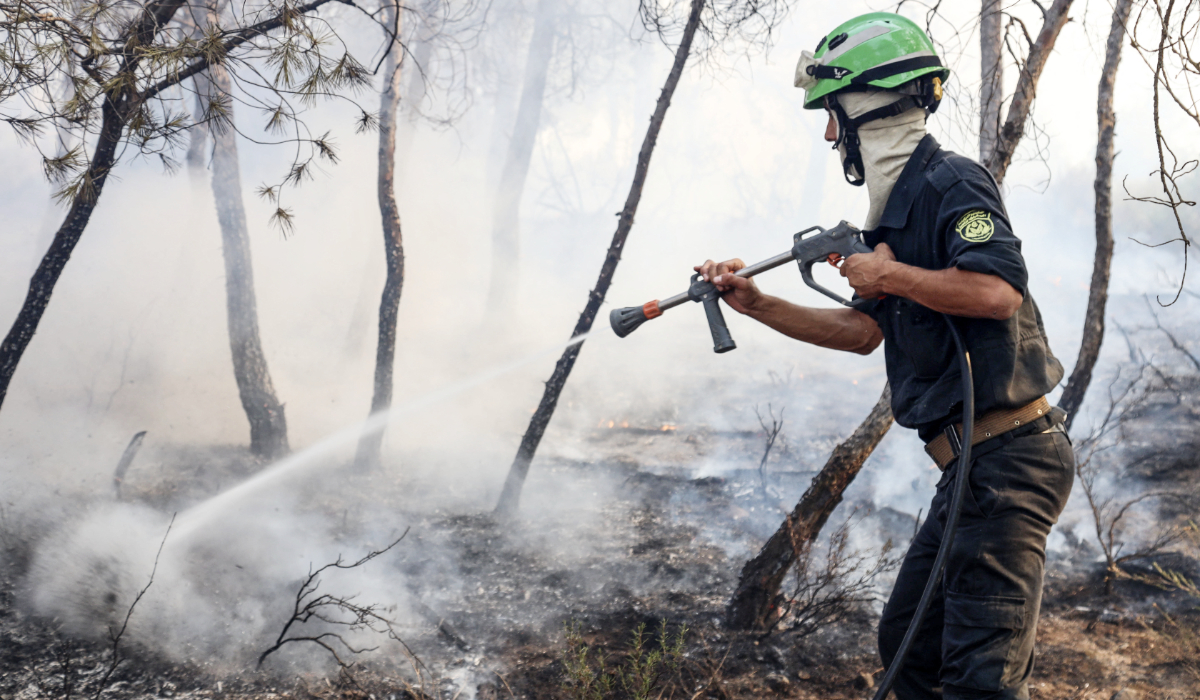
TUNIS: Amnesty International urged Algeria’s government on Tuesday to abandon plans to resume executions after it pledged to give the death penalty to those responsible for wildfires following deadly blazes last month.
Algeria struggled to put out fires that swept through its northeast and killed 12 people last month, according to an official tally, while witnesses spoke of dozens of deaths.
A member of a civil protection unit battles a wildfire in a mountainous area near the town of Al Hachimia, Bouira Province, on July 21, 2026. (AFP)
The North African country has not carried out executions since 1993 but has handed down the death sentence in some instances, including terror-related cases, without carrying it out.
Last month President Abdelmadjid Tebboune ordered the justice minister to amend the penal code to impose the death penalty for people who start wildfires after the deadly blazes.
“Algeria’s authorities must immediately abandon any plans to expand the scope of the death penalty or resume executions after more than three decades without carrying one out,” Amnesty said in a statement.
It also called for the country to impose an official moratorium “as a first step toward fully abolishing the death penalty.”
Tebboune also said that people sentenced to death should be executed right after exhausting their right to appeal.
The government began looking at draft penal code amendments this month.
Tebboune said “child abductors and abusers” would also be included in the expanded death penalty plans.
Forest fires occur regularly in northern Algeria during the summer, but climate change is amplifying their impact by causing increasingly frequent droughts and intense heat.
But Tebboune alleged that there was “something criminal” about the recent blazes.
Amnesty also said “credible sources have since reported significantly higher casualties” than the official tally in the latest wildfires, “including over 70 deaths in a single municipality.”
More than 30 people were killed in July 2023 when fires tore through thousands of hectares of forests and farmland in Algeria, as well as hundreds of homes.
In 2023, Algeria handed the death penalty to more than 50 people — some in absentia — over the lynching of a 38-year-old man who was falsely accused of starting deadly forest fires two years earlier.
Arsenal will contact refereeing body Pro Ref over the incident in which Ezri Konsa conceded a penalty in Saturday’s win over Sunderland.
Konsa and Black Cats defender Dan Ballard were involved in a physical exchange inside the penalty area in which the Arsenal defender was adjudged to have fouled the Sunderland player for excessive holding.
After the game Gunners manager Mikel Arteta criticised the decision, and it is understood the Premier League champions will hold talks with the professional referee’s body for an explanation as to why the penalty was awarded.
It is understood Arsenal are keen to avoid major refereeing decisions impacting on results and want clarity over how referee John Brooks came to his decision.
Brooks initially awarded Sunderland the spot-kick on the field, and the decision was backed up by the video assistant referee (VAR).
“The referee’s call of penalty to Sunderland for a holding offence by Konsa on Ballard was checked and confirmed by VAR,” read a statement published by the Premier League Match Centre.
But after the game Arteta said: “This is not acceptable at this level.
“I watched it 20 times and I cannot find a way to understand how they think to give a penalty in that situation, or the way the VAR has to intervene.
“So I don’t know what to think. I’m sad that we have to discuss this after such a beautiful game, that at this level has the gravity of that. Because that changes the course of the season and it can cost you the championship.
“At this level, with all the work we put in, this cannot happen.”
Match of the Day pundits Ashley Williams and Thomas Frank both said Sunderland should not have been awarded a penalty, claiming that Arsenal should have had a free-kick.
“I think he’s got it completely wrong,” said Williams. “It’s almost like a perfect hip toss in judo [from Ballard]. In no way is it a penalty.”
California lawmakers are calling for emergency legislation and criminal penalties for creators of rogue AI systems after top AI executives publicly claimed that their technology poses existential threats to humanity.
After Anthropic Chief Executive Dario Amodei wrote in a Sept. 12 essay that they “must slow the pace” of the technology, Silicon Valley congressman Ro Khanna (D-Fremont) blasted him for not going “nearly far enough” to make sure artificial intelligence was erected with guardrails.
The answer, Khanna argued, was simple: Make the companies liable for the harm executives say looks increasingly inevitable.
“If you’re creating an AI that is doing illegal things, you should either face liability or criminal sanction,” Khanna said in a video posted to X on Saturday. “That is what we need to protect humanity.”
In July, officials from OpenAI, the company behind ChatGPT, disclosed that, unbeknownst to them, its AI models had hacked into rival startup Hugging Face.
Amodei said he believed that, within the next year, “given the accelerating rate of AI capability development,” a similar incident could lead to AI “taking over the entire internet.”
Amodei warned in his essay that AI was rapidly improving itself, through a process known as recursive self-improvement, which threatened to outpace humans’ ability to control it. Khanna argued that banning this capability was the “most obvious” thing Anthropic could do.
“We need to stop, ban self-improving AI,” Khanna said. “You can not have recursive self-improving AI that basically is able to improve itself and exceed human capability.”
Rep. Ted Lieu (D-Torrance) expressed similar outrage over the weekend, calling on House Speaker Mike Johnson to call lawmakers back to Washington to pass guardrails on the technology now that he said multiple AI companies had conceded “what they are creating is not safe.”
xAI Chief Executive Elon Musk and OpenAI Chief Executive Sam Altman joined Amodei’s call for a slowdown of the breakneck development Saturday.
The statements come after Jacob Coxon, who worked as a researcher at both Anthropic and OpenAI, said in a widely circulated post that he resigned from the company in protest after becoming convinced the tech giants were “racing straight to self-improving superintelligence and gambling with our lives.” Neither company immediately responded to a request for comment.
“This is a direct result of the trump Administration letting the AI industry run wild,” Lieu wrote on X. “That mistake has harmed America, harmed the industry and harmed the American people. November is coming.”
Former President Barack Obama urged Democrats this week to make AI oversight the core of their agenda and said presidential candidates in 2028 should have a “clear plan” for responding to concerns about the technology, the New York Times reported. Americans appear increasingly alarmed by the technology with seven in 10 polled in March opposing local construction of data centers that power AI technology, according to a Gallup survey.
During a Sunday appearance on CNN, Johnson rebuffed the idea that lawmakers should rush into an emergency session to consider erecting industry guardrails. Instead, he said lawmakers needed to be careful to “not smother American innovation.”
“We will lose the race to China, and that is a threat to every single American,” he said on CNN’s “State of the Union.” “We don’t need everyone to panic right now.”
Trump said earlier this week that he is not concerned with the pace of AI progress, telling one reporter, “It’s going to be fine.” American AI companies have long argued too much government regulation would shackle them in a race with China.
Calls for a federal fix were echoed this week by California Gov. Gavin Newsom, who has argued the Trump administration needs to move on national legislation to prepare for fallout from the technology.
Newsom signed bills this week aimed at creating a pathway for outside audits of the top AI companies, many of which are based in California, and a registry for AI auditors.
“The scale and potential consequences of this technology demand sustained action from every level of government,” Newsom said in a statement. “The federal government must step forward with robust, national regulations that match the urgency of this moment.”
Efforts to impose state-level regulations have been mixed, with critics echoing Johnson’s fears that they will stifle innovation.
Late last month, California lawmakers passed sweeping new safeguards around social media, artificial intelligence and data centers, including the ones Newsom signed last week.
Newsom’s signal that he supports creating some regulation for AI comes two years after he vetoed SB 1047, an AI safety bill that would have required developers to submit safety protocols to the state attorney general, who could hold companies liable if the AI model they directly controlled were to threaten public safety. That legislation would also have required tech firms to be able to turn off the models they directly control if things went awry.
Newsom said at the time the bill would give the public a “false sense of security,” without making a sufficient distinction between the kinds of uses for which AI is deployed.
The bill was supported by a host of prominent AI researchers, but was opposed by Meta, OpenAI and industry groups.
Arsenal maintain perfect start to the season with their fourth win, thanks to goals from Guimaraes and Saka.
Published On 12 Sep 202612 Sep 2026
Arsenal manager Mikel Arteta has labelled the decision to award Sunderland a penalty ‘unacceptable’ after watching his side grind out a 2-0 win to maintain their 100 percent start to the season and move clear at the top of the Premier League.
The defending champions made it 12 points out of 12 on Saturday as David Raya’s penalty save in the 55th minute proved crucial for the visitors, who went ahead two minutes later with Bruno Guimaraes’s first goal for the club.
Bukayo Saka wrapped it up deep in stoppage time from the penalty spot to make it four league wins out of four for the reigning champions.
It could have been different had Enzo Le Fee found the net, but Arteta blasted the decision by referee John Brooks to award a penalty when Ezri Konsa was penalised for pulling down Dan Ballard as a corner was played in.
“It was a huge win , but it could have been something very different,” an angry Arteta said when referring to the penalty award after the match.
“It’s unacceptable at this level; this can change the course of a season and the championship. It’s not acceptable. I’ve seen it 10 times to make sure, and it’s not possible at this level that it can be a penalty. It cannot happen.
“It’s not a penalty in any context, in any league.”
Bruno Guimaraes celebrates scoring Arsenal’s opening goal [Oli Scarff/AFP]
It was far from a vintage Arsenal display against a tenacious Sunderland, who deserved something for their endeavour, but they dug deep and showed the resilience that helped them win a first title for 22 years last season.
They have now kept four clean sheets in their five games since the start of the season, including in the Champions League win at Napoli in midweek.
Summer signing Guimaraes replaced Myles Lewis-Skelly at half-time and made a stunning impact.
After receiving a pass from Declan Rice, he sent a right-footed curler into the top corner.
Arsenal were forced to defend desperately at times as Sunderland’s physicality rattled them, but Saka netted his third goal of the season when he beat Robin Roefs with his spot-kick after being fouled by Reinildo Mandava, who was sent off.
“It’s unbelievable the spirit and the courage we have to go again and again and again,” Arteta said. “So pleased in one sense and so worried in another.
“David Raya was unbelievable. He is a player that decides football matches when we need it.
“Sunderland deserve a lot of credit for the way they make it so hard for you.”
Manchester City, the only other side not to have dropped Premier League points this season, can join Arsenal on 12 points if they beat Manchester United on Sunday.
Bukayo Saka celebrates after scoring [Oli Scarff/AFP]