pearl

Unease in Japan after Trump cites Pearl Harbor to defend Iran war | News

US president’s reference to Japan’s 1941 attack on naval base in Hawaii has shaken the Japanese public as PM Takaichi’s silence gets mixed reaction.

There has been embarrassment, confusion, and unease in Japan after US President Donald Trump used the Pearl Harbor attack during World War II to justify his secrecy before launching the war on Iran.

Trump was asked by a reporter why he did not tell allies in Europe and Asia in advance of the US-Israel attack on Iran during a news conference with Japanese Prime Minister Sanae Takaichi at the White House on Friday.

Recommended Stories

list of 4 itemsend of list

Trump cited Pearl Harbor to defend his decision saying, “Who knows better about surprise than Japan? Why didn’t you tell me about Pearl Harbor, OK?”

Following the remarks, social media reaction has ranged from accusations of ignorance and rudeness by the US president to claims that he does not see Japan as an equal partner. There were calls for Japan to protest Trump’s comments.

Tsuneo Watanabe, a senior fellow at the Sasakawa Peace Foundation, said in an opinion piece in the Nikkei newspaper on Saturday that the remarks signalled Trump is “not bound by existing American common sense”.

“I get the impression that the comment was intended to bring the Japanese reporter [who asked the question] or Ms Takaichi into complicity in order to justify his ‘sneak attack’ on Iran during diplomatic negotiations and without telling allied countries,” Watanabe wrote.

There is also a feeling that an unspoken understanding exists between United States and Japanese leaders to tread carefully on the subject.

Both sides need each other, with Washington relying on Japan to host 50,000 troops and an array of powerful hi-tech weapons, and Japan relying on the US nuclear umbrella to deter hostile, nuclear-armed neighbours.

Japan’s post-World War II constitution bans the use of force except for its self-defence, but Takaichi and other officials are now seeking to expand the military’s role.

Mixed reaction to Takaichi’s response

Takaichi, a hardline conservative, was praised by some for not reacting to Trump’s comments, letting them pass with a roll of her eyes and a glance at her ministers seated nearby.

The goal of her summit was to deepen ties with her most important ally, and she arrived shortly after Trump suggested Japan was among the nations that did not quickly join his call to help protect the Strait of Hormuz.

Some, however, criticised Takaichi for not speaking up.

Hitoshi Tanaka, a former diplomat and a special adviser at the Japan Research Institute think tank, wrote on X that he felt embarrassed to see Takaichi flattering Trump.

“As national leaders, they are equals … To make an equal relationship is not to flatter,” he said. “Just doing what pleases Trump and calling it a success if you are not hurt is too sad.”

Initially, social media placed some of the blame on the Japanese reporter who asked the question that prompted Trump’s Pearl Harbor comment.

The reporter, Morio Chijiiwa with TV Asahi, later said on a talk show he asked the question to represent the feelings of Japanese who are not happy about Trump’s one-sided attack on Iran, and because other countries, including Japan, are now being asked to help out after the US and Israel started the war.

“So that’s why I asked the question. I was meaning to say, ‘Why didn’t you tell us, why are you troubling us?’” he said.

“Then President Trump hit back with the Pearl Harbor attack … I found it extremely awkward for him to change the subject.”

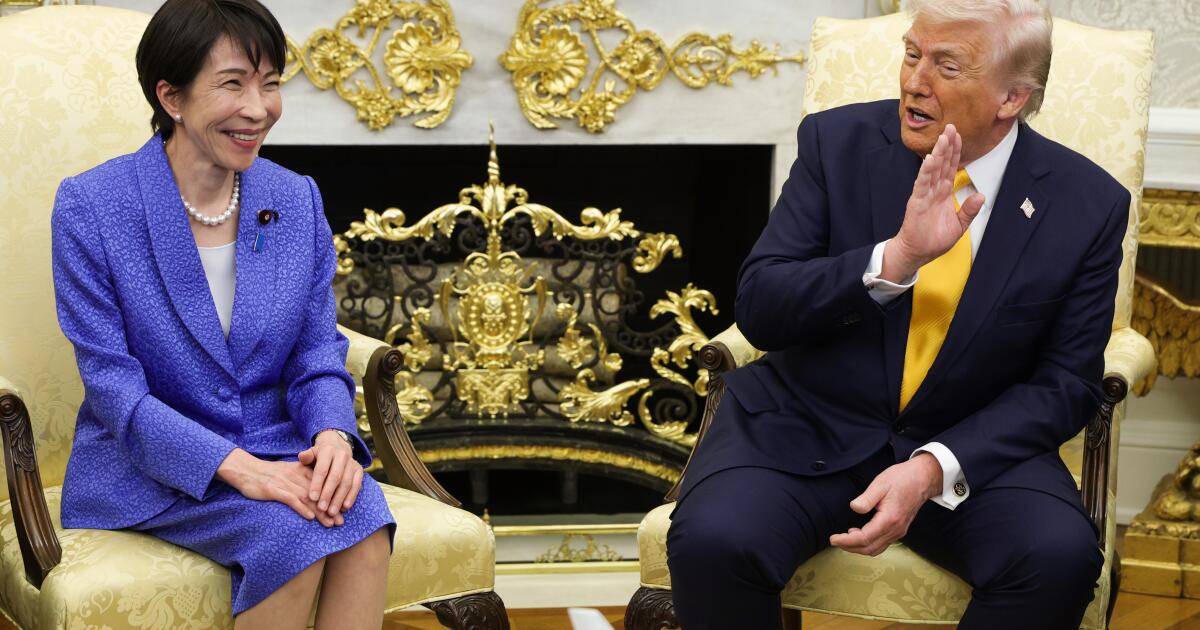
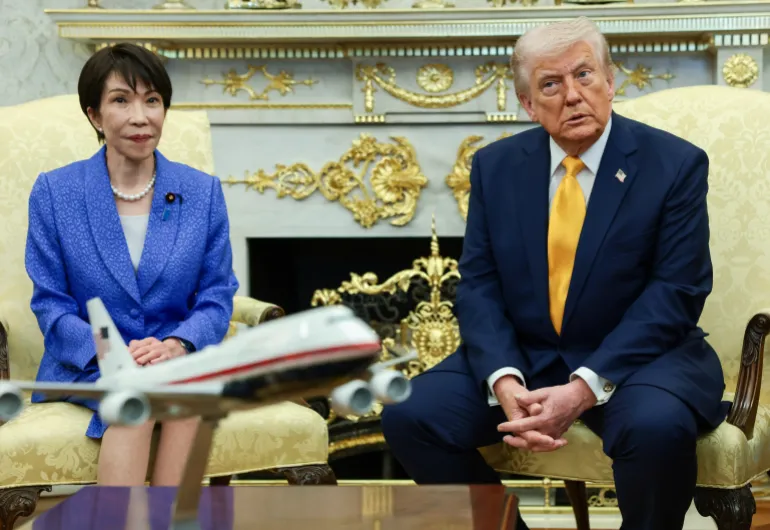
Donald Trump and Sanae Takaichi meet in the White House
Japanese Prime Minister Sanae Takaichi, left, meets President Donald Trump [Evelyn Hockstein/Reuters]

Source link

Trump cracks a joke about Pearl Harbor

Before Japanese Prime Minister Sanae Takaichi departed for Washington, she told her nation’s lawmakers that her Oval Office meeting with President Trump on Thursday would be “very difficult.”

Actually, it was awkward.

After a reporter questioned Trump about not warning Japan before launching his “surprise” offensive in Iran, Trump said that surprise was the point.

“Who knows better about surprise than Japan?” Trump said, turning toward a visibly tense Takaichi, seated next to him. “Why didn’t you tell me about Pearl Harbor, OK?”

The joke hung in the air. There was brief and muted laughter.

Takaichi’s eyes appeared to widen, but she kept her expression neutral as the the cameras rolled. She did not comment on the president’s remark. (She smiled at other times during their meeting.)

When leaders of the United States and Japan have raised the events of Dec. 7, 1941 — the day of “infamy” that plunged the U.S. into World War II — the circumstances have previously been far more solemn.

In 2016, President Obama and Japanese Prime Minister Shinzo Abe scattered petals together on the waters of Pearl Harbor to honor the more than 2,400 killed in the attack. Abe laid a wreath in honor of the dead.

“Ours is an alliance of hope that will lead us to the future,” Abe said, speaking to World War II veterans after paying tribute at the Pearl Harbor memorial. “What has bonded us together is the power of reconciliation, made possible through the spirit of tolerance.”

Japan, long constrained by its pacifist constitution, is now under intense pressure from the White House to support the U.S.-led war in Iran.

“Look, I expect Japan to step up, because, you know, we have that kind of relationship, and we step up in Japan. We have 45,000 soldiers in Japan,” Trump said. “We spend a lot of money on Japan, and we’ve had that kind of relationship.”

Trump has made a habit of going off script during televised Oval Office encounters with foreign leaders.

A meeting with Ukrainian President Volodymyr Zelensky devolved into an on-camera shouting match with Trump and Vice President JD Vance repeatedly berating Zelensky for “gambling with World War III” and not showing enough gratitude for U.S. support.

And when South African President Cyril Ramaphosa visited the White House, he said he was “ambushed” when Trump dimmed the lights and played a video promoting widely debunked claims of white genocide in South Africa.

By comparison, the Japanese prime minister’s summit in Washington was mild. For her part, Takaichi focused her statements on a new $550-billion trade pact involving Alaskan oil.

As for Iran, along with America’s European allies, Takaichi had already signaled she would not send warships to the embattled Persian Gulf to protect oil shipments through the Strait of Hormuz. But Takaichi promised cooperation in other areas, perhaps in a logistical support role.

“I firmly believe that it is only you, Donald, who can achieve peace across the world,” she told Trump.

Source link

Chad Baker-Mazara’s USC exit stemmed from more than one incident

USC’s decision to dismiss top scorer and three-point shooter Chad Baker-Mazara on the doorstep of the postseason left many wondering Sunday why coach Eric Musselman would willingly sabotage his team’s already-tenuous hopes of making the NCAA tournament.

To Gilbert Arenas, the former NBA star and podcast host whose son, Alijah, is a freshman guard with the Trojans, the move was particularly baffling. So he took to social media Sunday, wearing Baker-Mazara’s No. 4 USC jersey, to share his frustration.

“Right before the tournament? This is what we’re doing?” Arenas said in the video. “Our best player? Mr. I-Get-Buckets? Every night, he brings it every night. Guaranteed 18, 20 every night.”

“When you the best player on the team, whatever you say, you right,” he continued.

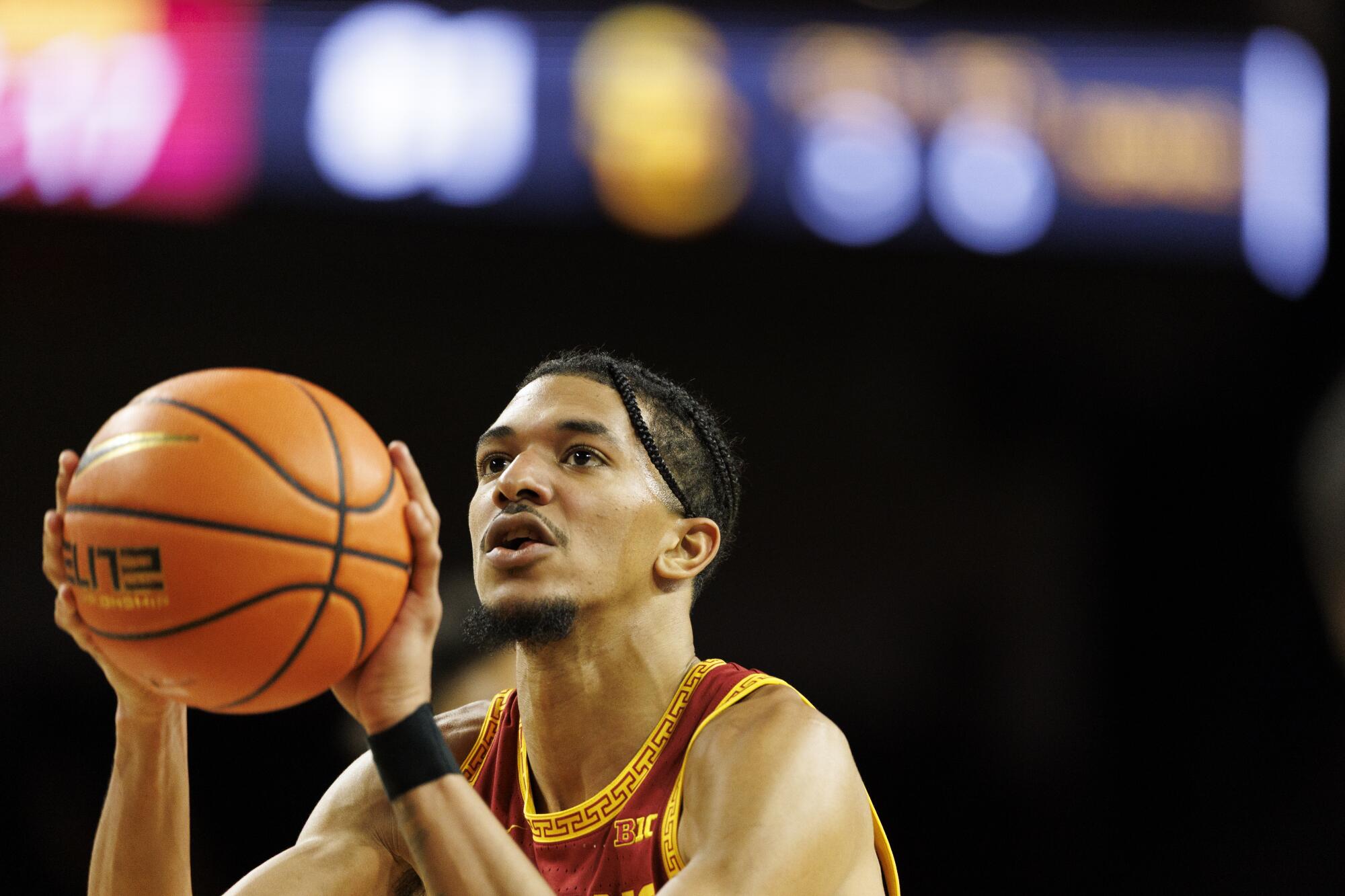
USC guard Chad Baker-Mazara shoots a free throw at the Galen Center on Dec. 17.

LOS ANGELES, CA – DECEMBER 17, 2025: USC Trojans guard Chad Baker-Mazara (4) shoot a foul shot against the UTSA Roadrunners at Galen Center on December 17, 2025 in Los Angeles, California.(Gina Ferazzi / Los Angeles Times)

(Gina Ferazzi/Los Angeles Times)

But the move to part ways with Baker-Mazara was not based on an isolated incident, a person familiar with the decision but not authorized to discuss it publicly told The Times, but rather a culmination of a season’s worth of issues that boiled over after the second half of Saturday’s loss to Nebraska.

The Trojans were trailing by three points three minutes into the second half when Baker-Mazara took off in transition after Huskers forward Pryce Sandfort, who was driving for a layup. Baker-Mazara closed the gap and swatted the ball. Then he fell hard on the hardwood.

Baker-Mazara had missed three games last month with a Grade I knee sprain and sat out practices throughout the season with other nagging minor injuries. But after a few seconds lying still on the court, he walked on his own down the Galen Center tunnel toward the USC locker room.

Baker-Mazara emerged from the tunnel a couple minutes later with a noticeable limp. He took a seat in a courtside seat on the baseline, two chairs down from injured guard Rodney Rice.

The sight of Baker-Mazara sitting away from the rest of the team sparked questions after the game, but the seating arrangement wasn’t that unusual for Baker-Mazara, who’d sat there at various times this season. What was odd was how Baker-Mazara handled the rest of the half after he told the USC staff he wasn’t able to resume play.

As USC unraveled without him in the second half, Baker-Mazara was mostly detached from the action. At one point, he went behind the USC bench and chatted with fans in the first row.

The incident on its own could have been innocuous. But at the end of a season filled with similar such moments, patience had worn thin.

By the next morning, Baker-Mazara was no longer with the team.

USC did not disclose the reasons for his departure. But the staff was well aware when they brought in the sixth-year senior last spring that his long history in college hoops was littered with similarly volatile moments. USC was Baker-Mazara’s fifth school in six seasons.

“There will never be a dull moment,” Musselman said in May. “Might be that I’ve got a little more on my plate.”

Baker-Mazara spent his freshman season at Duquesne before transferring to San Diego State. He was named Mountain West as a sophomore, but was kicked off the team by coach Brian Dutcher after he skipped classes, failed tests, missed assignments and fell so far behind on his classes he couldn’t catch up.

Baker-Mazara told the San Diego Union Tribune last spring that it was “a growing-up moment” for him. He assured he’d “learned [his] lesson.”

USC forward Chad Baker-Mazara goes up to dunk under pressure from Indiana forward Sam Alexis  at the Galen Center.

USC forward Chad Baker-Mazara goes up to dunk under pressure from Indiana forward Sam Alexis at the Galen Center on Feb. 3.

(Jae C. Hong / Associated Press)

“Some people have to go through it in different ways,” Baker-Mazara told the Union Tribune. “I had to go through it that way. … My parents were both mad. That was weeks of earfuls: ‘Man, what are you doing?’ It was weeks. I had to get my ear chewed off a couple times.”

He ended up at Northwest Florida State, a junior college in Niceville, Fla., before signing with Auburn. At the time, according to the Union Tribune, Dutcher spoke with then-Auburn coach Bruce Pearl on the phone. He told him that Baker-Mazara’s issues weren’t on the court, but that he “just needs to get his life in better order, be more organized, be more on time, do all the little things.”

Pearl and Auburn proved to be a good fit; though, Baker-Mazara earned some ire there, too, after he was ejected in the second half of Auburn’s two-point tournament loss to rival Alabama for elbowing a Tide player in the back of the head. Pearl later defended him on social media.

Pearl, now a college basketball analyst, said Monday in light of Baker-Mazara’s dismissal that the guard was “an incredibly talented kid with a real gift,” but that his “emotions at times have gotten the better of him.”

“He helped us get to the Final Four, we won a league championship with him,” Pearl said during FS1’s Wake Up Barstool on Monday. “On a good day, he would’ve been about the 20th-best player taken in the NBA Draft last year.

“But we all know that Chad has bad days.”

Routinely this season, Baker-Mazara jolted the Trojans’ offense to life. When Rodney Rice went down with a season-ending shoulder injury in November, Baker-Mazara became even more vital to USC’s offense and responded to the call, averaging 26 points per game during the Trojans’ first seven without Rice. Even in his final game against Nebraska, Baker-Mazara scored 14 points in 16 first-half minutes. Against UCLA, he knocked down three consecutive three-pointers. The previous Saturday, he scored 14 straight.

But there were also stretches of the season during which Baker-Mazara’s status remained mysterious He sat out practices ahead of Big Ten play and dealt with what was deemed, at the time, to be a nagging neck injury, only to show up in the Trojans’ lineup against Michigan and Michigan State. He averaged just 20 minutes across both games.

By March, Baker-Mazara’s more volatile moments had started to outweigh his other contributions in the eyes of USC’s staff. Though, with time running out to save their season, how the Trojans plan to replace that production is a question everyone — not just Gilbert Arenas — is asking.

Source link