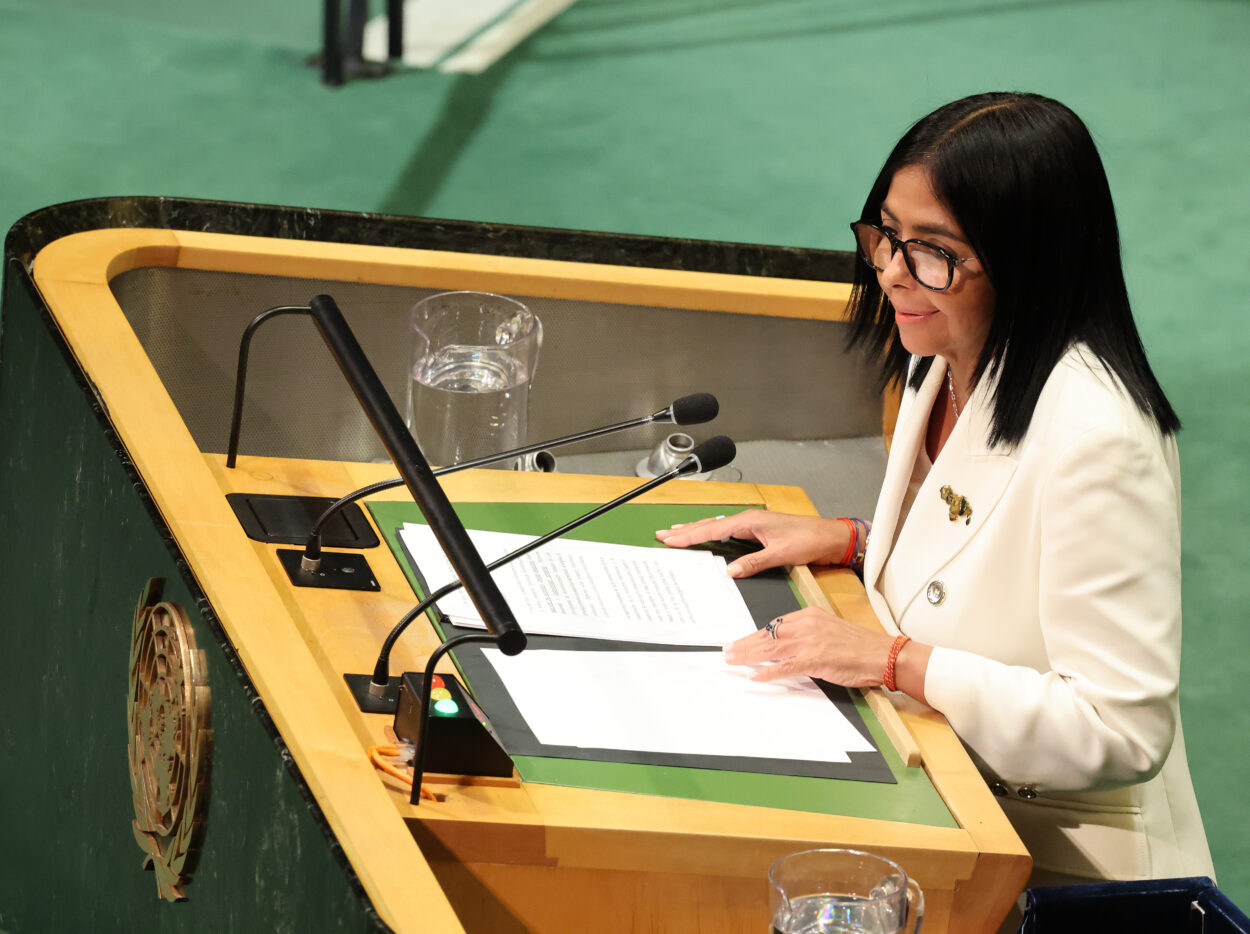
Acting President Delcy Rodríguez delivering her speech at the 81st United Nations General Assembly in New York. (Presidential Press)
Caracas, September 25, 2026 (venezuelanalysis.com) – Venezuelan Acting President Delcy Rodríguez outlined a foreign policy built on “peace” and “dialogue” in her address at the 81st session of the United Nations General Assembly in New York on Wednesday.
Speaking before world leaders, Rodríguez insisted on peace over conflict, thanked the Trump administration for diplomatic backing, and committed to international cooperation on environmental, energy, and AI regulation. She went on to urge young Venezuelan migrants to return home and laid out a proposal for structural “democratic transformation” of the Caribbean nation.
Opening her address, Rodríguez underscored Caracas’ rejection of warfare, linking global stability to diplomatic resolution.
“Venezuela, which today knows what it is to lift its children out from under the rubble, extends its deepest solidarity to all peoples who suffer from war, and reaffirms that peace […] is not a naive aspiration, but the only truly human path,” she declared.
Rodríguez explicitly addressed the diplomatic rapprochement with Washington after the January 3 US military strikes and kidnapping of President Nicolás Maduro and First Lady Cilia Flores. She expressed thanked Trump for aiding Venezuela’s reintegration into international forums following years of heavy economic sanctions and diplomatic isolation.
“I want to thank President Donald Trump and his government for their willingness to resume the path of diplomatic and cooperative relations with Venezuela,” Rodríguez stated, referencing the recent oil deal as “one of the largest ever signed” and pledging that it will contribute to regional energy stability.
Rodríguez refrained from condemning the US attack, calling it a “difficult moment” that resulted from the “exhaustion of domestic policies and heightened confrontation with the US.” She likewise made no mention of Maduro and Flores, presently detained 10-15 miles away from the UN headquarters and facing trial for charges including drug trafficking conspiracy.
The Venezuelan acting president had conveyed similar gratitude in a face-to-face meeting with Trump on Tuesday that she labeled as “historic.”
Turning to domestic affairs in her UN address, Rodríguez spoke of the severe wave of migration triggered by past political and economic crises, and vowed to the Venezuelan youth residing abroad that there will be improved conditions for their return.
“To the young people, who have grown up seeing a fractured country and who often decided to leave seeking what they could not find here: I tell you that it is worth believing again,” the acting leader affirmed. “This is the moment to build the country that many want to return to, and not just the one that many wanted to flee.”
This message was framed as part of what Rodríguez termed a “democratic transformation for a rebirth,” which she described as an institutional, orderly, and verifiable process.
“In Venezuela, there will be elections. We have already initiated a political dialogue with sectors of the opposition that leads to a process on equal terms for all,” she noted.
Though Rodríguez did not explicitly name unilateral sanctions from Washington and its allies, she stated that the country needs to be “free from economic restrictions” and pledged to “guide Venezuela toward an era of full democracy, recognized by its people and the world.”
The acting president’s UN speech came amid a flurry of diplomatic activity in New York, including meetings with International Monetary Fund (IMF) Managing Director Kristalina Georgieva, World Bank President Ajay Banga, and Inter-American Development Bank (IDB) President Ilan Goldfajn.
On the sidelines of the UN assembly, Rodríguez also held bilateral meetings with Chilean far-right president José Antonio Kast to discuss regional trade and stability, as well as with a delegation from Trinidad and Tobago, led by Prime Minister Kamla Persad-Bissessar, initiating a “new stage in bilateral relations” centered on joint offshore natural gas exploration and maritime security.
Venezuela had suspended cooperation with neighboring Port of Spain after Persad-Bissessar backed the US’ military build-up on the country’s shores in late 2025.
Rodríguez’s New York trip coincided with a second round of US-backed talks between government negotiators led by National Assembly President Jorge Rodríguez and a sector of the opposition led by former deputy Dinorah Figuera.
The latest negotiations reportedly focused on electoral guarantees, freedom of expression, institutional reform, including renewing the Supreme Court, and efforts to secure the unfreezing of Venezuelan assets abroad, including gold reserves worth approximately US $4 billion. The gold held by the Bank of England is set to be transferred to the US, to be released for post-earthquake recovery efforts under White House oversight.
Four days before they’re set to play the first-ever concert by their new band, Dhani Harrison and Nigel Godrich sit down to enjoy a post-rehearsal libation in the parking lot of a North Hollywood practice space.
“Is there an opener?” asks Godrich, who holds a bottle of fancy root beer. Harrison, who’s clutching a Sapporo, grabs his friend’s drink and neatly pops the top off using his own bottle.
“I went to Brown,” he says with a little smile. “That’s what they teach you in the Ivy League.”
Harrison, 48, is the son of the late Beatles legend George Harrison; long before college, he got a priceless musical education from his father, whose final solo album — 2002’s Grammy-winning “Brainwashed” — Dhani helped complete after George’s death in 2001. Godrich, 55, made his name working in the studio with Radiohead on game-changing records like “OK Computer” and “Kid A”; he’s also produced for Beck, Paul McCartney and Roger Waters and played with Thom Yorke and Flea in Atoms for Peace.
Now the two have teamed up in Dragonflies, a spacey and atmospheric art-rock duo with a self-titled debut album due Friday from Dark Horse Records, the label George Harrison founded in 1974 and Dhani Harrison relaunched in 2020. This weekend, Harrison and Godrich will celebrate the LP’s release with two shows at Hollywood Forever’s Masonic Lodge, where they’ll be joined by guitarist Nick Valensi (of the Strokes) and drummer Joey Waronker (who’s played with Beck, R.E.M. and Oasis).
Asked how exactly the group came together, Godrich and Harrison look at each other across a picnic table and shrug. “The real reason we did it was as a vehicle to hang out,” Godrich says of the two, who’ve been pals since both were living in Los Angeles in the early 2000s and who both found themselves back home in England a few years ago.
Yet “Dragonflies” has plenty to offer the rest of us: Built around Harrison’s high, sighing vocals, the music moves with a funky rhythmic propulsion rooted in Godrich’s signature tape loops; lush string arrangements by David Campbell (also known as Beck’s dad) add a touch of slightly spooked romance to songs about nature and friendship.
Harrison describes the band’s sound as “a bit creaky” and compares it to the feeling of being out on the water. “I always thought that’s a cool place to start — like you’re on a sinking ship,” he says.
Godrich laughs and adds, “Well, I hope not.”
For Harrison, working with Godrich provided a kind of full-circle moment nearly two decades after he caught one of Atoms for Peace’s first gigs at downtown L.A.’s Orpheum Theatre in 2009.
“I remember it made me want to quit music,” he says, which draws a frown from his bandmate.
“That’s not a great review,” Godrich says.
“No, that concert blew me away,” Harrison replies. “I went home and I was like, Oh, they’ve already done all the things I want to do. So I just went and sulked for a few days.”
Dragonflies began after Harrison returned to England, where he’d grown up on his father’s Friar Park estate, following the death of his grandmother, who famously raised George Harrison’s widow, Olivia Harrison, in Hawthorne. “I was still here basically to be around her,” says the musician, who formed the bands Thenewno2 and Fistful of Mercy while in L.A. “When she passed, that was the last of my grandparents. My mom was living in England, and so I just thought, Well, time to go.”
Harrison sought out Godrich for help on his 2023 solo album, “Innerstanding”; later, he lent the producer one of his dad’s old tape machines — “They did ‘Shankar Family & Friends’ on it,” he points out — which led to a series of casual jam sessions at Godrich’s studio in London’s Brixton neighborhood.
“It was like, ‘Hey, you want to get some Japanese food and make some tape loops?’” Harrison recalls.
Godrich notes proudly that “the way the record was made was completely mechanical,” meaning nothing was programmed on a computer but instead recorded “live on the fly” using older equipment.
“Fortunately, we both own a ridiculous amount of analog gear,” Harrison adds. “Because we’re nerds.”
“I’m not a nerd,” Godrich says. “I hate gear chat.”
“That’s true,” Harrison says. “He doesn’t nerd out about that stuff — I’m the nerd. He won’t even let me use six Kaoss Pads onstage.”
What’s a Kaoss Pad?
“You don’t want to know,” Godrich replies.
Gearhead or no, the producer was adamant that Dragonflies not rely on prerecorded backing tracks when it starts playing live.
“No computers were harmed in the making of this show,” Harrison says — thus the extra players.
(Brian Feinzimer / For The Times)
Waronker is an old friend of Godrich’s who played drums in Atoms for Peace and on Beck’s “Sea Change” and “Morning Phase” (not to mention Beck’s brand-new “Ride Lonesome,” which Godrich mixed); the producer has known Valensi since he “didn’t work with the Strokes,” as he puts it, in 2003, when Godrich tried a couple of sessions with the New York garage-rock band before deciding it wasn’t a good fit.
Godrich says he plays bass in the live group because it’s easy. But also: “Bass is such an important part of the sound that if somebody else was doing it, they would never do it the same as me, and it would annoy me.”
Top three bass players of all time, according to Dragonflies?
“McCartney’s good, isn’t he?” Godrich asks.
“Les Claypool,” says Harrison. “I’m a huge Primus fan.”
“I like David J from Bauhaus,” Godrich says. “He’s an incredibly innovative bass player — always did very interesting things. Stylistically, he’s someone that I probably copy a lot from. It’s just the root notes, but whoever’s in control of the root notes is in control of everything.”
“It really is a power move to be the bass player,” Harrison says.
“I don’t want to be at the front — that’s not my thing,” says Godrich. “I don’t want to be the guy.”
Does Harrison?
“It takes me a while to get warmed up,” he says. “I don’t really look at people when I’m playing a show. I’m not sure if that means I’m mildly spectoral. I took the test, actually — I scored highest in my old band. I know a lot of neurodivergent people who perform.” He shrugs. “Sometimes you don’t get to choose if you’re the guy, but you’re the guy.”
In addition to his father, one of Dhani’s mentors was George’s friend and latter-day creative partner Jeff Lynne, who for all his musical genius has never seemed particularly comfortable onstage.
“He’s brilliant at what he does, but you talk about in-ear monitors or the sound onstage or the lighting or something, and it’s over,” Harrison says. “It’s too much input. That’s why Jeff wears the Spider-Man goggles,” he adds, referring to the ELO frontman’s ever-present aviator shades. “He has too much Spider-Sense. My dad was the same way. He definitely was like, ‘Look at him — don’t look at me!’”
After Dragonflies’ Hollywood Forever shows, Godrich and Harrison have dates scheduled in Europe for November and hope to play more in the future, depending on when Godrich finishes a couple of records he’s producing. (To give a sense of the stress he’s under, he mimes putting a gun to his head.) The duo already has enough material for a second album too.
How much time does Harrison intend to dedicate to the project?
“As much as I can, really,” he says. “How much do you want to hang out with your mate? I got bored of being Dhani Harrison anyway — I like being Dragonflies now.”
WASHINGTON — Philippine President Corazon Aquino, given a rousing reception, told a joint meeting of Congress today that if she fails to negotiate peace with communist guerrillas threatening her government she will not flinch from “taking up the sword of war.”
“I will not stand by and allow an insurgent leadership to spurn our offer of peace and kill our young soldiers and threaten our new freedom,” Aquino said.
Aquino was greeted in the House chamber by enthusiastic applause and cheers from the members of Congress, many of whom sported yellow flowers in their lapels. Aquino wore her trademark yellow suit, like the ones she wore so often during her campaign for the presidency earlier this year.
Many visitors in the gallery, and several members as well, chanted “Cory, Cory, Cory” for half a minute as she entered the chamber.
Several members later said her speech had been so well received that it could mean more U.S. aid for her nation. Speaker Thomas P. (Tip) O’Neill said it was the best he had ever heard on Capitol Hill.
‘Hit a Home Run’
Senate Republican leader Bob Dole said he told Aquino she had “hit a home run” with Congress, and said she replied: “I hope the bases were loaded.” Impressed senators and House members called her speech “brilliant,” “eloquent,” “magnificent” and “moving.”
She opened her speech with a tribute to her husband, Benigno S. Aquino Jr., a human rights activist whose murder in Manila in 1983 after years of exile in the United States swelled the widespread disenchantment with the government of Ferdinand E. Marcos and eventually led to his downfall.
Her husband’s death “was my country’s resurrection in the courage and faith by which alone they could be free again,” she said. “And so began the revolution that has brought me to democracy’s most famous home, the United States.”
Aquino’s speech underscored her policy of negotiating with the communist New People’s Army guerrilla movement and, if the talks fail, waging a vigorous war against the insurgents.
“I must explore the path of peace to the utmost, for at its end, whatever disappointment I meet there, is the moral basis for laying down the olive branch of peace and taking up the sword of war,” she said.
“Still, should it come to that, I will not waver from the course laid down by your great liberator,” a reference to Abraham Lincoln and his determination to fight the Civil War.
‘Whatever It Takes’
“Like Lincoln, I understand that force may be necessary before mercy,” she said. “Like Lincoln, I don’t relish it, yet I will do whatever it takes to defend the integrity and freedom of my country.”
She said the aim of the negotiations is “to bring the insurgents down from the hills and, by economic progress and justice, show them that for which the best intentioned among them fight.” Persuading the guerrillas to stop fighting will be accomplished by “political initiatives and local reintegration programs.”
She said her predecessor, Marcos, set aside democratic rights to wage a war against “a communist insurgency that numbered less than 500.
“Unhampered by respect for human rights, he went at it with hammer and tongs. By the time he fled, that insurgency had grown to more than 16,000.
“I think there is a lesson here to be learned about trying to stifle a thing with the means by which it grows.”
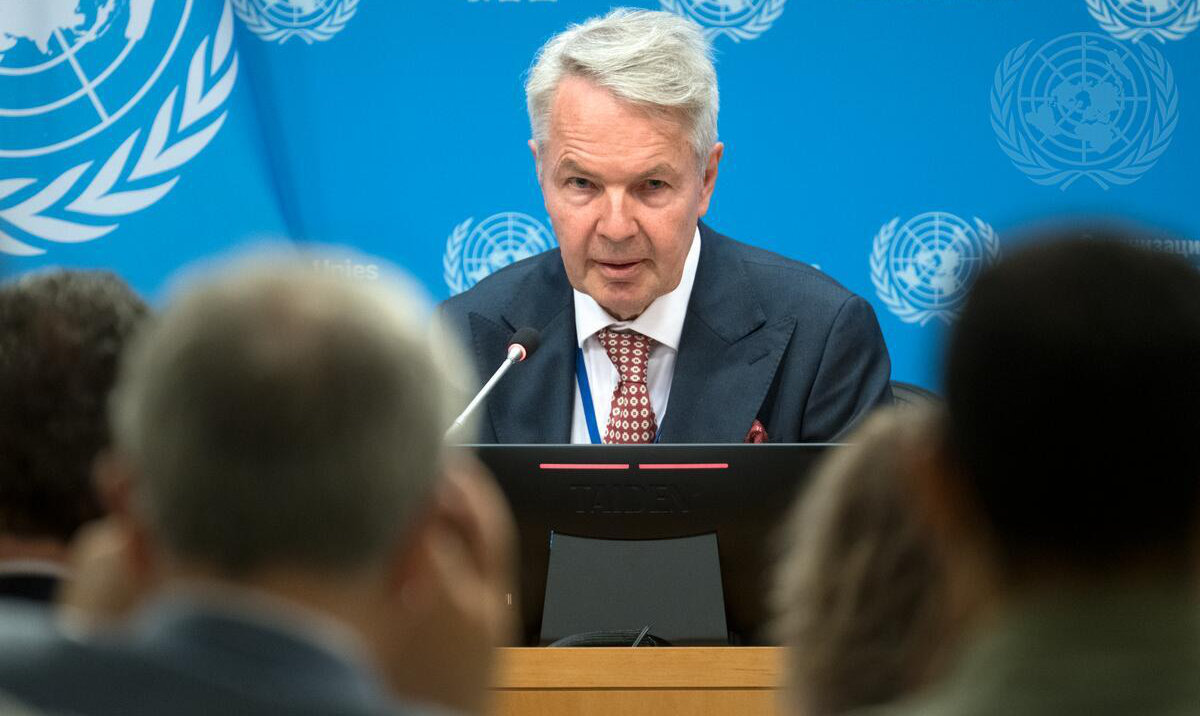
NEW YORK CITY: The UN secretary-general’s personal envoy for Sudan, Pekka Haavisto, joined fellow “Quintet” mediators in Khartoum on Tuesday for a round of talks aimed at reviving an inclusive political process that can end the conflict in Sudan, the UN said.
The Quintet group — comprising the African Union, the Intergovernmental Authority on Development, the League of Arab States, the EU and the UN — held what Stephane Dujarric, spokesperson for UN Secretary-General Antonio Guterres, described as a “good offices mission” to hear an assessment by Sudanese stakeholders of the political and security situation in the country, and to share reflections on efforts to advance peace.
The envoys met at the Sudanese Foreign Ministry before engaging with representatives of UN agencies, Dujarric told reporters in New York. Next, they will meet Sudanese political and civilian representatives, followed by further engagements, he said.
Sudan has been locked in a civil war between the Sudanese Armed Forces and rival paramilitary faction the Rapid Support Forces since April 2023.
Haavisto arrived in Khartoum on Friday and held a series of meetings with the chairman of Sudan’s Transitional Sovereignty Council, the prime minister, the foreign minister and senior government officials, as well as other political leaders and representatives of civil society, Dujarric said.
Haavisto’s talks over the weekend focused on “practical measures to advance deescalation and the protection of civilians,” Dujarric added. He also raised the issue of the release and exchange of detainees, and stressed the importance of a single national examination process for all Sudanese schoolchildren.
Haavisto called for an inclusive political process alongside concrete steps to reduce violence in the country, insisting that a negotiated settlement remained “the only viable path” toward a comprehensive ceasefire agreement and a sustainable end to the conflict.
The envoy is expected to remain in Sudan until the end of this week.
RIYADH: Eight Islamic and Arab countries on Sunday condemned Israeli plans for the removal of Palestinians from the Gaza Strip saying the designs, voiced by ministers, jeopardise a US-backed peace in the territory.
Israeli Defence Minister Israel Katz said Wednesday the government had plans to remove Palestinians from Gaza but was waiting for US approval on where to displace the territory’s population.
A day later, Israel’s National Security Minister Itamar Ben Gvir said the plan aimed to remove 250,000 Palestinians from Gaza in the first year, followed by the rest of the roughly two million residents over the following six years.
The foreign ministers of Saudi Arabia, Egypt, Jordan, the United Arab Emirates, Qatar, Pakistan, Indonesia and Turkey said they condemned in “the strongest terms” the “plans and mechanisms they proposed aimed at forcibly expelling Palestinians from their land”.
“Such measures directly challenge international efforts to achieve peace, particularly President Donald Trump’s comprehensive plan to end the conflict in Gaza, which includes a firm rejection of forced displacement,” they added referring to a US-backed, October 2025 peace plan for Gaza.
On Saturday the US ambassador to Israel Mike Huckabee, a staunch supporter of Israel and Israeli settlers in the occupied West Bank, denied there was an Israeli plan to force Palestinians out of Gaza.
Yayoi Kusama, the Japanese artist known for her hypnotic, repetitive polka dot artworks, died earlier this week at the age of 97. Hers was the third in a string of deaths this week that left me feeling quite melancholy. First Dolly Parton, then Tim Curry and finally, Kusama.
The silver lining in the death of an artist, whether they be musician, actor, writer or visual artist, is that they leave a trail of comfort for fans through their work. I can (and did) sit in my breakfast nook weeping to the sound of Parton’s voice in songs including 1971’s “Coat of Many Colors.” When it comes to mourning Kusama, I am planning a trip to the Broad museum in downtown L.A., which houses two of her famous Infinity Mirror Rooms.
“Longing for Eternity” (2017) is on view on the third floor and can be accessed with a free general admission ticket. “Infinity Mirrored Room —The Souls of Millions of Light Years Away” (2013), however, requires a separate free reservation. A rep for the museum said reservations are currently available through September with many time slots already completely full. The museum is also accommodating as many walk-ups as capacity allows — and these walk-ups have increased in the wake of Kusama’s death.
In an email to The Times, Broad founding President and Director Joanne Heyler wrote that Kusama’s Infinity Mirror Rooms, “have been among the most beloved works at The Broad since we opened in 2015.”
Heyler noted that the Broad’s 2017 exhibition, “Yayoi Kusama: Infinity Mirrors,” “was an incredible moment in the museum’s early history. It was a beautiful show, and unprecedented operationally: the only time our ticketing system broke down due to demand, minutes after release. Her work is both wildly popular and conceptually rigorous; her journey as an artist is complex, full of resilience and a refusal to be limited. Visitors have found deep connection inside the Infinity Mirror Rooms at The Broad — smiles, tears, even marriage proposals. We’re grateful to be one of the places where people can go to spend time with her work and remember her, and we’ll keep working to ensure her art is experienced as she intended: by everyone, infinitely.”
This is welcome news, and the devoted interest makes sense. In many ways, these physically small but emotionally vast rooms encapsulate the essence of Kusama’s practice throughout her life. Built in a distinctively analog way, the rooms create the illusion of endless space through the use of light, mirrors and splashes of color. Kusama incorporated hand-sewn cloth, and later, multimedia video projections, but at their core the rooms remained largely technology-free.
It’s a pity because all the people who stepped into those rooms with their cellphone cameras at the ready missed a profound opportunity to inhabit a floating dreamscape of true peace and quiet — the kind we rarely grasp in our digital-notification suffocated world.
I can still remember the first time I had the opportunity to experience one of Kusama’s Infinity Mirror Rooms. It was dark and glittering with tiny pinpricks of colored light. I felt as if I were suspended in a deep, black pool of energy that extended beyond me in all directions. I could hear my blood rushing in my ears and briefly wondered if this could be what it felt like in the womb.
I got dizzy and recovered, and then — for what felt like a long time but was only a matter of seconds — I was free.
I’m Arts editor Jessica Gelt taking moments of solace where I can get them. This is your arts and culture news for the week.
You’re reading Essential Arts
Our critics and reporters guide you through events and happenings in the SoCal arts scene. In your inbox every Friday.
By continuing, you agree to our Terms of Service, which include arbitration and a class action waiver. You agree that we and our third-party vendors may collect and use your information, including through cookies, pixels and similar technologies, for the purposes set forth in our Privacy Policy such as personalizing your experience and ads.
The week ahead: A curated calendar
FRIDAY
Babatunde Akinboboye The baritone fuses classical opera with hip-hop on “Toreador,” “Funiculi, Funicula,” “O Sole Mio” and more. 8 p.m. Friday and Saturday. Sierra Madre Playhouse, 87 W. Sierra Madre Blvd. sierramadreplayhouse.org
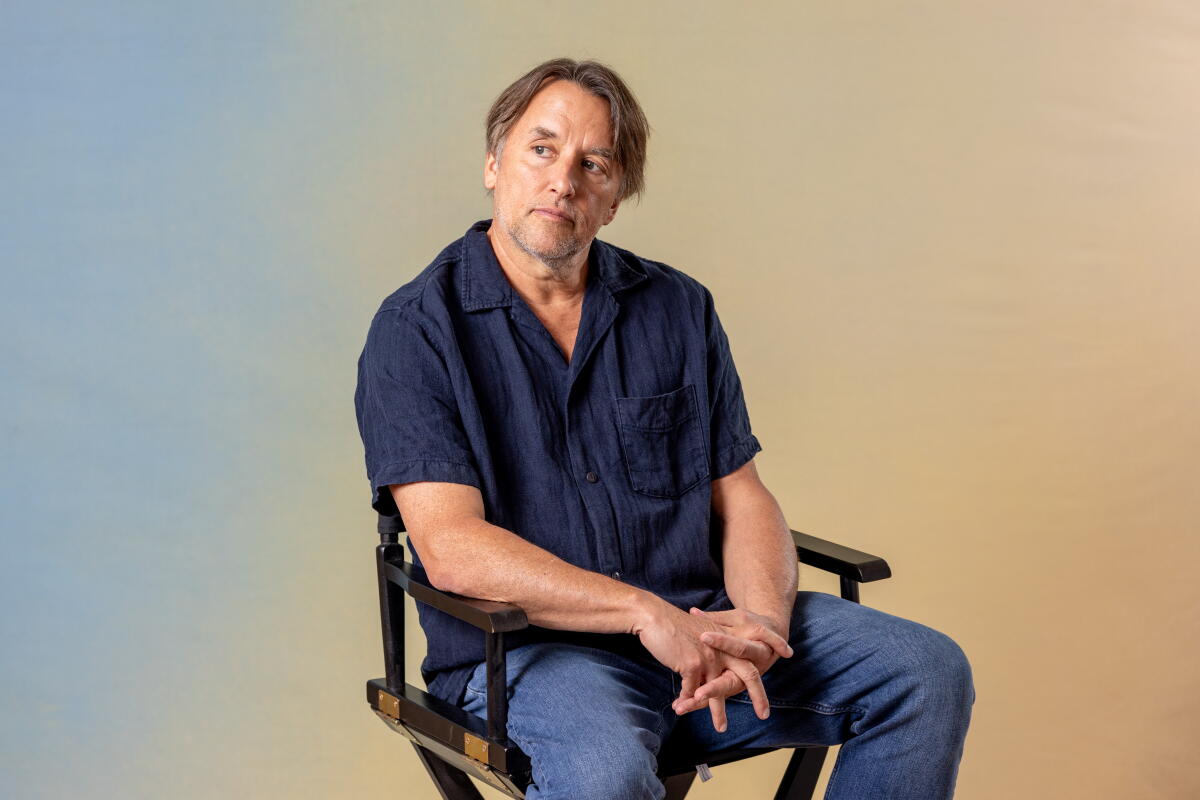
Director Richard Linklater at the 2023 Toronto Film Festival.
(Jay L. Clendenin / Los Angeles Times)
Richard Linklater A three-movie American Cinematheque tribute featuring Q&As with the Texas filmmaker. In a recent interview, Times film writer Mark Olsen asked Linklater what it’s like to reflect on his work: “What resonates with me in my mind is the experience of making the movie more than the movie itself — all the people you worked with and the cast and all those good feelings.” “Boyhood,” 7:30 p.m. Friday; “Waking Life,” 4 p.m. Saturday. Aero Theatre, 1328 Montana Ave., Santa Monica; “Dazed & Confused,” 7:30 p.m. Saturday. Directors Village, 961 Broxton Ave. Westwood. americancinematheque.com
Pericles Boston Court, in partnership with Play On Shakespeare, presents the West Coast premiere of Ellen McLaughlin’s modern verse translation of Shakespeare’s rarely performed adventure tale. Directed by Margaret Shigeko Starbuck. Through Sept. 27. Boston Court Pasadena, 70 N. Mentor Ave. bostoncourtpasadena.org
Romeo & Juliet A site-specific, immersive, queer adaptation of Shakespeare’s tragedy. 7:30 p.m. Friday and Saturday; 1 p.m. Saturday and Sunday. Sassafras Saloon, 1233 Vine St. eventbrite.com
SATURDAY
Place Is the Space A four-hour immersive performance experience created by artist Edgar Arceneaux and co-creator Frank Lawson employs live jazz improvisation, theatrical storytelling and multimedia design inspired by Sun Ra’s philosophy and his film “Space Is the Place.” Presented by CAP UCLA, the event includes an audience procession to the Hammer Museum in conjunction with the current exhibition, “Space Is the Place,” for a final performance. 1 p.m. UCLA Nimoy Theater, 1262 Westwood Blvd. cap.ucla.edu
Joshua Smith Untitled (Yellow Heart), 2026 Acrylic on canvas 14 ¾ x 14 ½ in.
(839 Gallery)
Joshua Smith: Hearts and Triangles The artist’s first Los Angeles solo show includes brightly colored monochrome paintings on shaped canvases. Opening reception, 5-8 p.m. Saturday; exhibition continues through Oct. 17. 839, 839 N. Cherokee Ave. 839gallery.com
Winter’s Bench The world premiere of Mike Kenny’s play about a woman who returns to a park where she thinks a tree once spoke to her. Starring Anne Gee Byrd and Shih-wei Wu. Directed by Debbie Devine. All performances will feature Spanish supertitles. Previews, 8 p.m. Saturday; 2 p.m. Sunday; 7:30 p.m. Wednesday, Thursday and Sept. 4; 8 p.m. Saturdays, 2 p.m.; Sundays, 8 p.m.; Sept. 7 and 14; through Oct. 25. 24th Street Theatre, 1117 W. 24th St. 24thstreet.org
SUNDAY
Element Band Led by Ara Dabandjian, the ensemble features 12 musicians and vocalists, including Soseh Aramouni Keshishyan and Natalie Avunjian, in a celebration of Armenian heritage, creativity and live music. 7:30 p.m. The Ford, 2580 Cahuenga Blvd. East. theford.com
TUESDAY
Dvořák & Bruch Conductor Anja Bihlmaier and violinist Bomsori join the Los Angeles Philharmonic. 8 p.m. Hollywood Bowl, 2301 N Highland Ave. hollywoodbowl.com
THURSDAY
Amadeus in Concert The Los Angeles Philharmonic, led by conductor Norman Huynh, conductor, and the Pacific Chorale perform live to Milos Forman’s 1984 Oscar-winning best picture starring Tom Hulce and F. Murray Abraham. 8 p.m. Hollywood Bowl, 2301 N Highland Ave. hollywoodbowl.com
The Arsonists Max Frisch’s 1953 absurdist satire, translated by Alastair Beaton and directed by Luke Harlan. 8 p.m. Thursdays through Saturdays; 5 p.m. Saturdays; 2 p.m. Sunday; through Sept. 20. Skylight Theatre, 1816 1/2 N. Vermont Ave. skylighttheatre.org
Under the Oaks A weekly salon series featuring performance and music: “Currents: Composers in Concert” (Sept. 3); “Beer! A New Musical-in-Development” (Sept. 10); “Cabaret Theatricum Sings Marvin Gaye” (Sept. 17); and “The Voice of Dr. King” (Sept. 24. 7:30 p.m. Thursdays through Sept. 24. Will Geer Theatricum Botanicum, 1419 N. Topanga Canyon Blvd. Topanga. theatricum.com
Arts everywhere
Sarah Bareilles in the documentary “Sarah Bareilles: Good Grief.”
(A Group Effort Films / Naked Edge Films)
Sara Bareilles: Good Grief The Grammy-winning Broadway star and pop singer’s return to the recording studio for the first time in seven years is captured in this intimate documentary directed by Josh Alexander receiving a one-night-only theatrical release. The film looks at Bareilles’ experience of channeling her own pain to create art and the healing journey that accompanied it. Bareilles will perform at the Dolby Theatre, Oct. 12-14. 7 p.m. Wednesday. Laemmle and AMC theaters. sarabmusic.com
Culture news and the SoCal scene
Dolores Huerta photographed at Dolores Huerta “Help Wanted/Leave Now” exhibit at California Museum.
(Beth Baugher / California Museum)
Dolores Huerta has prioritized involving herself in projects relating to labor and women’s rights in the wake of going public with sexual abuse allegations against former labor leader Cesar Chavez. One of those projects can now be seen at the California Museum in Sacramento in an exhibition called “Help Wanted/Leave Now: ‘Operation Wetback’ and the Revolving Door of Mass Deportation,” which, according to a story by contributor Isa Farfan, “examines decades of the federal government’s deportation campaigns against Mexican immigrants even while it recruited millions of these farmworkers and rail workers to fill labor shortages during and after World War II.”
Contributor Leah Ollman reviews a new Eileen Cowin retrospective called “Between Panic and Paradise” at Los Angeles County Museum of Art. Labeling Cowin a “wry disruptor,” Ollman notes that over the artist’s nearly six-decade career, she has toyed with time in a novel way: “By deviating from straightforward chronology, the installation resonates smartly with one of Cowin’s key operating principles — that we don’t experience time as a continuous line moving in one direction, but as episodic, fragmented, interrupted, layered.”
Gustavo Dudamel at the end of the first half his show at the Hollywood Bowl on Aug. 20.
(Jason Armond / Los Angeles Times)
Gustavo Dudamel is really leaving — although it feels as if the city has been mourning the eventuality for years. Times classical music critic Mark Swed was, of course, on hand to bear witness to Dudamel’s final farewell: a four-night Hollywood Bowl extravaganza. “Dudamel addressed the audience, sounding very much like he had 17 years ago at the Bowl, extolling in our being a crowd of many types together for many musics. L.A., he said, made him an Angeleno,” Swed wrote.
Swed also attended a Tuesday night show at the Hollywood Bowl after the Dudamel farewell extravaganza and found it rather empty and a bit “forlorn,” a situation, he writes in a review, that “left Anna Handler, who becomes the Los Angeles Philharmonic’s conductor-in-residence this fall, with the trickiest conducting assignment of the summer anywhere.”
Theater Director Bart DeLorenzo on the set of “Enemy of the People” at the Odyssey Theatre on Friday, Aug. 21, 2026.
(Ariana Drehsler / For The Times)
Times theater critic Charles McNulty recently sat down for a lunchtime conversation with Bart DeLorenzo, “L.A.’s most playfully provocative theater auteur,” about his decision to direct (and adapt) Henrik Ibsen’s “Enemy of the People” at Odyssey Theatre. “If ever there was a moment to revive ‘An Enemy of the People,’ it’s now,” McNulty writes. “The demoralizing spectacle of the U.S. Senate’s inquisition of Dr. Anthony Fauci last month, led by Sen. Rand Paul (R-Ky.) in unapologetic witch-hunt mode, was yet another reminder that Ibsen’s drama about a public health crusader being targeted by politicians and business leaders when his medical advice goes counter to their interests hasn’t lost its punch.”
The drama never stops at the beleaguered Kennedy Center as it deals with the continued tumult resulting from President Trump’s takeover early last year. Most recently the Justice Department claimed in a recent court filing that Trump’s “efforts and prestige provide the sole hope for the Center’s financial survival, and structural renewal.” If the center isn’t shut down for the two-year renovation Trump demands, it may need to be demolished, the filing reads.
Enjoying this newsletter? Consider subscribing to the Los Angeles Times
Visitors line up outside the Japanese American National Museum for a 2022 event recalling World War II incarceration camps.
(Genaro Molina / Los Angeles Times)
After closing in early January, 2024, the Japanese American National Museum has announced it will reopen its newly renovated Pavilion on Jan. 23, 2027. Renovations include a new main entrance and new first-floor galleries for a brand new exhibition titled “In the Future We Call Now: Realities of Racism, Forging Democracy.” The special exhibition galleries on the second floor have also been updated and will feature the inaugural exhibition, “Pictures of Belonging: Miki Hayakawa, Hisako Hibi, and Miné Okubo.”
The Broad has announced its next fall exhibition, “Has the myth been shattered,” opening Nov. 21. The exhibition is set to include recent acquisitions by Guadalupe Rosales, Hank Willis Thomas and Mickalene Thomas. “Gathered together, works in the exhibition create unexpected connections across six decades, prompting an examination of how media has shaped history, memory, and collective experience,” a news release notes.