pct

BOK lifts S. Korea’s growth forecast to 2.6 pct for this year amid robust chip-driven exports

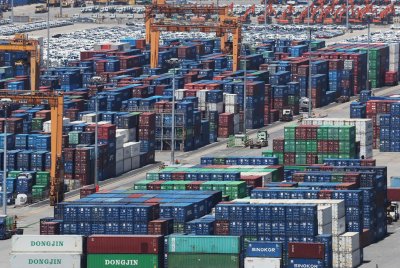
The central bank on Thursday raised its economic growth forecast for South Korea to 2.6 percent for 2026 amid solid semiconductor exports. This file photo shows containers stacked at a port in Pyeongtaek on May 8. Photo by Yonhap

The central bank on Thursday raised its economic growth forecast for South Korea to 2.6 percent for 2026 amid solid exports driven by a semiconductor super cycle.

The revision by the Bank of Korea (BOK) represents a 0.6 percentage-point increase from its previous forecast of 2 percent issued in February.

It is the largest upside revision since May 2021, when the BOK raised its growth projection by 1 percentage point from 3 percent to 4 percent.

For 2027, the central bank estimated its growth outlook at 2.1 percent.

The South Korean economy grew 1.7 percent in the first quarter, marking the sharpest quarterly growth in 5 1/2 years.

The revised outlook broadly aligned with forecasts from other institutions.

The International Monetary Fund (IMF) projected growth of 1.9 percent this year, while the Asian Development Bank (ADB) projected 1.9 percent growth.

The Korea Development Institute (KDI) earlier improved its growth forecast to 2.5 percent for 2026 from 1.9 percent.

The BOK also revised up its inflation prediction to 2.7 percent from 2.2 percent, citing higher international oil prices in the aftermath of the U.S.-Iran war.

For 2027, consumer prices are estimated to rise 2.3 percent, according to the BOK.

“The Korean economy is projected to expand by 2.6 percent this year, well above the February forecast of 2 percent, driven by robust semiconductor exports, while government measures, including the supplementary budget, partially offset the Middle East-driven supply shock,” the BOK said in a release.

BOK Gov. Shin Hyun-song said in a press conference that strong exports will likely contribute 0.7 percentage point to the country’s growth this year, alongside the 0.2 percentage point gains generated by the government’s fiscal support and the 0.1 percentage-point increase brought on by the local stock market rally. On the other hand, the ongoing U.S.-Iran war will drag down the economy by 0.4 percentage point, he added.

“Based on our analysis, we concluded that if the situation in the Middle East is resolved early, this year’s growth rate could exceed 2.6 percent,” he said. “We do not think the growth is a short-lived trend.”

The central bank presented an optimistic scenario in which semiconductor-driven exports gain further momentum, raising its growth forecast by 0.5 percentage point for 2026 and 0.3 percentage point for 2027.

Under a pessimistic scenario, however, a possible slowdown in artificial intelligence investments would lower economic growth by 0.3 percentage point this year and 0.2 percentage point next year, the central bank said.

In line with the upbeat outlook, the BOK kept the key interest rate unchanged at 2.5 percent but signaled a possible rate hike in the second half.

Copyright (c) Yonhap News Agency prohibits its content from being redistributed or reprinted without consent, and forbids the content from being learned and used by artificial intelligence systems.
Source link

Seoul shares shoot up nearly 6.5 pct to over 7,300 on chip rally, Mideast hopes; won rises

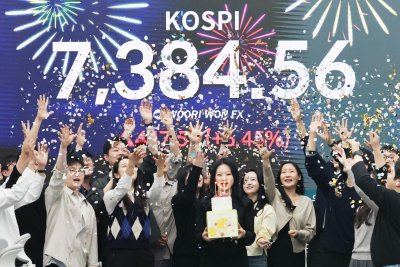
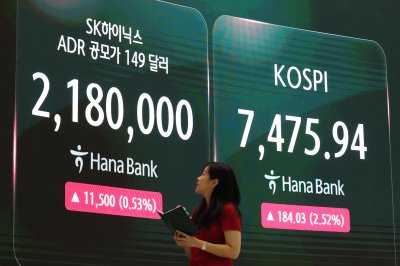
Employees take part in a ceremony at the trading room of Woori Bank in Seoul on Wednesday to celebrate the benchmark KOSPI closing at an all-time high of 7,384.56. Photo by Yonhap

South Korean stocks shot up nearly 6.5 percent Wednesday, extending a record-breaking run to top the 7,300-point mark, driven by a semiconductor rally and optimism for a potential peace deal in the Middle East. The local currency also strengthened against the U.S. dollar.

The benchmark Korea Composite Stock Price Index (KOSPI) added 447.57 points, or 6.45 percent, to a fresh record high of 7,384.56.

It marked the second-largest daily gain in terms of points following 490.36 points reached on March 5.

Trade volume was heavy at 984.4 million shares worth 58.2 trillion won (US$40 billion), with losers outnumbering winners 199 to 677.

Foreigners bought 3.1 trillion won worth of local shares, while institutions and individuals dumped a net 2.3 trillion won and 571.2 billion won, respectively.

Overnight, U.S. President Donald Trump said he would pause operations to escort ships through the Strait of Hormuz as part of efforts to reach a final agreement with Iran.

The KOSPI opened 2.25 percent higher to surpass the landmark 7,000-point threshold for the first time and extended the gains throughout the session.

The main index has been on a bullish run in recent months, surpassing the 5,000-point mark in late January and topping another milestone of 6,000 points in February.

After recouping its losses in March following the outbreak of the U.S.-Iran war in late February, the KOSPI breached the 7,000-point level on continued optimism over the artificial intelligence (AI) boom and hopes for the reopening of the key waterway.

“Global tech giants’ strong performances and the strengthened value chain for AI data centers boosted the AI-related shares,” Lee Kyung-min, an analyst at Daishin Securities, said. “In particular, the market’s top-three shares of Samsung Electronics, SK hynix and SK Square led the rally.”

Top-cap Samsung Electronics surged 14.41 percent to close at 266,000 won, pushing its market capitalization above 1.5 quadrillion won and becoming the second Asian company to surpass the $1 trillion milestone after Taiwan Semiconductor Manufacturing Co.

SK hynix soared 10.64 percent to 1.6 million won, and AI investment firm SK Square jumped 9.89 percent to 1.1 million won.

Hanmi Semiconductor, a chip manufacturing company, rose 4.37 percent to 394,500 won, and LG Electronics vaulted 8.17 percent to 154,900 won.

However, shipbuilding and defense shares dropped. Major shipyard HD Hyundai Heavy Industries fell 4.71 percent to 648,000 won, and defense giant Hanwha Aerospace lost 2.18 percent to 1.4 million won.

Leading biotech firm Samsung Biologics declined 0.34 percent to 1.48 million won, and top mobile carrier SK Telecom backtracked 1.95 percent to 95,500 won.

The Korean won was quoted at 1,455.1 won against the U.S. dollar at 3:30 p.m., up 7.7 won from the previous session.

The quotation marks the highest since February 27, when the currency closed at 1,439.7 to the greenback.

Copyright (c) Yonhap News Agency prohibits its content from being redistributed or reprinted without consent, and forbids the content from being learned and used by artificial intelligence systems.
Source link

Seoul shares spike over 5 pct to approach 7,000 on chip rally; won sharply up

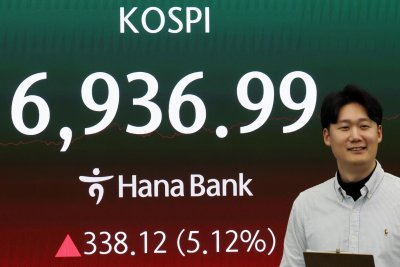
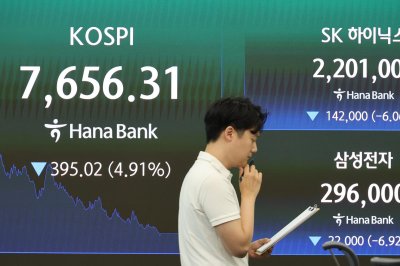
This photo, taken Monday, shows the trading room of Hana Bank in Seoul as South Korean stocks rose more than 5 percent to reach a record high. Photo by Yonhap

South Korean stocks shot up by more than 5 percent to close at a fresh high Monday, approaching the 7,000-point mark, as investors scooped up semiconductor shares while awaiting developments in U.S.-Iran peace talks. The Korean won rose sharply against the U.S. dollar.

The benchmark Korea Composite Stock Price Index (KOSPI) added 338.12 points, or 5.12 percent, to a fresh record high of 6,936.99.

Trade volume was heavy at 864.3 million shares worth 41.3 trillion won (US$28.2 billion), with losers outnumbering winners 473 to 392.

Foreigners bought 3 trillion won worth of local shares, and institutions purchased a net 1.9 trillion won, while retail investors dumped a net 4.8 trillion won.

The index opened 2.79 percent higher after U.S. President Donald Trump announced a plan to guide ships not involved in the Iran conflict through the Strait of Hormuz as a “humanitarian gesture” starting this week.

Later, a senior Iranian official warned that Tehran would consider any U.S. interference in the strait a ceasefire breach.

However, the KOSPI extended its gains in the afternoon, supported by foreign and institutional buying.

“Tech shares were driven by gains on Wall Street over the weekend,” Lee Kyung-min, an analyst at Daishin Securities, said. “Also, foreign investors expanded their net purchase ahead of the market closure for Children’s Day on Tuesday.”

The main index surpassed the 5,000-point mark in late January and topped another milestone of the 6,000-point level in February.

After recouping its losses in March following the outbreak of the U.S.-Iran war in late February, the KOSPI is now approaching the uncharted 7,000-point level on continued optimism over the AI boom and hopes for the reopening of the key waterway.

Semiconductor stocks led the rally.

Chip giant Samsung Electronics jumped 5.44 percent to 232,500 won, and its chipmaking rival SK hynix surged 12.52 percent to a fresh record high of 1.4 million won, surpassing 10 trillion won in market capitalization for the first time.

Hanmi Semiconductor, a chip equipment manufacturer, rose 2.72 percent to 378,000 won, and Samsung Electro-Mechanics, an electronic components affiliate of Samsung Electronics Co., soared 10.34 percent to 918,000 won.

Defense shares were also strong as industry leader Hanwha Aerospace advanced 3.39 percent to 1.4 million won and LIG D&A gained 4.46 percent to 983,000 won.

Top carmaker Hyundai Motor climbed 1.51 percent to 539,000 won, and leading battery maker LG Energy Solution increased 2.5 percent to 472,000 won.

However, bio shares went south as Celltrion fell 1.35 percent to 197,800 won, and Samsung Biologics dropped 2.58 percent to 1.4 million won.

The Korean won was quoted at 1,462.8 won against the U.S. dollar at 3:30 p.m., up 20.5 won from the previous session.

The quotation marks the highest since February 27, when the currency closed at 1,439.7 to the greenback.

Bond prices, which move inversely to yields, closed lower. The yield on three-year Treasurys added 2 basis points to 3.615 percent, while the return on the benchmark five-year government bonds gained 1.7 basis points to 3.797 percent.

Copyright (c) Yonhap News Agency prohibits its content from being redistributed or reprinted without consent, and forbids the content from being learned and used by artificial intelligence systems.

Source link