patriot

Patriot PAC-3 Missiles To Arm Navy Arleigh Burke Class Destroyers

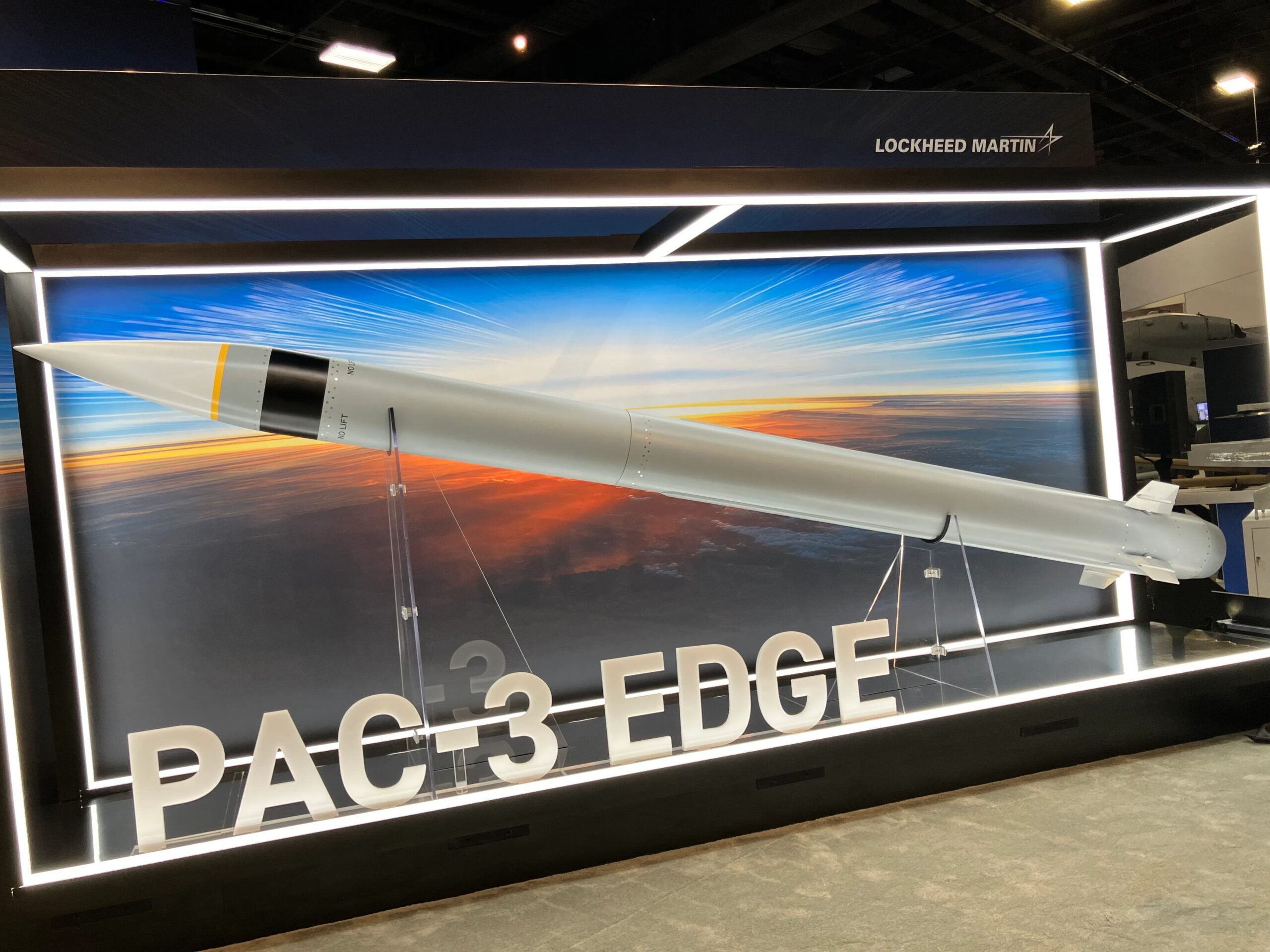
The U.S. Navy has handed Lockheed Martin a formal contract to integrate the Patriot PAC-3 Missile Segment Enhancement (MSE) surface-to-air missile with the Aegis Combat System. The Navy’s main Aegis-equipped ships today are its Arleigh Burke class destroyers. The service is also seeking just over $1.73 billion to order its first-ever tranche of PAC-3 MSEs, 405 in total, as part of its proposed budget for the 2027 Fiscal Year.

The idea of combining PAC-3 MSE and Aegis, as well as the Mk 41 Vertical Launch System (VLS), first emerged in 2023. Since then, TWZ has highlighted how this offers the Navy a valuable alternative source of anti-air interceptors, and maybe even eventually a replacement for the venerable Standard Missile-2 (SM-2).

A rendering of an Arleigh Burke class destroyer firing a PAC-3 MSE missile. Lockheed Martin

Lockheed Martin announced it had received the PAC-3 MSE/Aegis integration contract, said to be a multi-million dollar deal, earlier today, around the Navy League’s annual Sea Air Space exposition, at which TWZ is in attendance. The Navy has separately shared more details about its PAC-3 MSE acquisition plans as part of the full rollout of the Pentagon’s budget request for Fiscal Year 2027, which also occurred today.

Per the Navy’s Fiscal Year 2027 budget request, the service sees PAC-3 MSE integration with Aegis as providing an additional means of intercepting “a wide range of threats, including tactical ballistic missiles, air-breathing threats, cruise missiles, and unmanned aerial systems.” As mentioned, Arleigh Burke class destroyers make up the vast majority of American warships equipped with the Aegis Combat System today. There are also a steadily shrinking number of Ticonderoga class cruisers with this combat system.

PAC-3 MSE has been in full-scale production since 2018. Pairing it with Aegis “has been in the works, I probably think, close to 10 years,” Chandra Marshall, Vice President and General Manager of the Multi-Domain Combat Solutions business unit within Lockheed Martin’s Rotary and Mission Systems division, told our Jamie Hunter on the floor of Sea Air Space. She added that the goal now is for the Navy to achieve initial operational capability (IOC) with this combination in approximately 18 months, or by the end of 2027 if the clock starts now.

A briefing slide offering a general overview of the PAC-3 MSE missile, as well as its improvements over the previous PAC-3 CRI surface-to-air interceptor. Lockheed Martin An overview of the improvements found on the PAC-3 MSE variant over its predecessors, including a “New LE [lethality enhancer].” Lockheed Martin

“So, there’s two pieces of it. So the PAC-3 missile, there’s a small update to it to be able to communicate with S-band radar. So, currently it communicates with X-band [radars]. So, now with this update, it will be able to communicate both with S and X-band,” Marshall explained. “And then we have to integrate PAC-3 as a missile type with the Aegis Combat System.”

“We have a very open architecture [with Aegis], so the way that we componentize everything, we feel like it’s a very short putt for the Aegis integration of the PAC-3 missile,” she added. “So, it’ll just be another missile in the inventory for the Navy to be able to diversify based on the threat.”

You can read more about the Aegis Combat System and how it has evolved to adopt a modular, open architecture approach, specifically to make it easier to add new capabilities and functionality, in this previous TWZ feature. Lockheed Martin has already demonstrated the ability of a modular and scalable version of the system, called the Virtualized Aegis Weapon System, to fire a PAC-3 MSE from a containerized Mk 41-based launcher on land.

Aegis: Capable. Proven. Deployed. thumbnail

Aegis: Capable. Proven. Deployed.


No changes to the Mk 41 VLS – another Lockheed Martin product – are planned or required as part of the PAC-3 MSE integration. Work has been ongoing on adapting the interceptors into launch canisters, allowing them to slot right into existing Mk 41 cells. At just over 17 feet long, PAC-3 MSE should fit in shorter so-called tactical length versions of the Mk 41, as well as one with longer strike-length cells.

A graphic showing existing missiles compatible with tactical and strike-length versions of the Mk 41 VLS. Lockheed Martin A graphic showing various missiles already compatible with the tactical and strike-length versions of the Mk 41. Lockheed Martin

Lockheed Martin has said in the past that each canister will contain a single PAC-3 MSE missile. At around 11 inches wide, the PAC-3 MSE is just over half the maximum diameter available in a Mk 41 cell. This raises the question of whether future canisters could be designed to hold multiple interceptors, which would give ships valuable additional magazine depth.

From a capability standpoint, PAC-3 MSE is generally discussed in comparison to SM-2 surface-to-air missiles in the Navy’s arsenal today. In terms of missiles that can be fired via the Mk 41, SM-2 is a middle-tier anti-air capability that sits between shorter-range RIM-162 Evolved Sea Sparrow Missiles (ESSM; which can also be quad-packed into a single cell) and upper-tier SM-6s and SM-3s. The SM-6 is a multi-purpose weapon that can also be employed against targets on land and at sea. SM-3s, of which there are multiple variants in service today, are specifically designed as anti-ballistic missile interceptors.

“A lot of places the Navy has said ‘I got red or yellow challenges that I can’t deal with.’ This missile does a really good job at that. When you marry them all together, it is very complimentary to SM-6,” Chris Mang, Vice President of Strategy & Business Development at Lockheed Martin’s Missiles and Fire Control, told TWZ at last year’s Sea Air Space conference. “You’d always want a layered defense, right? I’ll pick the longest shot I can get, but then at a certain point, MSE really starts to outperform in certain envelopes.”

An SM-6 seen at the moment of launch. USN

For the Navy, PAC-3 MSE also presents important logistics, cost, and supply chain benefits. The latest conflict with Iran has only underscored now long-standing concerns about U.S. munition expenditure rates, especially when it comes to anti-air interceptors. A large-scale, high-end fight with a near-peer adversary like China would put much more pressure on munition stockpiles and the U.S. industrial base working to restock them. As such, it would be a boon for the Navy to have an additional stream of interceptors to arm its warships.

As noted, the Navy is already moving to buy hundreds of what documents currently refer to as the “PAC-3 MSE / Navy” missile, as well as launch canisters. The service’s Fiscal Year 2027 budget request puts the unit cost for each missile at $4.05 million. The canister adds another $200,000 to the price tag. The Army’s Fiscal Year 2027 proposed budget says the unit cost for standard PAC-3 MSEs has risen now to $5.3 million. The exact reasons for the cost discrepancy between the Army and Navy versions are unclear.

A PAC-3 MSE missile seen being fired from a ground-based launcher. US military A Patriot launcher fires a newer PAC-3-series missile during a test. DoD

“Both quantities and unit cost are estimates based on U.S. Army contract pricing. Both quantities and unit cost will adjust based on award of DoN CLINs [Department of Navy Contract Line Item Numbers] on ARMY contract in execution and final cost of the Navy components (radio, canister, etc),” per the Navy’s latest budget request.

At $4.05 million, the Navy’s PAC-3 MSEs will be slightly cheaper per missile than the Block IA version of the SM-6. The service’s latest budget request puts the unit cost of the latter missiles at $4.348 million. The cost of a current-generation Block IIICU variant of the SM-2 is unclear, given that they have often been procured as upgrades of existing Block IIICs rather than new-production missiles. Historically, the average price point for an SM-3 Block IIIC has been around $3.6 million.

“By leveraging the high-volume Army PAC-3 MSE production contract, the Navy achieves significant cost avoidance through economies of scale, as unit price decreases with larger quantities,” the Navy’s latest budget documents also note.

Lockheed Martin announced in January that it had reached an agreement with the U.S. government to ramp up annual PAC-3 MSE production, for domestic and foreign customers, from 600 to 2,000 missiles. Last week, the company received a contract to help further accelerate production of these missiles. This could all help drive down the unit cost of the missiles going forward, as well as speed up their delivery.

Lockheed Martin Receives Contract to Accelerate PAC-3® MSE Production thumbnail

Lockheed Martin Receives Contract to Accelerate PAC-3® MSE Production


It is worth pointing out here that PAC-3 MSE’s performance in the Middle East, as well as in Ukraine in recent years, has also prompted a significant increase in demand from the U.S. Army, as well as foreign Patriot operators. The overall Patriot user base is also expanding.

Adding the Navy to the mix will add to that demand, even with the production ramp-up, and could add to already growing concerns about production backlogs now. Integrating PAC-3 with Aegis and the Mk 41 VLS could also spur additional interest from other navies globally that have ships with that combat system and/or launchers.

Reuters reported just last week that U.S. officials had informed allies and partners in Europe that deliveries of unspecified munitions could now be delayed due to American needs in relation to the war with Iran. When it comes to PAC-3 MSE, the budget documents the Army released today, at least, do not appear to show any changes to the delivery schedule for foreign customers.

🇺🇸 Is the US re-sequencing scheduled PAC-3 MSE deliveries away from FMS customers to the US Army’s inventory?

The J-books say no. In fact, FMS customers are scheduled to receive the majority of production.

Delivery schedule unchanged from last year. Only 252 missiles from… pic.twitter.com/iZdXlAYQ82

— Colby Badhwar (@ColbyBadhwar) April 21, 2026

Regardless of any of these issues, the Navy is now pushing full steam ahead on integrating PAC-3 MSE with Aegis and the Mk 41 VLS.

Jamie Hunter contributed to this story.

Contact the author: joe@twz.com

Joseph has been a member of The War Zone team since early 2017. Prior to that, he was an Associate Editor at War Is Boring, and his byline has appeared in other publications, including Small Arms Review, Small Arms Defense Journal, Reuters, We Are the Mighty, and Task & Purpose.


Source link

On This Day, April 18: Patriot Paul Revere begins midnight ride

1 of 5 | On April 18, 1775, U.S. patriot Paul Revere began his famous ride through the Massachusetts countryside, crying out “The British are coming!” to rally the minutemen. File Image courtesy of the Library of Congress

April 18 (UPI) — On this date in history:

In 1506, the cornerstone was placed for St. Peter’s Basilica in Rome.

In 1775, U.S. patriot Paul Revere began his famous ride through the Massachusetts countryside, crying out “The British are coming!” to rally the minutemen.

In 1906, an earthquake estimated at magnitude-7.8 struck San Francisco, collapsing buildings and igniting fires that destroyed much of what remained of the city. Researchers and historians concluded that about 3,000 people died in the quake and its aftermath, and roughly 250,000 were left homeless.

In 1912, three days after the sinking of Titanic, her survivors arrived in New York City aboard the RMS Carpathia.

In 1923, the original Yankee Stadium opened in New York. The stadium was demolished in 2010 after it was replaced a year prior by the new Yankee Stadium.

File Photo by Monika Graff/UPI

In 1942, Lt. Col. James Doolittle led a squadron of B-25 bombers in a surprise raid against Tokyo in response to the Japanese sneak attack on Pearl Harbor on Dec. 7, 1941.

In 1945, U.S. journalist Ernie Pyle, a popular World War II correspondent, was killed by Japanese machine-gun fire on the island of Ie Shima in the Pacific.

In 1949, the Republic of Ireland formally declared itself independent from Britain.

In 1968, McCulloch Oil Corp. paid $2.24 million to buy London Bridge, which was sinking into the Thames under the weight of 20th century traffic. The oil company rebuilt the bridge bloc by block over Lake Havasu in Arizona.

In 1980, Rhodesia became the independent African nation of Zimbabwe.

In 1983, the U.S. Embassy in Beirut, Lebanon, was severely damaged by a car-bomb explosion that killed 63 people, including 17 Americans.

In 1992, an 11-year-old Florida boy sued to “divorce” his natural parents and remain with his foster parents. The boy eventually won his lawsuit.

In 2002, former U.S. Sen. Bob Kerrey, D-Neb., revealed that at least 13 civilians were killed by his U.S. Navy unit in a Vietnamese village in 1969.

File Photo by Ezio Petersen/UPI

In 2007, more than 125 people were killed in a suicide car-bomb explosion near a Baghdad market.

In 2014, an avalanche on what is known as a particularly dangerous route to the top of Mount Everest in the Himalayas killed 16 Sherpa guides.

In 2018, the first movie theaters in Saudi Arabia opened with a public screening of Black Panther.

In 2024, police arrested more than 100 protesters at Columbia University for refusing to leave a large pro-Palestinian encampment on campus. The incident sparked more protests at the school and other campuses across the country.

File Photo by John Angelillo/UPI

Source link

Retired Patriot Battalion Commander On The Challenges Of Defeating Iran’s Barrages

When it comes to understanding air and missile defense, especially in the Middle East, David Shank has few peers. The retired Army colonel served as Commandant of the Air Defense Artillery School at Fort Sill, Oklahoma and as the 10th Army Air Missile Defense Commander in Europe, back when Israel was defended by U.S. European Command. He also commanded a Patriot battery that deployed to Qatar, Bahrain and Jordan.

In an exclusive, hour-long, wide-ranging interview on Sunday, Shank offered some unique insights into the challenges faced by the U.S. and its partners in the region after four weeks of defending against Iranian missile and drone barrages. He is now a consultant for Orion 360 Consulting, his family-owned company which works with prime contractors on counter missile and drone capabilities.

Some of these questions and answers have been edited for clarity.

Now retired Col. David Shank, then Commander of 10th Army Air and Missile Defense Command, answered questions from international and Romanian media after a successful multinational surface to air missile live fire demonstration as part of Saber Strike 19. (Michigan Army National Guard photo by Lt. Col. Savannah Halleaux)

Q: Are you surprised with how many drones and ballistic missiles are getting through U.S. and allied defenses in the region?

A: I am not surprised based on Iranian overmatch with regards to the vast numbers of ballistic missiles, cruise missiles, long range rockets and unmanned aerial vehicles (UAVs). The only surprise to me were the attacks on Gulf nations’ population centers and the reported 1,500-plus [missiles and drones fired at] the UAE.

🇦🇪🇮🇷 Iran strikes UAE with drones once more

Since the conflict began, the UAE has faced approximately 1,138 drone attacks.

Source: YediotNews pic.twitter.com/mwVzHsoHmQ

— WAR (@warsurv) March 5, 2026

There’s no system that’s 100% guaranteed. As a former U.S. Army air defender, we’ve planned, we’ve studied, we’ve exercised against an Iranian threat, where we clearly understood that they possessed thousands of long range ballistic missiles, long range rockets, cruise missiles. And then, of course, in the last 10-plus years, the use of unmanned aerial systems. It’s not just the Iranians, but their proxies also, which are across the region from Iraq to Hezbollah and Lebanon to Hamas that we’ve seen recently, down to Yemen and the Houthis.

Q: There have also been a lot of drone attacks in Iraq from Iranian proxies there.

A: Yes, they’ve targeted some U.S. footprints in Iraq and across the region. And on that note, across the Middle East, we’ve had U.S. and coalition forces forward deployed for decades. They didn’t just show up there last week or two months ago. We’ve been occupying some of the same terrain for decades. And so this goes back to one of your initial questions of, why do we think Iran is able to penetrate the U.S. and Israeli and other coalition defenses. It is because 1.) they’re known targets for the Iranians, and 2.) because of the vast number of missiles and now drones and long range rockets they possess along with their proxies.

On Friday night, the Iraqi resistance and Iran launched fresh attacks on the Victoria military base in Baghdad and a number of Kurdish militia positions in Erbil, northern Iraq. 🇮🇶🇮🇷 🇺🇸 pic.twitter.com/FLVtbO20f2

— @Suriyak (@Suriyakmaps) March 21, 2026

Q: What is your observation of how these systems and personnel are performing?

A: Well, you know, the American soldiers are the very best. And as a former air defender, yeah, I’m a little biased. I think they’re performing extremely well. From an Israeli perspective – and I’ve spent many, many days and weeks on the ground in Israel during my time as the 10th Army Air Missile Defense Commander from 2017 to 2019 while stationed in Europe. U.S. European Command at that time had the responsibility for the defense of Israel, and so I’ve made a number of trips in and out of Israel during that two-plus-year period. I’ve walked the ground. We exercised. We deployed Patriot capabilities. We deployed [Terminal High Altitude Area Defense] THAAD capabilities during that time frame, primarily as an exercise, but it was a rehearsal for what’s taking place today. 

So while some of the war plans have changed and been adjusted, as we do over time, the outcome remains the same. That’s U.S. forces standing shoulder to shoulder with the Israelis in the State of Israel on ground. As for the rest of the region, we’ve had Patriot battalions and THAAD batteries rotating in and out for probably going back to the mid-to-late 2000s. I was a Patriot battalion commander in 2013. I deployed with my battalion to Qatar, Bahrain, and then was tasked to put Patriot capability in Jordan at the time, because of what the Assad regime was doing to the civilian population – those chlorine gas bombs. That was under the Obama administration. So this has been ongoing for decades.

Pfc. James Weaver, 1-62 Delta Battery Air Defense Artillery Regiment Patriot station launcher operator and maintainer from Steelville, Mo., unlocks torque tubes behind a PAC-2 missile interceptor during an operational readiness exercise at Al Udeid Air Base, Qatar, March 4. The Patriot missiles at AUAB protect the base from a variety of airborne threats including tactical ballistic missiles and drones. (U.S. Air Force photo by Tech. Sgt. James Hodgman/Released)
Pfc. James Weaver, 1-62 Delta Battery Air Defense Artillery Regiment Patriot station launcher operator and maintainer from Steelville, Mo., unlocks torque tubes behind a PAC-2 missile interceptor during an operational readiness exercise at Al Udeid Air Base, Qatar, March 4, 2014. (U.S. Air Force photo by Tech. Sgt. James Hodgman/Released) Tech. Sgt. James Hodgman

Q: What makes you say these systems and personnel are performing well?

A: The Army has rehearsed this. We’ve exercised these requirements for decades. The Israelis fight every day against proxies who consistently lob or launch long-range rockets or some type of device, either from the north or from the south, or even by the Houthis. It’s been a constant. So it’s easily, if not every day, at least once a week. And Israel has been enduring this for decades.

And so we are a trained force. We’re a capable force. The forensics continues, battle-tracking continues, the number of interceptors launched, the number of hits to kill, what that battle damage looks like. And then, of course, when, when a ballistic missile or cruise missile or even a drone is able to penetrate the defenses, at least from an American perspective, we roll up our sleeves and we determine, ‘Okay, why did that happen’?

When a ballistic missile or cruise missile or even a drone is able to penetrate the defenses, we conduct these very detailed and sometimes challenging after-action reviews to do our very best to ensure that that doesn’t happen again. 

Q: Speaking of which, Israeli media outlets are reporting that a THAAD system failed to intercept ballistic missiles that attacked the southern Israeli cities of Arad and Dimona, the site of Israel’s unacknowledged nuclear weapons program. These claims are unverified, with suggestions that it could have been an Israeli David’s Sling system that missed, but what would the U.S. after-action investigation into a potential THAAD failure look like?

A: The investigators will try to determine whether it was a system malfunction. It starts with the network. It starts with the communications piece, both voice and data. All part of this integrated network. It starts with sensing. There are sensing radars for long range specifically, and how they’re interconnected on this network. And then, of course, passing those tracks to an effector. And then there’s the human in the loop, the decision maker. There’s a decision maker that ultimately directs a subordinate echelon to engage a specific target. So the investigation will look into all these aspects. It could be human error, or it could be a technical glitch. And they’ll determine that.

ARAD, ISRAEL - MARCH 22: An emergency responder stands near destroyed buildings after an Iranian missile strike on March 22, 2026 in Arad, Israel. Iran has continued firing waves of drones and missiles at Israel after the United States and Israel launched a joint attack on Iran early on February 28th. (Photo by Amir Levy/Getty Images)
An emergency responder stands near destroyed buildings after an Iranian missile strike on March 22, 2026 in Arad, Israel. (Photo by Amir Levy/Getty Images) Amir Levy

Q: What makes drones like the Shahed-136 so hard to target and successfully engage?

A: Radar cross section. Let’s look at one radar versus one Shahed-136. If you’re not looking for that size and that speed of a target, you’re not going to see it. And so you’ve heard the cliche, there’s no silver bullet, right? And this drives the importance of a layered defense, and that layered defense includes radars. So very elementary nonetheless, but it’s radar cross section. 

Iranian-made Shahed-136 'Kamikaze' drone flies over the sky of Kermanshah, Iran on March 7, 2024. Iran fired over 100 drones and ballistic missiles on Saturday, April 13, 2024, in retaliation to an attack on a building attached to the country's consular annex in Damascus that killed the guards, and two generals of the Quds Force of Iran's Islamic Revolutionary Guard Corps (IRGC) on April 01, 2024. Iran has blamed Israel for the attack on April 5, 2024 in Tehran. (Photo by Anonymous / Middle East Images / Middle East Images via AFP) (Photo by ANONYMOUS/Middle East Images/AFP via Getty Images)
Iranian-made Shahed-136 ‘Kamikaze’ drone. (Photo by Anonymous / Middle East Images / Middle East Images via AFP) ANONYMOUS

Q: What’s being done to calibrate sensors to be able to pick up these Shaheds? And is it working?

A: I think we’ve had a great deal of success against some of these Group-3 drones, specifically the Shahed-136s. From a technical standpoint, the industry is continuing to work and make adjustments to their sensors, especially those that are programs of record, but also sensing capabilities that are non-programs of record to the Department of War and U.S. forces. So yes is the answer. And again, it goes back to layering. 

And one other point worth mentioning – you can probably tie this into some of the other comments I made. From a U.S. air defense perspective, and really, probably any coalition or friendly force, we’re not defending dirt. If a ballistic missile is going to land somewhere in the desert – if it’s uninhabited – it’s not an area that we need to be concerned with defending. We’re going to let it impact. And so sometimes people get lost in those types of impacts. 

Now turn around, and we talked a little bit earlier about Dimona, right? Whether the Israelis have nuclear capability or not, when you know if a ballistic missile is targeting a population center – or, let’s say, an air base, a logistics center, or maybe even oil or naturl gas fields – those are deemed critical assets and would have some type of defensive capability to prevent any type of strike against those assets. Hope that helps.

Visuals of a missile strike in Israel’s Dimona city, an area key to country’s nuclear initiatives. Comes on a day with Iran’s Natanz site came under attack.

Vdo ctsy: Times of Israelpic.twitter.com/JRTqUZ3Idt

— Sidhant Sibal (@sidhant) March 21, 2026

Q: What Iranian ballistic missile technology have you seen during this conflict that is concerning in terms of Iran’s ability to penetrate even the best defense?

A: Well, I think that [attempted] strike against Diego Garcia got everyone’s attention because of the range. Reports were that there were two ballistic missiles, one broke up in flight. I think [the other missile reached a distance of] 3,800 kilometers [about 2,400 miles], and our expectation was that they had a ballistic missile they could travel 2,000 kilometers [about 1,240 miles]. Maybe they decreased the size of the warhead in order to travel further. I’m not an engineer. I own a set of post hole diggers, and that’s my PhD, by the way.

We’ve known for decades that Iranians have possessed thousands of ballistic missiles, long-range rockets and cruise missiles. And in the last 10 to 15 years, the evolution of drones has changed the character of war. It’s clearly evident that Russians are assisting the Iranians, not just with missile technology, but now with drone technology. And so the Russians have a lot of lessons learned. Ukrainians have a lot of lessons learned unless you’ve had your head in the sand. The Ukrainians are also assisting in the region to provide not just awareness but expertise in both offensive and defensive actions, using drones and defeating drones.

Ukraine is recruiting additional troops to fight the increasing Shahed drone threat.
Russia is providing Iran with missile and drone technology, says retired Army Col. David Shank. (Via Russian media/RT)

Q: The U.S. and allies are expending a large amount of interceptors, batting down a variety of missiles and drones. How concerned are you about America’s magazine depth of these critical defensive weapons? 

A: Very, very concerned. Clearly, I recognize the efforts, at least in the last several months, of increasing production, for example, of the Patriot interceptor. And we haven’t talked about the cost curve, but Patriot PAC-3 interceptors are not cheap. You know, $3 million, $4 million, $5 million each. That THAAD interceptor, I’ve heard numbers anywhere between $8 million and $12 million per and that’s just from a U.S. perspective. So not cheap at all, especially when you’re engaging potentially a $200,000 target. So you can recognize the cost curve very quickly.

And these munitions are limited, hence, the aggressive movement towards effectors that have an unlimited magazine, or a very deep magazine, such as directed energy. Are we moving fast enough to get to directed energy? Maybe, maybe not. There are some use cases and the one in El Paso was not so well coordinated. In fact, it wasn’t coordinated at all, in my opinion. And it showed a very concerning disconnect between departments here in the U.S. But, the US Navy possesses some directed energy capability.

The U.S. Navy's Arleigh Burke class destroyer USS Preble used its High-Energy Laser with Integrated Optical Dazzler and Surveillance (HELIOS) system to down four drones in a demonstration last year, Lockheed Martin has shared.
An infrared picture of USS Preble firing its High-Energy Laser with Integrated Optical Dazzler and Surveillance (HELIOS) system during a test prior to January 2025. US military

Q: From what you’re seeing on this conflict, do you think the proper planning was in place in terms of magazine depth of defensive weapons?

A: My experience is the number of interceptors were always factored into the war plans, and so recognizing that based on the number of whether it’s Patriot or THAAD or both interceptors on hand, clearly, we would war game. We would rehearse. We would recognize, okay, through modeling and simulation, certain Patriot locations would go what we call Winchester (out of ammo in military parlance). You’re out of ammunition by a specific day in a conflict. That drives the importance of air power and nowadays, cyber strikes, and even the potential for ground warfare. All of that is factored in. I’m sure additional munitions, potentially from other combatant commands around the globe, were moved to the region to prepare for what’s transpiring now.

A U.S. Army Soldier, assigned to 1-43 Air Defense Artillery Regiment (ADAR), operates a forklift bearing MIM-104 Patriot Surface-to-Air Missile (SAM) cannisters during a guided-missile transporter reload certification on October 25, 2023 at an undisclosed location in the CENTCOM Area of Operations. This training will increase the operator and team’s proficiency and ability to work in austere environments. (U.S. Army Photo by Capt. Nick Beavers)
A U.S. Army Soldier, assigned to 1-43 Air Defense Artillery Regiment (ADAR), operates a forklift bearing MIM-104 Patriot Surface-to-Air Missile (SAM) canisters in the CENTCOM Area of Operations. (U.S. Army Photo by Capt. Nick Beavers) Capt. Nick Beavers

Q: In addition to interceptors, the U.S. has shipped a lot of air defense systems from Europe and the Pacific to the Middle East. How concerning is that for other regions, specifically Pacific? If a fight broke out in the Pacific tonight, do we have enough systems and munitions there to defend us assets?

A: It’s a really good question. And so hence the importance of our allies and partners possessing their own capability, because it alleviates some of the stresses on the U.S. force and other nations for that matter. And so to answer your question, if a second conflict were to take place today in another part of the world, there’d be some challenges, but there’d also be some reliance on our allies and partners. They provide their capability and become part of whether it’s a coalition or multilateral bilateral agreement, but it would definitely require additional capability from other nations.

Patriot missile systems belonging to 2nd Battalion, 1st Air Defense Artillery Regiment, 35th Air Defense Artillery Brigade positioned in a standby mode during the Freedom Shield training exercise in South Korea on Mar. 19, 2023. The purpose of the training was to improve individual Soldier capability and to maintain unit readiness. (U.S. Army photo by Sgt. Josephus Tudtud / 35th Air Defense Artillery Brigade)
Patriot missile systems belonging to 2nd Battalion, 1st Air Defense Artillery Regiment, 35th Air Defense Artillery Brigade positioned in a standby mode during the Freedom Shield training exercise in South Korea on Mar. 19, 2023. (U.S. Army photo by Sgt. Josephus Tudtud / 35th Air Defense Artillery Brigade) 8th Army

Q: Pacific allies have expressed concerns about U.S. air defense assets heading to the CENTCOM region. How much does that concern you?

A: The State Department is heavily engaged when it comes to having those difficult conversations with some of our allies and partners and explaining why, for example, we need to move a Patriot from the Pacific to the Middle East. I’m sure they’re receiving push back. Because there is a concern, whether it’s PRC, or whether it’s the DPRK, there’s always that concern [about being properly equipped].

Q: You mentioned moving air defense assets. What does it take to move a Patriot battery, which can have up to eight trailer-mounted launchers, as well as an AN/MPQ-65 multifunction phased array radar and other fire control, communications, and support equipment, operators and maintenance personnel?

U.S. Army Soldiers from the 1st Battalion, 7th Air Defense Artillery Regiment, 108th Air Defense Artillery Brigade, load equipment and trucks onto a C-17 Globemaster III with U.S. Air Force Airmen assigned to the 21st Expeditionary Airlift Squadron at an undisclosed location in the CENTCOM Area of Operations, Dec. 31, 2023. U.S. Army air defense artillery batteries are highly mobile, capable of deploying swiftly across the globe to support and defend U.S. troops and partners. (U.S. Army photo by Sgt. Christopher Neu)
U.S. Army Soldiers from the 1st Battalion, 7th Air Defense Artillery Regiment, 108th Air Defense Artillery Brigade, load equipment and trucks onto a C-17 Globemaster III with U.S. Air Force Airmen assigned to the 21st Expeditionary Airlift Squadron at an undisclosed location in the CENTCOM Area of Operations. (U.S. Army photo by Sgt. Christopher Neu) Staff Sgt. Christopher Neu

A: It’s very taxing on the airlift, the C-17s and C-5s. One Patriot battery would take eight to 10 C-17s, it’s a lot. And that was just for an initial deployment. So potentially not the full complement of launching stations. These are very large trucks, very large pieces of equipment. You ship the interceptors in a different airframe, because of the munitions aspect. So there’s some synchronization involved as you think through this. If you put a Patriot battery on the ground, and the radar comes in last, it’s no good. You’ve got to synchronize the flow. 

Q: How many flights would it take for a whole battalion, which includes a headquarters element, along with between three and five firing batteries?

A: I’d say about 70 to 75 aircraft. This is why the Army Prepositioned Stocks (APS) stored at a number of locations around the world are so important.

Q: Based on the information at hand, it appears that Iran has been able to destroy one U.S. AN/TPY-2 radar in Jordan and damage the massive American-made AN/FPS-132 phased array radar in Qatar. Reportedly, Iran has hit 12 US and allied radar and SATCOM terminals since the start of the war. How difficult are they to replace and how do their losses affect the overall situational awareness, command and control, reaction time and the overall ability to identify and destroy threats?

NEW: The radar for a THAAD system was struck and apparently destroyed in Jordan while two other THAAD radar systems may have been hit in the UAE, satellite images show – w/ @ThomasBordeaux7 https://t.co/qiuWVQgyda

— Gianluca Mezzofiore (@GianlucaMezzo) March 5, 2026

A: It’s no different than what we do to an adversary. We conduct some type of air campaign. First thing we want to do is we want to blind, right? We want to take out their communications. We want to take out their air defenses radars so our aircraft can get deep into a country, and strike strategic-level targets initially. The Iranians are doing the same. 

If they can take out our sensing capability, or how we see air threats thousands of kilometers away, that’s one of their targets. A high payoff target for the Iranians is to destroy a THAAD radar like the  AN/TPY-2 you mentioned. The AN/FPS-132 that you mentioned. If they can destroy these types of long range sensors, that benefits the adversary. 

Patriot radars are a target. They emit a signal, and so it drives the importance that they’re not easy to move. It drives the importance of emissions control. When you turn on a radar, when you turn it off, how long is it operating for? Again, you’re not just going to pick up a Patriot, but this is very difficult for some – even American leaders – to understand. You don’t just move a Patriot battery on a dime. I mean, it’s not a tank. And so I know during my career, it was challenging to explain that to senior leaders who were not air defenders. 

Elements of a US Army Patriot surface-to-air missile battery deployed to Slovakia as part of efforts to bolster the alliance’s force posture in light of the conflict in Ukraine. (US Army / 2nd Lt. Emily Park)

Q: How difficult are these radars to replace how are these losses affecting the overall situational awareness, command and control, reaction time and ability to identify and destroy threats?

A: Well, you only have so many radars. There are no radars just sitting around in a motor pool, not being used, except at Fort Sill, Oklahoma, where they do the training. That’s the first point. So they’re limited in number. If and when a radar is destroyed, it goes back to that integrated network where there’s potential, depending on proximity and range, that one Patriot battery could actually sense for another Patriot battery. For example, if a radar is destroyed or non-mission capable, say, a technical issue, depending on range, one radar could sense for another battery. 

Same at the battalion level. If you have loss of capability there’s capability where one battalion could provide sensing for another battalion’s launchers. And again, it’s all about being on the network as well – an integrated network of sensors. Coupled with what you’ve probably written and talked to people about – launch-on-remote, engage-on-remote – we have done a lot of that testing and experimentation within the last 10 years. So that is supporting the loss of sensors.

A battery assigned to 1st Battalion, 1st Air Defense Artillery Regiment, displays their Patriot radar and antenna mast group during table gunnery training exercise on Kadena Air Base in Japan, Oct. 19, 2017. (U.S. Army Photo by Capt. Adan Cazarez) A battery assigned to 1st Battalion, 1st Air Defense Artillery Regiment, display their patriot radar and antenna mast group during table gunnery training exercise on Kadena Air Base in Japan, Oct. 19, 2017. (U.S. Army Photo by Capt. Adan Cazarez)

Q: Is there anything we can do to improve defending these systems?

A: Get more systems. We’ve learned so many lessons with what’s going on in Ukraine when it comes to a drone war. There’s persistent surveillance, 24/7. Now you can expect to have eyes on your location if you’re a Ukrainian soldier. Now bring that to the Middle East. You know Ukrainians are producing thousands of drones and counter system capabilities a month and now we’re seeing how that’s impacting the Middle East and the requirements for us and partner nations.

So that’s what we need. We need more capability. There’s always someone that says we need more Patriot. We need more THAAD, we need more Aegis, we need more SM-6s. We need more defensive counter air airframes. I do work in and out of the Middle East. And when you talk to those service members and their leadership, their greatest concerns are Group 3 drones, and we’re seeing it play out in real time.

Q: Do you see higher headquarters pushing to get more defenses for the air defense systems?

A: Yes. Just last week, was the activation of the first divisional counter UAS battery in the First Armored division. That’s been a long time coming of having U.S. Army divisions possessing a counter UAS battery. Doesn’t sound like a lot, but that’s in addition to the ongoing activations of short-range air defense battalions across U.S. Army divisions. 

Activation are taking place with capability, with trained soldiers, and you don’t have to look very far back in 2004-2005 timeframe, when decisions were made by senior leaders at the time based on the [Counter Insurgency] fight to inactivate short-range air defense battalions. Well, now we’re bringing them back. So the challenge is that generational gap. It’s a crash course on short-range air defense operations. How do you integrate with maneuver forces? How you defend maneuver forces, both in the offense and in the defense? And again, I’m just speaking from an Army perspective.

Contact the author: howard@thewarzone.com

Howard is a Senior Staff Writer for The War Zone, and a former Senior Managing Editor for Military Times. Prior to this, he covered military affairs for the Tampa Bay Times as a Senior Writer. Howard’s work has appeared in various publications including Yahoo News, RealClearDefense, and Air Force Times.


Source link