passed

Arab News | Saudi Civil Defense says danger has passed in Khamis Mushayt

RIYADH: Saudi civil defense issued an emergency alert for ‌the ‌south western ‌province ⁠of Khamis Mushait to ⁠warn of potential ⁠danger ‌for the ‌fourth time ‌in ‌24 hours.

The civil ‌defense posted on X ⁠shortly ⁠after saying the danger has passed.

The General Directorate of Saudi Civil Defense said: “The danger has been lifted from Khamis Mushayt Governorate. For your safety, continue to follow the instructions of the Civil Defense and completely avoid gatherings and photography. In case of emergencies, call the number (998).”

Yemen’s Houthis said on Tuesday they had attacked an airbase in the area, which lies in the south of the Kingdom.

Houthis attacks have left more than 70 people injured, including women and children, a military spokesman said on Tuesday, adding that the Kingdom would take measures to counter the militia.

The spokesperson for the Coalition to Support Legitimacy in Yemen, Maj. Gen. Turki Al-Maliki, described the Houthi escalation and attempts to target Saudi territory and infrastructure as “dangerous,” saying they demonstrated the group’s “hostile and irresponsible” approach.

Al-Maliki said the latest attacks targeted civilian and economic sites in the Saudi cities of Abha, Khamis Mushayt, Jazan and Najran, resulting in 73 civilian injuries.

The spokesperson added that the coalition’s joint forces would take all necessary operational measures to deter the Houthis and confront what he described as their hostile approach.

The Saudi Cabinet on Tuesday said the Houthis had committed a heinous act of aggression against civilian and economic targets, and directed that the highest level of medical care and attention be provided to those injured in the terrorist attacks.

The Saudi Foreign Ministry condemned the attacks, stating the Kingdom will not tolerate any attack targeting its territory and resources, as it reserves the legitimate right to take the necessary measures to defend its sovereignty.

The UN also condemned the cross-border attacks by the Houthis.

“We condemn the Houthi cross-border attacks against multiple sites in southern Saudi Arabia, which affected civilian and energy infrastructure, and express deep concern over reports of civilian injuries,” UN spokesperson Stephane Dujarric told reporters, citing an escalation in hostilities in recent days.

The EU also urged the Houthis to “end all attacks” after strikes on Saudi Arabia.

GCC Secretary-General Jasem Al-Budaiwi condemned the Houthis for targeting southern Saudi cities.

Pakistan also condemned the strikes, with Prime Minister Shehbaz Sharif writing on X: “I condemn in the strongest terms the cowardly attack by Houthis targeting civilian and energy facilities in the Kingdom of Saudi Arabia, which left many people injured. Pakistan stands in unwavering solidarity with the Custodian of the Two Holy Mosques His Majesty King Salman bin Abdulaziz Al-Saud, His Royal Highness Crown Prince Mohammed bin Salman and the brotherly people of Saudi Arabia.

“Such dastardly attacks threaten innocent lives as well as regional peace and security. We reaffirm our steadfast support for the Kingdom’s sovereignty, security and territorial integrity, and pray for the swift recovery of all those injured,” he added.

Joining the condemnation, Algeria criticized the attacks — which injured civilians, including women and children — and expressed its full solidarity with Saudi Arabia.

In a statement, the Algerian Ministry of Foreign Affairs affirmed Algeria’s strong condemnation and described the attacks as a violation of the Kingdom’s sovereignty and a threat to its security and stability.

Somalia also strongly condemned the attacks. In a statement, its Ministry of Foreign Affairs and International Cooperation said that the deliberate targeting of civilians and civilian infrastructure constitutes a dangerous escalation and a grave violation of international law, expressing its full solidarity with Saudi Arabia.

Source link

Navy Sounds Like It Now Wants The Air Combat Drone It Notoriously Passed Over A Decade Ago

The U.S. Navy’s newest stated requirements for its Collaborative Combat Aircraft (CCA) effort point toward a drone that sounds very much like an advanced uncrewed combat air vehicle (UCAV), rather than a smaller and less capable autonomous ‘loyal wingman’ intended to economically augment crewed fighters. Overall, the new requirements serve as a tacit admission that the Navy is still looking for the kind of drone that it previously explored with extreme promise in the X-47B and Unmanned Carrier-Launched Airborne Surveillance and Strike (UCLASS) program. The UCLASS requirements were abruptly shelved and replaced with an uncrewed carrier-based tanker effort, which resulted in the MQ-25 Stingray. This act was seen by some as one of the most controversial and puzzling procurement decisions in modern naval aviation history.

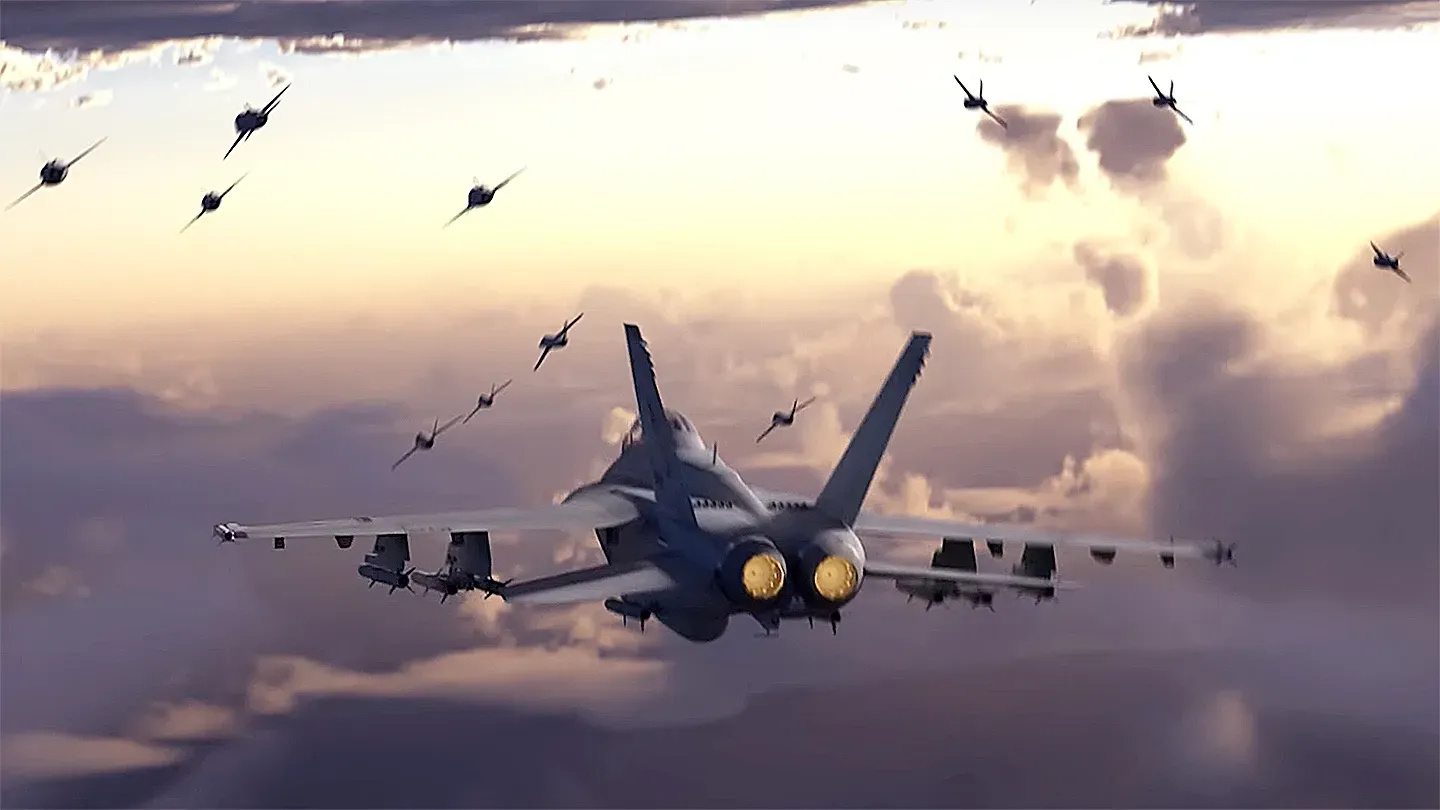
The traditional loyal wingman or CCA concept generally envisions uncrewed ‘fighter’ aircraft whose primary purpose is to complement crewed companions. This typically involves extending the crewed platform’s sensor reach, carrying additional weapons, and opening up a greatly expanded tactics playbook. An advanced UCAV, by contrast, is fundamentally an independent combat aircraft in its own right, designed to deliver weapons and other effects similar to what a crewed platform can provide without requiring a crew onboard or nearby. As such, it is more capable, survivable, and an overall ‘exquisite’ asset with a heavier payload, more capable of taking the place of a crewed aircraft in certain roles, rather than augmenting them, although there is nothing keeping them from working in a loyal wingman type role if required.

A rendering of a U.S. Navy Super Hornet working alongside smaller collaborative drones. Collins Aerospace/screencap

Yesterday, Naval Air Systems Command (NAVAIR) released a new Request for Information (RFI) that lays out an unusually demanding set of requirements for a CCA Increment 1 prototype. Among other things, the Navy wants an aircraft capable of operating from its aircraft carriers, carrying plentiful weapons, conducting strike missions in highly contested environments, and operating both independently and as part of a larger crewed-uncrewed team.

The combination of these requirements provides a much clearer picture of what the Navy wants its future carrier-based combat drones to be capable of.

Perhaps the most striking requirement concerns weapons carriage. The Navy says the Increment 1 CCA must have the ability to carry four externally mounted weapons weighing up to 2,500 pounds each throughout the target flight envelope and during carrier certification activities. That equates to a potential external weapons load of 10,000 pounds, although it should not necessarily be interpreted as the aircraft’s normal operational configuration. By way of comparison, a very heavily loaded F/A-18E/F Super Hornet might launch with close to 17,000 pounds of weapons and stores — though that is far from common.

An F/A-18F equipped with a uniquely massive weapons load, including no fewer than 10 1,000-pound GBU-32 JDAMs slung under its wings. All in, this stores load-out weighed roughly 16,750 pounds. U.S. Navy

Meanwhile, the kinds of drones that the U.S. Air Force is currently exploring under its own separate CCA Increment 1 effort, namely the General Atomics YFQ-42A Dark Merlin and Anduril YFQ-44A Fury, are air-to-air optimized. Their primary loadout is widely expected to be a pair of AIM-120 AMRAAM missiles, which is just a fraction of the Navy’s newly stated payload requirement.

A YFQ-44A Fury drone carrying an inert AIM-120 air-to-air missile during a flight test. U.S. Air Force

The RFI NAVAIR put out yesterday also specifically asks respondents to address internal weapons carriage, with both capacity and survivability among the factors the Navy will consider. Internal stores carriage would offer obvious advantages in reducing an aircraft’s radar signature and preserving aerodynamic performance.

The Navy also wants the aircraft to have a substantial combat radius while carrying its required weapons load, as well as the ability to spend at least 30 minutes on station while retaining sufficient fuel reserves to return to the carrier.

For a CCA, carrier operations add another layer of complexity. The aircraft must be capable of catapult launches and arrested landings from both Ford and Nimitz class carriers, while operating within existing carrier deck, elevator, hangar, and support constraints.

F/A-18E/Fs and F-35Cs seen on the deck of the Nimitz class supercarrier USS Theodore Roosevelt on July 10, 2026. Seaman Apprentice Tyler Harstad/U.S. Navy

Autonomy is similarly central to the concept. The Navy wants mission and flight autonomy that can support the aircraft from launch through recovery, along with the ability to incorporate third-party mission software. The prototype is also expected to demonstrate both individual and multi-aircraft autonomous operations. While crewed-uncrewed teaming is a fundamental part of the concept, the latest requirements make it clear that the aircraft will not depend on a crewed aircraft continuously supervising its actions.

The video below from Collins Aerospace offers a notional look at what crewed-uncrewed teaming involving carrier- and land-based CCA-type drones might look like in the future.

Collaborative Mission Autonomy thumbnail

Collaborative Mission Autonomy


In terms of the survivability requirement, the Navy specifically wants the aircraft to operate in highly contested environments and is asking industry to provide approaches for assessing and managing survivability during collaborative operations. The consideration of internal weapons carriage is another indication that signature reduction and survivability are important design considerations, pointing to a low-observable (stealthy) platform.

All of this begins to blur the distinction between the Navy’s Increment 1 CCA plan and a traditional survivable UCAV concept.

That does not necessarily mean the Navy is abandoning the CCA concept entirely in favor of resurrecting the carrier-based UCAV concept. Rather, it suggests that the distinction between the two becomes blurred as requirements overlap. There also remains the strong possibility (or more likely probability) that the Navy will seek to explore CCA designs closer to what the Air Force, as well as the U.S. Marine Corps, are pursuing. This could potentially include development of carrier-based versions of one or more of those designs under a future increment.

A rendering depicting General Atomics carrier-based Gambit 5 drones operating from a British Queen Elizabeth class carrier. General Atomics

The new RFI is also consistent with the Navy’s broader Air Wing of the Future effort (AWOTF).

An earlier NAVAIR sources-sought notice released in July outlined an expansive vision for future carrier-based uncrewed aircraft covering missions including surface warfare; strike warfare; anti-submarine warfare; air warfare; electronic warfare; intelligence, surveillance, reconnaissance and targeting (ISR&T); mobility; and logistics. That notice also pointed toward aircraft capable of attacking targets at least 1,000 nautical miles from the carrier without requiring aerial refueling, while leaving open the possibility of extending that reach with tankers.

The mission sets as defined in the earlier RFI from July 2026. The acronyms JFC and CVW here refer to the joint force commander and the carrier air wing, respectively. U.S. Navy

Intriguingly, the new RFI does not include an explicit maximum range target, but based on the payload requirements alone, this would be very considerable, reflecting the Navy’s concerns about fighting a future conflict across the vast distances of the Pacific. Traditional advanced UCAVs usually have a combat radius measured in thousands of miles, not hundreds, far exceeding the reach of their crewed fighter counterparts.

Whatever the possible range target, the planned weapons load also points to a substantial airframe. Indeed, the deck-space requirement outlined in the RFI is relevant here. The CCA’s “spot factor” cannot exceed that of an existing fourth-generation fighter, meaning that it could potentially be as large as an F/A-18E/F.

Otherwise, however, the latest CCA Increment 1 RFI is considerably more concrete.

The Navy wants a first flight of a prototype within 24 months of a contract award and carrier certification during a three-year development effort. It also wants a path toward an affordability target of around $30 million per aircraft. This kind of price point would put it at the top end of the CCA concepts we have seen so far, and is fairly ambitious for a higher-end UCAV.

Navy officials said in 2024 that the CCA’s unit cost target was around $15 million, reflecting the idea that the aircraft would be sufficiently inexpensive to be expendable under some circumstances. The new RFI instead asks industry to outline a path toward an affordability target of $30 million per aircraft. That is still a fraction of the cost of a modern carrier-based fighter, but it suggests the Navy is willing to pay considerably more for an aircraft with substantially greater weapons capacity, range, autonomy, and survivability.

Concept artwork showing Boeing MQ-28 Ghost Bat CCAs alongside a Super Hornet. Boeing

As to the companies that might respond to the RFI, in August of last year, the Navy confirmed that Anduril, Boeing, General Atomics, and Northrop Grumman were all on contract for “conceptual” CCA designs. At that time, the service also said Lockheed Martin had been hired to work on a common control architecture for the drones. Lockheed Martin is already the prime contractor for the control stations and associated software the service is integrating onto its carriers now to support the MQ-25.

The new RFI, however, marks a shift from the conceptual studies described last year toward a specific prototype effort. The Navy is seeking industry input as it shapes the acquisition strategy, with responses due September 18.

In the past, the Navy has said it is aiming for the total makeup of carrier air wings to eventually be 60 percent or more uncrewed, although the precise balance is still to be determined and will certainly be informed by the lessons of Navy CCA Increment 1. Exactly how the CCA might fit in with the Navy’s sixth-generation crewed fighter – known as F/A-XX – is another intriguing prospect, but would clearly be optimized to work alongside that platform.

Now, back to the Navy’s earlier effort to develop a high-end, stealthy, carrier-based UCAV capability. Northrop Grumman built two X-47B demonstrators for that program, both of which underwent extensive flight testing, including carrier operations and aerial refueling. The aircraft flew from 2011 for around half a decade. As of 2022, both X-47Bs had been earmarked for eventual public display at museums.

The two X-47Bs together. Northrop Grumman

The two X-47Bs had offered far more than a glimpse of what a carrier-based UCAV capability might look like, and the base design was set to evolve into an operational type. These were large, stealthy UCAVs with thousands of pounds of payload and endurance that far outstripped crewed naval fighter aircraft. The follow-on UCLASS program aimed to see the capabilities the X-47 demonstrated put into operation via a new aircraft procurement effort. However, it transformed into the radically different, less ambitious, tanker-focused Carrier-Based Aerial-Refueling System (CBARS) program in the mid-2010s. This, as noted, led to the MQ-25 Stingray.

To this day, the cancellation of UCLASS remains a very sore spot and is widely seen as a nearsighted and even reckless decision. This mirrored earlier moves by the USAF, which had demonstrated how revolutionary UCAV capabilities could be, only to entirely walk away from the concept. In fact, that service went even further, appearing to erase those developments from recent memory. You can read all about this bizarre and troubling inflection point in American air power history and the glaring questions surrounding it in this past feature.

MQ-25 T-1 seen during deck handling testing aboard the USS George H.W. BushU.S. Navy

Fast forward to today, and the Navy is getting the MQ-25, which is primarily a tanker, but clearly, that was not the only mission set that influenced its exotic design. In fact, these Navy requirements could open the door for the Stingray platform to potentially fulfill at least parts of the Navy uncrewed combat drone role in a ‘cleaned-up,’ stealthier configuration, something we have explored in depth in the past.

Overall, the takeaway here is that the Navy’s latest CCA requirements raise the intriguing possibility that its earlier UCAV ambitions are resurfacing, this time under the CCA banner. This is happening as China is moving very quickly with its own stealthy UCAVs, a number of which are in testing, and one of which is very mature and is navalized for shipboard operations the GJ-11 Sharp Sword. The GJ-11 sounds very similar to the Navy’s requirements wish list, including its ability to act independently and teamed with crewed counterparts, as well as its general size and need for survivability.

While an RFI only represents an early part of the contracting process, in practical terms, it looks like the Navy is asking whether industry can finally make good on the past promise of a U.S. Navy UCAV.

Contact the author: thomas@thewarzone.com

Thomas Newdick is a staff writer at TWZ, where he covers military aviation, defense technology, weapons systems, and international security. Based in Berlin, Germany, he reports on conflicts, military modernization efforts, and emerging aerospace technologies around the world, with a particular interest in airpower and its role in contemporary warfare. His reporting is informed by deep expertise in modern and historical airpower, particularly in Europe, with a focus on military aviation, air campaigns, and aerospace developments across the continent and beyond.


Tyler’s passion is the study of military technology, strategy, as well as foreign policy, and he has fostered a dominant voice on those topics in the defense and national security space. Tyler was the creator of the hugely popular defense site Foxtrot Alpha before developing TWZ, which he continues to lead as the Editor-In-Chief to this day.


Source link

Coverage for smoke damage, money for protecting homes passed to help wildfire victims

California lawmakers passed laws that would ensure insurance companies provide better coverage for smoke-damaged homes and financing for upgrades protecting residences from future fire damage.

The measures were among a slew of bills approved during the 2026 legislative session to deal with the continuing aftermath of the devastating 2025 Los Angeles area fires.

The Eaton and Palisades fires, which destroyed more than 16,000 structures and killed 31, were two of the deadliest and most destructive fires in state history. Like with catastrophic fires before them, tragedy spurred action.

Much of the focus on wildfire issues by Gov. Gavin Newsom and California lawmakers in the waning days of the legislative session focused on a proposal to shift liability away from utilities whose equipment ignites wildfires.

The complex, high-stakes policy debate attempted to address the needs and financial risks faced by the utilities, their customers and insurance companies following the catastrophic wildfires that have plagued California in recent years, but a proposed compromise recently pieced together by lawmakers and the governor fell through Tuesday.

However, lawmakers did pass several bills this year to help fire victims navigate burdensome insurance requirements in the aftermath of a disaster and increase prevention efforts. All head to Newsom for his consideration.

Two complementary bills approved Monday ensure homes that survive a wildfire but are contaminated by the onslaught of smoke are properly remediated before residents move back in.

The bills were prompted by the 2025 Eaton fire, which left thousands of homes contaminated with lead, some at levels hundreds of times what the U.S. Environmental Protection Agency considers safe. Homeowners routinely reported that their insurance companies refused or delayed claims, advocated for cleaning methods that experts deemed insufficient and pushed residents to move back before testing showed their homes were safe.

The first bill, AB 1642, would direct the Department of Toxic Substances Control to create scientific standards for what constitutes a safe home and provide guidance on how to properly remediate homes. The second, AB 1795, would require insurers to abide by those standards in the claims process and do so in a timely manner.

The companion laws only take effect if Newsom signs both.

The two bills originally conflicted with one another. The scientific standards bill was supported by many Eaton fire survivors from the get-go. However, the insurance bill — born out of a Department of Insurance task force — was widely criticized by survivors for leaving insurance companies wiggle room to deny claims and placing a burden on homeowners to prove their home was in fact contaminated by a fire.

In an eleventh-hour sprint of “sleepless nights,” “five-hour Zooms” and intervention from the governor’s office, advocates won additional protections for fire survivors in the insurance bill and brought the two into harmony, said Dawn Fanning, managing director at the smoke-damaged home advocacy group Eaton Fire Residents United.

“It took a lot of work to get here, and we’re really happy where we landed,” Fanning said.

After the Eaton fire, “it was the Wild West, trying to scramble to find answers,” she said. “If these laws were in place, so many thousands of people would be back home by now.”

Separate legislation by Sen. Benjamin Allen (D-Santa Monica), who is in a hotly contested race for California Insurance Commissioner, seeks to give homeowners more notice and options before being dropped by their insurer, a problem homeowners increasingly face as wildfires have become more frequent and destructive.

Many nonrenewal notices sent by insurance companies include vague reasoning, Allen said during a May hearing on the bill, SB 1301. His legislation would require specific information so property owners can have a chance to mitigate problems and keep their insurance.

Another bill from Allen, who represents the Palisades area that burned in 2025, would create a new loan program to help property owners mitigate fire risks through home hardening, or installing fire-resistant materials on the outside of a structure.

“It can sometimes cost tens of thousands of dollars for homeowners and there’s simply not a lot of financing for this kind of work. There’s not a market for that,” Allen said during an April hearing.

The program is expected to help fund 1,000 projects in its first year and up to 2,400 within five years, according to a bill analysis.

A budget bill approved Tuesday morning also includes $25 million for home hardening grants, rebates or loans to be distributed through a separate program to be created by the Governor’s Office of Emergency Services. It would cap assistance at $25,000 per homeowner or property.

But other proposals to provide financial incentives for home hardening did not pass, including bills by Assemblymember Steve Bennett (D-Ventura) to exclude home hardening upgrades from property tax reassessment and to require insurance companies to provide two quotes to inquiring homeowners: one for the property as is, and another for if it met full home-hardening certification by the state.

Another bill on Newsom’s desk seeks to get restitution for victims of utility-caused wildfires who in some cases have waited more than a decade, said Assemblymember Joe Patterson (R-Rocklin).

In 2019, the state established a wildfire fund paid by utility companies that reimburses claims stemming from wildfires caused by the companies’ equipment. But the fund was not retroactive, and some people who suffered losses before its creation are still waiting to be paid.

Patterson’s bill requires the California Public Utilities Commission to determine how much is still owed to those victims, including for losses from the deadly Camp fire that was sparked by a PG&E power line and destroyed the town of Paradise in 2018.

“For years, wildfire survivors have been forced to wait for answers while restitution shortfalls remain unresolved,” Patterson said in a statement after the bill passed. “AB 2700 is about doing what is right for wildfire survivors who have waited far too long to be made whole.”

Source link

Dolly Parton died after ‘brief battle with cancer’ as country music icon passed away ‘surrounded by loved ones’

DOLLY Parton’s cause of death has been revealed as the country music superstar died following a “brief battle with cancer”, aged 80.

The Queen of Country passed away on Tuesday after suffering from a number of health issues in recent months.

Dolly Parton’s cause of death has been revealed after the country superstar died on Tuesday Credit: Rex
The Queen of Country passed away following a ‘brief battle’ with cancerCredit: Refer to source

It has now been revealed that Dolly died “surrounded by loved ones” in Nashville after a “brief battle” with cancer, reports People.

Representatives revealed the news in a statement to the outlet which did not reveal the type of cancer Dolly had been battling.

The statement read: “Our beloved Dolly Parton spent her life and career bringing joy, laughter, hope and integrity into everything she touched.

“Her unmatched generosity reached the lives of countless people whom she would never meet, yet she was always there to offer a helping hand.

BITTERSWEET GOODBYE

Dolly Parton’s funeral plans revealed after family announces her death


‘A TRUE LOSS’

American flags to be lowered for a week to honor Dolly Parton, Trump says

News of the superstar’s death was announced on Tuesday, shocking fans around the world Credit: Getty
The legendary singer spent over 65 years in the music industry Credit: Getty Images – Getty

It comes as:


“Whether it be the hundreds of millions of books donated through her invaluable Imagination Library or funding research that helped create a lifesaving vaccine used around the world, Dolly’s unconditional love for all people was the guiding force for her lasting impact.

“After bravely facing a brief battle with cancer, Dolly departed her Earthly life today at the Vanderbilt-Ingram Cancer Center surrounded by loved ones.”

Most read in Entertainment

Dolly’s nephew Bryan Seaver announced her death in a heartbreaking statement on her official Instagram page Tuesday afternoon, shocking her fans worldwide.

Dolly had been struggling with her health for some time before her passing and was forced to bow out of numerous gigs.

She told PEOPLE on Friday: “I am dealing with some health issues that I just didn’t pay attention to when I was watching over Carl.”

Her beloved husband of 60 years, Carl Thomas Dean, died last March after being diagnosed with Alzheimer’s disease in 2019. He was 82 years old.

After cancelling a slew of shows in December, the Tennessee native admitted she needed to go through “a few procedures”.

Last October, Dolly’s sister Frieda had pleaded with her fans to pray for her sibling due to fears around her health.

Dolly released 50 studio albums over her legendary 65-year career Credit: Getty
She recently had to cancel numerous appearances due to her health problems Credit: Youtube/Khloe Kardashian

It was only earlier this month that she shared an update with fans on social media saying she had a “few little health issues”.

She added that “sometimes I get a little dizzy and I get dehydrated”, saying her doctors had banned her from traveling to the opening of Dollywood’s latest ride.

But during her last public appearance, Dolly appeared upbeat at the unveiling of her new Nashville truck stop.

And just one week before her death, she shared about her excitement to open a new museum in her very last post.

Dolly has no children but leaves behind her legacy in music.

Across her illustrious career, Dolly became one of the most-honored female country performers of all time.

Dolly Parton’s Career Highlights

Dolly Parton is one of the most well-known country stars in the business, and her career has continued to flourish. Here’s a look at the highlights of the music legend’s decades-long career.

  • Dolly wrote and released her first single, Puppy Love, including the B-track Girl Left Alone, on Goldband Records when she was 11 years old.
  • Although her single wasn’t a big hit, she ended up performing at Nashville, Tennessee’s Grand Ole Opry for the first time at 13 years old and was introduced by Johnny Cash.
  • Dolly made the Billboard country charts in January 1967 with two singles from Monument Records: Dumb Blonde and Something Fishy.
  • The singer earned her first number-one hit in 1971 with her single Joshua.
  • In 1974, Dolly’s arguably most well-known song, Jolene, reached number one on the country charts.
  • Her music continued to succeed, and she was awarded the Female Vocalist of the Year award at the CMAs in 1975.
  • Dolly’s track, Here You Come Again, achieved platinum status in 1978, and the album earned her a Grammy award for Best Female Country Vocal Performance.
  • In 1980, Dolly starred in her first film, 9 to 5, alongside Lily Tomlin and Jane Fonda and released her hit song of the same name.
  • The star opened her famed amusement park, Dollywood, in Pigeon Forge, Tennessee, in 1986.
  • Later that year, she was inducted into the Nashville Songwriters Hall of Fame.
  • At 75 years old, Dolly recreated her 1978 Playboy Cover for her husband Carl Dean’s birthday.
  • In May 2022, it was announced that Dolly would officially be inducted into the Rock & Roll Hall of Fame, alongside Eminem, Lionel Richie, Carly Simon, Eurythmics, Duran Duran, and Pat Benatar.

A total of 25 of her singles or albums became Gold, Platinum or Multi-Platinum records. 

She had 26 songs reach number one on the Billboard country charts – a record for a female artist – and 42 career top 10 country albums.

As of 2012, she had written more than 3,000 songs and sold more than 100 million records.

She also boasts a whole host of awards including 11 Grammy Awards alongside 55 nominations.

Dolly is also in several halls of fame across the US including the Hollywood Walk of Fame, Country Music Hall of Fame and the Nashville Songwriters Hall of Fame.

In 2023, she was even ranked at number 27 on Rolling Stone‘s 2023 list of the 200 Greatest Singers of All Time.

Source link