passage

‘If my people’: Here’s why the Bible passage Trump will read aloud is so potent and polarizing

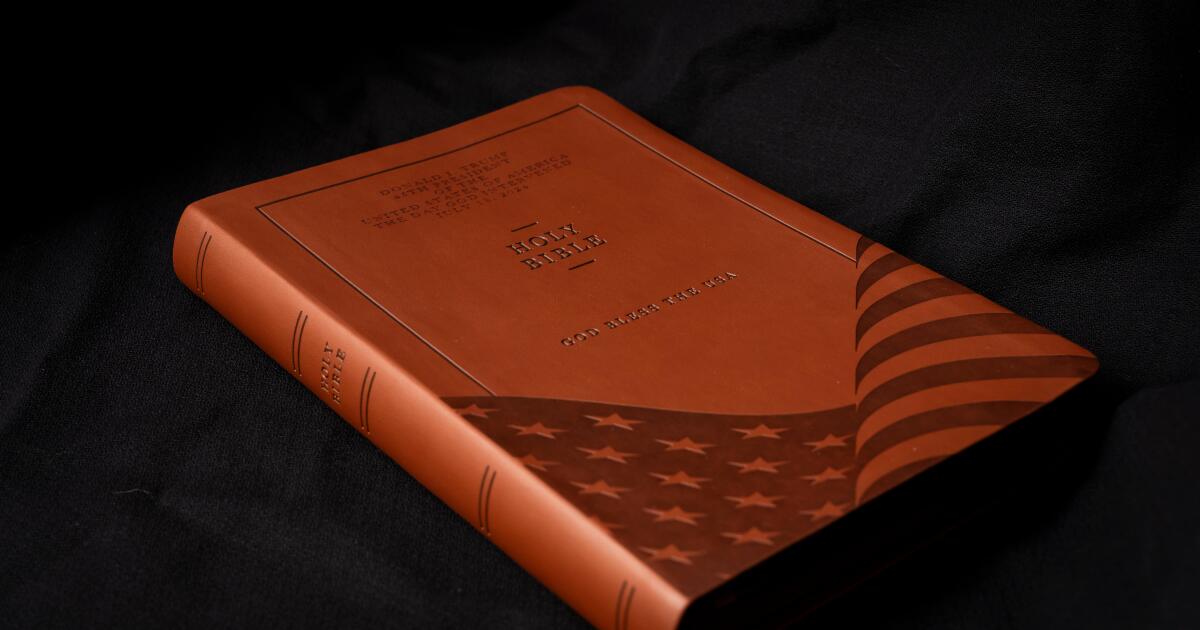
The scriptural passage that President Trump plans to read Tuesday evening in a livestreamed Bible-reading marathon dates back to the depiction of an ancient event — but it’s one that carries a highly charged significance in the current religious and political climate.

It has long been quoted and promoted by those who believe America was founded as a Christian nation and should be one. It’s from the seventh chapter of 2 Chronicles, a book in the Hebrew (Old Testament) portion of the Bible.

The 14th verse — the one most often quoted — says:

“If my people, which are called by my name, shall humble themselves, and pray, and seek my face, and turn from their wicked ways; then will I hear from heaven, and will forgive their sin, and will heal their land.”

Trump is among hundreds who are taking turns reading the entire Bible aloud over the course of a week. Most of the readings are taking place at the Museum of the Bible in Washington, though Trump’s is coming by video from the Oval Office.

A passage often quoted at National Day of Prayer events

The Chronicles passage has for decades been a major theme at annual National Day of Prayer events. Organizers of the America Reads the Bible marathon invited Trump to read from it. “It’s a powerful statement that he decided to read that passage,” said Bunni Pounds, founder of Christians Engaged, which organized the project.

The passage has been recited over the decades at countless rallies, services and events, often organized around the disputed belief that America was created as a Christian nation and needs to repent of its sins and return to God. The passage has particularly been associated with annual events commemorating the National Day of Prayer, which has taken various forms since the mid-20th century and became fixed by law on the first Thursday in May since the 1980s.

The verse is set in a context far from modern America — during the reign of King Solomon in ancient Israel some 3,000 years ago. Solomon is presiding over the dedication of the first temple in Jerusalem, and in a lengthy prayer he asks for divine mercy if a future generation sins, is punished with military or natural disaster and then repents. In the key passage, God replies with a promise of restoration.

Critics say the passage is used out of context

But the use of the passage in modern settings has its critics.

The Chronicles passage is “a popular verse among Christian nationalists and has been for quite some time,” said Brian Kaylor, a Baptist pastor and president and editor-in-chief of Word&Way, a progressive site covering faith and politics.

He said its use has taken on a partisan and polarizing tone, often used in tandem with a promotion of a belief in a Christian America in an increasingly diverse country.

“This verse is not about the United States,” said Kaylor, author of “The Bible According to Christian Nationalists: Exploiting Scripture for Political Power.” It is “a promise made to one particular person in one particular moment. It doesn’t really work to pull it out of context and apply it to whatever you want to.”

But many have done so recently and in decades past, either saying America has a divinely ordained destiny similar to ancient Israel’s or simply that they believe every nation has a duty to follow God and repent when needed.

President Dwight D. Eisenhower took the oath of office in 1953 with his hand on a Bible opened to the 2 Chronicles passage. President Ronald Reagan quoted the passage in a proclamation declaring 1984’s National Day of Prayer. A speaker at the 2024 Republican National Convention also quoted it.

The National Day of Prayer, while officially nonsectarian, has long been drawn particular promotion and participation from evangelical Christians. Readings of the “If my people” passage has been a staple of such events.

Politicians, others joining in the Bible-reading marathon

Evangelicals — a loyal Republican voting bloc for decades — have formed a crucial part of Trump’s electoral base. His rallies have featured a fusion of Christian and national symbols and rhetoric, featuring songs like “God Bless USA” and T-shirts with slogans like “Jesus is my savior, Trump is my president.”

Many other Republican politicians are taking part in the Bible reading, along with celebrities, pastors and others. And Trump isn’t the only one reading a passage significant to his office or mission.

Mike Huckabee, a Baptist pastor and U.S. ambassador to Israel, is reading from a Genesis passage in which God says he will bless those who bless Abraham — a passage popular with many evangelicals who believe they have a biblical mandate to support Israel.

David Barton, whose Wallbuilders promotes belief in America as a Christian nation, will read from a passage that gave his organization its name, in which Nehemiah rebuilds the broken walls of Jerusalem.

Smith writes for the Associated Press.

Source link

Trump says US could charge for Strait of Hormuz passage amid Iran war | News

US president says Washington, as the ‘winner’ of the war, has a ‘concept’ for charging a toll in strategic waterway.

President Donald Trump has suggested the United States may be looking to charge a toll in the Strait of Hormuz after the war, a move that would likely require direct US military control over the strategic waterway.

Asked on Monday whether he would accept a deal that would allow Iran to take fees from ships to traverse the strait, the US president said: “What about us charging tolls? I’d rather do that than let them have them. Why shouldn’t we? We’re the winner. We won.”

Recommended Stories

list of 3 itemsend of list

Trump reiterated that Iran has been militarily defeated, a claim that he has been making since the early days of the war, despite Iran’s sustained drone and missile attacks across the region and its continuing blockade of Hormuz.

“The only thing they have is the psychology of, ‘Oh, we’re going to drop a couple of mines in the water.’ All right, no, I mean, we have a concept where we’ll charge tolls,” Trump told reporters.

Hormuz, which connects the Gulf to the Indian Ocean, lies mostly within Omani and Iranian territorial waters. About 20 percent of the world’s oil and liquefied natural gas (LNG) passed through the strait before the war.

Trump’s latest comments came as he issued what he called a “final” ultimatum to Tehran to reopen the strait and agree to Washington’s terms or face attacks against Iran’s civilian infrastructure, including bridges and power plants.

The US president told reporters on Monday that any deal with Iran must include reopening the Strait of Hormuz.

“We have to have a deal that’s acceptable to me, and part of that deal is going to be, we want free traffic of oil,” he said.

Reports have suggested that Iran is already charging a toll for some of the few ships it is allowing to pass through the strait.

“The Strait of Hormuz situation won’t return to its pre-war status,” Iranian Parliament Speaker Mohammad Bagher Ghalibaf wrote on X last month.

Iran’s Foreign Minister Abbas Araghchi has also called for “new arrangements” to manage the waterway after the war, ensuring safe passage for ships and protecting Iran’s interests.

“I believe that after the war, the first step should be drafting a new protocol for the Strait of Hormuz,” he told Al Jazeera in March. “Naturally, this should be done between the countries that lie on both sides of the strait.”

The White House said last week that Trump is considering asking Arab countries to pay for Washington’s expenses in its war on Iran.

Source link

Lee says S. Korea, France agree to cooperate on safe passage through Strait of Hormuz

French President Emmanuel Macron (L) and South Korean President Lee Jae Myung (R) enter a welcome luncheon at the presidential Blue House in Seoul Friday. Photo by Yonhap

President Lee Jae Myung said Friday he and French President Emmanuel Macron agreed to work together to secure the safe passage through the Strait of Hormuz and mitigate the broad impact from the war in the Middle East.

Lee addressed concerns over uncertainties in global energy supply chains following summit talks with Macron, during which the two leaders discussed ways to deepen economic ties and strengthen coordination on security issues.

“President Macron and I agreed to share policy-related experiences and strategies in order to jointly address the economic and energy crises triggered by the Middle East war. We also concurred on working together to reduce uncertainty in the global economy,” Lee said during a joint press announcement.

“We confirmed our commitment to bolstering energy security by expanding our cooperation in the nuclear and offshore wind power sectors while collaborating to secure safe maritime transport routes through the Strait of Hormuz,” he added.

Lee said the two leaders also agreed to boost trade and investment with a goal of reaching $20 billion in annual bilateral trade by 2030, up from $15 billion last year.

To boost cooperation across sectors, the two sides signed a series of memorandums of understanding (MOUs) and other documents.

They pledged to expand cooperation in advanced technologies and future industries — including artificial intelligence, semiconductors and quantum technology — and to establish a ministerial-level joint committee on science and technology.

The two countries also signed a letter of intent on cooperation in critical mineral supply chains, aimed at combining South Korea’s manufacturing capabilities with France’s processing technology and infrastructure.

The state-run Korea Hydro & Nuclear Power signed MOUs with French nuclear firms, Orano and Framatome, as well as a separate MOU with France’s EDF on a joint development of an offshore wind power plant in the southwestern city of Yeonggwang.

Lee expressed hope that the agreements would ensure a stable supply of raw materials for South Korea’s nuclear power plants and lay the groundwork for joint entry into the global market.

He also laid out plans to cooperate in space and defense while pledging efforts to bolster collaboration in the cultural sector in light of an MOU signed between the two nations’ cultural heritage agencies.

During the talks, Lee said he explained Seoul’s efforts to resume dialogue with Pyongyang to promote peace on the Korean Peninsula, while Macron reaffirmed Paris’ support for peace and stability on the peninsula.

“We two leaders shared a profound understanding that peace on the Korean Peninsula has far reaching implications not just in Northeast Asia and Europe but also the rest of the world,” Lee said.

Lee noted that Seoul and Paris have expanded cooperation across a wide range of sectors, including future strategic industries, such as artificial intelligence, quantum technology, space, nuclear energy and defense, and expressed hope to deepen coordination on the international stage.

“As responsible members of the international community, the two countries are also working together to respond to rapid changes in the global landscape,” he said.

Lee said Macron extended a formal invitation to the Group of Seven summit scheduled for June in Evian, France, adding that he accepted the invitation. If he attends, it would mark his second consecutive appearance at the G7, following his participation in Canada last year.

Lee welcomed the two countries’ decision to upgrade ties from “a comprehensive partnership for the 21st century,” established in 2004, to “a global strategic partnership,” calling it “a new milestone” in bilateral relations built on 140 years of trust and friendship.

Macron struck a similar tone, expressing hope to expand cooperation across a broad range of areas, including artificial intelligence, quantum technology, semiconductors, space and culture, under the upgraded partnership.

He said that Seoul and Paris could strengthen security cooperation and work together to help stabilize the situation in the Middle East, including ensuring safe passage through the Strait of Hormuz.

The visit marks Macron’s first trip to South Korea since taking office in 2017 and the first by a French president in 11 years. It comes as the two countries mark the 140th anniversary of diplomatic relations, established with the signing of the Treaty of Friendship, Commerce and Navigation between France and the Joseon Dynasty (1392-1910).

Copyright (c) Yonhap News Agency prohibits its content from being redistributed or reprinted without consent, and forbids the content from being learned and used by artificial intelligence systems.

Source link