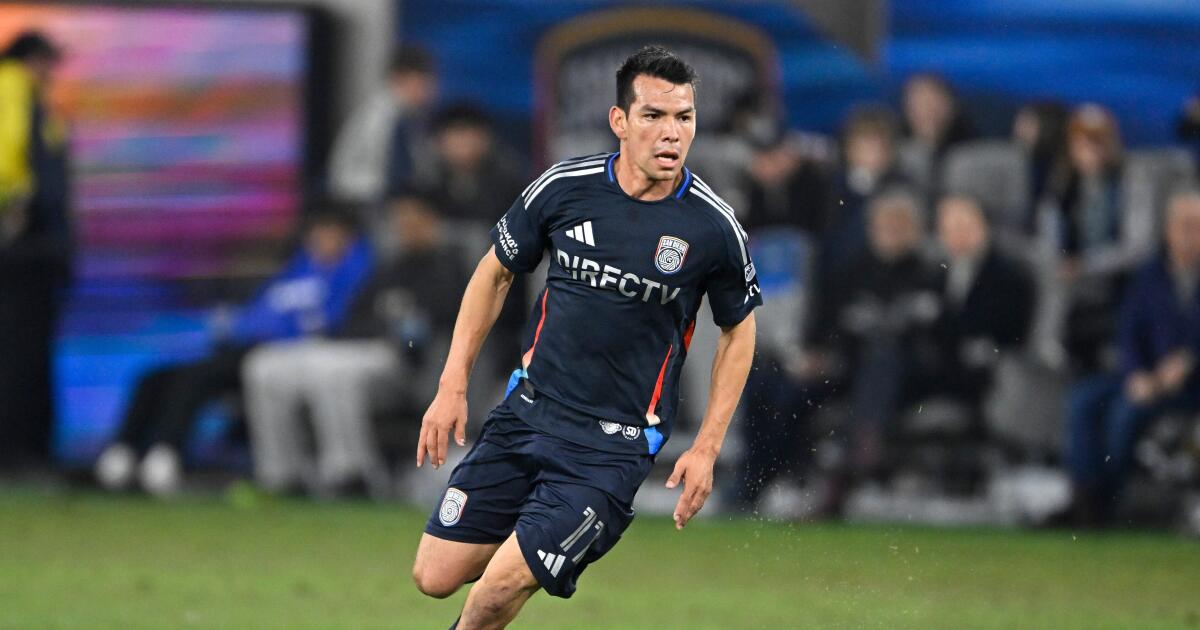
The Galaxy announced on Friday Hirving “Chucky” Lozano is joining its roster, making one of the most significant moves of the MLS transfer window in an attempt to turn around a disappointing season while the team still has a chance to make the playoffs.
The Mexican forward arrives on loan from San Diego FC through December with an option to buy. Lozano will occupy a designated player spot, becoming the new offensive leader of the team coached by Greg Vanney for the final stretch of the season.
Although his time with San Diego FC began in June 2024 with high expectations as the first designated player signed in the club’s history, the relationship between Lozano and the club deteriorated.
The Mexican forward suffered several muscle injuries that limited his playing time last season and toward the end of Lozano’s tenure, coach Mikey Varas opted not to feature Lozano because he didn’t fit with the club’s sporting vision.
The combination of physical problems and internal disagreements ultimately paved the way for his departure even though he made a strong offensive impact.
“Hirving is a player whom we tried to acquire three years ago, so this feels like something of a full-circle moment. He is a fierce competitor with an excellent track record of performing on teams that have competed for titles in multiple leagues, including his debut season in MLS,” Galaxy general manager Will Kuntz said.
Kuntz said after evaluating various options to strengthen the roster, the club concluded that Lozano was the ideal fit to help them tackle the final 15 games of the season.
“We have a talented group, a strong locker room, and a clear objective over these final 15 games of the season, and we are thrilled that Hirving and his family are joining the Galaxy,” Kuntz said.
In 33 matches with San Diego FC, Lozano recorded 20 goal contributions, including goals and assists.
Before arriving in MLS, Lozano made his professional debut with Pachuca, where he won the 2016 Clausura and the 2016–17 CONCACAF Champions League, a tournament in which he finished as the top scorer.
He later moved to PSV Eindhoven, where he won the Eredivisie title in the 2017–18 season before signing with Napoli in Italy. With the Neapolitan club, he played in 155 matches, scored 30 goals and was part of the historic squad that won the Scudetto in the 2022–23 season, ending a wait of more than three decades for the club.
He returned to PSV in 2023 and added two more consecutive Dutch league titles before embarking on his MLS adventure.
With the Mexican national team, he has accumulated more than 70 international appearances, 18 goals, and 12 assists.
He etched his name into Mexican soccer history by scoring the goal that gave El Tri a 1-0 victory over Germany at the 2018 World Cup in Russia — one of the national team’s most important World Cup victories.
He also represented Mexico at the 2018 and 2022 World Cups, in addition to competing in the Copa América, the Confederations Cup, the Gold Cup and the CONCACAF Nations League. In 2018, he was named CONCACAF Player of the Year.
At 31, Lozano joins the Galaxy —which no longer has Gabriel Pec — as the team seeks to strengthen its attack to stay in the hunt for a playoff spot.
The Galaxy hope to capitalize on his speed, ability to play on both wings and experience in high-pressure situations.
MEXICO CITY — After what may have been the most important game in the Mexican national team’s World Cup history, coach Javier Aguirre hugged each of his 26 players.
The embraces weren’t to celebrate a victory. They were hugs of gratitude, encouragement and, above all, resignation.
Minutes earlier, the players paraded around Azteca Stadium — traditionally an impenetrable fortress — to applaud El Tri fans with tears in their eyes. Mexico had just lost 3-2 to England, extinguishing the hope that it could parlay its World Cup co-host role into the deepest tournament run in the country’s history.
The goal was to advance to the quarterfinals for the first time since 1986 and, above all, to show the world that Mexican soccer finally had taken the leap that had been demanded for so long — defeating a past world champion, England, that hadn’t looked particularly dominant. But reality, once again, hit hard as the loss became Mexico’s eighth defeat in the round of 16 since 1994.
This time, Mexico had the support of its fans, playing on home soil. And it wasn’t enough.
“I’m satisfied with the work we’ve done, but when you lose — and I’ve lost a lot in my career — you never quite get over it,” Aguirre said. “It’s very painful because dreaming gives us hope; losing this way hurts a lot.”
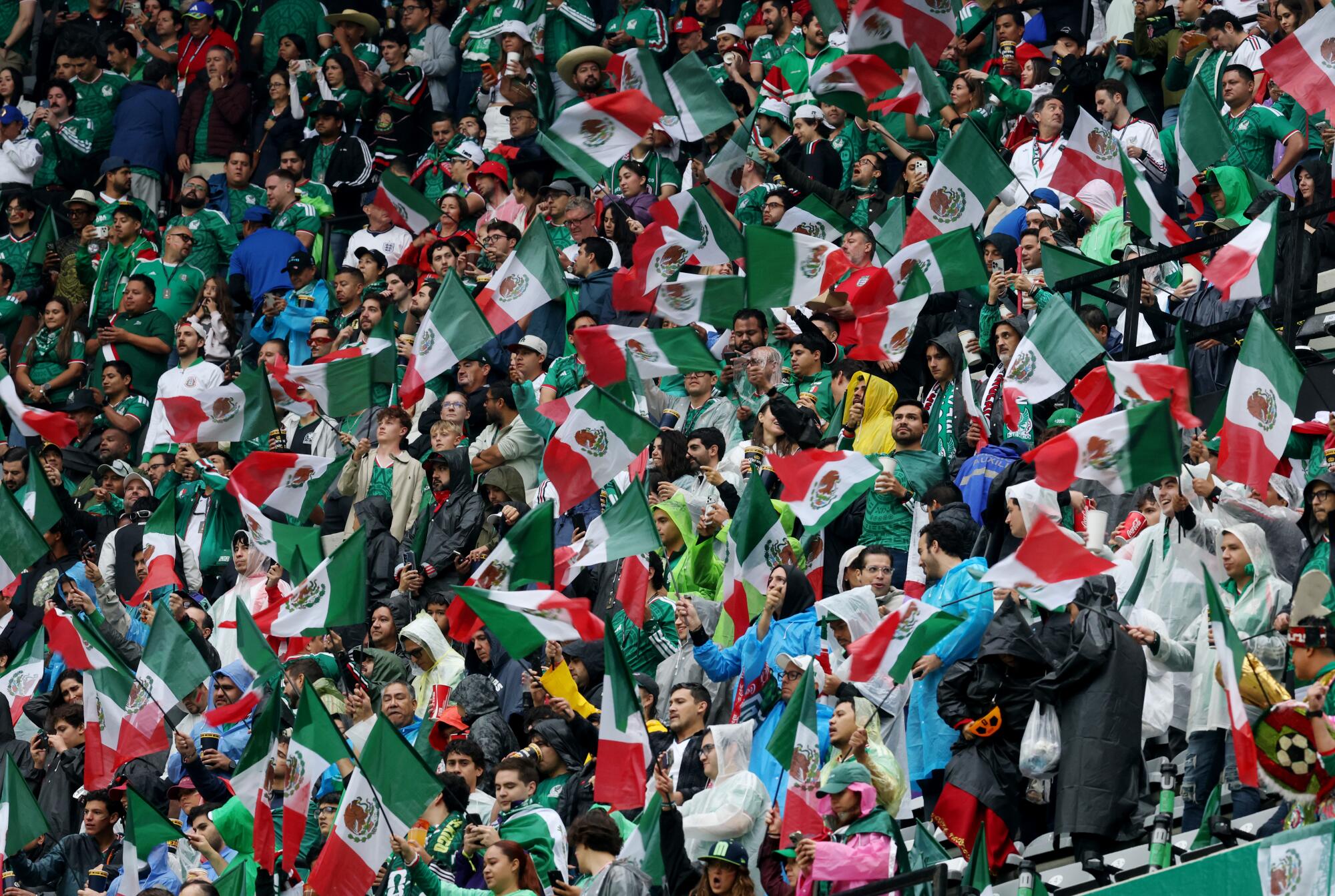
Mexico fans show their support before their team faced England in a Round of 16 World Cup match at Azteca Stadium on July 5.
(Richard Pelham / Getty Images)
After weeks of celebrations following wins over South Africa, South Korea, Czechia and Ecuador, Mexico failed the test against England, ranked fourth in the world. El Tri dominated possession but could not convert it into goals, while the English were clinical, led by Jude Bellingham, Harry Kane, Anthony Gordon, Bukayo Saka and goalkeeper Jordan Pickford.
For Aguirre, the loss reopened a familiar wound. In the 2002, Mexico lost 2-0 to a U.S. squad led by Landon Donovan in what many consider the most painful defeat in the country’s World Cup history. This defeat to England very well could rival it.
“I would have liked to win five games, to leave home with five victories. That hurts — it hurts a lot,” Aguirre said. “A loss is a loss. Our opponent didn’t make the same mistakes we did.”
Judging Aguirre solely on the end of this World Cup run would be simplistic given what he inherited. Two years ago, he was asked to lead the struggling team for the third time. When he arrived, Mexico was ranked 17th in the world and had not won the Nations League. He leaves with Mexico ranked in the top 10 and as Nations League champion and two-time defending Gold Cup champion.
This World Cup wasn’t the disaster that Qatar was four years ago, when Mexico was eliminated in the group stage. This summer, Mexico secured its first knockout-round victory since 1986, advanced to a fifth World Cup match for the second time and swept three games during the group stage without conceding a goal — something no other Mexican team achieved.
In 22 months at the helm — having taken over in 2024 following Jaime Lozano’s failure at the Copa América, where Mexico failed to advance past the group stage — Aguirre achieved something that went beyond the scoreboard by uniting players previously accused of having too much ego and preferring not to sacrifice to help the team.
At this World Cup, that squad gave its all — body and soul — and rebuilt a relationship with the fans that had seemed broken since the 2024 Copa América. Thousands of fans filled the Ángel de la Independencia, the Zócalo and other squares across the country, as well as watch parties in cities like Los Angeles.
“We managed to restore the pride of being part of the national team — for the national anthem and for its people. It’s a privilege to be here, and they know it,” Aguirre said of his players. “I think we’ve returned to a Mexican identity.”
Green jerseys were seen all over Mexico as people set aside their differences to cheer on El Tri.
“Mexico was the best host of the three. It had the best atmosphere — it’s a country that truly loves soccer,” Mexico City native Santiago Mondragón said before the England match.
Mexico had standout and inspired performances from Erik Lira, Gilberto Mora and Roberto Alvarado, but its lineup struggled to keep pace with English players trained at elite European clubs.
Mora, just 17 years old and with tremendous potential, made a mistake on the play leading to England’s second goal. Alvarado, who provided strong passes to Raúl Jiménez and was solid in defense throughout the tournament, lost track of Bellingham on the first goal. Raúl Rangel, who was outstanding against South Korea and who three years ago was playing for Tapatío in the Mexican expansion league, stepped too far forward on the penalty kick that sealed the match, minutes after an English player was sent off in the second half. Edson Álvarez, who did not have a good season with Turkey’s Fenerbahce because of an injury, received little playing time and made a serious mistake marking Kane, which led to Gordon’s breakaway on the play that resulted in the penalty kick.
Mexico’s Raúl Jiménez gets tangled with England’s Ezri Konsa while going for the ball during a World Cup Round of 16 match at Azteca Stadium on July 5.
(Francois Nel / Getty Images)
Following the loss, many in Mexico still are wondering why, despite having a one-man advantage for 36 minutes —plus 11 minutes of stoppage time — the team was unable to tie England. Aguirre replaced Mora and goal-scorer Julián Quiñones, bringing on an attacking lineup that focused on sending in crosses, which the English defense easily cleared.
While it’s possible a few changes could have shifted the match in Mexico’s favor, there were limits to how much the technical staff could get out of the roster.
El Tri lacks sufficient depth to assemble a truly competitive 26-man roster, as players such as Álvarez and Santiago Giménez didn’t arrive at their best form, and players such as Brian Gutiérrez weren’t ready for the pressure of a tournament of this magnitude, in need of more time to develop.
Mexico lacked game-changing players capable of breaking down tight defenses — the role Hirving Lozano played in 2018 or Giovani Dos Santos in 2014. The lack of creativity that showed against Saudi Arabia in 2022 flared up late against England.
Thanks to Jiménez and Quiñones, the team did show firepower, scoring 10 goals in five matches, but it lacked depth to break down a well-organized English defense.
The talent pool has been hindered by the Mexico club system.
Mexico’s Julián Quiñones is tossed in the air by teammates as they celebrate a Round of 32 World Cup win over Ecuador at Azteca Stadium on June 30.
(Kevin C. Cox / Getty Images)
Liga MX owners maintain a narrow view of domestic soccer, prioritizing foreign signings over the development of local players and promotion and relegation remain abolished — removing competitive pressure that is the backbone of English leagues.
Top Mexican players continue to be overvalued by their home clubs, which makes it difficult for European clubs to sign them when there are cheaper options with more impressive résumés.
“This was the opportunity; that’s why it’s frustrating, that’s why it’s sad,” Mexican journalist Javier Alarcón said of El Tri’s World Cup exit. “With the Mexican federation and its owners, there isn’t much hope.”
Rafael Márquez, a former FC Barcelona star and one of the greatest players in Mexican national team history, is succeeding Aguirre after serving as one of his assistant coaches. Márquez has formed a close bond with players, who tossed the 47-year-old former defender in the air after one of their World Cup wins, and is familiar with all the reasons Mexico continues to hit the same World Cup wall.
“Rafa is a great guy, a great coach,” said Aguirre, who noted that the team’s average age has dropped and that more and more players are playing in Europe. “Hopefully he can do better than we were able to.”
MEXICO CITY — Mexico advances to the second round of the World Cup backed by its strong record in the group stage and a formidable fortress — Azteca Stadium — where it will host Ecuador on Tuesday at 6 p.m. PDT in a knockout match airing on Fox and Telemundo.
El Tri became the first Mexican team to win all three of its group stage matches at a World Cup — a perfect finish accompanied by fan support rarely seen before, with more than 80,000 packing Azteca Stadium for two of its games and more than 800,000 surrounding El Ángel de la Independencia statue to celebrate wins.
Coach Javier Aguirre’s third stint leading the national team, which began in 2024 amid skepticism, has sparked World Cup fever in the streets of Mexico City, which have filled with fans wearing green jerseys, along with their dogs, cats and even ducks decked out in the national team colors.
“We’re motivated, but nothing is decided yet,” Mexico forward Armando González said. “Earning points is useless because now comes the important part — do-or-die matches. We’re focused on that.”
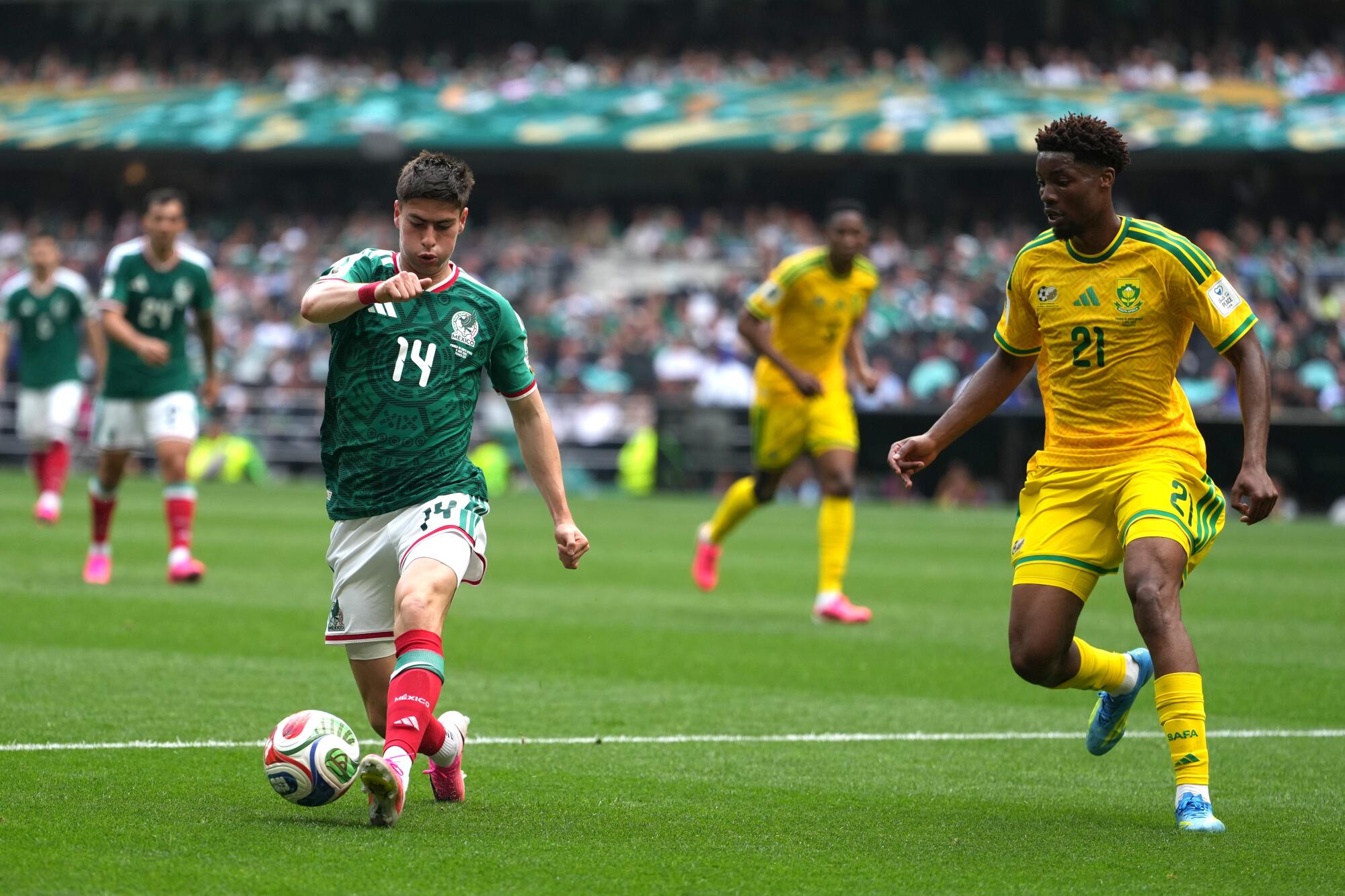
Mexico’s Armando González controls the ball in front of South Africa’s Ime Okon during on a World Cup match on June 11 at Azteca Stadium.
(Eduardo Verdugo / Ap Photo/eduardo Verdugo)
The winner of the match will face the winner of the contest between England and Congo on July 5 at Azteca Stadium.
Mexico has also been solid on defense, keeping three clean sheets while scoring six goals.
“We respect all our opponents,” said Mexico defender Jesús Gallardo, who sat out the last group stage match against Czechia. “We know this is the World Cup and every team is playing to win. We’ve won our three matches, and we’re proud of that. But we haven’t won anything yet. Ecuador has played well. We know they’re a very dynamic, very strong team.”
Erik Lira, Raúl Jiménez and Brian Gutiérrez will join Gallardo returning to the lineup after sitting out Mexico’s last match. Gutiérrez had a yellow card and was held out against Czechia to avoid a second yellow card and suspension. Gilberto Mora, 17, started in place of Gutiérrez and had a tremendous performance.
“We have to focus on what we do on the field; we want the fans to cheer us on,” Gallardo said. “We want to bring them a lot of joy.”
Following the convincing 3-0 victory over Czechia while resting some starters, the atmosphere on the Mexican team has been very relaxed, with several videos showing the players joking around with each other. Some of them have been training together for nearly two months because Aguirre arranged a monthlong training camp ahead of the World Cup.
“That’s why these past few months have gone by so quickly. Even though they’re always joking around, we know that we have a brother right beside us who would give his life for us,” González said.
On the other side, Ecuador arrives after advancing as one of the best third-place finishers, having closing Group E competition with four points — a stark contrast to its performance in the South American qualifiers, where Ecuador finished second only to world champion Argentina.
At the World Cup, Ecuador began the tournament with a tough last-minute loss to Ivory Coast and then failed to score against debutant Curacao. But when Ecuador had its back against the wall and needed to beat Germany in the final group-stage match, it pulled off a stunning upset, defeating the German team 2-1 to secure its spot in the next round.
That inconsistency makes Ecuador a wild card.
Mexico’s Luis Romo celebrates with Jesus Gallardo, Erik Lira and Johan Vasquez after scoring against South Korea during a World Cup match at Guadalajara Stadium on June 18.
(Silvia Izquierdo / Ap Photo/silvia Izquierdo)
“That’s what life is all about — having faith, having confidence. The team is very united,” said Sebastián Beccacece, Ecuador’s Argentine coach. “We’ve always remained calm and cautious in the face of adversity.
“The team is united, obviously full of enthusiasm and energy — like all national teams — but also tired, especially due to the schedule. Still, that’s no excuse. We’re driven by enthusiasm and the desire to make history; we’ll build our efforts on these foundations.”
Ecuador has also had to move quickly to plan for the match against Mexico. Following Thursday’s victory, Ecuador didn’t know it would be facing Mexico until Saturday morning. The team tried to travel to Mexico City on Sunday, but it ran into logistical problems and had to do so on Monday.
“Traveling to the Azteca Stadium is going to be a bit of a challenge,” Agustín Delgado, the all-time leading scorer for the Ecuadorian national team, said in an interview with Claro Sports. “That ultimately takes its toll in a match of this magnitude.
“This generation has what it takes for this World Cup and another one after that. They’re very young players. They haven’t reached their full potential yet; they have a lot to give.”
Unlike the game against Czechia, altitude won’t be as big a factor, since the Ecuadorian national team plays its home games in Quito, which sits at an elevation of 9,350 feet — making it the second-highest capital city in the world and more than 2,000 feet higher than Mexico City. It also has players who compete for clubs accustomed to playing at Mexican altitudes, such as Pedro Vite of Pumas and Enner Valencia of Pachuca.
Ecuador boasts proven talent such as Moisés Caicedo of Chelsea in England; William Pacho of Paris Saint-Germain in France; Piero Hincapié of Arsenal; and Joel Ordóñez of Club Brugge in Belgium.
“It’s a close match; there are star players on both teams,” said Álex Aguinaga, a former Ecuadorian player and Liga MX legend who is now a commentator for Fox Sports. “Ecuador’s defense is much more solid; it has players who handle the defensive zone very well.
Mexico fans cheer during a World Cup game against Czechia at Azteca Stadium on June 24.
(Alex Slitz / Getty Images)
“It’s so close, but I think it’s going to come down to a single goal.”
Ecuador will also try to capitalize on the pressure stemming from the fact that Mexico has won only one match in its entire history in knockout rounds — in 1986 when it played at home against Bulgaria and won 2-0. Between 1994 and 2018, Mexico was eliminated in the second round of the World Cup on each of the last seven occasions it reached that stage.
Mexico has never lost a match at Azteca Stadium in a World Cup, and its last defeat in an official match was against Honduras in a qualifying match in 2013.
“I think right now all the opponents are going to be tough; none of them will be easy,” said Obed Vargas, an Atlético Madrid player who has come off the bench for Mexico. “We’re taking it one game at a time, but for me, we have to make it to the final.”
GUADALAJARA, México. — With first place in Group A secured after two wins in two matches, the Mexican national team heads into its final group stage match against Czechia on Wednesday at 6 p.m. on Fox and Telemundo without pressure and is preparing to play some of its reserves.
The situation is quite different for Czechia, which has just one point after losing 2-1 to South Korea and drawing 1-1 with South Africa. The European team needs a win against Mexico at Azteca Stadium in Mexico City to advance to the next round — either as the group runner-up or as one of the best third-place finishers.
“The Czechs are incredibly tough; they’re a very physically demanding team,” Mexico coach Javier Aguirre said. “We watched them in their two matches against their group opponents, and it’s not going to be easy.”
Aguirre will have to strategize with an eye toward what lies ahead in the next round, which is a single-elimination format. Mexican American midfielder Brian Gutiérrez enters this final group stage match with an accumulated yellow card, so Aguirre likely will not play him to avoid risking suspension for the round of 32 game. FIFA rules clear all cards after the group stage ends.
The match could mark the return of César Montes, who was sent off against South Africa and missed the South Korea game.Goalkeeper Guillermo “Memo” Ochoa, in his sixth World Cup, could see some playing time as a sort of tribute to his career, but Raúl Rangel had an extraordinary performance against South Korea, so it remains to be seen whether Ochoa will get playing time.
“Obviously, it would be something extraordinary; it would be really cool for Memo. He’s a legend in Mexico and on the national team. He’s always been a player willing to give his all for the national team,” Mexico forward Alexis Vega said. “In the end, I think [Aguirre] will make the decision. I believe that all 26 of us here will give it our all if given the opportunity. Whoever gets the chance will do their best.”
Erik Lira, Johan Vásquez, Jesús Gallardo and Roberto Alvarado are the Mexican players who have covered the most ground for the national team in both matches, making them candidates for rest. Gallardo has a strong replacement available in young AZ Alkmaar player Mateo Chávez.
Mexico’s Edson Álvarez clears the ball away from the goal during the first half against South Korea during a World Cup match.
(Ricardo Mazalan / Ap Photo/ricardo Mazalan)
Edson Álvarez, who had a strong performance against South Korea, is likely to start again.
Another player who could see action is Santi Giménez, the AC Milan forward, who has been recovering from an injury and played only 10 minutes against South Korea. Gilberto Mora, Mexico’s youngest World Cup player at age 17, could start the game.
“We have to treat the game against [Czechia] like a final. We know [Czechia] needs this win, but we’re preparing ourselves. Getting used to winning goes a long way,” Giménez said in an interview on Wednesday with TV Azteca.
Mexico does not yet know its opponent in the next round, which will be one of the best third-place finishers. Its opponent will not be determined until the eight best third-place teams that advance to the round of 32 are identified.
On the Czech side, coach Miroslav Koubek favors a disciplined and physical approach, with Patrik Schick and Adam Hložek leading the counterattack that will seek to capitalize on any Mexico mistakes.
“We know that Mexico is one of the best teams in our group, and it will be tough for us on their home turf. But we believe we can get a good result and finish the group stage on a high note,” said Michal Sadilek, a midfielder for the Czech team.
Since Czechia needs a win to advance, that suggests the team will attack more aggressively, which will be dangerous for the Mexico defense but will also leave more space for the home team to exploit the counterattack. Czechia has shown this World Cup it is particularly dangerous on set pieces.
Fellow Group A teams South Korea and South Africa will face off at the same time as the Mexico-Czechia match — 6 p.m. Thursday — in Monterrey. The South Koreans, with three points, are looking to secure second place and a round-of-32 game at SoFi Stadium, while South Africa needs a win to compete for a spot as the second-place finisher or a berth among the best third-place teams. A South Korean loss combined with a Czech victory over Mexico would knock LAFC’s Son Heung-min and his South Korea teammates out of the tournament.
GUADALAJARA, Jalisco — Before the World Cup, critics and fans of the Mexican national team debated whether Javier Aguirre’s third stint as head coach was the right decision. Two games later, the coach has led Mexico to the tournament’s knockout round.
Thursday’s 1-0 victory over South Korea at Guadalajara Stadium made the World Cup co-host the first in the tournament to advance while also clinching the top spot in Group A with one group play game remaining. After South Korea’s goalkeeper fumbled a ball, Luis Romo scored the goal that gave the Mexicans six points and pushed them to the top of the standings.
El Tri will close out the first round against Czechia (6 p.m.) at Azteca Stadium on Wednesday.
During his post-match news conference, Aguirre spoke less about the result and more about the journey that led him to this moment. At 67 and having coached Mexico in three World Cups, he explained that his experience allowed him to approach a match he described as eminently tactical.
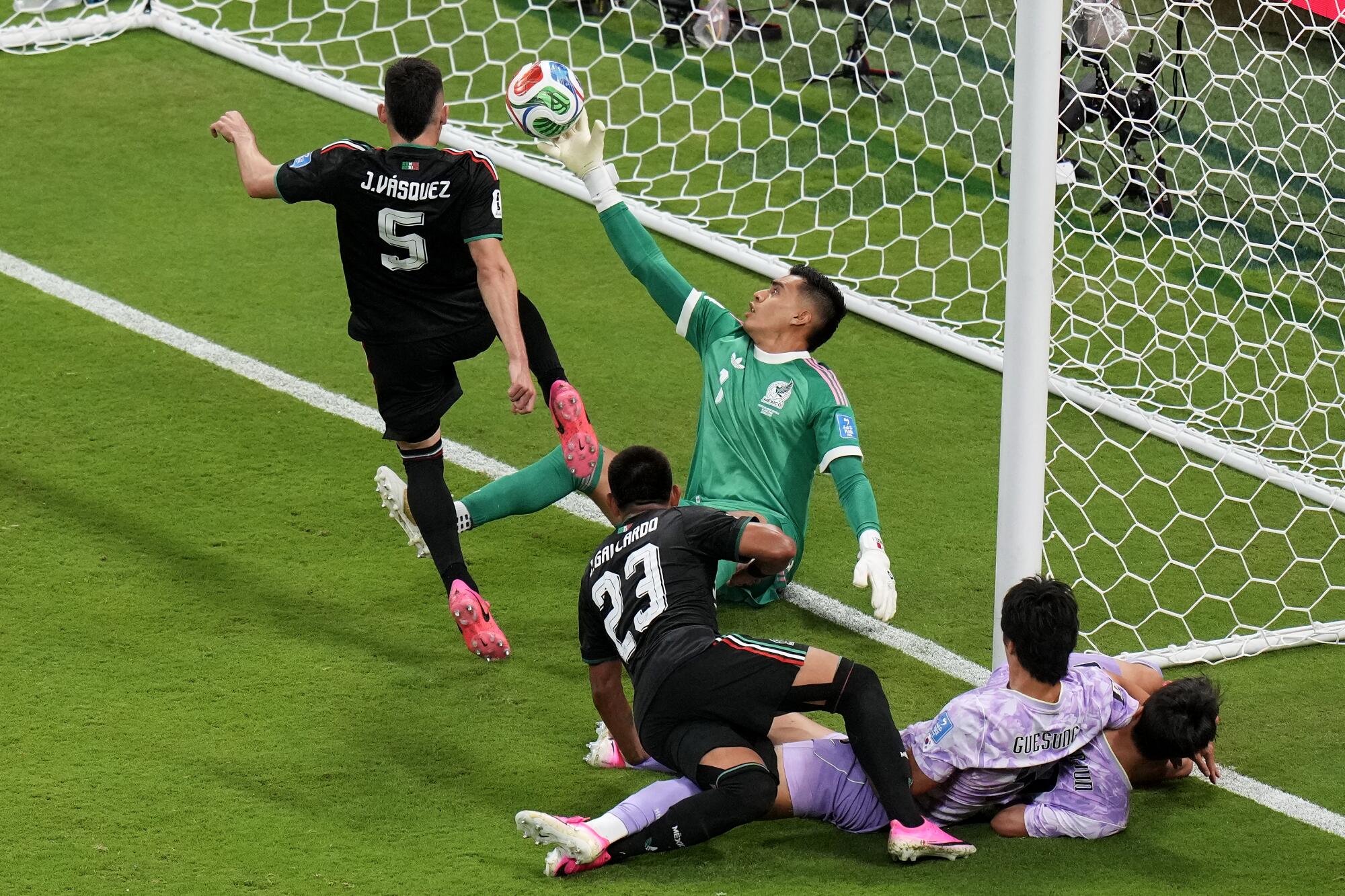
Mexico goalkeeper Raul Rangel reaches back to stop the ball from entering his goal during his team’s 1-0 World Cup win over South Korea Thursday.
(Silvia Izquierdo / Associated Press)
“I’ve always tried to get my team to play well and to help the players and the national team develop,” Aguirre said.
For the coach, advancing to the knockout round represents the culmination of more than three decades of work on the sidelines and the support of a group of players who rose to the occasion under the most demanding circumstances.
The coach also acknowledged that advancing to the next round has eased the tension surrounding the team after the doubts that existed before the World Cup. Without mentioning personal vindication, he noted that soccer tends to judge solely based on the most recent result.
“If you win, you’re the best; if you lose, you’re the worst,” Aguirre said.
Aguirre said he remains calm because he believes his approach to coaching hasn’t changed and that the team was rewarded Thursday night against South Korea in a match marked by limited space and a high degree of tactical discipline.
With qualification secured, Aguirre said he will not alter his soccer philosophy during Mexico’s final group stage match even though it no longer faces the pressure of securing a spot in the next round.
He said Czechia will enter the game with a different competitive need and a drive to advance, while Mexico will work to maintain a high level of performance that allowed it to record two consecutive wins and keep two clean sheets at the start of the tournament.
On the South Korean side, coach Hong Myung-bo avoided making excuses and focused his analysis on the play that decided the match. Although he explained that he had not yet reviewed the goal sequence in detail, he knew the team made a series of small errors in an area of the field where he had previously warned that losing possession could prove decisive.
Mexico goalkeeper Raul Rangel blocks a shot by South Korea’s Son Heung-min during the World Cup match on Thursday.
(Natacha Pisarenko / Associated Press)
The coach said that one of the central focuses of their preparation had been avoiding turnovers near South Korea’s box in the face of Mexico’s high press.
Myung-bo said that during the pre-match talk, he emphasized that the first 20 minutes would be crucial and believed his players had executed that part of the plan. He said that as the minutes passed, South Korea managed to create chances and was gaining strength until its critical turnover.
“After the momentum of the match shifted in our favor … both in terms of overall pressure and the play itself, we were able to create many opportunities,” Myung-bo said. “Although it ended up being a very frustrating match and we’re left with a bitter taste in our mouths over the lost possession, there’s no time to dwell on it. We have one last match ahead of us, so we’ll prepare well.”
MEXICO CITY — The Mexican national team will kick off the 2026 World Cup against South Africa on Thursday with the weight of entertaining 83,000 at iconic Azteca Stadium and soccer fans around the globe.
The match at the venue known as Mexico City Stadium during the World Cup will kick off at noon PDT and air on Fox and Telemundo.
Once the ball starts rolling, the stadium’s altitude — 7,216 feet above sea level — will be one of the biggest assets for the Mexican lineup led by coach Javier Aguirre.
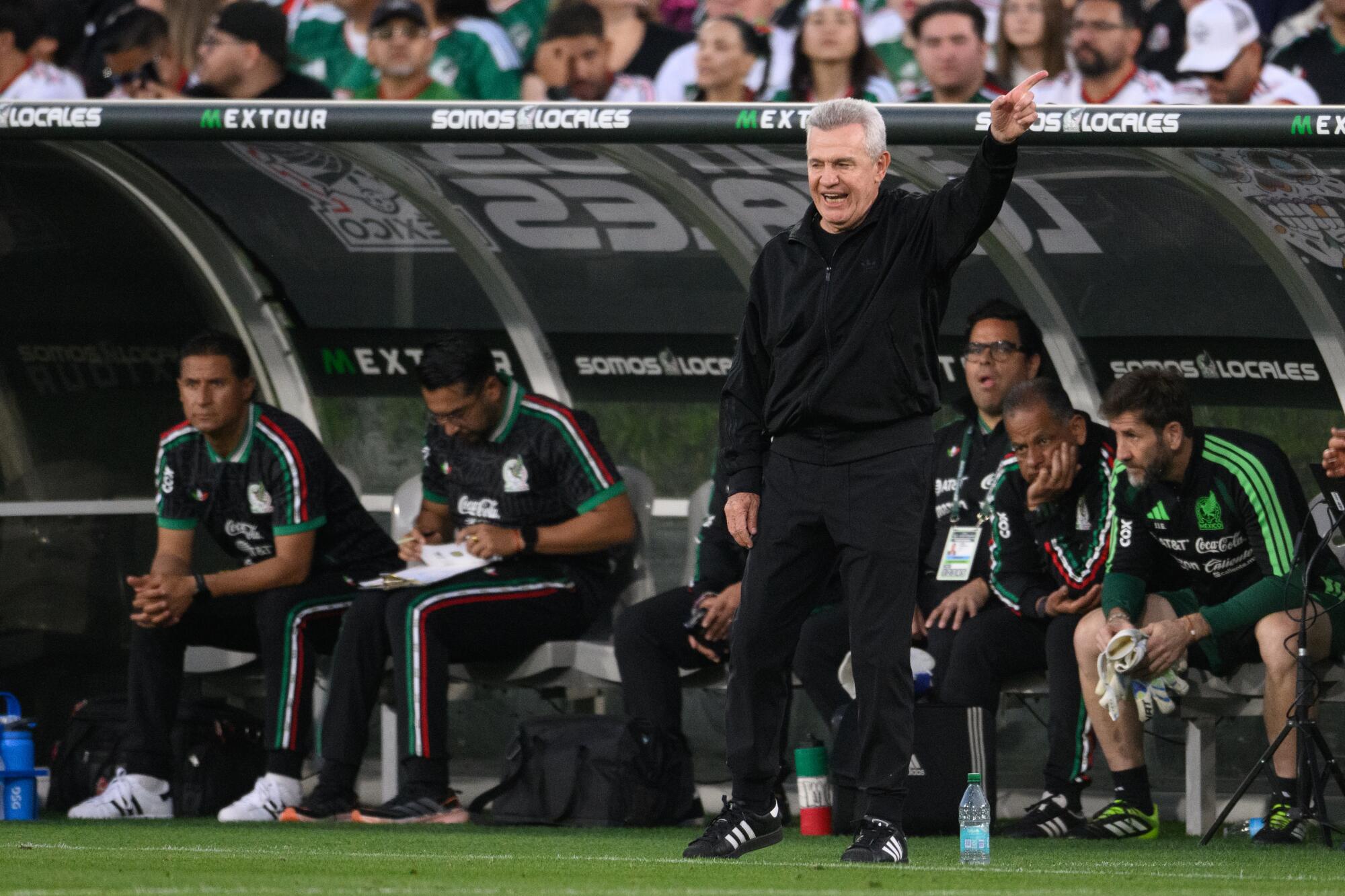
Mexico coach Javier Aguirre directs his players during a friendly against Australia on May 30 at the Rose Bowl.
(Kyusung Gong / Ap Photo/kyusung Gong)
Aguirre will likely deploy the 4-3-3 formation he used during Mexico’s final warm-up match against Serbia.
“We’re ready; we’ve been working for 22 months,” said Aguirre, 67, who took the reins of the national team on Aug. 1, 2024, following Jaime Lozano’s failure at that year’s Copa América, when Mexico was knocked out in the group stage.
Since his arrival, Aguirre has led the team to its first Concacaf Nations League title and the Gold Cup. Mexico enters the tournament on an eight-game unbeaten streak, though several of those results came against lower tier opponents and at home. The two most encouraging highlights of that streak were the draws against Belgium and Portugal.
“If my teams are known for anything, it’s for their character,” Aguirre said. “My team is just like me.”
The starting goalkeeper position remains a topic of debate, but it appears Aguirre has already made his decision. Guillermo Ochoa, who will be playing in his sixth World Cup with Mexico, is considered by many to be the ideal experienced goalkeeper to use during the opener, when nerves are sure to be high. However, Raúl Rangel has been the starting goalkeeper during Mexico’s past three warm-up matches, playing the full 90 minutes each time.
Rangel, who was 10 years old when Mexico tied South Africa in the opening match of the 2010 World Cup and who fondly remembers El Tri’s victory over France that tournament, is confident between the posts.
Mexico could turn to veteran goalkeeper Guillermo Ochoa to calm nerves during the World Cup opener on Thursday.
(Ronaldo Bolanos/Los Angeles Times)
“We’re in great shape; we proved it against Portugal and Belgium, two teams that are among the world’s elite,” said Rangel, who noted that Ochoa has instilled a sense of calm in the team.
“I do believe we can be champions. We have to start keeping that in mind and believe that it’s possible. Not everyone can boast that they played in a World Cup on home soil.”
The Mexican team’s lack of elite club experience, however, is obvious and could be a problem. El Tri has few players in top-tier leagues and lacks game-changers on the wings, as Diego Lainez, Uriel Antuna and Hirving Lozano were left off the final roster. Offensive output is a cause for concern. In tight matches, goals have come mainly from defenders, with César Montes and Johan Vásquez being the primary threats on set pieces.
The commitment to youth appears to be a key factor in Aguirre’s approach to building the roster. Mexican American Brian Gutiérrez brings freshness and dynamism to the midfield, alongside Erik Lira’s energy. As an option off the bench, Aguirre could turn to 17-year-old Gilberto Mora, the youngest player in the tournament, who is sure to draw cheers from the crowd.
For his part, South Africa’s 74-year-old head coach, Hugo Broos, knows the Azteca Stadium well, having marked Maradona during the 1986 World Cup semifinals. To acclimate his players to the altitude, he held training camp in Pachuca, at an elevation of 7,979 feet.
“This game is special. I’ve played in European championships, but there’s nothing like a World Cup. And we’re going to play at the Azteca Stadium — it’s incredible that this is going to happen,” Broos said.
South Africa coach Hugo Broo talks with Nigeria’s players during a World Cup qualifying match against Nigeria in Bloemfontein, South Africa, on Sept. 9.
(Themba Hadebe / Associated Press)
He expects to be challenged by Mexico.
“They’re a very well-rounded team, with great mobility and teamwork,” Broos said of El Tri. “You can tell they want to be world champions.”
South Africa will pose a real threat with Mbekezeli Mokoena driving the midfield and the speed of Oswin Appollis and Relebohile Mofokeng on the wings. The team’s main weakness lies in finishing, as Lyle Foster is their only striker, and if he doesn’t perform well, the South African side will suffer.
“We can’t say we don’t have a chance against Mexico, because that’s not true,” said Broos about his team, which is ranked 60th in FIFA rankings and will tangle with a Mexican squad ranked No. 14.
Pregame entertainment will kick off at 10:30 a.m. PDT with performances by Shakira, Burna Boy, Maná, J Balvin, and Alejandro Fernández. As a new ceremonial feature, all 26 players from each team — starters and substitutes — will participate in the ceremony by lining up around the tournament’s central emblem on the field, rather than in the traditional pregame formation.
The match is expected to be played in the rain. Protests are expected around the stadium throughout the day, including demonstrations by the teachers’ union and groups representing the families of missing persons.
Recent losses, outside criticism and a sense that the team’s identity has strayed from its original path have left LAFC in an uncomfortable position.
As the team prepares to host the Seattle Sounders on Sunday at BMO Stadium before a mandatory break for the World Cup, coach Marc Dos Santos shared his thoughts on the team’s adversity and goals for the future.
The coach said one of his main self-criticisms involved straying from the attacking identity he intended to build at LAFC since taking over as head coach.
“Outside criticism when the team loses isn’t that important to me because I’ve learned in my life that if you’re going to build a life based on what outsiders think of you, you’re going to be very unhappy,” Dos Santos said. “But in self-reflection, I’ll tell you one thing: I’m hard on myself. I believe we were building something with a clear identity, and after the series against Cruz Azul — in the Concacaf Champions League quarterfinals — I thought about switching to a three-man backline to defend more. I went in a more defensive direction, and I don’t want to be like that.”
The coach said the tactical change was the wrong move for LAFC.
“It was a mistake on my part, and it doesn’t reflect LAFC’s identity — it’s not what I want to build here,” Dos Santos said. “I want to make sure that this summer I thoroughly analyze what we need to change, and I have to stay true to LAFC’s identity.”
The comments come at a delicate time for LAFC, which has let potential MLS wins slip away despite showing competitive moments recently against St. Louis City SC and Nashville SC.
LAFC had hoped to once again be one of the dominant teams in the Western Conference, but offensive inconsistencies and tactical adjustments have led to questions about the coaching staff. The Los Angeles side sits in seventh place in the West with 21 points, eight points behind the leader, the Vancouver Whitecaps.
Dos Santos dismissed the idea that the problem is solely related to the tactical scheme and insisted that the most important change involves reclaiming aggressive principles with and without the ball.
“When we have the ball, we have to show the character to go after it — we can’t be afraid,” he said. “And when we don’t have the ball, we can’t just sit back. Look at one of the best teams in the world, Paris Saint-Germain F.C. Look at how they run without the ball. That’s soccer today.”
Amid this soccer overhaul, one of the most closely watched names remains Denis Bouanga. The Gabonese forward hasn’t made the same dominant influence as in previous seasons, though Dos Santos insisted that his relationship with the player remains solid and transparent.
“Denis knows what I want. I’ve always been very honest with him,” the coach said. “Last year we played a lot of games in a 3-5-2, defending a lot with Denis and Son [Heung-min,] but the club and I want to move to a different model. We’re all on the same page.”
Son Heung-min will temporarily leave LAFC after the match against Seattle to join South Korea’s training camp ahead of the World Cup, which will be played in the United States, Mexico and Canada.
The Asian forward said his full focus remains on this weekend’s match.
“I’m not thinking about that yet,” Son said of the World Cup. “The most important match is on Sunday. I just want to make sure we get a great result before heading to the World Cup and arrive in good physical condition.”
Son expects to be tested when South Korea travels to Mexico to play some of its World Cup matches.
“It’s not easy in Mexico, honestly,” he explained. “The altitude and conditions are different, but you have to love those big challenges. We’re really excited.”
As Son prepares to leave, LAFC faces a second-half schedule filled with intense competition. Following the match against Seattle, the club will return from the break to play against the rival Galaxy on July 17.
For Dos Santos, these challenges define the demands of managing LAFC.
“LAFC is a club that wants to win and whose fans want to see it win,” Dos Santos said. “Here, there’s always the responsibility to perform at a [high level]. If you don’t want to be in big games, you don’t coach at LAFC.”
The coach said external criticism isn’t influencing his plans.
“The pressure we feel is the pressure we put on ourselves,” Dos Santos said. “Pressure is when a doctor calls you and tells you you have a problem, or when your child has a problem. Soccer is a sport. You can win or lose. What you can control is improving the team during the week.”
Dos Santos said the World Cup break will serve as a key opportunity for internal analysis before redefining the club’s soccer direction. With the season barely halfway through, the coach said that regaining the team’s identity will be just as important as earning points when MLS returns in the summer.