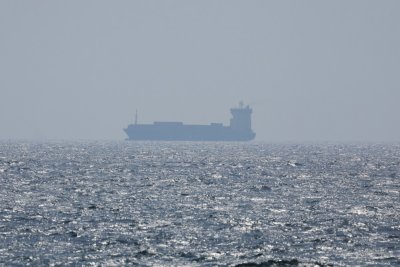
A container ship sails on the Strait of Hormuz, as seen from Ras Al Khaimah, United Arab Emirates, on June 23, 2025. Iran partially closed the Strait of Hormuz, a critical shipping path, to conduct military drills on Monday. File Photo by Ali Haider/EPA-EFE
Feb. 17 (UPI) — Oil prices climbed on Tuesday as Iran partially closed the Strait of Hormuz, a critical shipping path, to conduct military drills.
Fars, an Iranian news agency, cited “security precautions” as the reason for the closure, with no indication of when the Strait of Hormuz will fully open again.
About 13 million barrels of crude oil were transported through the strait each day in 2025, making up about 31% of oil shipments by sea. It is the main seaborne export route for Middle Eastern oil shipping to Asia.
Iranian naval forces began the drill “Smart Control of the Strait of Hormuz,” on Monday.
The drill involves deploying drones capable of striking aerial and maritime targets and is “focused on enhancing operational readiness, strengthening deterrence, and reinforcing multilayered defense,” Fars reported.
Tuesday is the first time that Tehran has closed any part of the Strait of Hormuz since President Donald Trump threatened military action against Iran in response to the killings of protesters.
The United States has posted warships on the Indian Ocean as Trump attempts to negotiate with Iran to scale back its nuclear program.
The United States and Iran held a second round of negotiations in Geneva on Tuesday. Trump was not present for those negotiations but said he would participate “indirectly.”
ONE of the most popular beaches in the UK will close during half-term.
Undergoing important works to ensure it’s ready for summer, part of Weymouth Beach will close to visitors next week.
Sign up for the Travel newsletter
Thank you!
Part of Weymouth Beach will close to visitors during half-termCredit: AlamyDuring the day there won’t be access from the Pavilion to the Jubilee Clock TowerCredit: Alamy
In a Facebook post, Weymouth Town Council gave advance notice of the beach closure for ‘annual levelling works’.
It detailed that from Monday 16 until Friday 20, 2026, Weymouth Beach will be closed between the Pavilion Theatre and the Jubilee Clock.
It added that “the reason the work needs to be done now is because we need to coincide with the spring tide”.
“During the spring tide, more of the beach is exposed, which allowed the team to get the diggers further on to the beach”.
Diggers will take to the sand to level it out from where it’s been moved from bad weather and tides – all in preparation for peak summer season.
Some comments on the post aren’t overly positive due to the closure coinciding with the half-term break.
One person wrote: “But why do it at school half term its crazy.”
Another added: “Half term week of all weeks! Next you’ll be telling us that you are going to close off the best part of the beach for a week in the summer holidays.”
A third wrote: “That’s half term week! Going to have very disappointed children.”
Others were more understanding with one encouraging families to watch the diggers in operation.
The part of the beach past the clock tower will remain open to visitors.
Weymouth is one of the most popular beaches in the country and was named one of the best beaches in Europe by Tripadvisor last year.
Previously, Weymouth was also named the UK’s best beach by The Times – it beat 49 other beaches that also made the list.
The longest beach in the country is less than 20-minutes away from Weymouth
If you want some more space on the beach, just a 17-minute drive away from Weymouth is the longest and largest in the county.
Chesil Beach has 18 miles of stretching coastline, and on the part of the promenade that’s on the Isle of Portland, is one of the best pubs in the UK.
The Cove House Inn made an appearance on the list of the 25 best spots for a pint by Big7Travellast year.
One visitor commented: “And the VIEWS! Amazing – right on Chesil beach with views out to sea. What a gem of a place.”
The pilot comes before Gaza residents begin to pass through the crossing on Monday, Israeli authorities say.
Israel says it has partially reopened the critical Rafah border crossing between Gaza and Egypt in a limited capacity.
Israel announced on Sunday that the crossing had reopened in a trial. Meanwhile, COGAT, the Israeli military agency that controls aid to Gaza, said in a statement that the crossing was actively being prepared for fuller operation, adding that residents of Gaza would begin to pass through it on Monday.
Recommended Stories
list of 3 itemsend of list
“In accordance with the ceasefire agreement and a directive of the political echelon, the Rafah Crossing was opened today for the limited passage of residents only,” COGAT said.
The Israeli army said it has completed a complex that will serve as a screening facility for Palestinians passing in and out of Gaza through the Rafah crossing, which will be open for the movement of some people on Monday.
Rafah has been largely shut since it was seized by Israel in May 2024, amid the country’s two-year genocidal war on Gaza.
Al Jazeera’s Hani Mahmoud, reporting from Khan Younis in southern Gaza, said the crossing’s reopening was an “uncomfortable dynamic”.
“Palestinians want to leave, but at the same time, they’re worried they won’t be able to come back,” he said. “People said the purpose for them departing would strictly be for medical evacuation or continuing their education, and they want to come back later on.”
Ismail al-Thawabta, the director of Gaza’s Government Media Office, told Al Jazeera that about 80,000 Palestinians who left Gaza during Israel’s war are seeking to return.
An estimated 22,000 wounded and sick people are also “in dire need” to leave Gaza for treatment abroad, he added.
Israeli attacks continue
An Israeli drone attack on Sunday killed one person in the northwest of Rafah city in southern Gaza, according to a source at the Nasser Medical Complex.
Palestinian media outlets confirmed the death of Khaled Hammad Ahmed Dahleez, 63, in the Al-Shakoush area.
Meanwhile, in central Gaza, an Israeli drone attack killed a Palestinian in the Wadi Gaza area.
The attacks came after at least 31 people were killed on Saturday in multiple Israeli air raids on northern and southern Gaza.
Israeli forces have killed at least 511 Palestinians, and wounded 1,405, since the start of the US-backed “ceasefire” on October 10.
(Al Jazeera)
Israel to ban MSF
The Israeli government dealt another blow to the dire humanitarian situation in Gaza, announcing on Sunday that it will terminate the humanitarian operations of Doctors Without Borders, known by its French acronym MSF, in the besieged Palestinian territory after it failed to provide a list of its Palestinian staff.
The decision followed “MSF’s failure to submit lists of local employees, a requirement applicable to all humanitarian organisations operating in the region”, Israel’s Ministry of Diaspora Affairs and Combating Antisemitism said.
In December, Israel announced it would prevent 37 aid organisations, including MSF, from working in Gaza from March 1 for failing to submit detailed information about their Palestinian employees, drawing widespread condemnation from NGOs and the United Nations.
Israel’s decision to terminate MSF’s operations in Gaza “is an extension of Israel’s systematic weaponisation and instrumentalisation of aid”, James Smith, an emergency doctor based in London, told Al Jazeera.
“Israel has systematically targeted the Palestinian healthcare system, killing more than 1,700 Palestinian healthcare workers”, thereby “creating a profound dependency on international organisations”, Smith said.