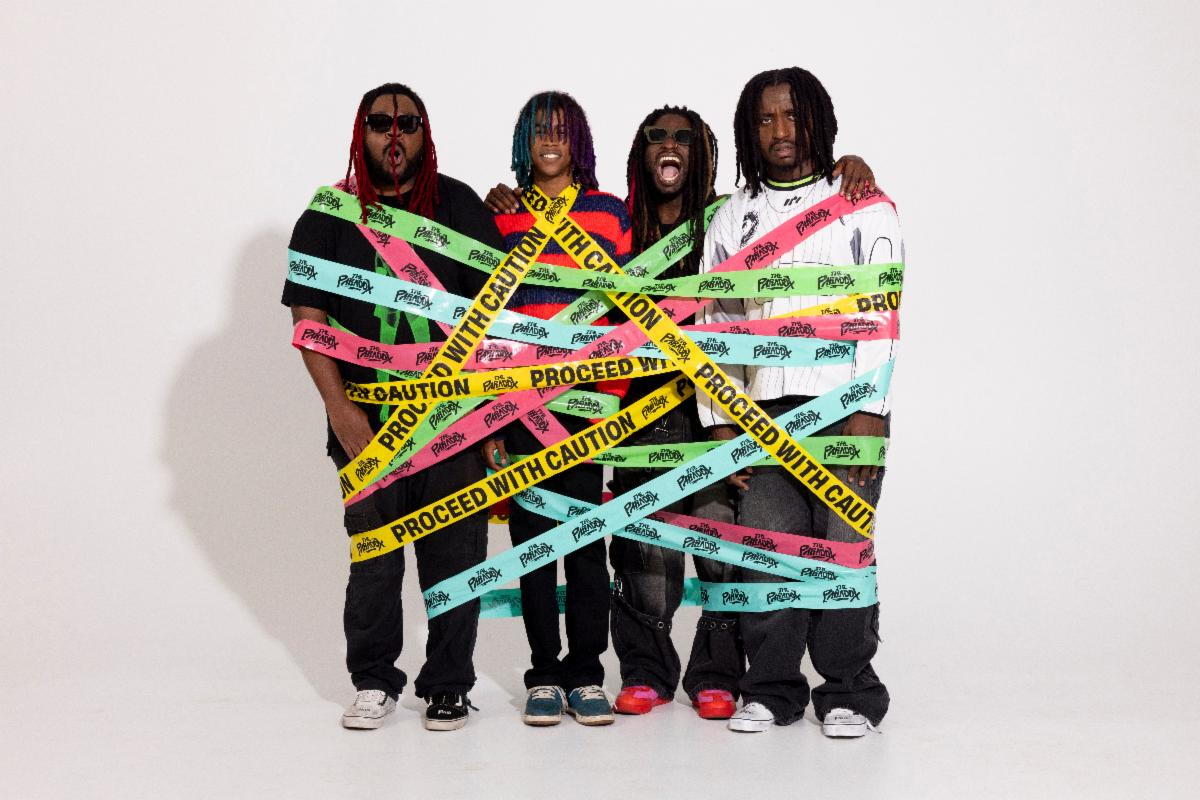
The Paradox’s pop-punk saviors are coming to a town near you
Eric Dangerfield is surrounded by senior citizens.
After a packed set at Riot Fest the previous weekend, the 25-year-old lead singer and rhythm guitarist of the Paradox welcomed the quiet of his boomer-dominated neighborhood.
“I’m a suburban dude,” he said, smiling from his home in metro Atlanta, his cropped two-toned dreads bobbing as he spoke.
The Paradox spent much of the summer on the festival circuit, powering through a growing discography of pop-punk gems, so Dangerfield and the three other band members are taking a brief breather before their Proceed With Caution Tour starts this month — their first as headliners.
It’s peaceful. That is, “Except when the boys come over,” he adds.
On a late morning in September, the boys are here and accounted for: patching in to a video call, minutes apart, from their homes, also in suburban ATL. Dangerfield, born with the perfect stage name, has ideas that flow faster than he can seem to get them out. Then there’s Donald Bryant on bass. Yin to Dangerfield’s yang, with a quiet, commanding presence.
Percy “PC3” Crews has been playing drums since he was 3, and his vicious skills on the drum kit contrast with a cheery, relaxed demeanor. Finally, there’s Christopher Bernard, a.k.a. Xelan — the lead guitarist and Dangerfield’s vocal complement.
Dangerfield likens the four to musical superheroes from a Marvel series. But not so much the “Earth’s mightiest heroes” variety.

On their first headlining tour, the band brings its new EP, “Proceed With Caution,” to Los Angeles while claiming space in a historically white genre and weaving social commentary into its pop-punk sound.
(Shorefire Media)
“I’m like Mister Fantastic and Donald’s my Invisible Woman. Xelan’s the Thing, and Percy is John Storm,” he says of his partners in musical mischief. “If I’m ugly, just say that,” quips Xelan, the band’s oldest member at 30. “Yeah. Because you’re strong, bro,” reassures Eric.
By this time, the interview has devolved into fun-loving chaos.
They finish each other’s sentences and switch up their Google Meet backgrounds, cracking up as an awkward graduation portrait pops up. At some point, Bernard decides to give a bedroom tour, showing off his collection of Blink-182 and Fall Out Boy posters.
A photo of him with Travis Barker hangs next to a framed Billboard plaque on a nightstand. Barker was featured on the Paradox’s 2025 single “Bender” and performed with the group at Vans Warped Tour the same year.
The Billboard plaque commemorates the band’s song “Get the Message” from its debut EP, “NSFW,” reaching No. 1 on the Alternative Airplay chart in January — a great achievement for any rock artist — but the Paradox also happens to be the first all-Black band to do so.
The success, although rapid, didn’t come from nowhere. All of the members have been working toward music in some form for years.
Dangerfield had a deal with a small label where he was originally making a go of it as a pop and R&B soloist. He also put out his music online. Looking for something different, he remembered his passing interest in pop-punk from his days growing up in Palm Coast, Fla. It was the “Fat Lip” video by Sum 41 that sealed the deal.
Yearning to be in a band, he started working with Bernard, whom he met online and shared his passion for the genre. Bryant was Dangerfield’s childhood friend from Palm Coast who had also moved to Atlanta, while Crews had been a fixture on the local music scene. And the name? It came from Dangerfield’s love of quantum physics.
Shortly after the group officially formed in June 2024, Dangerfield’s then-girlfriend — now wife and band “momager” Lexi Dangerfield — opened Instagram and TikTok accounts filming and posting their homey videos. The band’s song “Kaitlyn” and some covers blew up. The artists’ perspective, filtered through a Gen Z lens, struck a multigenerational nerve.
Attention came so quickly that Dangerfield felt the need to defend against online detractors who were convinced the group was an industry plant.
From there, the fairy-tale plot thickened. Billie Joe Armstrong followed Dangerfield on Instagram, and the two struck up a friendship that led to the Paradox opening for Green Day on the Atlanta stop of its Saviors Tour. But this was, of course, after Jack White’s people called — who the group ended up opening for at Basement East in Nashville.
Things haven’t slowed down in the two years since, with opportunities coming fast and furious. In the spring of last year, the band signed a deal with Hundred Days Records, a subsidiary of Virgin Music Group, and teamed up with producers Mike Pepe and Robopop to work on “NSFW.”
“Bender,” the group’s collaboration with Barker, and “Do Me Like That” are featured on Madden NFL 27 and NBA 2K26 video game soundtracks. Last month, the musicians streamed a concert from Twitch superstar Kai Cenat’s house. And now, instead of opening for their idols, they are inviting them up on stage as guests. For their second Warped Tour in Long Beach, that meant Deryck Whibley of Sum 41 and Logan Henderson from Big Time Rush.

The embrace from established musicians has definitely helped the band navigate its rise. In a moment of doubt, Crews said Good Charlotte’s Joel Madden, in particular, came through with sage advice.
“He asked me a question: ‘How does it feel being where we were?’ And I was like, ‘It feels like a dream.’ It felt like I was gonna wake up on my desk sophomore year with drool on my f— table. And I was telling him that, and he was like, ‘You know, it may feel that way, but it is real … It’s real, and it’s you … you belong in these rooms.’”
The irony of being embraced in a mostly white subgenre of punk rock while Black American culture formed its foundation is not lost on the group. Had the band come about during one of Dangerfield’s favorite eras of music, the ’50s and ’60s — there would likely have been rooms in which they weren’t welcomed.
While the band members understand the impact their visibility has — especially for non-white kids who grew up in the suburbs as they did: skating, riding BMX, building Legos, watching anime, dreaming of a life onstage — it does require some balance. “They’re not asking Taking Back Sunday this stuff,” Dangerfield acknowledged when asked if they might tire of the representation mantle. “Or Blink, but … We are a minority in this space and in this country, and I think that you know the stuff that comes with being Black should definitely be talked about. I think those conversations are important.”
He said as much in August, when the group made its Tiny Desk debut in celebration of NPR’s Black Music Month. “Now, like they said, we made history,” he said, leaning into the mic after the first song. “And the Paradox is in the business of bringing rock ’n’ roll back to the originators.”
A glance at the comment section under the video makes clear the group’s authenticity resonates with those who haven’t felt seen or heard in certain spaces.
“I’m a black girl from the suburbs of Metro ATL,” wrote @rainjojo. “And I’m glad to see representation of people who are like me indulging in punk rock. I got into this genre from childhood shows like “16,” “Stoked”, and other early 2000 to 2010 shows, and I remember being bullied for being whitewashed. Please keep making more music like this.”
The tour is named after “Proceed With Caution,” the band’s sophomore EP released on Oct. 2. Across six tracks, it continues in the same vein as “NSFW,” with sharp melodies and a dash of humor thrown in. But on “That’s Not Fair,” the group wades deeper into social commentary. It was also the most difficult to record, cut raw with no click track.
“We were just trying to think of things that were not fair, [from] small and trivial like losing your keys to, I don’t know, using it as a bridge to talk about larger issues and things like that,” Dangerfield says of the song. “I think a big thing for me personally, it’s not political … is kind of the fact that everything is getting so expensive. The price of everything is rising so rapidly, and the salaries that people are being paid are not really growing to match that.”

The Paradox perform at The Moroccan Lounge on Thursday, Oct. 22.
(Hunter Lyon)
“And it’s like, we got very lucky, but the thing is, most people don’t,” he continued. “If you’re gonna sacrifice all your time, slaving away working for big corporations and stuff like that, you should at least be able to, you know, buy a candy bar or something.”
So far, the musicians aren’t taking anything for granted and are trying to enjoy the in-between moments.
Dangerfield and his wife took their daughter on a Disney cruise for her second birthday — she’s spent much of her young life traveling with the band.
With some of his publishing money, Bernard indulged his love of vintage Japanese fashion and has a 2000s-era Tuscan house on his vision board. Crews stays healthy, listens to lots of Snarky Puppy, and looks forward to the relaxed cannabis laws of L.A. when the tour stops at the Moroccan Lounge on Oct. 22 and 23. If time allows, he might even have time to surf in Malibu.
Bryant, who counts Mike Dirnt, Mark Hoppus and James Jamerson among his biggest influences, balances a dream of seeing his band play for thousands with looking forward to a life lived like his older brother: a chiropractor with a nice family.
But some dreams will have to wait as the band goes back to making music, hopefully with lasting impact. The members want to become household names, “like Nirvana,” with music people will play for hundreds of years. Why not?
Anything is possible when you are a fantastic foursome.