papal

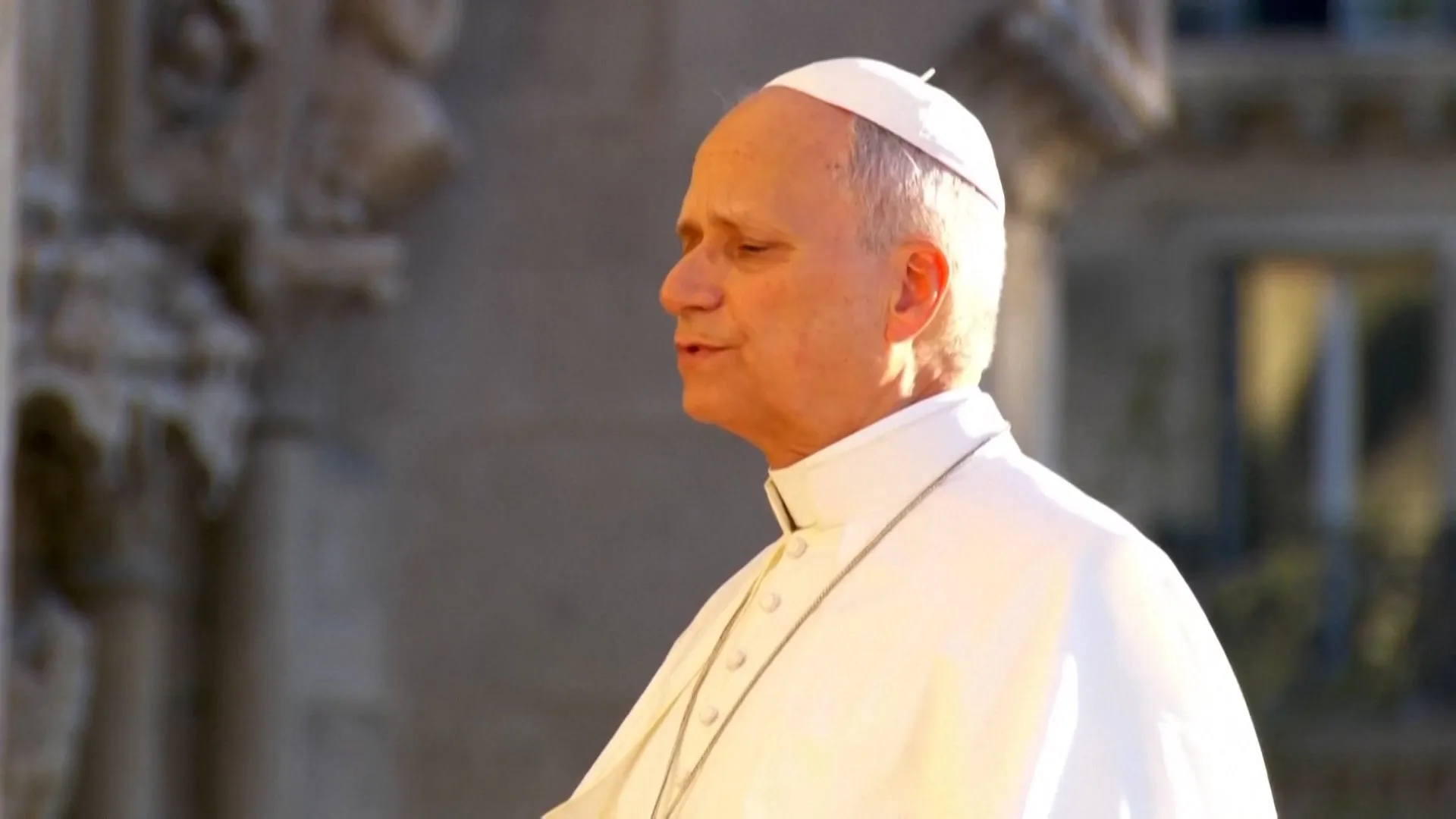
Pope Leo hopes to bridge Spain’s political divide on papal visit

1 of 2 | Pope Leo XIV blesses infants on his visit to the Caritas Charity Centrer in the Lucero neighborhood of Madrid Saturday. The pontiff is visiting Spain from from June 6 through June 12, with stops in Madrid, Barcelona and the Canary Islands. Photo by Ciro Fusco/EPA

June 6 (UPI) — Pope Leo XIV landed in Madrid Saturday to begin his one-week papal visit to the country, the first in 15 years.

Leo was greeted at the airport by King Felipe VI and his wife Queen Letizia, then addressed them at the Royal Palace along with politicians and diplomats.

He acknowledged political polarization and called for an end to it in Spain and elsewhere in the West.

“I come among you to affirm, encourage and instill a renewed fidelity to the Gospel among believers, as well as a deeper reconciliation and collaboration among the various elements of this nation,” the first American pope said.

“In reality, the message of peace, which at present unfortunately strikes some as naive and others as confrontational, is welcomed by those who do not shut themselves off in preconceived ideologies, but are rather open to the truth,” Leo said.

Spanish Deputy Prime Minister Yolanda Díaz told the Washington Post that the left in Spain embraces the pope.

“The [left’s] alignment with Pope Francis was immediate: He defended Spain’s labor reform and the Episcopal Conference also supported it, something that would have seemed unthinkable 20 years ago,” she said. “With Leo XIV, that alignment deepens.”

The Spanish far-right are battling the Church, which they believed an ally. They are particularly upset over the church’s advocacy for migrants, The Washington Post reported. The left once saw the Church as complicit in the Franco dictatorship.

“The far right in Spain wants to copy the far right in the United States,” Bishop José Mazuelos Pérez, who heads a Canary Islands diocese providing shelter, food, blankets and medical care for arriving migrants, told The Post. “To go to war with the bishops over the issue of migration.”

On Monday, Leo will address the Spanish parliament, which is gridlocked. He’s expected to discuss that type of polarization, and his other visits around the country highlight differing segments of the Church.

He will have a prayer vigil with young people Saturday, then march Sunday in a traditional Spanish street procession.

On Thursday, Leo plans to visit the Canary Islands, a landing for Latin American migrants and for those arriving by sea from the African coast. He is planning to visit Lampedusa on July 4, an Italian island where migrants from Africa and beyond land.

On his flight to Spain, Leo acknowledged that he would be competing popular with Puerto Rican singer Bad Bunny, who played the Super Bowl halftime show this year, for Spanish attention. Bad Bunny is scheduled to perform in Madrid Saturday night.

Leo said that more young people are turning to the Church, looking for something more.

“If they are confronted with the question: do they want to see Bad Bunny or do they want to see the pope, I think many will see Bad Bunny,” Leo said. “But I think there will also be a few here to see the pope. And that says something.”

On Sunday, the pope will celebrate mass on the feast of Corpus Christi in the Plaza de Cibeles. There will be a Corpus Christi procession, the Vatican said. He will also meet privately with members of the Order of St. Augustine to which he belongs.

Later, he will go to a gathering of representatives of culture, arts, business and sports at Madrid’s Movistar Arena.

The Vatican spokesperson Matteo Bruni said, “Leo XIV’s trip to Spain is a sign that, despite the secularization of society, the pope still has something to say in many areas, in Spain and in Europe, where he can play a constructive role in public debate,” Euro News reported.

Russian Mirra Andreeva plays against Ukrainian Marta Kostyuk in their semi-final match during the 2026 French Open in Paris on June 4, 2026. Andreeva won 6-1, 6-3. Photo by Maya Vidon-White/UPI | License Photo

Source link

In 1960, fears over papal sway. In 2026, a president attacks a pope

It was hard to miss President Trump’s very public spat with Pope Leo XIV this week.

The split was the first time in modern memory that an American president has so openly badmouthed a sitting pontiff, or, for that matter, distributed an image depicting himself as Jesus Christ. Critics cried “blasphemy!” even as supporters continued to stand behind the man whose presidency, some argue, was God sent.

Students of American history will recall an earlier incident that pitted papal and presidential authority against each other. The concern: that a president would align himself too closely to the church, or even take orders from the pope.

That anxiety seeped into the 1960 presidential campaign of John F. Kennedy, whose eventual victory would make him the first Catholic president.

Back then, Kennedy was constantly fending off accusations from Protestant ecclesiastic types who were wary that his nomination meant the pontiff, John XXIII, was already packing his bags for a move into the White House.

A black-and-white photo of a man in dark suit and tie seated next to a man in ornate religious vestments and a white skullcap

President John F. Kennedy meets with Pope Paul VI at the Vatican in July 1963, one month after Paul succeeded John XXIII as pontiff.

(Bettmann Archive / Getty Images)

The issue was so pronounced that 150 clergymen and laypeople formed Citizens for Religious Freedom, which in a pamphlet warned, “It is inconceivable to us that a Roman Catholic President would not be under extreme pressure by the hierarchy of his church to accede to its policies and demands.”

One particularly loud voice among the ministers was the Rev. Norman Vincent Peale, a popular and influential pastor and author. Peale was especially disturbed by Kennedy’s prospects.

“Our American culture is at stake,” he said at a meeting of the ministers. “I don’t say it won’t survive, but it won’t be what it was.”

The group asked Kennedy to “drop by Houston” to make clear his views on faith and government. He agreed, making a televised speech at the Rice Hotel, where he famously spelled out his firm opinions on the separation of church and state.

“I am not the Catholic candidate for president,” Kennedy told the group. “I am the Democratic Party’s nominee for president who happens to be Catholic.”

Time magazine reflected on the address some years later, concluding that the speech had gone so well for Kennedy “that many felt the dramatic moment was an important part of his victory.”

Since then, modern presidents have occasionally found themselves at odds with the Vatican. Typically Republican presidents would hear from the pope about foreign wars, while Democratic presidents were derided over abortion policies.

But such disagreements tended to be handled with the decorous language of diplomacy.

A man in a dark suit presents a medal on a ribbon to a man in white skullcap and religious robes, seated in an armchair

President George W. Bush presents Pope John Paul II with the Presidential Medal of Freedom in Rome on June 4 , 2004. The pope reminded Bush of the Vatican’s opposition to the war in Iraq. Bush praised him as a “devoted servant of God.”

(Eric Vandeville/Gamma-Rapho via Getty Images)

Then came Trump, who is now being accused of openly mocking the Catholic faith and the 1st Amendment. He called Leo weak on crime and foreign policy, among other things. A self-described nondenominational Christian who says his favorite book is the Bible, Trump’s hasn’t shied from bashing the pontiff, nor has he hesitated to blur the line separating church and state.

Where Kennedy argued for an absolute separation, Trump has advanced a model of religious resurgence, promising “pews will be fuller, younger and more faithful than they have been in years.” Through initiatives including the “America Prays” program launched last year, the White House has sought to bring “bring back God” by inviting millions of Americans to prayer sessions. The webpage for the program focuses features only Christian Scripture.

“From the earliest days of the republic, faith in God has been the ultimate source of the nation’s strength,” Trump said at a National Prayer Breakfast in February.

A man in a dark suit, hands clasped on a desk, is surrounded by other people standing near windows with gold curtains

President Trump, then-Vice President Mike Pence and faith leaders say a prayer during the signing of a proclamation in the Oval Office on Sept. 1, 2017. .

(Alex Wong / Getty Images)

In the United States, the Catholic Church historically has “loved the 1st Amendment” and its guarantee of religious liberty and, as a result, largely kept some distance from government, according to Tom Reese, a Jesuit priest and religious commentator. After its failures attempting to influence monarchs and politicians in Europe, the Catholic Church “didn’t want the government interfering with them and knew that it wasn’t their right to interfere with the government,” Reese said.

Kennedy loved the 1st Amendment too. He put it above his own religious beliefs, and said as much on his way to the White House.

“I would not look with favor upon a president working to subvert the 1st Amendment’s guarantees of religious liberty,” he said. “Nor would our system of checks and balances permit him to do so.”

A man with glasses, in red vestments, holds out his hands in prayer in a room with ornate blue and yellow mosaic walls

Pope Leo XIV meets with members of the community in Algiers at the Basilica of Our Lady of Africa on April 13, 2026.

(Vatican Pool via Getty Images)

Source link