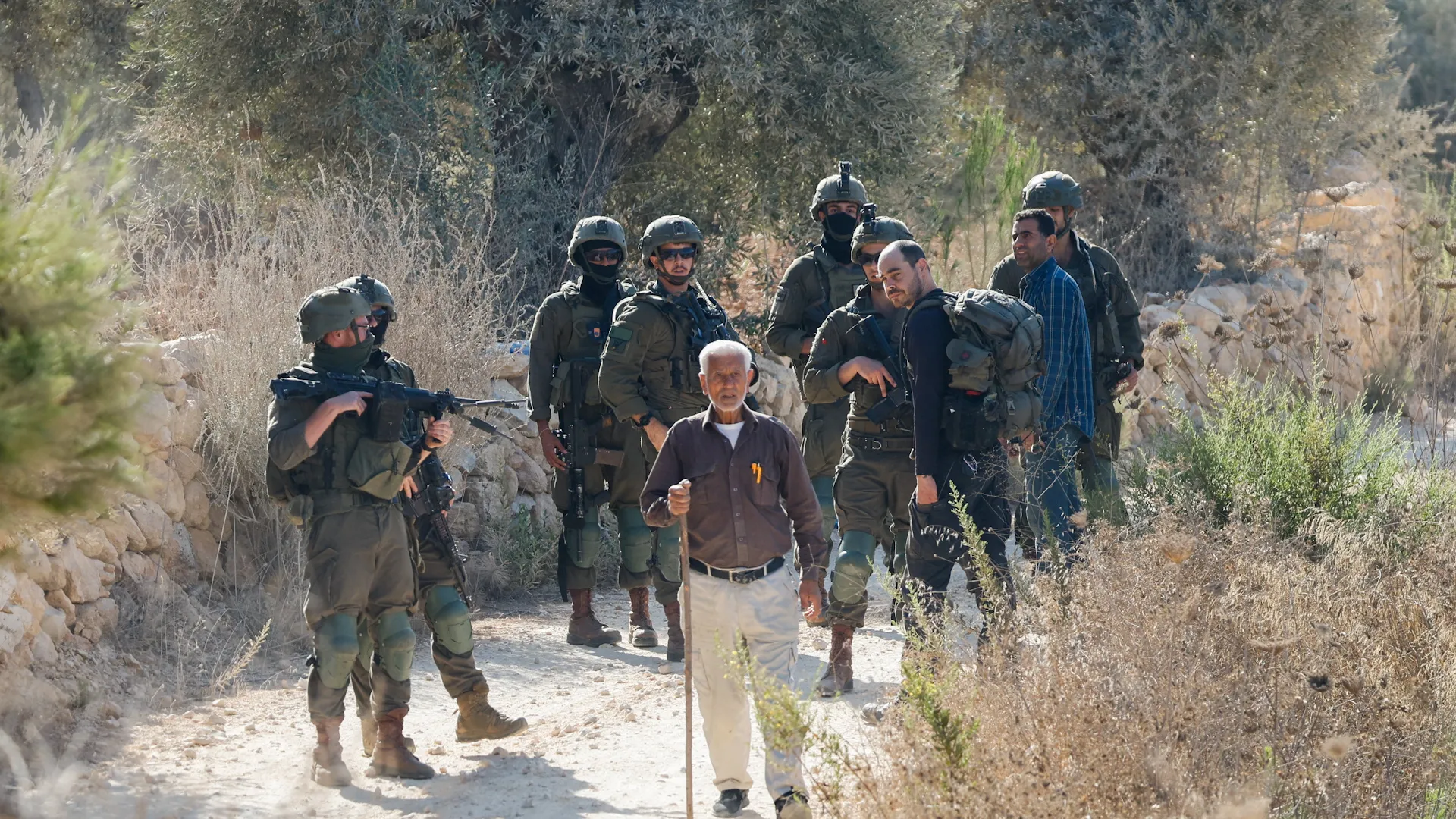
Israeli settlers and soldiers have attacked and blocked Palestinian farmers from harvesting olives as the season begins. More than 80,000 Palestinian families rely on the olive harvest as a source of income.
Gaza’s health toll mounts, with 1,439 dead and 5,052 injured since the ceasefire began in October 2025.
Published On 1 Oct 20261 Oct 2026
An Israeli drone strike has killed a Palestinian man and wounded several others in southern Gaza while settlers shot dead another Palestinian man near Ramallah in the occupied West Bank.
The body of Tamer al-Hamayda, 42, and three wounded people were brought to Nasser Medical Complex on Thursday after the strike hit a tent sheltering displaced Palestinians in the al-Mawasi area, west of Khan Younis on the southern coast of the Gaza Strip.
Recommended Stories
list of 3 itemsend of list
Another Palestinian succumbed to wounds sustained in an earlier Israeli drone strike on Tuesday that targeted a gathering of Palestinians in Jabalia refugee camp in northern Gaza, according to medical personnel in Nasser Medical Complex.
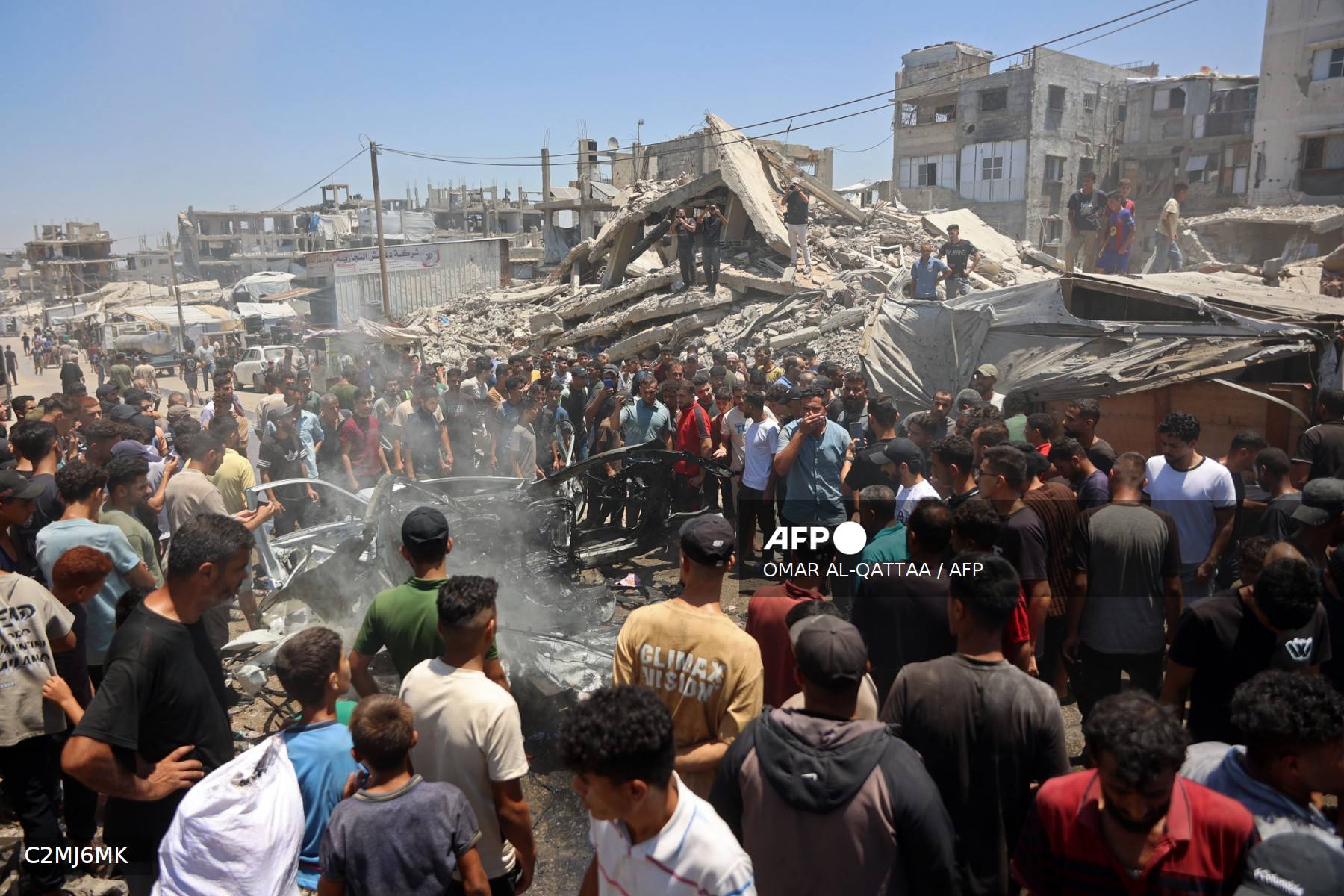
Israeli forces also carried out a large-scale demolition operation targeting buildings east of Gaza City’s al-Tuffah neighbourhood.
The Gaza Health Ministry reported eight new deaths and 26 wounded over the past 24 hours, putting the toll since the “ceasefire” took effect in October 2025 at 1,439 killed and 5,052 wounded, with 834 bodies recovered from the rubble.
Israel’s war on Gaza has killed at least 74,040 Palestinians and wounded 175,168 since October 2023, the ministry said.
Occupied West Bank pogroms
In the occupied West Bank, Israeli settlers shot dead a Palestinian man and wounded another during a raid on the village of Yasuf, north of Ramallah, on Thursday.
51-year-old Mashhour Yassin was shot dead by settler gunfire, the Palestinian Health Ministry said.
Describing the attack, the Palestinian Ministry of Foreign Affairs said Israeli forces had detained an ambulance, seizing its key and throwing it aside, “in a crime that reflects clear coordination between the settlers and occupation forces.”
It said the killing “falls within the framework of a serious and continuous escalation in organised settler crimes,” saying Israel gives free rein to settler “terrorism against our people in the service of settlement, annexation, forced displacement and ethnic cleansing plans.”
Yasuf Mayor Jumaa Abdel Fattah told the AFP news agency that dozens of Israeli settlers armed with sticks and firearms had attacked the village, which lies between four Israeli settlements.
“Yassin was at his doorstep when the settlers attacked the village homes. He went out to defend his house,” Abdel Fattah said, adding that Yassin’s nephew was also wounded in the attack.
Abdel Fattah said the settlers had come from Havat Anton, an illegal Israeli settlement established in July that has previously attacked the village’s residents.
Palestinians in the occupied West Bank have reported a surge in settler pogrom attacks in recent months.
More than 500,000 Israelis live in West Bank settlements considered illegal under international law.
According to the UN, at least 1,112 Palestinians in the occupied West Bank have been killed by Israeli forces or settlers in the territory since October 2023, including at least 37 killed by settlers.
Israel imprisons hundreds of Palestinian children at a time, holding them indefinitely in military detention systems that traumatise the children. Their suffering was discussed during an event on the sidelines of the UN General Assembly High-Level Week.
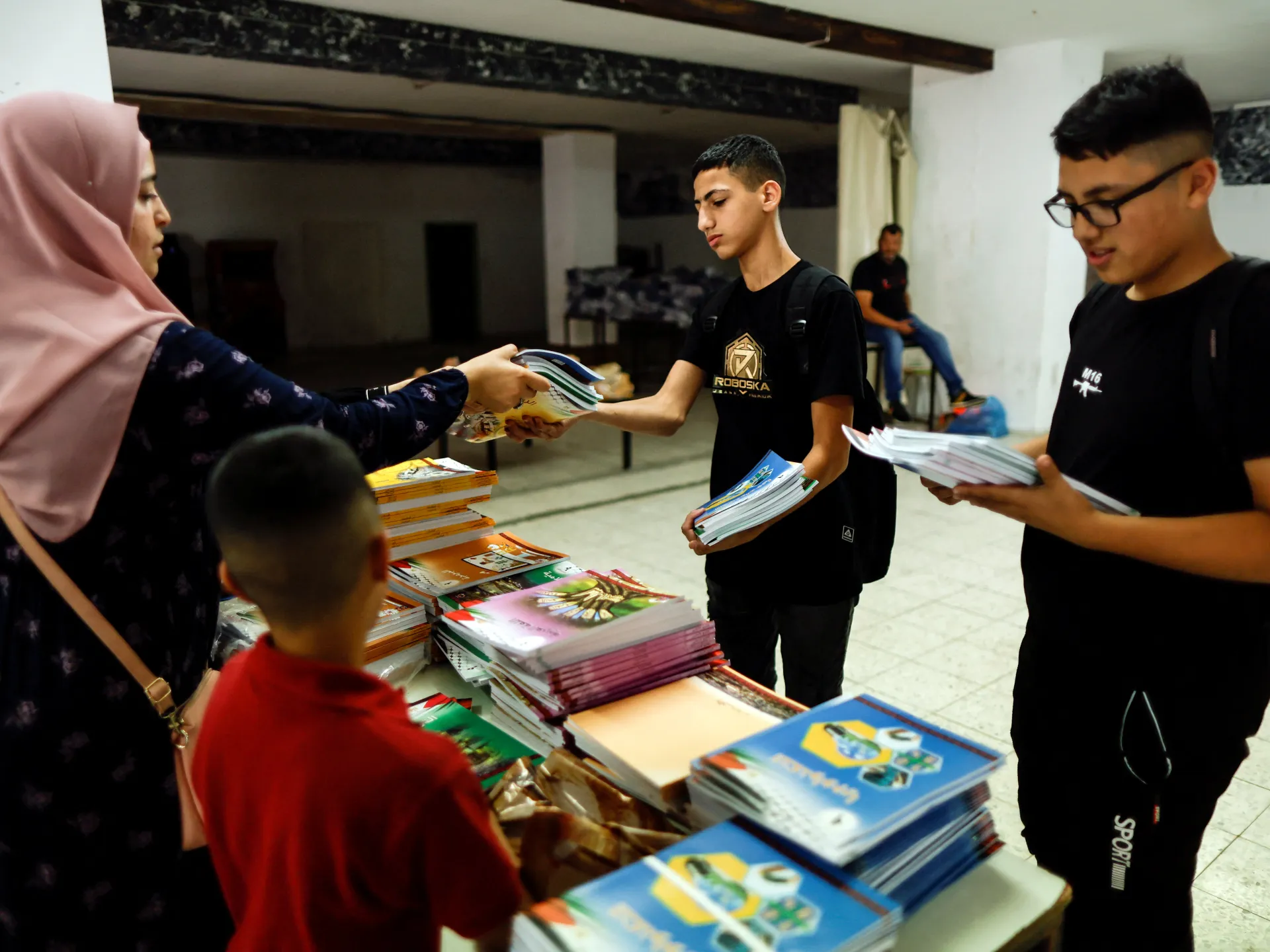
The school year started in occupied East Jerusalem with the news that 45,000 Palestinian children are now studying a curriculum put together by the Israeli authorities. That is more than a third of the Palestinian students in the occupied territory and almost double the number from the previous year.
Meanwhile, Christian schools started the school year with a strike, as many of their teachers who live in the occupied West Bank were not granted permits to enter the city.
For the Palestinian population of occupied East Jerusalem, this is yet another form of encroachment on their national rights by the occupation authorities. For Israel, this is a justified intervention because Palestinian textbooks produced by the Palestinian Ministry of Education and Palestinian teachers trained in Palestinian Authority (PA) institutions “teach hate”.
According to international humanitarian law, an occupying power must facilitate the normal operation of educational institutions and avoid interference in their affairs. Recently updated commentary by the International Committee of the Red Cross, the institution tasked with overseeing the application of the Geneva Convention, says an occupying power must not replace the existing education system with its own structures or impose new curricula.
Yet Israeli interference in Palestinian education is extensive and reaches well beyond occupied East Jerusalem – into the occupied West Bank and, more recently, the Gaza Strip. For years, successive Israeli governments have demanded that the United States and European governments pressure the PA to revise its textbooks by conditioning aid. Meanwhile, the devastation of Gaza’s education system has allowed NGOs funded by Western donors to introduce curriculums approved by Israel.
The Israeli argument that all this is necessary to prevent Palestinian children from learning “to hate” in school does not stand up to scrutiny.
Academic research, including a study funded by the US Department of State and prepared by both Palestinian and Israeli scholars, found that Palestinian textbooks do not promote hate and dehumanisation of Israelis.
So what is Israel actually looking to revise in Palestinian textbooks?
Studies comparing Palestinian textbooks with the Israeli-edited versions used in occupied East Jerusalem have documented the removal or alteration of references to Palestinian national symbols, such as the national flag and anthem, Palestinian sovereignty and history.
A 2025 study of primary-school textbooks found that Israeli modifications included replacing “Palestine” with “Israel” in some contexts and removing passages about the realities of occupation.
Israel wants references to the occupation, Palestinian history and self-determination erased from Palestinian textbooks not because they “teach hate”, but because they teach Palestinian children national consciousness – something Israel has fought against since its own creation, claiming “there is no such thing as a Palestinian people”.
This is why Palestinian resistance to curriculum changes in East Jerusalem should not be understood only as resistance to an Israeli textbook. For many parents, teachers and schools, the fear is that accepting the Israeli curriculum also means accepting the Israeli annexation of Jerusalem and its erasure of Palestinian identity inside it.
Removing concepts such as the occupation, the Nakba, refugees, the right of return, Palestinian sovereignty and national symbols from education materials can gradually detach Palestinian political identity from the historical narrative that gives those claims meaning.
While Israel gets to censor and shape Palestinian curriculums, there is little scrutiny by its Western allies of what Israeli curriculums teach Israeli children.
For her book Palestine in Israeli School Books, Israeli philologist Nurit Peled-Elhanan studied Israeli history and geography textbooks published in the post-Oslo years and discovered the extensive use of racist tropes and erasure of Palestinians. In the conclusion, she expressed concern that Israeli students graduate from Israeli schools and enter mandatory military service having “been taught to resent and fear” Palestinians and having no knowledge of their “life-world”.
Another more recent study of 123 textbooks used in Jewish Israeli schools by Israeli scholar Yael Teff-Seker found strong ethnocentric framing, a persistent sense of Jewish victimhood and relatively little space for Palestinian narratives. The author notes that while the concept of peace with Arab nations is described positively, the occupation is “described impartially, without judgement”, while the occupied Palestinian territory is sometimes referred to with Israeli names, for example, Judea and Samaria instead of the occupied West Bank.
A research paper coauthored by another Israeli academic, Roy Weintraub, explores how Israeli state curricula cover the Nakba, one of the central events that shapes Palestinian identity and political realities. The term is “partially present” in Israeli textbooks and teaching materials and “most teaching materials justify the actions taken by Israeli forces during the 1948 War”. The paper concludes: “Inclusion of difficult histories in the curriculum does not necessarily encourage a critical understanding of the suffering and injustices experienced.”
The issue with the curricula in Israel-Palestine is larger than education. It is about power. When one side controls land, movement, permits, budgets and institutions, and can also influence the language through which the other side describes that reality to its children, the classroom becomes another arena of the conflict itself.
The struggle over Palestinian textbooks is not only about what children should learn. It is also about who has the authority to decide what counts as legitimate history in the first place.
The views expressed in this article are the author’s own and do not necessarily reflect Al Jazeera’s editorial stance.
Settler pogroms intensify as a total lockdown of the occupied West Bank enters its third day. And Israeli worshippers harass an elderly Palestinian man at Damascus Gate in occupied East Jerusalem.
The Houston Texans’ linebacker wore eye black with the names of slain sisters Lana, 12, and Bana, eight.
Published On 28 Sep 202628 Sep 2026
American football player Azeez Al-Shaair has once again honoured Palestinian children killed by Israeli forces in Gaza, despite previous fines and the threat of being removed from games, this time wearing the names of sisters Lana and Bana Ahmad on his eye black during his latest National Football League (NFL) game.
The Houston Texans linebacker took the field against the Indianapolis Colts on Sunday wearing the names of Lana, 12, and her sister Bana, eight, who were killed along with their family in an Israeli air attack earlier this month.
Recommended Stories
list of 4 itemsend of list
Hours before the game, Al-Shaair posted about the sisters on his Instagram account and followed it with a photo of the black tape bearing their names that he would later wear during the game. The image also showed part of Al-Shaair’s black shoes with flags of Palestine and Sudan stitched on them.
Al-Shaair, a Black American Muslim player, has repeatedly spoken about the plight of Palestinians. On September 13, he wore the name of Hind Rajab, the five-year-old girl who was killed in Gaza after Israeli soldiers opened fire on her family’s stranded car on January 29, 2024.
The NFL fined him $11,491 for breaching the league’s code of conduct on players’ clothing and equipment during a match against the Buffalo Bills.
However, basketball player Kyrie Irving stepped in and offered to pay the fine for Al-Shaair, who later confirmed that he had been in touch with the nine-time NBA All-Star.
Al-Shaair brushed off talk of the fine while speaking to reporters last week. “It’s bigger to me; what’s a life worth? Is a life worth $11,000? No, I think it’s priceless,” he said.
In his subsequent game against the Cincinnati Bengals, Al-Shaair then wore an eye black — a sticker or paint frequently used by NFL players to reduce glare — with the name of Wafa Akila, an eight-year-old who was killed along with her father in an Israeli attack in western Gaza as they were making their way home.
He was also fined in January, during the NFL’s last season, for displaying the message “Stop The Genocide” on his nose tape. While it did not specifically refer to a particular conflict, it was widely understood to be about Gaza and Sudan.
Following his NFL outing in which he wore the name of Rajab, Al-Shaair was informed he would have to remove the eye black or he would not be permitted to continue playing in the game, according to reports in US media.
US Democratic politician Isaiah Martin condemned the NFL’s reported reaction to Al-Shaair wearing eye black with the names of slain Palestinian children.
“This harms no one by letting him do this,” Martin said in a post on X. “I think it’s absurd they were fining him, but those were the ‘rules’ and he agreed to pay the fine. Removal from the game is INSANE. This shouldn’t stand!”
The Israeli genocide in Gaza has severely limited education for the Strip’s 660,000 children, with 90 percent of schools left damaged or destroyed.
Washington, DC – Palestinian Americans have held a day of advocacy at the United States Capitol under the spectre of a new $2.8bn arms transfer to Israel reportedly approved by the administration of US President Donald Trump.
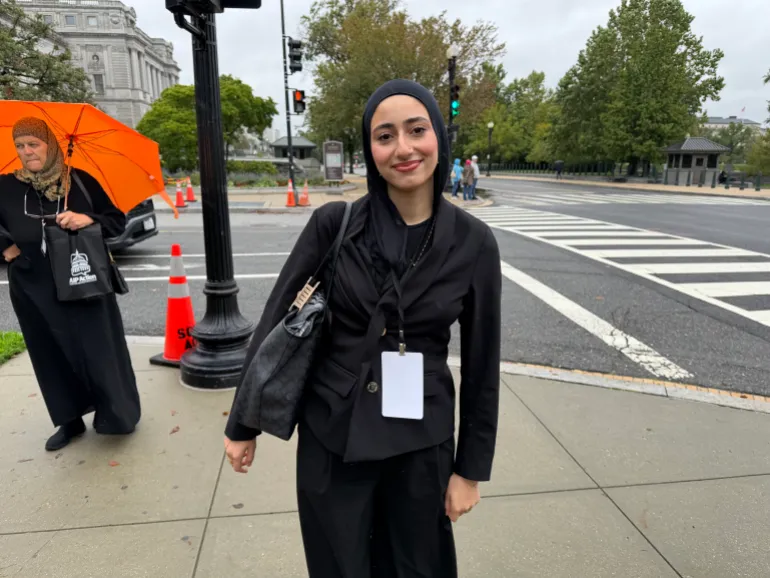
The Americans for Justice in Palestine Action (AJP Action) group, which organised Tuesday’s event, said more than 300 constituents from across the country met with the offices of more than 100 US lawmakers. They advocated on behalf of a slate of legislative initiatives related to Israel’s genocidal war in Gaza, surging Israeli settler violence in the occupied West Bank, and efforts to use immigration law to stifle Palestinian advocacy in the US.
Recommended Stories
list of 3 itemsend of list
Jenna Escheik, a 19-year-old meeting with lawmakers and staffers from Virginia, including Democratic Senator Tim Kaine and Republican Representative Rob Wittman, said she was planning to speak with “some very challenging and interesting people”.
“I think the main point that we’re trying to get across to every single office is that we’re all proud to be American, and we all have our taxpayer dollars that we just don’t want to see going to wars,” said Eschiek, who is originally from outside of Ramallah in the West Bank.
Yaseen Shaikh, a 22-year-old who travelled with a delegation from Cleveland, Ohio, said he will be meeting with the offices of Republican Senator Jon Husted, who faces a competitive midterm race against former Democratic Senator Sherrod Brown, as well as the state’s other Republican Senator, Bernie Moreno.
Both Republican senators have consistently voted against legislative efforts to limit arms sales to Israel.
“As I stand among my peers here, among people who I stand on their shoulders, I can only feel hopeful and optimistic that we will make a difference and that change will come,” Shaikh told Al Jazeera.
“We just have to be vehicles for that,” he said.
Palestinian rights ‘catching up’ with lawmakers
Successive presidential administrations, as well as Congress, have for decades resisted calls to condition US military aid to Israel, including throughout Israel’s latest war in Gaza, which will reach its three-year mark early next month.
To date, nearly 74,000 Palestinians have been killed in Gaza since October 7, 2023, with nearly 1,400 killed since a “ceasefire” agreement went into effect in October 2025.
Last week, US media widely reported the Trump administration approved a US taxpayer-funded $2.8bn military package to Israel, which included 907kg (2,000-pound) MK-84 bombs known to have already caused widespread civilian devastation in the Palestinian enclave.
The package reportedly included 20,000 of those munitions, as well as 20,000 BLU-117s, a close variant.
Several Democrats have vowed to block the transfer, with the ranking member of the House Foreign Affairs Committee, Gregory Meeks, using his leverage last week to at least slow congressional clearance.
Osama Abu Irshaid, AJP Action’s executive director, said the new weapons package runs counter to public opinion polls, which have regularly found majority support for conditioning at least some weapons to Israel, as well as surging support for Palestinian rights.
Abu Irshaid said the polls underscore a new political reality for lawmakers.
“I think now we are functioning within this context, where what happens in Palestine, the genocide that took place and continues to take place, what the terrorist settlers are doing in the West Bank, what the US and Israel are doing in the Middle East is catching up with us here,” Irshaid said, “and we’re paying a price”.
Jenna Escheik was among the Palestinian Americans meeting with US lawmakers in Washington, DC [Joseph Stepansky/Al Jazeera]
While entrenched support for arming Israel has persisted among some segments of the Democratic Party, advocates have hailed what they see as a historic shift in recent months.
In July of last year, 26 Democrats in the Senate voted to block some arms transfers to Israel, the first time in history a majority of Democratic lawmakers in the chamber did so. In April, similar resolutions gained a record 40 votes in the Senate, all Democrats, but ultimately failed to pass in the 100-member chamber.
The so-called Block the Bombs Act in the House, which calls for a partial arms embargo against Israel, reached 81 co-sponsors as of August.
Twenty-two Democratic senators also introduced a resolution last week to force the US Department of State to conduct an investigation into the violence committed by Israeli forces and settlers in the West Bank, in which at least nine US citizens have been killed in recent years.
Abu Irshaid was optimistic that headway could also be made among Republicans, who have been reckoning with an internal divide over US support for Israel, with exceedingly few members of the party currently willing to vote to limit aid.
A December poll by the IMEU Policy Project found a majority of Republicans under 45 said they would prefer to support a presidential candidate in 2028 who “supports reducing taxpayer-funded weapons to Israel”.
“I think what we’re seeing now is that the dam within the Republican Party is cracking,” Abu Irshaid said.
“But the question is, ‘What is after Donald Trump when Donald Trump no longer owns the Republican Party, owns the MAGA movement?’ I think that’s when you will see more cracks taking place.”
‘The same system’
Advocates on Tuesday also focused on what they called the Trump administration’s practice of using immigration law to stifle pro-Palestine advocacy.
Among their policy priorities, those meeting with lawmakers sought to reform language in the Immigration and Nationality Act of 1952, which the Trump administration has cited in efforts to deport individuals whose presence in the US the administration deems to have “adverse foreign policy consequences”.
Among those speaking at the US Capitol on Tuesday was Salah Sarsour, the president of the Islamic Society of Milwaukee, who was detained by ICE in April and released in June. His legal team has charged that the three-decade US resident was targeted based on a coerced confession when Sarsour was detained by Israeli forces as a young man.
Sarsour, who continues to face deportation proceedings, said the ICE detention reminded him of being held in Israeli detention.
“Those criminals that [detained me], they still exist,” he said. “The same criminals that destroy Gaza, they killed tens of [thousands] of children and women, and men and family members.”
Leqaa Kordia, who was among those targeted by immigration enforcement agents following a wave of pro-Palestine protests that swept US campuses in 2024, also recounted the “dehumanisation” of her 368 days in ICE detention.
“And then it hit me that…the same system that threw me in an ICE jail is the same system that funds and arms the military prisons in Israel,” said Kordia, who, like Sarsour, still faces deportation proceedings.
“The same dehumanisation logic that allowed a guard to humiliate me allows the Israeli soldier to kidnap Palestinians and throw them into the shadows,” she told those gathered.
“The same power that keeps my case in limbo is the same power that sends billions of US tax dollars in bombs and weapons to fuel the Palestinian genocide.”
Jason Eaton faces up to life in prison after a jury rejected his insanity defence.
Published On 21 Sep 202621 Sep 2026
A jury in the US state of Vermont has convicted a man of attempted murder for shooting three Palestinian college students in 2023, rejecting his defence that he was not guilty by reason of insanity.
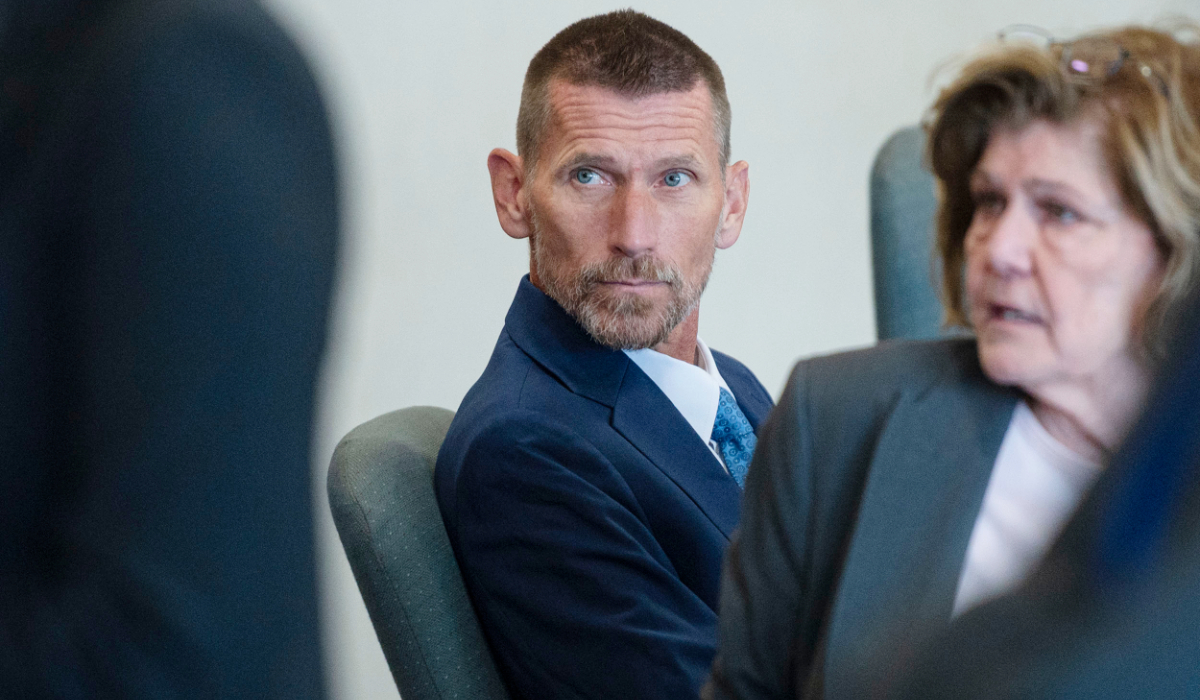
Jason Eaton, 51, faces up to life in prison for the attack near the University of Vermont campus in Burlington. It left Hisham Awartani paralysed from the waist down and wounded his friends Tahseen Aliahmad and Kinnan Abdalhamid.
Recommended Stories
list of 4 itemsend of list
The jury deliberated for several hours on Monday before reaching its verdict after a week-long trial that included testimony from the three men and psychiatric experts called by both the defence and prosecution.
Eaton was ordered jailed pending sentencing, which has yet to be scheduled.
Awartani and Aliahmad, who were sitting in the front row of the courtroom, smiled and hugged people around them as the verdict was read.
Eaton did not dispute that he shot the three men in November 2023. Instead, his lawyers argued that he should be found not guilty by reason of insanity.
The defence said Eaton was suffering from a delusional psychotic disorder and believed the CIA and Israel’s Mossad were transmitting messages to him through FM radio.
Joshua O’Hara, the supervising attorney at the Chittenden County Public Defender Office, told jurors that Eaton believed the intelligence agencies had enlisted him to “overwatch duty” to protect a Jewish family living across the street and that God was commanding him to act.
Prosecutors rejected the insanity defence, telling jurors that a state psychiatrist had concluded Eaton did not have a mental disease or defect and that the evidence showed he intended to kill the three men.
‘He pulled out a handgun and started shooting’
Awartani, Aliahmad and Abdalhamid, now 23, grew up together in Ramallah in the occupied West Bank before moving to the US for university.
They were visiting Awartani’s grandmother in Burlington over the Thanksgiving holiday when they went for a walk near the University of Vermont campus after dark.
Awartani testified that the friends were smoking cigarettes and speaking a mix of English and Arabic. Two of them were wearing keffiyehs.
He said Eaton was standing on the porch of the apartment building where he lived before approaching the friends without saying anything.
When Eaton was about five to 10 feet (1.5 to three metres) away, Awartani testified, he pulled out a handgun and began shooting.
Awartani, then a student at Brown University, was shot in the chest and left paralysed from the waist down. Aliahmad, who attended Trinity College, was shot in the collarbone, while Abdalhamid, a Haverford College student, was shot in the right buttock.
The shooting prompted calls for a hate crime investigation, but no hate crime charges were filed.
Police later found three shotguns in Eaton’s apartment as well as a Ruger .380-calibre handgun that crime laboratory testing identified as the weapon used in the shooting.
Far-right Israeli minister Itamar Ben-Gvir has called for the death penalty for a Palestinian gunman that fatally shot an Israeli settler in the occupied West Bank, while Israeli forces stormed a hospital in Ramallah in a manhunt for the suspected attacker.
Al-Shaair wears eye black with Akila’s name despite being fined for displaying messages about Israel’s genocide in Gaza.
American football player Azeez Al-Shaair has persisted with his stance on raising awareness about slain Palestinian children by wearing eye black bearing the name of Wafaa Akila, an eight-year-old girl killed by Israeli forces in Gaza, during his latest appearance in the National Football League (NFL).
The Houston Texans’ linebacker wore the black tape across his nose during a game against the Cincinnati Bengals on Sunday, days after he wore the name of Hind Rajab on his eye black, which led to an $11,941 fine by the NFL as he breached the league’s code of conduct on players’ clothing and equipment during a match against the Buffalo Bills on September 13.
Recommended Stories
list of 4 itemsend of list
However, basketball player Kyrie Irving stepped in and offered to pay the fine for Al-Shaair, who later confirmed that he had been in touch with the nine-time NBA All-Star.
Al-Shaair brushed off talk of the fine while speaking to reporters last week. “It’s bigger to me; what’s a life worth? Is a life worth $11,000? No, I think it’s priceless,” he said.
In his first match appearance since being fined, Al-Shaair took the field with “Wafaa Akila” written on his eye black, a sticker or paint frequently used by NFL players to reduce glare.
On September 6, the first day of school for the eight-year-old, she was killed along with her father in an Israeli attack in western Gaza as they were making their way home.
The Israeli drone struck their car, leaving it burned and charred, with only a few pages of Akila’s school books surviving the horrific attack. A few hours earlier, a smiling Akila posed for a photo before setting off for her first day of school.
The Israeli genocide in Gaza has severely limited education for the Strip’s 660,000 children, with 90 percent of schools left damaged or destroyed.
Akila’s death was similar to that of Rajab, aged five, who was killed in Gaza after Israeli soldiers opened fire on her family’s stranded car on January 29, 2024. A phone call by the Palestine Red Crescent Society documented her final moments and was the subject of an Oscar-nominated docudrama.
Al-Shaair shared posts about Akila, as well as her mother’s reaction to the killing, on his Instagram account on Sunday.
Following the Texans’ match against the Bengals, a social media user posted a video that showed Al-Shaair interacting with children – some sporting keffiyehs, others who were amputees and were holding posters in support of the player – on the sidelines.
‘Be like Azeez Al-Shaair’
Al-Shaair, a Black American Muslim player, has frequently spoken about the plight of Palestinians and has paid the price for it.
He was also fined in January, during the NFL’s last season, for displaying the message “Stop The Genocide” on his nose tape. While it did not specifically refer to a particular conflict, it was widely understood to be about Gaza and Sudan.
Prominent American Muslim scholar Omar Suleiman has repeatedly voiced his support for Al-Shaair.
“My brother, who went to Jordan to be with Palestinian refugees this summer, who spends time with Palestinian children with missing limbs in Houston, who is using every week of his Pro Bowl NFL career to honour a Palestinian child despite the fines,” Suleiman wrote about Al-Shaair in a social media post on Sunday.
“In the sports and entertainment arenas run by many of the same types of people who run government, choose to be like Azeez Al-Shaair, Kyrie, and Macklemore.”
The NFL’s fine on Al-Shaair comes at a time when Robert Kraft, owner of the Boston-based team New England Patriots, confirmed that he pressured pop star Ed Sheeran to drop rapper Macklemore from his tour of the United States.
The United Nations General Assembly will allow Palestinian President Mahmoud Abbas to address via a prerecorded video.
Published On 19 Sep 202619 Sep 2026
The European Union says it regrets the denial of visas by the United States for the second year running to Palestinian Authority (PA) officials seeking to attend the United Nations General Assembly (UNGA) in New York, urging it to reconsider the decision.
The statement on Saturday comes just days after the UNGA voted to allow Palestinian President Mahmoud Abbas to address the body during the upcoming 81st session via a prerecorded statement.
Recommended Stories
list of 3 itemsend of list
“In light of its existing headquarters agreements with the UN and its obligations as host state, we urge the United States for this decision to be reconsidered,” said Anouar El Anouni, a spokesman for the EU’s diplomatic service.
On Friday, UN Secretary-General Antonio Guterres also expressed regret at Washington’s decision, adding he was concerned about its impact “on the ability of the State of Palestine to participate fully in the work of the United Nations”.
The US Department of State announced on Wednesday that it would prolong visa sanctions on officials of the PA and members of the Palestine Liberation Organization (PLO).
“As a consequence of their failure to reform, contrary to their commitments to the United States, and their ongoing activities that undermine the prospects for peace, the United States will extend sanctions that deny visas to PLO members and PA officials,” the State Department said in a statement.
The department accused the PA of violating US law by bypassing direct negotiations to seek international recognition of Palestinian statehood.
It also cited the PA’s decision to take its dispute with Israel to international courts and its financial support for people the US and Israel label as convicted attackers and their families.
No Israeli officials face equivalent US travel restrictions, despite an International Criminal Court arrest warrant issued against Israeli Prime Minister Benjamin Netanyahu over alleged war crimes in Gaza.
Abbas’s address this year is expected to push for international recognition of Palestinian statehood and revive momentum for a two-state solution, building on a wave of formal recognitions by the United Kingdom, France, Canada and other Western nations last year.
His speech will also highlight the severe humanitarian crisis in Gaza alongside the rapid growth of illegal Israeli settlements and settler pogroms across the occupied West Bank.
Palestine’s Ministry of Foreign Affairs and Expatriates welcomed the UN resolution passed on Thursday allowing Abbas to address the assembly next week, saying it “represents a breaking of the attempt to prevent Palestine’s participation” in the UNGA’s annual session.
Separate attacks struck central refugee camps as officials warned Gaza’s health sector faces total collapse.
Published On 19 Sep 202619 Sep 2026
An Israeli strike on a motorcycle has killed one Palestinian and injured others, with one child in critical condition, reports the Palestinian Wafa news agency.
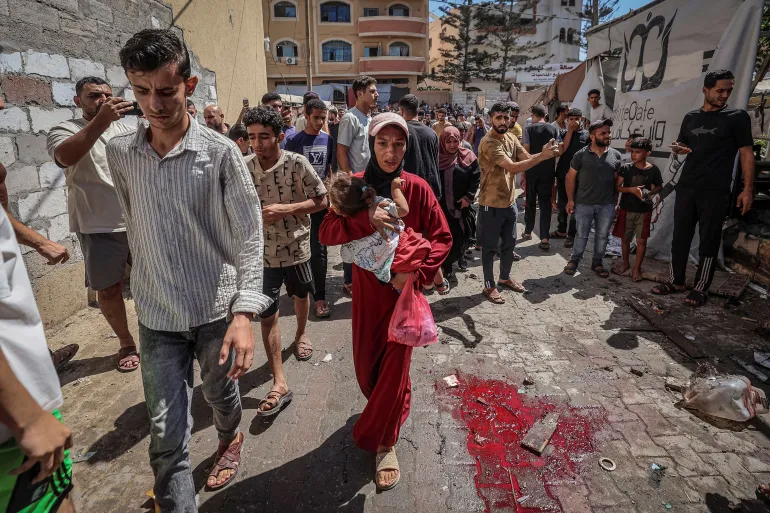
The air strike targeted the vehicle in the Sheikh Radwan neighbourhood, west of Gaza City, on Friday. Ongoing Israeli strikes on the besieged enclave have killed at least 1,381 people since the ceasefire was announced in October 2025.
Recommended Stories
list of 3 itemsend of list
Israel has killed at least 73,795 people and wounded 174,869 others since the start of its genocidal war in October 2023.
On Friday, the Israeli army also opened fire in the Nuseirat and al-Bureij refugee camps in the central Gaza Strip, reports Wafa. The attacks on tents sheltering displaced people have resulted in multiple injuries.
Earlier this week, an Israeli “double-tap” air strike killed a paramedic and a 15-year-old schoolboy in Gaza City. Israeli forces claimed they were targeting Hamas operatives.
Last month, UNICEF found that, on average, one child is killed a day by Israel.
Families are now confined to about a third of the enclave, sheltering among destroyed buildings, rubble and uncleared waste, the agency said.
A Palestinian woman carries a girl past a blood stain on the ground after an Israeli drone strike on a cafe in al-Bureij camp, central Gaza Strip, on September 16, 2026 [File: AFP]
On Wednesday, a previously damaged building collapsed in Gaza City, killing at least 21 people, including 12 children. The Palestinian Civil Defence agency in Gaza struggled to recover bodies from under the rubble due to Israel’s severe restrictions on heavy equipment.
The Health Ministry warned on Wednesday that Gaza’s health system was on the verge of “total collapse” as Israel continues to limit the amount of medical aid and fuel permitted to enter the enclave.
The rapper also challenged Robert Kraft to match the donation as fallout from his removal from Ed Sheeran’s tour grows.
Published On 16 Sep 202616 Sep 2026
Rapper Macklemore says he will donate the entire $1m he earned from singer Ed Sheeran’s Loop Tour to organisations supporting Palestinians, days after he was dropped from the tour over his support for Palestine.
Macklemore, whose real name is Ben Haggerty, announced the donation on Instagram on Wednesday, saying the money would go to six groups working directly to support Palestinians. He also called on pro-Israel billionaire Robert Kraft, owner of the New England Patriots, to match it after Kraft confirmed on Tuesday that he had barred Macklemore from performing at Gillette Stadium in the US state of Massachusetts.
Recommended Stories
list of 4 itemsend of list
“Whatever we disagree about, perhaps we can agree on this: Palestinian lives are worth protecting,” Macklemore wrote. “A Palestinian life is no less valuable than any other life on this earth.”
In a statement on Wednesday evening, Kraft said that before Macklemore issued the challenge, Sheeran had called and asked him to commit $2m in humanitarian aid to the region. Kraft said Sheeran now planned to approach other venue owners in an effort to raise more money.
“I believe deeply that all lives are worth protecting,” Kraft said.
Macklemore’s announcement comes as the fallout over his removal from Sheeran’s tour continues to grow. Macklemore said on Monday that he was dropped from the remaining United States dates after using his performances at MetLife Stadium in New Jersey to speak in support of Palestinians.
All of the supporting acts for Sheeran’s upcoming US Loop Tour have now pulled out in solidarity with the rapper. Some of the artists are Irish and pointed to their own country’s history of occupation in explaining their decision to withdraw.
Sheeran has said the decision to remove Macklemore was ultimately made not by him but by the tour promoter.
Kraft later said he had opposed allowing the rapper to perform, citing what he described as Macklemore’s history of “antisemitic rhetoric and imagery”.
Kraft, in a statement to Al Jazeera, said the decision to ban Macklemore from his venue wasn’t about “diminishing the suffering of innocent Palestinians” but argued that “advocacy should not come at the expense of the Jewish community or obscure the responsibility of Hamas”.
In his latest statement on Wednesday, Macklemore said he wanted to pull the conversation away from himself and the controversy surrounding the tour.
“That is what this has always been about. Not me. Not a tour. Not the headlines or the controversy,” he wrote. “It is about Palestinians’ right to freedom, dignity and safety in their own homeland.”
He also acknowledged that donating money carried far less risk than the work being done by people in Gaza and those organising in support of Palestinians.
“Writing a check is one of the least costly forms of solidarity available to me,” he wrote. “I am doing it because I can, and because these organizations are doing the work while much of the world debates it.”
He ended with a call for people to keep paying attention.
“When the news cycle moves on, which it will, don’t move with it. Free Palestine.”
DUBAI: Britain will “no longer stand by” while Israel kills Palestinian children in Gaza, First Secretary of State Louise Haigh said on Tuesday, pledging to increase pressure on Tel Aviv over the war and illegal settlement expansion in the occupied West Bank.
Speaking at the Trades Union Congress in Brighton, Haigh said Prime Minister Andy Burnham was right to acknowledge that Britain had been “too slow” in its response to the situation in Gaza and the West Bank.
“At a time when it has never been more important to remind the world who we are, we hesitated,” Haigh said.
“We will no longer stand by while innocent Palestinian families are torn apart, while innocent children are killed in Gaza, and while the hope of a two-state solution evaporates before our eyes,” she added.
Haigh said sanctions announced last week by Foreign Secretary Ed Miliband were intended to “change course,” adding that Britain was “purposefully targeting the illegal settlements” and increasing pressure on the Israeli government.
The measures include sanctions targeting individuals and companies linked to Israeli settlement expansion, as well as a ban on imports from settlements in the occupied West Bank.
“The Israeli people are not responsible for the actions of their government,” Haigh said. “We will stand against injustice. We will stand up for peace.”
She added that Britain would work with international partners to “speak with one voice” and help preserve the prospect of a two-state solution.
WASHINGTON: Jason Eaton insisted he was acting on orders from the CIA and Mossad when he shot three Palestinian college students who were walking past his home a few days after Thanksgiving. He said the US and Israeli intelligence agencies transmitted the messages to him via FM radio and that God was commanding him to protect his Jewish neighbors.
Eaton’s claims were at the heart of his insanity defens e as he went on trial Monday on attempted murder charges in a case that shook Burlington, Vermont, and reverberated in the West Bank, where the three wounded men grew up and became friends as schoolmates in Ramallah before moving to the US for college.
Jason Eaton appears in court during his trial in Burlington, Vt., Monday, Sept. 14, 2026. (AP)
The November 2023 shooting, weeks after the start of the Israel-Hamas war, spawned calls for a hate crime investigation. But no hate crime charges were filed as questions persisted about whether anti-Palestinian animus, an altered mental state or something else had compelled Eaton to open fire on Hisham Awartani, Tahseen Aliahmad and Kinnan Abdalhamid, who were all 20 at the time.
The men testified one after another as Eaton, now 51, watched stoically from the defense table in a Burlington courtroom. He has pleaded not guilty but doesn’t dispute that he was the shooter. If convicted, he faces up to life in prison. If found not guilty by reason of insanity, he could be ordered to undergo mental health treatment.
Defense lawyer Joshua O’Hara, previewing testimony from a defense psychiatrist, told jurors in an opening statement that Eaton was suffering from a delusional, psychotic disorder after losing his job at a credit union two weeks before the shooting.
While listening to a local NPR affiliate, Eaton believed he was hearing messages that he attributed to the CIA, O’Hara said. At first, the messages were encouraging and validating, the lawyer said, but subsequent messages turned dark, insisting that Eaton “has to go out and shoot somebody.”
Prosecutor Sally Adams told jurors that a state psychiatrist who is slated to testify concluded that Eaton did not have a mental disease or defect. Evidence will show he intended to kill the men, was not legally justified in shooting them, and does not meet the test of legal insanity, Adams said.
Authorities found three shotguns in Eaton’s apartment and a Ruger .380-caliber handgun that crime lab testing concluded was the gun used in the shooting, Adams said. Eaton had purchased the gun seven months earlier from a Vermont gun store.
“If the defense tries to focus on the story that Mr. Eaton tells about why he intended to kill these three young men, that story is only part of the whole picture,” said Adams, the chief administrative deputy at the Chittenden County State’s Attorney’s Office.
Awartani, Aliahmad and Abdalhamid, all of whom are now 23, told jurors of their holiday weekend visit to Awartani’s grandmother’s house, a trip to a bowling alley to celebrate his twin cousins’ birthday, and the walk they took near the University of Vermont campus after dusk that ended in bloodshed.
Awartani, who was studying at Brown University in Rhode Island at the time, said they were smoking cigarettes and speaking a mix of English and Arabic. Two of them said they were wearing traditional Palestinian scarves known as keffiyehs. Awartani said he first noticed Eaton standing on a porch as they approached the apartment house where he lived.
Within seconds, Awartani said, Eaton was off the porch and walking toward them. His face was expressionless and he didn’t say anything. As Eaton got to about five to 10 feet (1.5 to 3 meters) away, “he pulled out a handgun and started shooting at us,” said Awartani, who was paralyzed from the waist down in the shooting and now uses a wheelchair.
Jacob Pyne, who lived in a different apartment in the same house as Eaton, testified that he heard four to six gunshots, followed by footsteps going up the stairs of the apartment house. He said he ran outside and heard two men speaking, one of whom was more vocal and yelling, “I’ve been shot, help me.” He then brought the men blankets and called 911.
Abdalhamid, a student at Haverford College near Philadelphia, said he fled and hid behind another home after seeing Aliahmad fall to the ground. He said he only realized later when he sat down that he had also been wounded. Awartani was shot in the chest and the bullet ricocheted off his scapula, causing paraplegia in his spinal cord. Aliahmad, who was a student at Trinity College in Connecticut, was struck in the collarbone, and Abdalhamid was shot in the right buttock.
O’Hara, the supervising attorney at the Chittenden County Public Defender Office, told jurors that Eaton was confused by the messages he said he was receiving, and became convinced that the CIA and Mossad were enlisting him into “overwatch duty” to protect a Jewish family living across the street.
“These were delusions,” O’Hara said. “He believed in the moment that he was doing something that was right. He had been commanded to do this. And that he did not have the ability to appreciate the wrongfulness of his conduct in the moment because he believed he’d been instructed to do this by a government agency or God.”
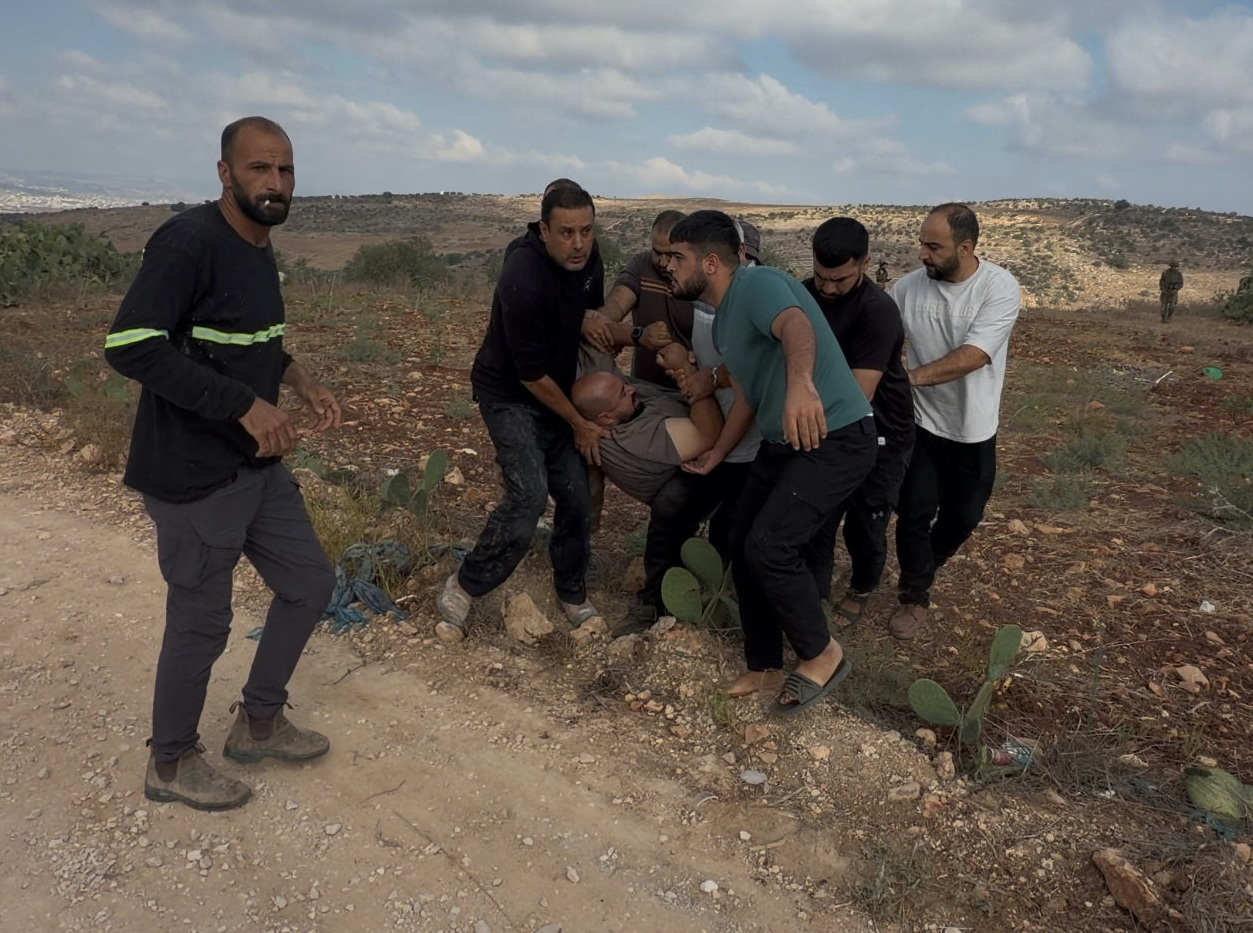
Israeli troops opened fire Saturday at a group of Palestinians who did not appear to be posing a threat in the occupied West Bank, wounding one man, according to video obtained by The Associated Press.
The video, shot by an eyewitness, showed the man falling to the ground near the Palestinian village of Faqqua, north of the West Bank.
At least 14 shots in total were fired during the duration of the video. They continued as several men rushed to move the injured man to safety before setting him down and tying a tourniquet around his leg in an apparent attempt to stop the bleeding.
Mahmoud Shahin, a resident of the village, said the Palestinians had rushed to the area after receiving reports that Israeli settlers had arrived there with a flock of sheep. He said Israeli soldiers then came and began firing in the air and toward the Palestinians.
He added that the wounded man was undergoing surgery at a hospital in Jenin.
Israel’s military said the video was authentic and confirmed its forces had fired toward the Palestinians, wounding one man, and said commanders would review the incident.
Under the ultranationalist government of Israeli Prime Minister Benjamin Netanyahu, settler violence in the West Bank has surged. The international community largely considers Israeli settlements to be illegal and obstacles to peace.
Over 700,000 Israelis now live in the West Bank and east Jerusalem, areas captured by Israel in the 1967 Mideast war and claimed by the Palestinians as parts of a future state.
GAZA: An Israeli strike in Gaza on Thursday killed a family including two children, Palestinian hospital and security sources said.
“The bodies of four members of the Ahmad family were recovered in pieces after an Israeli strike hit a house in the Beit Lahia Project area in the northern Gaza Strip,” an official at Al-Shifa hospital in Gaza City said, identifying the children as aged 12 and eight.
The Israeli military, contacted by AFP, said it was checking.
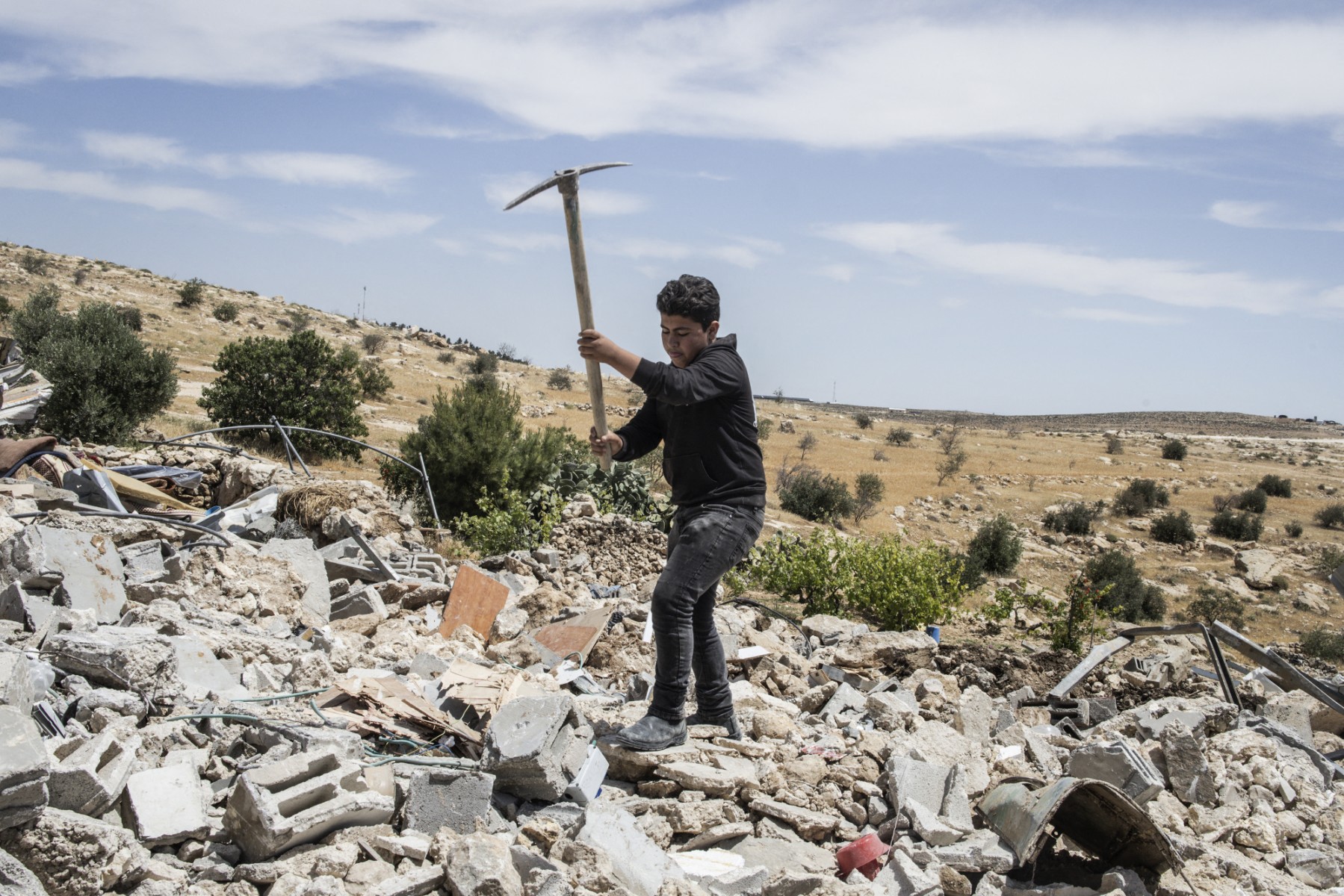
LONDON: Israeli forces demolished a home on Tuesday that belonged to a Palestinian family in the nomadic hamlet of Khirbet Khalla Al-Dabaa, located in Masafer Yatta, south of the occupied West Bank.
Fourteen members of the Mohammad Ali Dabbaba family lost their home when Israeli authorities demolished their 200-sq.-meter residence, constructed from tin and stone, according to the Palestine News Agency.
Forces also filled a crucial water well for the Bedouin community, destroyed electricity networks, damaged several water tanks, and uprooted 15 trees. Additionally, Israeli forces demolished a residential cave belonging to Abdullah Dabbaba, which housed six people.
Israeli authorities have issued demolition notices for 14 inhabited caves and several homes in Khirbet Khalla Al-Dabaa, the report added.
Masafer Yatta consists of nearly 15 Palestinian hamlets located in the southern West Bank; Khirbet Khalla Al-Dabaa is one of them. Israeli forces and settlers regularly invade the area in an effort to evict its total population of 1,150 residents, half of whom are children. Since the 1980s, the area has been designated a military zone by Israel.
In late August, armed Israeli settlers detained a 22-year-old British activist in the village of Umm Al-Kheir in Masafer Yatta, who was part of a “protective presence” initiative intended to support Palestinian residents. He was deported from Israel last week.
Amid the grapevines that once provided a steady income for her family, 56-year-old Palestinian farmer Theeba al-Sabaa spends much of her day guarding her home and farmland in the occupied West Bank from settlers.
From dusk till dawn, she works on her land in the town of Beit Ummar, north of Hebron, known by locals as “Jabal Sabaa”.
Theeba is engaged in a daily battle against the encroaching settler outposts that have emerged among the rolling hills that surround her, and which block access to sections of her land.
“By God, the land has taught me patience, and to cling to my right, for as long as I have a right, I must take it and never let it go,” she told Al Jazeera.
“I will never leave it because I worked hard on it, I toil and sweat on it, so I will not leave my toil and sweat, or the toil of my children and my husband, to go to someone else.”
Weaponising livestock
Since mid-2024, when settlers established new outposts on the nearby hills, every one of Theeba’s moves has been monitored.
Settlers frequently approach the perimeter of her home and deliberately release livestock into the cultivated fields.
“They enter with their sheep into our land after we plow and fix it, grazing in it, trampling the crops, and stomping on them with their sheep, leaving nothing,” Theeba said.
“As soon as they feel any movement or anyone entering the land, you find them attacking us immediately.”
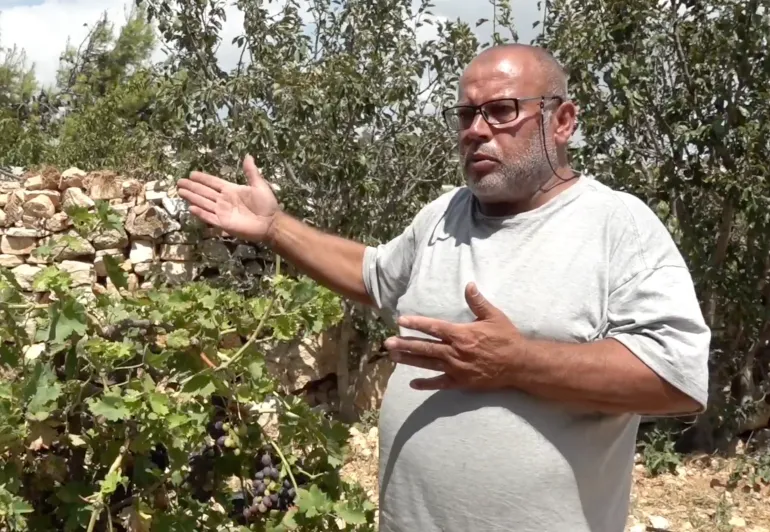
This intimidation extends to the adjacent fields, where 59-year-old Anwar Sabarneh lives with his extended family of seven brothers.
Due to the repeated settler violations, two of his brothers have been forced to abandon their land.
Sabarneh, who supports a family of 14, owns several dunams of vineyards located just 300 metres (980 feet) from his home. With aggressive settlers around, reaching them has become a dangerous ordeal.
Palestinian farmer Anwar Sabarneh, whose sheep have been confined for months, is barred by the Israeli military from accessing his nearby vineyards in Beit Ummar [Screen grab/Aljazeera]
Military complicity
Sabarneh said that the Israeli army even demands permits from Palestinians to work on their own land.
“The army came with the settlers to ask me for a permit so I can work in my home, in front of my house’s door, and on my land where I am the rightful owner,” Sabarneh said.
Farmers are also barred from building anything on their land. Sabarneh’s sheep have also been locked in a barn for over eight months due to the dangers posed by settlers.
“If they see me taking the sheep out, the settlers chase me, kidnap them, and steal them,” he said.
When Sabarneh’s children have tried to retrieve their stolen sheep, Israeli soldiers have arrested and beaten them.
A forced exodus
Repeated pogroms by settlers against Palestinian farmers reflect a broader strategy targeting agriculture across the southern West Bank.
Settlers and the Israeli troops carried out 11,074 attacks in the West Bank during the first half of 2026, according to the Colonization and Wall Resistance Commission. This includes 3,488 carried out by settlers.
Hasan Breijieh, a settlement affairs expert and director at the commission, told Al Jazeera that continuous settlement expansionism, alongside restrictions on Palestinian movement, are the primary reasons that so many Palestinians have been forced to flee their farms.
“Military gates erected at the entrances of Palestinian communities have tightened control over… access to their orchards and vineyards,” he said.
Bypass roads, built by Israel, have also hindered “connectivity between Palestinian communities”, Breijieh said.
Under such restrictions, Palestinian farmers have faced a fourth consecutive season without being able to harvest olives, grapes, or guava. Their lands have been “neither plowed nor pruned”, and have been forcibly abandoned.
In the face of such oppression, Palestinian women like Theeba al-Sabaa have continued to play a pivotal role in protecting their land, particularly when men have been killed or detained by Israeli forces.
“They continue to maintain their leadership role in preserving the family’s agricultural legacy today,” Breijieh said. “This land was historically the primary source of livelihood for families, and a Palestinian cannot leave it voluntarily, no matter the sacrifices.”
He recalled his own grandfather, who went to his fields to bid farewell before dying. “Goodbye, vineyard,” he said to his land.













![Palestinian farmer Anwar Sabarneh, whose sheep have been confined for months, is barred by the Israeli military from accessing his nearby vineyards in Beit Ummar.[Screengrab/Aljazeera]](https://i0.wp.com/occasionaldigest.com/wp-content/uploads/2026/09/Screenshot-2026-09-06-at-1.13.28-PM-1788689675.png?w=640&ssl=1)