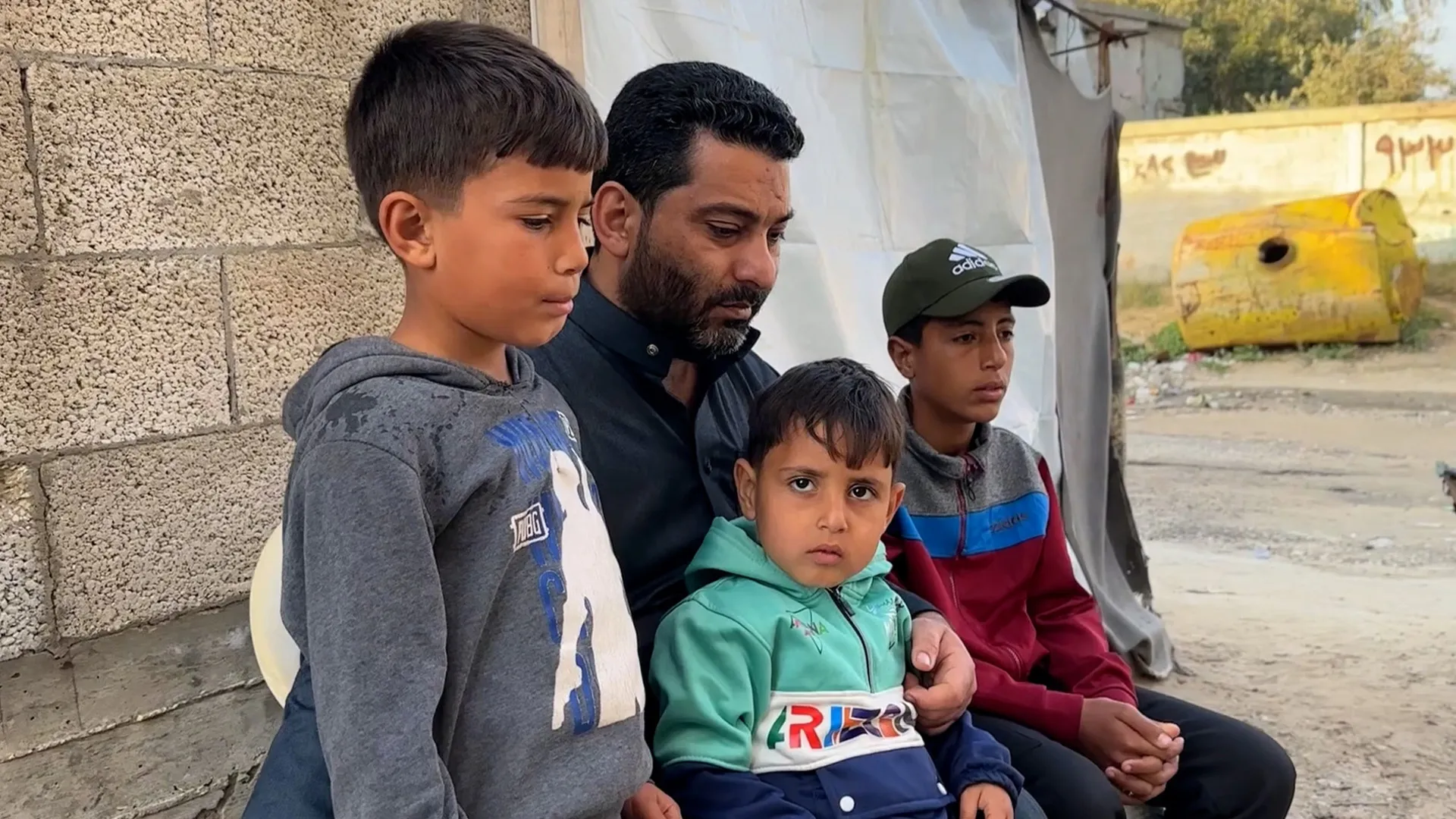
16-year-old Mohammed Ibrahim is recovering after spending 9 months in an Israeli prison, for allegedly throwing rocks. The Palestinian American boy’s plight sparked widespread outrage and condemnation at Israel’s abuses in the occupied West Bank.
A 15-year-old Palestinian boy was shot by Israeli troops in the occupied West Bank and was not given medical attention, leading to his death. He is among dozens of children who have been targeted and killed by Israeli troops in the occupied territories.
Israel continues to attack Lebanon on a near-daily basis in violation of a yearlong ceasefire with Hezbollah.
At least 13 people have been killed in an Israeli air strike on a Palestinian refugee camp in southern Lebanon, according to the Lebanese Ministry of Public Health.
The drone strike hit a car on Tuesday in the car park of a mosque in the Ein el-Hilweh refugee camp on the outskirts of the coastal city of Sidon, the Lebanese state-run National News Agency reported.
At least four people were wounded in the attack, the ministry said, adding that “ambulances are still transporting more wounded to nearby hospitals.”
Israel said it struck members of the Palestinian armed group Hamas who were operating in a training compound in the refugee camp.
“When we say we will not tolerate any threat on our northern border, this means all terrorist groups operating in the region,” the Israeli military’s Arabic spokesperson Avichay Adraee said in a statement. “We will continue to act forcefully against Hamas’s attempts to establish a foothold in Lebanon and eliminate its elements that threaten our security.”
Hamas denied Israel’s claim, calling it a “fabrication” and stressing the group doesn’t have training facilities in Lebanon’s refugee camps.
“The Zionist bombardment was a barbaric aggression against our innocent Palestinian people as well as Lebanon’s sovereignty,” it said in a statement.
Earlier on Tuesday, Lebanon said Israeli strikes on cars elsewhere in the country’s south killed two people.
Israel has killed several officials from Palestinian factions including Hamas in Lebanon since it launched its war on Gaza in October 2023 after Hamas led an attack on southern Israel
Israel’s war on Gaza has killed at least 69,483 Palestinians and wounded 170,706. A total of 1,139 people were killed in Israel during the October 7, 2023, Hamas-led attacks, and more than 200 were taken captive.
A day after Israel launched its war on Gaza, Hezbollah began firing rockets towards Israel, which responded with shelling and air strikes in Lebanon, and the two sides became locked in a conflict that Israel escalated into a full-blown war in late September 2024.
Israel’s war killed more than 4,000 people in Lebanon, including hundreds of civilians. In Israel, 127 people were killed, including 80 soldiers.
The war halted in late November 2024 with a United States-brokered ceasefire, but since then, Israel has carried out dozens of air attacks on Lebanon, accusing Hezbollah of trying to rebuild its capabilities.
Lebanon’s Health Ministry has reported more than 270 people killed and about 850 wounded by Israeli military actions since the ceasefire.
“There are daily violations of the ceasefire by Israel in Lebanon, and it would be unfair at this stage to pin the blame on the Lebanese government,” Lebanese political analyst Karim Emile Bitar told Al Jazeera. “The Lebanese government went above and beyond what was required … and took a historic decision to ask the Lebanese army to disarm Hezbollah.”
However, Bitar said, Israel has not lived up to its end of the bargain. Under the terms of the ceasefire signed on November 27, 2024, Israel was meant to withdraw its forces from southern Lebanon by January 26, a deadline it missed.
Seventy-six Palestinian patients and their attendants have returned to Gaza after being stranded for two years in hospitals in occupied East Jerusalem where they’d been getting treatment, unable to come back due to Israeli restrictions.
New attacks near Bethlehem and Hebron underscore intensifying Israeli violence in occupied Palestinian territory.
Israeli settlers have launched two major arson attacks on Palestinian villages near Bethlehem and Hebron amid a wave of rising violence by Israel in the occupied West Bank.
Dozens of settlers rampaged through the village of al-Jaba, located 10km (six miles) southwest of Bethlehem, on Monday, torching three Palestinian homes, one shack and three vehicles, according to Dhyab Masha‘la, the head of the local council.
Recommended Stories
list of 3 itemsend of list
Masha‘la told Palestinian news agency Wafa that the attackers caused extensive damage to the village, but that locals had managed to extinguish the flames. No casualties were reported.
Earlier on Monday, Wafa said settlers set fire to a home and two vehicles, and physically assaulted several civilians in Sa’ir town, northeast of Hebron, under the protection of Israeli forces.
The Israeli settlers beat the Palestinians with batons and sharp instruments, resulting in injuries to a number of women, with Israeli forces blocking fire engines and ambulances from reaching the scene, the agency reported.
Violence in the West Bank has broken new records this year, with settlers carrying out almost-daily attacks on Palestinians that have involved killings, beatings and the destruction of property, often under the protection of the Israeli military.
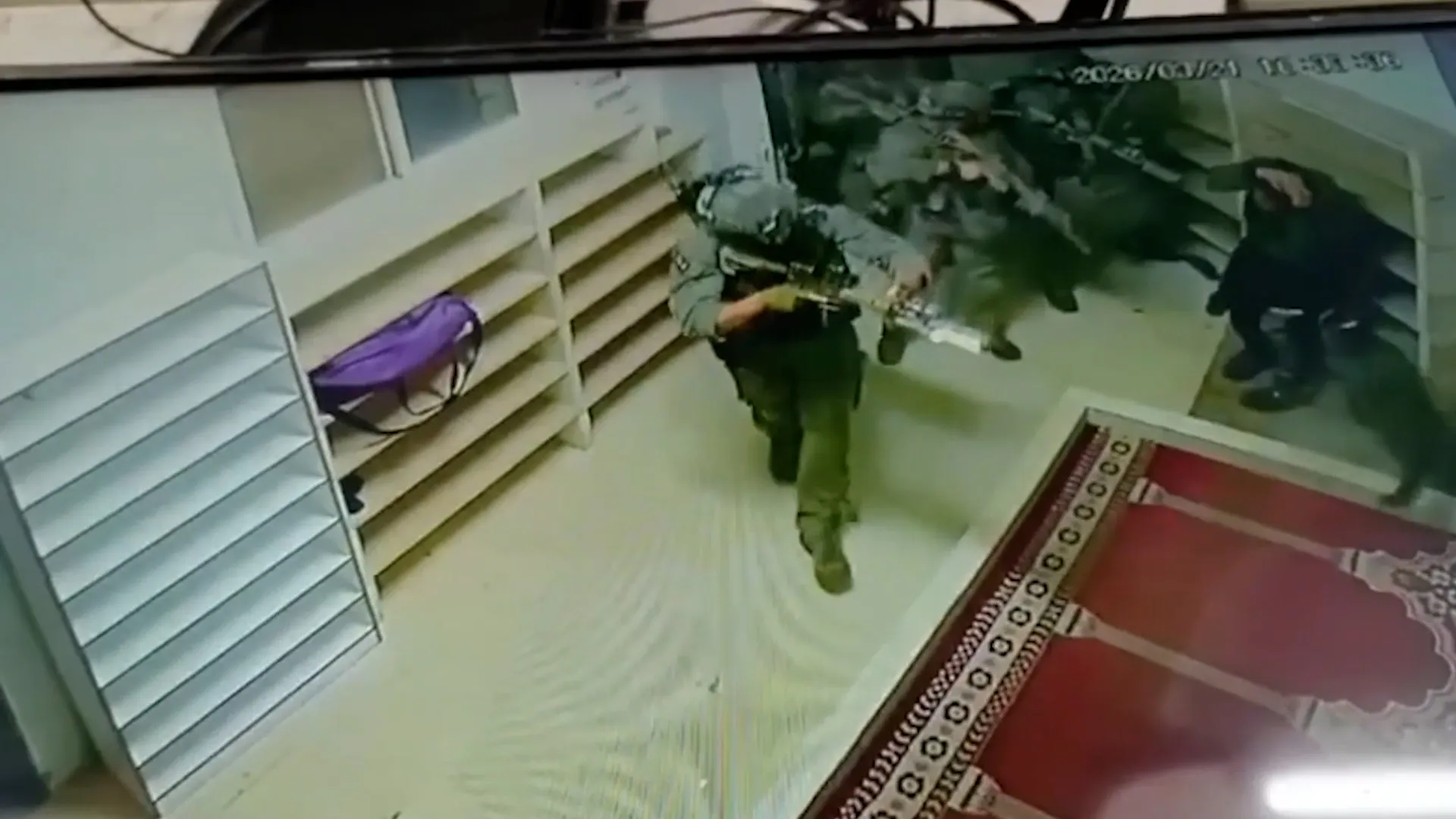
Last wek, settlers set a mosque ablaze in the village of Deir Istiya in the north of the West Bank.
The Palestinian Authority’s Colonization and Wall Resistance Commission says that Israeli forces and settlers carried out 2,350 attacks across the West Bank last month alone in an “ongoing cycle of terror”, which has been taking place in the shadow of the war in Gaza.
The violence is rarely prosecuted.
Referring to the attack on al-Jaba, an Israeli military spokesperson said security forces were “searching for those involved” after being deployed to the village following reports of “dozens of Israeli citizens” torching and vandalising houses and vehicles.
Israeli Prime Minister Benjamin Netanyahu, who has overseen the rapid expansion of settlements, denounced Monday’s attack, calling the assailants a “small, extremist group” and signalling that he would convene cabinet ministers to address the problem.
Defence Minister Israel Katz said on X that the government would “not tolerate the attempts of a small group of violent and criminal anarchists who break the law to take the law into their own hands and tarnish the settler community”.
But his statement backed the continued expansion of illegal settlements on Palestinian land.
The government, Katz said, would “continue to develop and foster the settlement enterprise throughout Judea and Samaria”.
Last year, the International Court of Justice – the top United Nations tribunal – ruled that the Israeli occupation of the West Bank is illegal and called for removing Israeli settlements from the territory.
Settler violence has spiked as members of Israeli Prime Minister Benjamin Netanyahu’s far-right government push to formally annex the area, which has long operated under a system of apartheid, according to leading rights groups.
The United Nations’ human rights office warned in July that the settler violence was being carried out “with the acquiescence, support, and in some cases participation, of Israeli security forces”.
Last week, in a rare public rebuke, Israeli President Isaac Herzog and army chief Eyal Zamir condemned the burgeoning settler attacks.
Israeli authorities have been systematically abusing Palestinian prisoners with impunity, according to PHRI.
The number of Palestinians that have died in Israeli detention facilities has surged amid the war in Gaza, according to a report issued by a human rights group.
At least 94 Palestinian deaths have been documented since October 2023, the report published on Monday by Physicians for Human Rights Israel (PHRI) said.
Recommended Stories
list of 3 itemsend of list
The report is just the latest accusation regarding Israel’s jails, in which critics say thousands of Palestinians taken from Gaza and the occupied West Bank are routinely abused.
The nonprofit organisation expressed “grave concerns that the actual number of Palestinians who have died in Israeli custody is significantly higher, particularly among those detained from Gaza”.
It said Israeli authorities have consistently failed to hold those responsible for the deaths to account.
Of the 94 deaths that the report documents, 68 were from the Gaza Strip, while 26 were from the West Bank or held Israeli citizenship.
Israeli military prisons were responsible for at least 52 of the deaths. The remaining 42 were documented in facilities run by the Israel Prison Service (IPS).
Amid the war, Israeli soldiers have detained thousands of people from across Gaza. PHRI’s report asserts that they are now effectively “disappeared”.
The Israeli authorities have stopped sharing detainee information with the International Committee of the Red Cross (ICRC) and barred all access to detention sites.
PHRI called those moves a “direct breach of both international and domestic law”.
Israel also refuses to acknowledge that it is holding many Palestinian prisoners, or that some have died in custody, leaving families in the dark for prolonged periods.
Some families found out about the death of their loved ones from Israeli media reports.
PHRI pointed at the case of Dr Hussam Abu Safia, the renowned director of the Kamal Adwan Hospital in Beit Lahiya in northern Gaza, for whom Israeli authorities claimed for days that they had “no indication of the individual’s arrest or detention”.
Israel continues to hold the doctor, who was taken from the hospital in December, despite an international outcry. His lawyer asserts that he has been subjected to torture and humiliation.
Deaths of Palestinians in Israeli custody have been recorded in almost all major IPS facilities, including Ktzi’ot Prison, Megiddo, Nitzan and Ofer, as well as military camps and bases, including the notorious Sde Teiman, the report says.
Physical violence, including bruising, rib fractures, internal organ damage and intracranial haemorrhage, has been a leading cause of death, followed by chronic medical neglect or denial and severe malnutrition.
“Given the grave conditions faced by Palestinians in Israeli incarceration facilities, and in light of Israel’s policies of enforced disappearance, systematic killing, and institutionalized cover-ups, PHRI calls for an independent international investigation into the deaths of Palestinians in Israeli custody,” the NGO said.
Israel is engaged in a last-ditch bid to change the wording of a United Nations Security Council (UNSC) resolution on the next phase of United States President Donald Trump’s Gaza peace plan that was recently amended to mention a “credible pathway” to Palestinian statehood.
Israeli Prime Minister Benjamin Netanyahu told his cabinet on Sunday that his opposition to a Palestinian state had “not changed one bit”, one day before the UNSC votes on the US-drafted resolution, which would mandate a transitional administration and an international stabilisation force (ISF) in Gaza.
Recommended Stories
list of 3 itemsend of list
Israeli public broadcaster Kan reported on Sunday that Netanyahu’s government was engaged in a last-minute diplomatic push to alter the draft resolution, which the US had changed to include more defined language about Palestinian self-determination under pressure from Arab and Muslim countries expected to contribute troops to the ISF.
The draft now says that “conditions may be in place for a credible pathway to Palestinian self-determination and statehood” after reforms to the Palestinian Authority are “faithfully carried out and Gaza redevelopment has advanced”.
There has been criticism that Palestinian voices and aspirations have been sidelined in the whole spectacle of Trump’s Gaza plan from its launch, which came with the US president’s customary fanfare.
Later on Sunday, Hamas and other Palestinian resistance factions called on Algeria – a non-permanent member of the UNSC – to reject the plan for stabilisation forces to be deployed in Gaza.
In a statement, the resistance factions called the efforts “a new attempt to impose another form of occupation on our land and people, and to legitimise foreign trusteeship”.
“We direct a sincere and fraternal appeal to the Algerian Republic, government and people, to continue adhering to its principled positions supporting Palestine, and its steadfast rejection of any projects targeting Gaza’s identity and our people’s right to self-determination,” the statement added.
On Friday, a joint statement with eight countries – Qatar, Egypt, United Arab Emirates, Saudi Arabia, Indonesia, Pakistan, Jordan and Turkiye – urged “swift adoption” of the draft resolution by the 15-member UNSC. Potential contributors to the force have indicated that a UN mandate is essential for their participation.
Israel has already said it will not accept Turkiye, a key Gaza ceasefire mediator, having any role on the ground.
Turkiye has maintained staunch criticism of Israeli actions in Gaza over the past two years and recently issued arrest warrants for genocide against Netanyahu and other senior officials.
Ahead of Monday’s crucial vote, which is expected to garner the nine votes needed to pass, with the likely abstention of Russia and China, Netanyahu confidants and officials from the Foreign Ministry were said to be engaged in intensive talks with their US counterparts, according to the Israeli Public Broadcasting Corporation (Kan).
Netanyahu under pressure
A far-right walkout over the ceasefire plan, in which Trump has heavily invested his own prestige, could bring down Netanyahu’s right-wing government well before the next election, which must be held by October 2026.
On Sunday, Israeli government officials lined up to express their opposition to any proposals backing a Palestinian state.
“Israel’s policy is clear: no Palestinian state will be established,” Defence Minister Israel Katz wrote on X.
He was followed by Foreign Minister Gideon Saar, who said on X that his country would “not agree to the establishment of a Palestinian terror state in the heart of the Land of Israel”.
Far-right firebrand and National Security Minister Itamar Ben-Gvir called the Palestinian identity an “invention”.
Hardline Finance Minister Bezalel Smotrich, a major backer of Israel’s settler movement who has been sanctioned by a number of countries for “incitement of violence” against Palestinians, urged Netanyahu to take action.
“Formulate immediately an appropriate and decisive response that will make it clear to the entire world – no Palestinian state will ever arise on the lands of our homeland,” he said on X.
Russia’s rival resolution
The UNSC resolution would give the UN’s blessing to the second phase of Trump’s 20-point plan, which brought about a ceasefire after two years of genocidal war that has killed nearly 70,000 Palestinians.
The ceasefire came into effect on October 10, although it has been repeatedly breached by Israel with near-daily attacks that have killed hundreds of people.
There has been plenty of jockeying ahead of the vote.
Meanwhile, Russia is circulating its own resolution to rival the US version, offering stronger language on Palestinian statehood and stressing that the occupied West Bank and Gaza must be joined as a contiguous state under the Palestinian Authority.
In a statement, Russia’s UN mission said that its objective was to “to amend the US concept and bring it into conformity” with previous UNSC decisions.
“We would like to stress that our document does not contradict the American initiative,” said the statement. “On the contrary, it notes the tireless efforts by the mediators – the United States, Qatar, Egypt, and Turkiye – without which the long-awaited ceasefire and the release of hostages and detainees would have been impossible.”
In the quiet of his Ramallah studio in the occupied West Bank, Palestinian artist Nabil Anani works diligently on artworks deeply rooted in a movement he helped create during the political tumult of the late 1980s.
Cofounded in 1987 by Anani and fellow artists Sliman Mansour, Vera Tamari and Tayseer Barakat, the New Visions art movement focused on using local natural materials while eschewing Israeli supplies as a form of cultural resistance. The movement prioritised self-sufficiency at a time of deep political upheaval across occupied Palestine.
Recommended Stories
list of 3 itemsend of list
“[New Visions] emerged as a response to the conditions of the Intifada,” Anani said. “Ideas like boycott and self-reliance inspired a shift in our artistic practice at the time.”
Each of the founding members chose to work with a specific material, developing new artistic styles that fit the spirit of the time. The idea caught on, and many exhibitions followed locally, regionally and internationally.
Nearly four decades later, the principles of New Visions – self-sufficiency, resistance and creation despite scarcity – continue to shape a new generation of Palestinian artists for whom making art is both an expression and an act of survival.
Anani, now 82, and the other founding members are helping keep the movement’s legacy alive.
Nabil Anani [Courtesy of Zawyeh Gallery]
Why ‘New Visions’?
“We called it New Visions because, at its core, the movement embraced experimentation, especially through the use of local materials,” Anani said, noting how he had discovered the richness of sheepskins, their textures and tones and began integrating them into his art in evocative ways.
In 2002, Tamari, now 80, started planting ceramic olive trees for every real one an Israeli settler burned down to form a sculptural installation called Tale of a Tree. Later, she layered watercolours over ceramic pieces, mediums that usually do not mix, defying the usual limits of each material, and melded in elements of family photos, local landscapes and politics.
Sixty-six-year-old Barakat, meanwhile, created his own pigments and then began burning forms into wood, transforming surface damage into a visual language.
“Other artists began to embrace earth, leather, natural dyes – even the brokenness of materials as part of the story,” Mansour, 78, said, adding that he had personally reached a kind of “dead end” with his work before the New Visions movement emerged, spending years creating works centred around national symbols and identity that had started to feel repetitive.
“This was different. I remember being anxious at first, worried about the cracks in the clay I was using,” he said, referring to his use of mud. “But, in time, I saw the symbolism in those cracks. They carried something honest and powerful.”
Sliman Mansour’s Mud on Wood 2 [Courtesy of Sliman Mansour]
In 2006, the group helped create the International Academy of Art Palestine in Ramallah, which was open for 10 years before being integrated into Birzeit University as the Faculty of Art, Music and Design. The academy’s main goal was to help artists transition from older ways of thinking to more contemporary approaches, particularly by using local and diverse materials.
“A new generation emerged from this, raised on these ideas, and went on to hold numerous exhibitions, both locally and internationally, all influenced by the New Visions movement,” Anani said.
A legacy maintained but tested
The work of Lara Salous, a 36-year-old Palestinian artist and designer based in Ramallah, echoes the founding principles of the movement.
“I am inspired by [the movement’s] collective mission. My insistence on using local materials comes from my belief that we must liberate and decolonise our economy.”
“We need to rely on our natural resources and production, go back to the land, boycott Israeli products and support our local industries,” Salous said.
Through Woolwoman, her social enterprise, Salous works with local materials and a community of shepherds, wool weavers and carpenters to create contemporary furniture, like wool and loom chairs, inspired by ancient Bedouin techniques.
A traditional loom used by the artisans Lara Salous works with [Courtesy of Lara Salous, photo by Greg Holland]
But challenges like the increasing number of roadblocks and escalating settler violence against Palestinian Bedouin communities, who rely on sheep grazing as a basic source of income, have made working and living as an artist in the West Bank increasingly difficult.
“I collaborate with shepherds and women who spin wool in al-Auja and Masafer Yatta,” said Salous, referring to two rural West Bank areas facing intense pressure from occupation and settlement expansion.
“These communities face daily confrontations with Israeli settlers who often target their sheep, prevent grazing, cut off water sources like the al-Auja Spring, demolish wells and even steal livestock,” she added.
In July, the Reuters news agency reported an incident in the West Bank’s Jordan Valley, where settlers killed 117 sheep and stole hundreds of others in an overnight attack on one such community.
Such danger leaves Palestinian women who depend on Woolwoman for their livelihoods vulnerable. Several female weavers working with Salous and supporting her enterprise have become their families’ sole breadwinners, especially after their spouses lost jobs due to Israeli work permit bans following the Hamas-led attacks on southern Israel on October 7, 2023, and the start of the Gaza war.
Visiting the communities where these wool suppliers live has become nearly impossible for Salous, who fears attacks by Israeli settlers.
Nabil Anani’s Exit into the Light, leather and mixed media on wood [Courtesy of Nabil Anani]
Meanwhile, her collaborators must often prioritise their own safety and the protection of their villages, which disrupts their ability to produce wool to sustain their livelihoods.
As a result, the designer has faced delays and supply chain issues, making completing and selling her works increasingly difficult.
Anani faces similar challenges in procuring hides.
“Even in cities like Ramallah or Bethlehem, where the situation might be slightly more stable, there are serious difficulties, especially in accessing materials and moving around,” he said.
“I work with sheepskin, but getting it from Hebron is extremely difficult due to roadblocks and movement restrictions.”
Creating vs surviving
In Gaza, Hussein al-Jerjawi, an 18-year-old artist from the Remal neighbourhood of Gaza City, is also inspired by the New Visions movement’s legacy and meaning, noting that Mansour’s “style in expressing the [conditions of the occupation]” has inspired him.
Due to a lack of materials like canvases, which are scarce and expensive, al-Jerjawi has repurposed flour bags distributed by the United Nations agency for Palestinian refugees (UNRWA) as canvases for creating his artwork, using wall paint or simple pens and pencils to create portraits of the world around him.
In July, however, the artist said flour bags were no longer available due to Israel’s blockade of food and aid into the Gaza Strip.
Hussein al-Jerjawi uses empty UNRWA flour bags as canvases for his artwork showing everyday life in Gaza [Courtesy of Hussein al-Jerjawi]
“There are no flour bags in Gaza, but I’m still considering buying empty bags to complete my drawings,” he said.
Gaza-born artist Hazem Harb, who now lives in Dubai, also credits the New Visions movement as a constant source of inspiration throughout his decades-long career.
“The New Visions movement encourages artists to push boundaries and challenge conventional forms, and I strive to embody this spirit in my work,” he said while noting that it has been challenging to source the materials from Gaza that he needs for his work.
“The ongoing occupation often disrupts supply chains, making it difficult to obtain the necessary materials for my work. I often relied on local resources and found objects, creatively repurposing materials to convey my message.”
Anani, who said the conditions in Gaza make it nearly impossible to access local material, added that many artists are struggling but still strive to make art with whatever they can.
“I believe artists [in Gaza] are using whatever’s available – burned objects, sand, basic things from their environment,” Anani said.
“Still, they are continuing to create in simple ways that reflect this harsh moment.”
Stories will long be told about what Gazans have endured these last couple of years, and movies will be part of that unburdening. This spring, Iranian filmmaker Sepideh Farsi believed she would be unveiling a uniquely dignified portrait of one Palestinian woman’s experience when the Cannes Film Festival accepted her documentary “Put Your Soul on Your Hand and Walk,” which comprised her year of spirited video chats with positive-minded 25-year-old photojournalist and poet Fatma Hassona. The day after the Cannes news, Hassona and her family were killed by an Israeli missile.
It’s not unheard of for a completed movie to become something entirely different overnight. But what’s quietly miraculous about “Put Your Soul on Your Hand and Walk,” considering its added tragic weight, is what the force of Hassona’s personality and Farsi’s filmmaking choices still manage to do: speak to what’s ineffably beautiful about our human capacity for hope and connection.
In her opening narration, Farsi explains how she’d been looking for a way into Gaza to understand it beyond the media reports. Physically, that proved impossible, but through a refugee friend, she was connected to Hassona in April 2024. In their first video call, which Farsi, then in Cairo, recorded with a separate smartphone, Hassona’s beaming face immediately dispels any notion that all Palestinians must exist in a defeated state amid relentless bombing. Asked how she feels, Hassona — who had just witnessed a huge explosion the day prior — says, “I feel proud.” With unforced lightness, she assures Farsi that they will continue to live their lives and laugh, that they are “special people.” She knows every day is about actively not letting themselves get used to it. The documentary’s title is Hassona’s description of what she does when she leaves her house.
You believe her. That high-wattage smile registers as whatever the opposite of a bomb is. But it’s also easy to notice Farsi’s ingrained cynicism about the state of things, having once been imprisoned as a teenage dissident during the years following her country’s Islamic Revolution, now in exile. In her voice-over, Farsi describes meeting Hassona as if encountering a mirror, realizing “how much both our lives are conditioned by walls and wars.”
Farsi threads in many of Hassona’s photographs. The images of daily life amid destruction and rubble — children, bicyclists, workers, laundry drying from high floors in a half-destroyed building — hint at an inextinguishable flame carrying on through a campaign of death.
Though Farsi knows how to ask for details about her life in Gaza, the vibe isn’t one of interviews conducted to make a film, but a genuine curiosity and warmth, the ebb and flow of real interaction captured whenever possible. Meanwhile, war, politics and failed leadership can be glimpsed in brief interludes of news reports on Farsi’s television. But they’re always cut short, as if to say: I’d rather hear from my friend who’s living it.
Hassona’s face becomes so familiar to us, we can tell when her cheery disposition is hard to maintain. But her energy and hope never feel like depletable resources. “I want to be in a normal place!” she blurts out in one of their last conversations, almost as if she were a musical protagonist about to break into song. But Hassona never got more than a first act.
Farsi doesn’t draw the ending out: just sparsely worded text after witnessing their final chat, followed by a video Hassona had taken rolling through her devastated city, somehow grounded in a palpable, undying everydayness. You’ll feel loss, but the afterimage of this singular woman’s belief in finding light is what will burn.
‘Put Your Soul on Your Hand and Walk’
In Arabic and English, with subtitles
Not rated
Running time: 1 hour, 53 minutes
Playing: Opens Friday, Nov. 14 at Laemmle Monica Film Center, Laemmle Glendale
Palestinians call for better tents and other supplies as Israel maintains restrictions on aid to war-ravaged Gaza Strip.
Displaced Palestinians are reeling after heavy rains flooded their tents in makeshift displacement camps in Gaza City, as the United Nations warns that Israeli restrictions on aid have left hundreds of thousands of families without adequate shelter.
Abdulrahman Asaliyah, a displaced Palestinian man, told Al Jazeera on Friday that residents’ mattresses, clothes and other belongings were soaked in the flooding.
Recommended Stories
list of 3 itemsend of list
“We are calling for help, for new tents that can at least protect people from the winter cold,” he said, explaining that nearly two dozen people had been working for hours to get the water to drain from the area.
“This winter rain is a blessing from God, but there are families who no longer wish for it to fall, fearing for the lives of their children and their own survival,” Asaliyah said.
Gaza’s civil defence agency said Friday’s flooding primarily affected Palestinians in the north of the Strip, where hundreds of thousands of people have returned following last month’s ceasefire agreement between Israel and Hamas.
Flooding was also reported in central Gaza’s Deir el-Balah, said the rescue agency, which urged the international community to do more to “address the suffering” of Palestinians whose homes were destroyed in Israel’s two-year war on the enclave.
“We urge the swift delivery of homes, caravans, and tents to these displaced families to help alleviate their suffering, especially as we are at the beginning of winter,” it said in a statement.
While the October 10 ceasefire has allowed more aid to get into the Gaza Strip, the UN and other humanitarian groups say Palestinians still lack adequate food, medicine and other critical supplies, including shelter.
Aid groups working to provide shelter assistance in the occupied Palestinian territory said in early November that about 260,000 Palestinian families, totalling almost 1.5 million people, were vulnerable as the cold winter months approached.
The UN agency for Palestinian refugees (UNRWA) said this week that it has enough shelter supplies to help as many as 1.3 million Palestinians.
But UNRWA said Israel continues to block its efforts to bring aid into Gaza despite the ceasefire deal, which stipulated that humanitarian assistance must be delivered to Palestinians in need.
“We have a very short chance to protect families from the winter rains and cold,” Angelita Caredda, Middle East and North Africa director at the Norwegian Refugee Council (NRC), said in a statement on November 5.
Reporting from Deir el-Balah on Friday, Al Jazeera’s Hind Khoudary said Palestinians across Gaza have been voicing fears that this winter would be particularly difficult due to the lack of safe shelter.
“It only rained for a couple of minutes – 30 minutes or so … [and] they were completely flooded,” she said. “Their tents are very fragile and worn-out; they have been using them for the past two years.”
She added that most Palestinians do not have any other options but to remain in tent camps or overcrowded shelters, despite the difficulties.
“We’re already seeing Palestinian children walking barefoot. They do not have winter clothes. They do not have blankets. And at the same time, the aid that is coming in … is being restricted,” Khoudary said.
Back in Gaza City, another displaced Palestinian man affected by the heavy rains, Abu Ghassan, said he and his family “no longer have a normal life”.
“I’m lifting the mattresses so the children don’t get soaked,” he told Al Jazeera. “But the little ones were already drenched here. We don’t even have proper tents.”
Over the past decade, we have seen again how the suffering experienced by the people of Gaza continues in the midst of global political forces that are silent on the sidelines. The Global Sumud Flotilla (GSF) as a new form of global solidarity emerged and was formed to turn a blind eye to this injustice. This movement itself sails across the country’s borders carrying messages of humanity and peaceful resistance as a form of opposition to Israel’s blockade policy that closes Palestinian land, air, and sea access to the Gaza Strip (Global Sumud Flotilla, 2025). The failure of formal diplomacy to open humanitarian channels has led international civil society to take the initiative to take over the role to show the world that now geopolitical conditions no longer limit and bind global solidarity to take steps on humanitarian issues like this.
The author considers that the Global Sumud Flotilla movement is a real representation of the practice of transnationalism, where this movement is a network of cross-border communities that move together with the same goals and basic human values. The moral, social, and political dimensions are all combined into one in the GSF; this is a concrete example of the active role of global civil society in humanitarian issues in Palestine. For this reason, the author will focus this discussion on three main aspects, namely the origins and actors behind the formation of the GSF movement, the human values and transnational solidarity that underlie this movement, and its relevance in the era of globalization, which is a manifestation of transnational society.
Discussion
The history of the formation of the Global Sumud Flotilla movement is rooted in an international network that has also tried to penetrate the blockade of Gaza through the sea route since 2010, namely the Freedom Flotilla Coalition (FFC) movement. Based on information from the official website of GSF (2025), there are more than 30 organizations from various parts of the world that are involved in this initiative, including Europe, Latin America, and Asia. It is not because of the state’s agenda or political interests, but the reason they sail is because of the humanitarian mission they bring, namely “Break the siege, break the silence.” There are various actors who participate in this movement, ranging from humanitarian activists and civil society leaders to journalists anddoctors, so this proves that the global community can also collaborate or cooperate outside the state structure. Keck and Sikkink (1998) put forward the theory of transnational advocacy networks; within the framework of this theory can be a strong example of how this network of cross-border activism uses their moral solidarity to oppose state power.
The main value that underlies or is the foundation of this movement is an Arabic term, namely “Sumud,” which means constancy or fortitude. Well, in this Palestinian context, sumud reflects the determination of the Palestinian people who are trying to survive and protect their homeland even in the midst of the colonial siege and violence that constantly hits them. This value was then adopted by the global community that is a member of the GSF as a form of symbolic solidarity that underlies their movement so that it is not only the Palestinian people who have constancy but also the common spirit of humanity who are moving to oppose and reject the injustices that occur. GSF volunteers stated that in this mission they not only brought the issue of aid but also defended the dignity of humanity in the face of the ruling military power (Harakah Daily, 2025).
The practice of transnationalism in the GSF is very clear, and we can see it in how this movement operates. All coordination is carried out in full by global civil society networks through various mechanisms, such as donations, digital campaigns, and international advocacy, so no single country is the main leader or sponsor in this movement. In breaking through the blockade of Gaza, global civil society faces various major challenges, but the presence of this GSF shows us all how this cross-border collaborative movement can suppress world public opinion. Every voyage they make can be used as an alternative space for diplomacy or citizen diplomacy, which emphasizes the position of the global community, which plays an important role in encouraging international humanitarian issues.
In addition to bringing physical aid, such as food, medical equipment, clothing, and so on, the GSF also plays a powerful symbolic role that is no less important. For example, when their ship was attacked by the Israeli navy, which occurred in October 2025, these volunteers did not show their fear of the Israeli navy (Kumparan, 2025). Instead, they showed and affirmed their determination to continue sailing to give freedom to the Palestinian people, especially in the Gaza Strip. The attitude shown by these volunteers reflects how the sense of transnational solidarity can transcend and eliminate their fear of repression. So, these people are actually not just volunteers but also a real form of global moral resistance to structural injustice.
The GSF movement also showed the world an important shift in international political practice. We can see that in humanitarian issues, which used to only move and become the realm of state diplomacy, it has now changed with the takeover by a global civil society network that has a common vision. The biggest challenge for the international community in dealing with this problem lies not only in the physical blockade of Gaza but also in the moral blockade that occurs here, which makes many countries reluctant to take action (Dall’Asta, 2025). For this reason, the GSF is here as the antithesis of state passivity, which shows countries and the whole world that if the citizens of the world unite and take collective action, then they can break through the global political impasse, as happened to the state.
From an academic point of view, the Sumud Flotilla has actually expanded the meaning of transnationalism, as explained by Scholte (2005) in his book entitled “Globalization: A Critical Introduction,” that social relations that cross national borders are built on the basis of shared values and goals, not because of national sovereignty. The GSF here affirms the existence of a global civil society that works in parallel with the nation-state system. In addition, this kind of cross-border solidarity can create a transnational form of humanity that is arguably more organic, so it means that the world community forms a network of collective action to deal with the ongoing global crisis.
Although this impact has not been able to end the blockade of Gaza, the existence of the GSF itself has had a great moral impact. This movement revived our awareness that in fact world politics does not only belong to the elite and the state but also belongs to all of us, belonging to the citizens of the world who care about it. Not only that, this movement also shows how a human value is able to penetrate walls or boundaries in geopolitics. This kind of initiative plays a very important role in building global awareness of what is happening in Palestine, that the struggle of the Palestinian people is a universal humanitarian struggle (Saleem & Khurshid, 2025).
Conclusion
The three arguments above, which focus on the origins and actors behind the GSF movement, the underlying and foundational humanitarian values, and its relevance as a manifestation of this transnational society, have shown that the Global Sumud Flotilla movement is a tangible form of cross-border solidarity on humanitarian issues in Palestine. This movement confirms to the world that the moral strength possessed by global civil society can be a real alternative to diplomacy that has repeatedly failed to uphold justice. Thus, we can conclude that the Global Sumud Flotilla is not only a symbol of humanitarian shipping but also a form of real representation of the birth of a transnational society that plays an active role in fighting for global humanity. And it also reminds us that true humanity does not know the state border but is something that is born or created from the collective consciousness to continue to sail against the injustice that exists in this world.
The Israeli parliament has pushed forward an amendment proposing the death penalty for any Palestinian convicted of killing Jewish citizens. It must pass a second and third reading before becoming law.
Gaza’s Health Ministry says it also received the remains of 45 Palestinians from Israel through the Red Cross.
Israel has released five Palestinian prisoners as part of a fragile ceasefire deal with Hamas, offering a rare moment of relief for the families in Gaza.
The five men, freed on Monday evening, were taken to Al-Aqsa Hospital in Deir el-Balah for medical examinations, Al Jazeera’s Hind Khoudary reported from outside the facility.
Recommended Stories
list of 4 itemsend of list
Relatives gathered at the hospital, some embracing the freed prisoners, while others anxiously sought information about missing family members.
“This is the first time since the ceasefire that Israeli forces have released unknown Palestinian prisoners,” said Khoudary.
Thousands of Palestinians remain imprisoned in Israel, many held without charge under what rights groups call arbitrary detention.
Israel returns remains of Palestinians
Earlier on Monday, Gaza’s Health Ministry said it received the remains of 45 Palestinians from Israel through the International Committee of the Red Cross (ICRC), bringing the total number of bodies handed over under the ceasefire agreement to 270.
Forensic teams have identified 78 bodies so far and will continue their examinations “in accordance with approved medical procedures and protocols” before returning the remains to families, the ministry said in a statement on Monday.
Officials previously reported that many of the returned bodies bore evidence of torture and abuse, including bound hands, blindfolds, and facial disfigurement, and were handed back without identification tags.
The handover forms part of the first phase of the ceasefire agreement that took effect on October 10, which includes prisoner and body exchanges mediated by Turkiye, Egypt, and Qatar, with involvement from the United States.
Reporting from Deir el-Balah in central Gaza, Khoudary said, “Many of the bodies returned show signs of torture.” She added that families of missing Palestinians are still searching for relatives among the dead.
“If these bodies are not identified, they will be buried along with other Palestinians in a mass grave in Deir el-Balah,” she said.
Israeli ceasefire violations
Despite a ceasefire, Israel continues to carry out deadly attacks. A source at Nasser Medical Complex told Al Jazeera Arabic that three Palestinians were killed on Monday by Israeli fire north of Rafah in southern Gaza.
The Israeli army said it launched strikes on southern Gaza, claiming individuals had crossed the “yellow line”, an Israeli-controlled area, in what it called a ceasefire violation.
The Israeli version of events could not be independently verified. It also remains unclear whether the Israeli military was referring to the same attack that killed the three Palestinians.
In Gaza City, a child was among three people wounded by Israeli fire in the city’s east, a source at al-Ahli Arab Hospital told Al Jazeera.
Reporting from Gaza City, Al Jazeera’s Tareq Abu Azzoum said Israel continues to use quadcopter drones to drop grenades on buildings left partially standing. “Authorities here describe these acts as violations of the ceasefire,” he said.
The Gaza Government Media Office has accused Israel of committing more than 125 ceasefire violations since the truce took effect, warning that continued attacks threaten to reignite full-scale hostilities.