painting

Largest U.S. survey of Huguette Caland’s work arrives at Hammer Museum

In Philippe Caland’s semi-autobiographical 2003 film “Hollywood Buddha,” his mother, Huguette Caland, plays herself. Wearing her signature white smock, inscribed with a flurry of painted swirls, circles, letters and cross-stitches, the Lebanese artist makes precise gray-blue lines on a canvas spread across her dining room table as her son laments a fickle movie industry.

Filmed in her Venice home, the scene, her three children agree, was true to life. Caland worked constantly: on stretched canvas, on fabric folded in her lap, on a children’s menu, on the wall of her kitchen, or the sleeve of her smock. Whatever was at hand.

“Of course it could be frustrating,” said her daughter Brigitte, an elegant, soft-spoken scholar of Semitic languages who has managed Caland’s estate since her death in 2019.

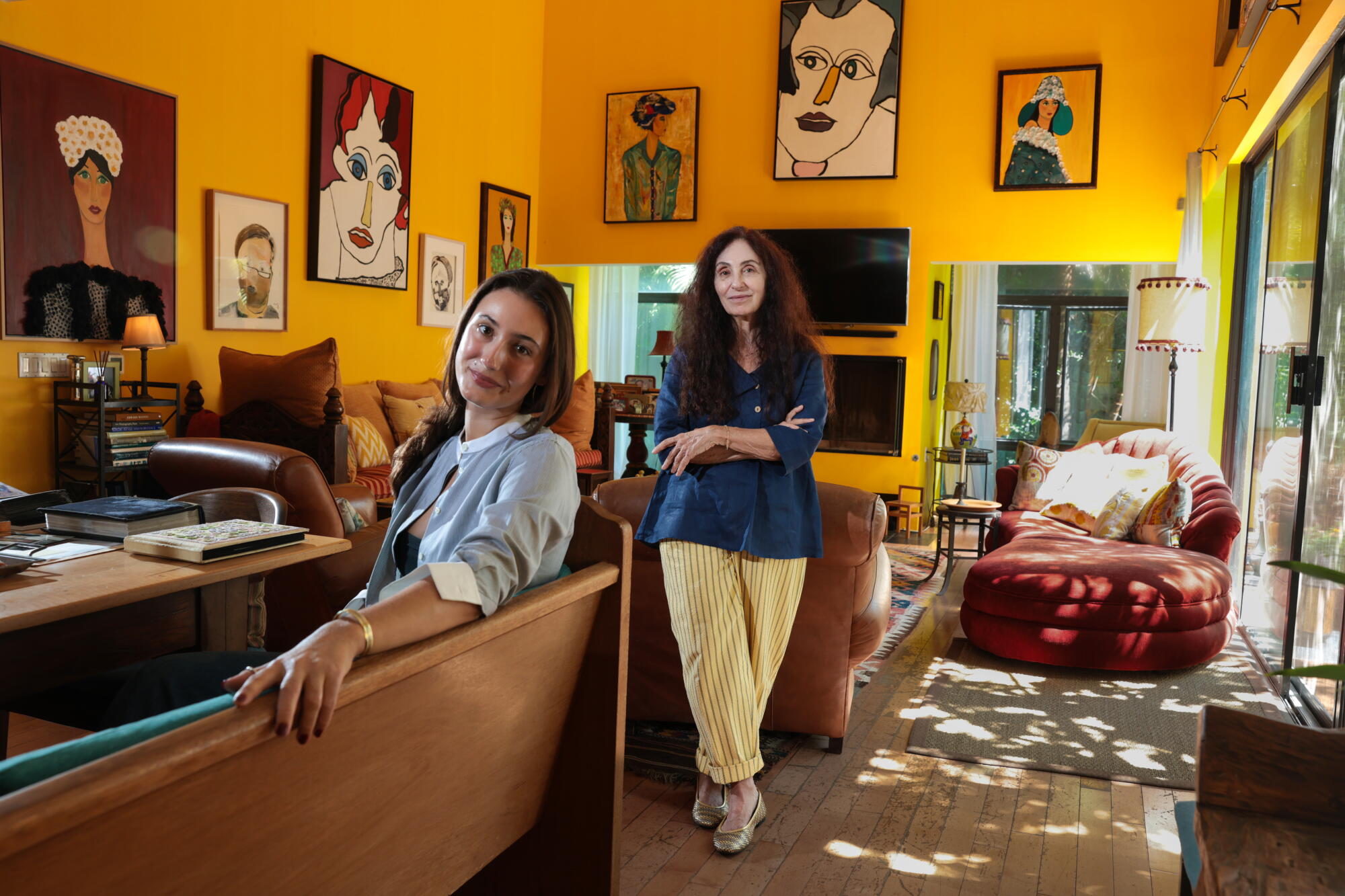
Two women in a colorful home.

Brigitte Caland, right, and Charley Caland — the daughter and granddaughter of the Lebanese-born painter, sculptor and fashion designer Huguette Caland — stand in Caland’s former L.A. home and studio.

(Robert Gauthier / Los Angeles Times)

Sitting in that very home, which Caland had built in 1997, Brigitte recalled the many times her mother invited her over only to continue working as they talked. “I’d go to leave, and she’d put the canvas away, beg me to come back, and as soon as I did, she’d start painting again.” Still, from early on, Brigitte understood the compulsion as evidence of her mother’s resolve. “She had this incredible drive to create.”

“Huguette Caland: A Life in a Few Lines,” opening Sunday at the Hammer Museum, traces that relentless drive across nearly 150 paintings, drawings, sculptures, garments and tapestries. Organized by the Museo Nacional Centro de Arte Reina Sofía in Madrid in collaboration with the Deichtorhallen Hamburg, the show comes to Los Angeles as the largest Caland survey in the country to date. Spanning five decades and installed chronologically, it features work from the 26 years she spent immersed in Venice’s creative community even as her practice was largely ignored.

It was Caland’s generous hospitality and boisterous wit that made her custom château a gathering place for a vibrant Westside art circle. Ed Moses, who lived around the corner, visited several times a week; Larry Bell, Frank Gehry, Robert Wilhite and others joined her for long meals and even longer parties. Her work surrounded them, and her studio, the grandest space in the house, stood open just beyond the living room. Yet her guests remained uninterested. “No one,” Brigitte said, “would walk the 10 steps.”

Huguette Caland in Stone Doorway, France, 1970.

Huguette Caland in Stone Doorway, France, 1970.

(Huguette Caland Estate)

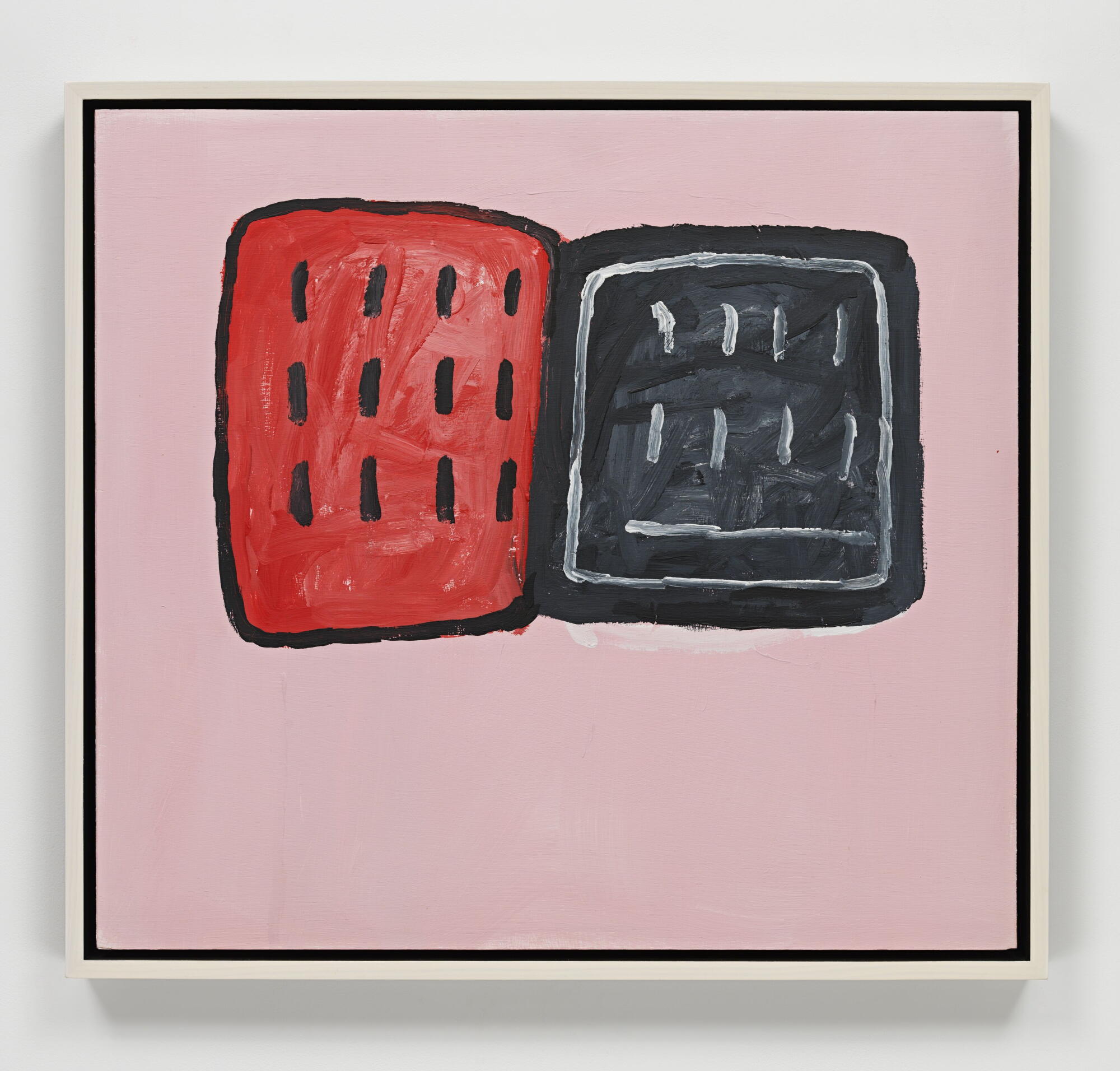
Curator Hannah Feldman sees that tension as central to Caland’s California years. “Instead of supporting and bolstering her as a creative in their midst, she became their salon host,” she said. The lack of recognition, Feldman argues, reverberates through Caland’s heavily impastoed portraits of Moses and her enigmatic late abstractions such as the rectilinear paintings in the “Silent Letter Series.”

“To draw a line is a way to contain one’s emotion, one’s anger, one’s anguish,” wrote Caland of her challenging relations with fellow artists in “Sketchbook 2” (1990-91). “My lines tell the story of my life, of people encountered along the path, people I loved, and found and even lost.”

Caland is perhaps best known for her cheeky, erotic paintings of fulsome body parts and for a biography too often reduced to cliché: the libertine daughter of Lebanon’s first post-independence president who left her husband and children in Beirut to pursue an art career in a less repressed Paris.

Huguette Caland, "Self-Portrait in Smock," 1992

Huguette Caland, “Self-Portrait in Smock,” 1992

(Huguette Caland Estate)

Feldman hopes the exhibition, which spans fine-line drawings of entangled lovers and radiant topographical tapestries, will complicate that familiar account. “There’s joy, and there’s sex,” she said, “but there’s also pathos, vulnerability. The search for autonomy is not an easy one; it comes with conflict, strife.”

Caland’s freedom was no doubt hard-won. She first picked up a brush as a married mother of three in her thirties, and only after her father’s death. In her first painting, alternately titled “Soleil rouge” and “Cancer” (Red Sun/Cancer) (1964), hazy concentric circles gather in a crimson orb at the center of the monochromatic plane. Simultaneously a tumor and a light source, the refulgent motif holds grief and release.

Soon after, Caland enrolled in art classes at the American University of Beirut, relinquished much of her constricting couture wardrobe, and adopted a uniform of loose, flowing kaftans, which she would later turn into works of art in their own right. Archival photographs show a glamorous Caland arriving at an event in a floor-length garment bearing painted breasts, a belly button and a triangle of curly pubic hair.

Huguette Caland, "Bribes de corps," 1973

Huguette Caland, “Bribes de corps,” 1973

(Huguette Caland Estate)

Caland moved to France in 1970, leaving her children (then 15, 13 and 12) in Beirut with their father, a French-Lebanese lawyer named Paul Caland. In paintings from that decade, Caland’s imagery of bodies swell, split, meld and dissolve. In “Enleve ton doigt” (Remove Your Finger) (1971), lipstick-red lips receive a pale finger reaching out from a crush of fantastical profiles; two years later, in “Self-Portrait” (Bribes de corps), Caland dispersed a sensual body across a pale pink field interrupted at the lower edge by a slight, shadowed cleft — either buxom cleavage or buttocks.

The distance from her children produced another kind of line: text. Philippe recalled receiving illustrated letters almost every week, filled with drawings, doodles and notes of affection. Most of these were later destroyed when the family house was bombed during the Lebanese Civil War of 1975. “I always knew my mother loved me,” Philippe said. “The family was not torn apart. She took a break, and in the end made a home for us in Paris, where we all landed when the war was raging.”

After the death of her lover, Romanian sculptor George Apostu, whose rough-hewn wood sculptures still populate the house’s patio, Caland’s children encouraged yet another departure. Her eldest son, Pierre, a businessman and former Olympic swimmer, paid for a stay at a friend’s Venice bed-and-breakfast, all but forcing his grieving mother out of Paris and to sunny L.A. Her initial reluctance gave way to affection. The light, arid climate and mountains sloping into the sea reminded her of Lebanon. “She liked that California land sounded like Caland,” Brigitte said.

Huguette Caland works at her home and studio in Venice, date unknown.

Huguette Caland works at her home and studio in Venice, date unknown.

(Huguette Caland Estate)

After making Venice her primary residence, Caland collaborated with architect Neil Kaufman on the design for her enclosed château. Its towering, mostly unbroken face and narrow swimming pool suggested a rampart and a moat, but behind the concrete exterior, Caland eliminated every door save the guest bathroom. Long vertical windows opened onto a courtyard shaded by a sprawling olive tree. Art crowded the steep stairwell; it accumulated on scattered plywood and Formica tables and unraveled across the kitchen in an intricate mural composed of tessellated marks that recall Byzantine mosaics and tatreez, a form of traditional Palestinian embroidery.

“There was no distinction for her,” Brigitte said, between the home and the studio, art and life. Caland once described her “very, very mixed media” as including “every single exchange, a look, a smile, a brief encounter.”

That original interior survives in “Hollywood Buddha” and archival photographs. Philippe now lives in the house with his family, and although the concrete exterior remains intact, the rooms and the courtyard have been remodeled around their own aesthetics and routines. Along with the technicolor mural, Caland’s singular sensibility persists in scattered drawings, a bouquet of her preferred 30-inch paintbrushes and a pair of stiff-backed pews. Her presence, too, is felt in the people who now inhabit the space, like her granddaughter Charley, 25, whose easy warmth recalls qualities long ascribed to the matriarch.

Photos on a shelf.

The former Venice home and studio of the Lebanese-born painter, sculptor and fashion designer Huguette Caland. The home is still occupied by Caland’s family and no longer looks how it did when she was alive, but her spirit lives on in small details.

(Robert Gauthier / Los Angeles Times)

When the Hammer selected Caland for “Made in L.A. 2016,” the honor brought some measure of the local attention that had long eluded her. “If you had to pick one critical turning point for her career,” Pierre said, “it was the inclusion of her work in that show.” For the family, the coming survey fulfills one of her long-held ambitions.

“She told me, ‘Live your life day by day and plan it on a thousand years,’” Philippe said. Only later did he understand that the advice described her own life. “Today, her work is here,” he added. “She continues with it.”

Huguette Caland, "Le grand bleu," 2012.

Huguette Caland, “Le grand bleu,” 2012.

(Huguette Caland Estate)

The final painting in the exhibition, an oceanic large-format canvas titled “Le Grand Bleu” (The Great Blue) (2012), once hung high above the central hearth in the Venice house. Surrounded by undulating circles, spots and stripes, red-roofed Lebanese abodes and white-masted schooners traverse an unsettled horizon line. From the dining table below, where a young Charley often helped her grandmother fill blank planes with delicate dots, Caland could look up and see how far her line had taken her.

Source link

Prompted by new California and U.S. laws, two new lawsuits demand return of Nazi-looted art

For the first time since California and Congress passed a pair of laws bolstering U.S.-based claims to Nazi-looted artwork around the world, two lawsuits have been filed in California demanding prominent museums relinquish pieces seized during World War II.

In one case, filed in federal court in Los Angeles on Monday, the daughters of Auschwitz survivor Dina Gottliebova Babbitt sued the Auschwitz-Birkenau Memorial and Museum in Poland for the return of watercolors Babbitt was forced to paint of fellow prisoners for the Nazi physician and war criminal Josef Mengele.

In the other, filed in Los Angeles Superior Court on Monday, the Jewish Federation of Greater Los Angeles and Daniel Gryczman, the federation’s board chair, sued the Norton Simon Museum in Pasadena for the return of the diptych “Adam and Eve,” a pair of 16th century masterpieces by Lucas Cranach the Elder.

The lawsuits revive legal battles waged unsuccessfully for the watercolors and the diptych for years, on the premise that their claims are newly viable under the new laws — one passed by California lawmakers in 2024 and the other signed into law by President Trump earlier this year.

Both laws were inspired in part by another legal battle over looted art between a California family and a prominent museum, which is still ongoing.

Lilly Cassirer Neubauer escaped Germany at the dawn of World War II by relinquishing to a Nazi art broker the exquisite impressionist masterpiece “Rue Saint-Honoré in the Afternoon. Effect of Rain,” by Camille Pissarro. The painting is now worth millions. Her grandson Claude Cassirer, who moved to California, and great-grandson David Cassirer have been fighting for the painting’s return from the Thyssen-Bornemisza Collection in Madrid for the last two decades.

Amid that battle, California lawmakers rewrote state law to make clear that in situations where it and another jurisdiction’s law on looted artwork are in conflict, California law applies and requires the return of the art to its original owners regardless of the passage of time. In an unusual moment of bipartisanship, Congress followed up by passing its own measure — the Holocaust Expropriated Art Recovery Act of 2025 — to further bolster such family claims.

The two new lawsuits — neither of which provide a valuation for the artwork in question — were filed just ahead of a deadline under the California law for claims to artwork with long-known locations.

David Cassirer said his father would be “extremely proud” to know a California law passed in part in response to his family’s fight has also given other families another chance “to vindicate their ancestors’ artistic legacies.”

Auschwitz watercolors

Michele Babbitt Kane, of Ben Lomond, Calif., and Karin Wendy Babbitt, of Las Vegas, say in their lawsuit that Mengele demanded their mother produce the seven watercolors in question — each depicting a Roma prisoner later murdered — to support his “pseudo-scientific” and racist work studying the Roma people. Known as the “Angel of Death,” Mengele conducted gruesome medical experiments on Auschwitz prisoners.

They said their mother obliged “with deep sympathy for her subjects,” on the condition Mengele “spare her and her mother from the gas chambers.”

After liberation, the lawsuit says, their mother moved to California and worked for nearly 20 years as an animation assistant for Hollywood studios such as MGM and Warner Bros., where she contributed to familiar cartoon characters such as Wile E. Coyote, Tweety, Daffy Duck and Speedy Gonzales.

They say theirs is exactly the sort of case California’s new law was enacted to allow — involving “a California family seeking the return of watercolors created by their Jewish mother under Nazi coercion at Auschwitz and withheld by a Polish state museum for decades despite the Museum’s own repeated acknowledgments of the family’s rights.”

Paweł Sawicki, a spokesperson for the Auschwitz Memorial, said in a statement to The Times that the Babbitt paintings “must remain in the Memorial as part of the documentation of the crimes of Mengele,” and that many in the Roma community agree.

“We fully understand the emotional approach of Dina Gottliebova’s family to the works she made on the orders of Josef Mengele in circumstances that certainly affected her life, but in carrying out our statutory responsibility, we express the deep conviction that the watercolors should remain at the Memorial,” Sawicki said. “The portraits of Roma victims are the few remaining fragments of the documentation made by Mengele as part of his criminal experiments. Therefore, they should be treated as unique documents related to the history of Auschwitz.”

‘Adam and Eve’ diptych

According to the Jewish Federation’s lawsuit, the “Adam and Eve” paintings were part of a vast collection seized from prominent Dutch Jewish art dealer Jacques Goudstikker by Hermann Göring, Hitler’s second-in-command. The collection was later recovered by Allied forces and given to the Dutch government, with the diptych being sold to the Norton Simon in 1971.

The lawsuit says Marei von Saher, Goudstikker’s surviving heir, has long sought the return of the Goudstikker collection, and years ago was successful in forcing the Dutch government to return 200 pieces still in its possession. She first demanded the “Adam and Eve” paintings from the Norton Simon in 2000, without success.

The new lawsuit says Von Saher on Monday signed her claimed rights to the paintings over to Gryczman and the Jewish Federation, which said in a statement that they will use a majority of any proceeds from the return of the paintings to “care for Los Angeles-area Holocaust survivors living in poverty.”

Von Saher’s daughter, Charlène von Saher, said in an interview that her family gave the painting rights to the Jewish Federation because of that shared mission. She said she wishes California and Congress had acted sooner but hopes a win now will help other Jewish families reclaim what is rightfully theirs in the future.

“My grandfather lost his life fleeing the Nazi invasion, and many of his family members were sent to Auschwitz and did not survive,” she said. “Victory would be justice, and a piece of the puzzle to restoring my grandfather’s legacy and his collection.”

The Norton Simon Art Foundation said in a statement to The Times that it was reviewing the new lawsuit, but that various courts, including the U.S. Supreme Court, have over decades of litigation confirmed that the foundation “has proper title” to the diptych paintings, and the foundation “will continue to make these important artworks accessible to the public.”

The Pissarro

The Thyssen-Bornemisza Collection and the Kingdom of Spain, which owns it, have fought the Cassirer family’s claims to the Pissarro painting since Claude Cassirer, now deceased, first sued for its return in 2005. Spain has argued the painting was legally obtained by the collection prior to its 1993 sale to the country by Baron Hans Heinrich von Thyssen-Bornemisza, a prolific art collector whose wealthy industrialist family helped finance Adolf Hitler’s rise.

The matter has repeatedly wound its way through the U.S. courts, including to the Supreme Court, which remanded the case to the lower courts for additional review in light of California’s new law. A hearing is set for next month.

The museum has contended California’s new law is unconstitutional, which California is contesting. David Cassirer has argued the law clearly requires the museum to return the painting — and has pledged to support other looting victims with any proceeds.

He said both California and Congress “acted decisively to guarantee that stolen art victims, and victims of political persecution in particular, can have a fair shot to recover family legacies the Nazis ruthlessly tried to destroy,” and that “the momentum at all levels of government in favor of restitution is very encouraging.”

Source link

‘What is sacred to you?’ This transgender Chicana artist invites guests to confess at Riverside Museum of Art

Inside the Universalist Unitarian Church of Riverside, a line of masked people filed into the red-lighted chapel, one by one, to take part in the rite of confession.

The private booth was framed in flowers, and rather than a priest listening inside, it was a microphone recording their confessions, to be played at an upcoming art exhibition. The brick triangle-roofed church that held the booth has stood since opening in 1892; that night, it was the site of a masquerade, or as Riverside artist Perry Picasshoe called it, the “Masqueerade.”

Picasshoe, whose real name is Neveah Marquez, hosted the event, which had an entirely LGBTQ+ guest list and one requirement: Bring a mask, whatever that looks like to you.

Marquez, a 26-year-old transgender woman robed entirely in red, stood at the pews and danced to the experimental electronic DJ sets and drag performances as guests entered in masks that ranged from papier-mâché deer antlers to collaged photos of eyes and lips.

The event came as a celebration ahead of the Riverside native’s first solo exhibition, “SagradX,” which will open Saturday at Riverside Art Museum and remain through Jan. 31.

The recorded confessions, layered over one another until they become an unintelligible cacophony, represent just one piece of the 25 paintings, photographs and interactive displays in the exhibition. The show explores the meaning of “sacred” as Marquez documents her most private places and experiences, and asks viewers to consider what they hold sacred.

The exhibition, she says, began with heartbreak.

Neveah Marquez (Perry Picasshoe), 26, stands inside the Riverside Art Museum where her exhibition SagradX will be held.

Neveah Marquez (Perry Picasshoe), 26, sits inside the Riverside Art Museum.

(Carlin Stiehl / For De Los)

“The first time I started thinking about sacredness … was when my ex-partner brought somebody into our bed,” said Marquez.

“I was crying, distraught, and drove over to these hills over Lake Mathews [in Riverside] and I realized: The bedroom was sacred to me. That’s why it hurt so much. And I started thinking, if it wasn’t sacred to them, how do we decide what is sacred to each of us?”

The very headboard of that bed sits in the exhibition; on it, Marquez painted fairy-tale creatures representing the lovers gallivanting across the woods.

While Marquez’s experience with betrayal sparked the idea, the exhibition explores sanctity in many different scenarios: In one, the artist plays with the concept of the digital safe space by inviting guests to look through her phone as she is tied on a handmade iron-wrought cross. Inside the exhibition space, she uses a small painter’s brush to slowly paint the white walls red over the course of the show.

In curating the exhibition, Marquez began to look inward, painting and photographing herself in ways she never had before: through the lens of femininity. She lived the previous 26 years of her life as a man, growing up religious to the point that she once considered becoming a priest. The paintings serve as portals into a part of her that she long held inside.

“I describe it like having blurry vision your whole life and not realizing how clearly you can see, until you put glasses on,” Marquez said. “That’s how painting myself as a woman felt.”

Neveah Marquez (Perry Picasshoe), 26, stands inside the Riverside Art Museum where her exhibition SagradX will be held.

Neveah Marquez (Perry Picasshoe) considers what is sacred.

(Carlin Stiehl / For De Los)

Though she initially identified with her male birth name, the more she painted herself in Venus-like, feminine poses and with longer hair, her understanding of her identity shifted. Illuminated by her signature scarlet red clothing and tastefully shrouded in sheets, the soft expression on her face was inspired by Raphael’s “La Fornarina.”

“I wasn’t thinking much of it in the moment, but as I kept painting these portraits, I was thinking a lot about myself and thinking about gender and my identity,” Marquez said. “Through my art process, I realized: ‘Maybe I would be a pretty woman.’ That’s what scared me the most from transitioning, was not feeling like I would be beautiful enough.”

In “SagradX,” Marquez’s body is documented vulnerably; easing into her own identity becoming a painfully honest artistic process, which the audience is now invited to watch.

“I feel like I don’t paint very often because when I do, it’s just so emotionally intense. Like when Olivia Rodrigo wrote that she’s scared of her guitar because she couldn’t lie to it, that’s how I feel about painting,” Marquez said. “I can’t lie to my painting.”

Neveah Marquez (Perry Picasshoe), 26, stands inside the Riverside Art Museum where her exhibition SagradX will be held.

Neveah Marquez (Perry Picasshoe) wears long, flowing red clothes.

(Carlin Stiehl / For De Los)

Aside from her self-portraits, Marquez includes photographs of her ice blocks project, in which she placed 25-pound blocks where immigration enforcement raids took place in the Inland Empire last year. These were once safe places that she says have been “desecrated with fear.”

Marquez’s personal journal, which documented her inner joys and struggles over the last year, is also open on a table in the exhibition for guests to read through, draw over, or tear. For Marquez, “SagradX” was the catalyst to “let everything out.”

“If the show is about vulnerability, I need to practice that for myself as well. Otherwise, you would see in the work that there’s a blockage, you can sense when artists aren’t fully honest,” Marquez said. “I want people to question, ‘What is sacred to you?’ If I give you access to something sacred to me, what will you do with that?”


Source link

Argentine court clears return of Nazi-looted portrait to Jewish dealer’s heir

Sergio Farella and Almudena Calatrava

A long-lost Italian portrait looted from a prominent Jewish art dealer during World War II was set to be returned to his heir after an Argentine court on Friday approved a deal under which the daughter of a fugitive Nazi official agreed to give up her claim rather than face trial.

The agreement paves the way for the long-sought return of “ Portrait of a Lady ” to Marei von Saher, the sole surviving heir of Dutch-Jewish art dealer Jacques Goudstikker, whose celebrated collection was sold under duress to Nazi officials after Adolf Hitler’s Germany invaded the Netherlands in 1940.

Patricia Kadgien, the daughter of the late high-ranking Nazi official Friedrich Kadgien, and her husband, Juan Carlos Cortegoso, were charged with aggravated cover-up last year after authorities said they hid the 18th-century painting despite knowing it was being sought by Argentine and international investigators.

Under the agreement, a copy of which was obtained by the Associated Press, the couple agreed to give up any claim to the work and consent to its return to Von Saher in exchange for avoiding a criminal trial and spending two years under court supervision. During that time, they must make payments to a hospital in Argentina’s coastal city of Mar del Plata, where they live, and keep authorities informed of their whereabouts.

The deal ends a generations-long search for the missing portrait and a yearlong legal saga that began in August 2025. Dutch reporters investigating Friedrich Kadgien, a fugitive Nazi financial official who fled to Argentina after World War II, spotted “Portrait of a Lady” hanging above a green velvet couch in an online real estate listing for his daughter’s rustic home in Mar del Plata.

The listing disappeared within hours of the Rotterdam-based newspaper Algemeen Dagblad publishing its findings. Police raided the home several times but failed to find the painting. More than a week later, Kadgien’s lawyer turned it over to authorities.

For decades, the portrait had been identified as a work by the Italian Baroque painter Giuseppe Vittore Ghislandi. It appeared under that attribution in Goudstikker’s collection records and was exhibited as a Ghislandi in Amsterdam before the war. But a court-ordered examination by Argentina’s National Academy of Fine Arts reached a different conclusion, attributing the work to the Italian artist Giacomo Antonio Melchiorre Ceruti.

Experts authenticated the painting as part of Goudstikker’s collection and estimated its value at about $290,000.

Goudstikker was one of Europe’s leading art dealers before World War II, known for a collection that included works by Rembrandt and Vermeer. He died in a shipwreck while fleeing Amsterdam with his family as German forces swept into the Netherlands in May 1940.

An estimated 1,100 works from his collection were illegally sold to Hermann Göring, known as Hitler’s right-hand man, who amassed a vast art collection during the war. It remains unclear exactly how “Portrait of a Lady” came into the possession of Kadgien, Göring’s financial advisor, who handled foreign currency, precious metals and the sale of confiscated property for the Nazi regime.

Kadgien fled Europe after Germany’s defeat, first for Switzerland and later Argentina. He died in the South American country in 1978 without having been arrested or charged with war crimes.

Lawyers for Von Saher, who now lives in Greenwich, Conn., and spent decades trying to recover her family’s looted art, said she has agreed to let the painting be exhibited in Argentina before being returned to her.

During last year’s raids on homes owned by Kadgien and her sister in Mar del Plata, Argentine police also seized two 19th-century paintings, along with other prints and engravings. Authorities are still investigating whether any of them may also have been looted during World War II.

Farella and Calatrava write for the Associated Press. AP writer Isabel DeBre in Buenos Aires contributed to this report.

Source link

U.S. seeks to sell ‘woke’ painting removed from Santo Domingo embassy

Aug. 28 (UPI) — The U.S. State Department removed a Kehinde Wiley painting from its embassy in the Dominican Republic and wants to sell it after Trump administration officials called it “woke.”

The department is talking with legal representatives to determine whether it can sell Young Artists After Siamesas 1960, which was commissioned with taxpayer funds in 2013 for the Art in Embassies cultural diplomacy program.

U.S. Ambassador Leah Campos posted a video Aug. 11 showing the painting being removed after it was initially covered with a tarp featuring a U.S. flag design.

“Under the Trump administration and my leadership, we are leaving behind globalist and ‘woke’ ideologies to embrace American patriotism and the beauty of our great country,” Campos wrote.

Erin Scavino, director of Art in Embassies, said in a recent interview with former Trump White House press secretary Sean Spicer that her team had worked to remove the painting. She described it as “very woke” and “aesthetically terrifying.”

The State Department cited comments Wiley made about another of his works and sexual misconduct allegations that the artist has denied, according to The Art Newspaper.

Dominican law would allow physical ownership of the painting to be transferred, but Wiley would retain his intellectual property rights, according to an analysis published by the Dominican news outlet Acento.

Attorney Edwin Espinal Hernández said the Dominican Republic’s copyright law distinguishes between ownership of the physical object and intellectual property rights over the work, Acento reported.

A buyer could own and display the canvas, but could not reproduce it, print it or sell copies without Wiley’s authorization unless the parties expressly agree otherwise.

Dominican law also recognizes an artist’s resale right. If the transaction takes place through a public auction, an exhibition or a professional dealer, Wiley would be entitled to receive at least 2% of the sale price from the seller.

In addition, if the transaction exceeds approximately $12,000, Dominican anti-money laundering law would prohibit a cash payment and require verifiable proof of the transaction.

Wiley created the painting in 2015 in collaboration with Dominican students from the School of Arts and the Altos de Chavón School of Design in La Romana, according to the official documentation from Art in Embassies.

According to the expanded Art in Embassies description, the 107-by-150-inch oil-on-linen painting depicts four local art students in poses inspired by Female Nude (1940) by Celeste Woss y Gil and Siamese Twins (1960) by Gilberto Hernández Ortega.

Wiley gained international recognition after painting President Barack Obama‘s official portrait, which was unveiled at the National Portrait Gallery in 2018.

The State Department had awarded Wiley a Medal of Arts in 2015 for his contributions to U.S. cultural diplomacy.

Source link