Weekly insights and analysis on the latest developments in military technology, strategy, and foreign policy.
L3Harris is pushing its modular Wolf Pack family of “launched effects vehicles” for the U.S. Army, including to equip its H-60 Black Hawk series and AH-64 Apache helicopters, with an eye on the specific demands of a future conflict in the Pacific. The family of vehicles includes the Red Wolf, configured for long-range precision strikes against targets on land or at sea, and the Green Wolf fitted with an electronic warfare payload. Overall, these are part of a wider drive toward fielding modular, relatively cheap, and small systems that increasingly blur the line between uncrewed aerial systems, especially longer-range kamikaze drones, and cruise missiles, as well as decoys.
Readers can refer to our previous coverage of the Wolf Pack family, and it is also worth noting that the company is under contract with the U.S. Marine Corps to deliver the related PASM, the Precision Attack Strike Munition.
At the Army Aviation Association of America’s Army Aviation Warfighting Summit in Nashville, Tennessee, this week, TWZ caught up with Brad Reeves, the director of strategy and requirements for the Agile Development Group at L3Harris, to talk about the company’s vision for the Wolf family with the Army.
A rendering of the Red Wolf launched effects vehicle. L3Harris L3Harris
TWZ: What is the primary driver behind the Wolf family, and how is it relevant to the Army’s rotary-wing fleets?
Brad Reeves: The Department of War has a heavy emphasis on the Pacific and a conflict over there. Mass is an issue. We have a lot of exquisite weapons today, but the numbers are not maybe as high as we might hope for a conflict over there. So, they’re trying to solve that problem. Affordable mass has kind of become the buzzword, which basically means, “hey, how do we get capability that we can buy in quantity without breaking the bank?” And so, with that, the Department of War, actually Secretary Hegseth, issued a memo on April 30 of last year. And one of the things he called out specifically was launched effects, the urgency to get that fielded beginning this year. So, that’s a high-emphasis item for those guys.
A U.S. Army UH-60M Black Hawk. U.S. Air Force photo
Launched effects are really meant to be an affordable mass solution for the Army. But the real story behind this is what we call our Wolf Pack family of systems, and our offering and the capability it brings. And the story here is it’s very capable, but it’s what it does for the Army and for Army aviation. So it’s transforming Army aviation, and it’s addressing platforms that lack some relevancy today in the fight. Black Hawks, Apaches, etc, have a very short-range capability, relatively speaking, when you’re talking about the Pacific, and you have the tyranny of distance and anti-access/area-denial threats. It’s a much harder challenge than what we’ve dealt with in the decades since those aircraft were first invented.
Now we’re basically bringing relevancy to those platforms. We’re transforming from a weapons-effectiveness range and lethality range of single-digit kilometers, maybe up to a dozen kilometers, and we’re now extending that to hundreds of kilometers. We’re taking what before was a single-mission aircraft that’s supporting the Army; it’s doing close combat attack missions for Army soldiers on the ground, and is basically specific to that single service. And we’re now expanding that, and we’re giving that platform a joint or coalition viability in a Pacific flight. And so, the relevance now has increased. We’re taking what was before, a single-domain, fully land-based capability. We’re turning it into multi-domain, so now surface, meaning maritime, and land. And then we’re taking the target sets, which were traditionally tanks, maybe threats that we get from ground forces, etc. Again, we’re expanding that so it can be maritime threats and ground threats. It’s kind of a revolution in the way that the Army is going to fight and what they’re going to contribute to the joint coalition force. The Army desperately needs this capability.
A U.S. Army AH-64D Apache fires a Hellfire missile during training. The basic Hellfire has an operational range of anywhere between four and just under seven miles (seven to 11 kilometers). U.S. Army photo by Spc. Dean John Kd De Dios
TWZ: And what are the differences between the Wolf Pack family members?
Brad Reeves: Our launched effects offering, we call it the Wolf Pack family of systems. Today, we have two high-level mission capability variants. We have the Red Wolf, which is the kinetic variant, so a cruise missile. We have the Green Wolf, which has a purely (non-kinetic) electronic warfare payload. So now you’re also doing suppression of enemy air defenses. These types of missions, the DILR mission — detect, ID, locate, report — and/or electronic attack to suppress this threat.
Wolf Pack is designed to have multiple variants, so one aircraft, let’s say an Apache in this instance, you could launch multiple variants, Green and Red. You have a Green Wolf that goes out ahead and is searching and building the EMBM, the electromagnetic battle management. Through some software we call DISCO, which is AI-driven software, it’s building the landscape where the threats are, whether on the surface or on the land.
The wait is over.
Introducing Red Wolf ᵀᴹ and Green Wolf ᵀᴹ, the first vehicles in our expanding pack of launched effects systems. pic.twitter.com/d4oG7fgeE4
Brad Reeves: It comes out of our Wolf Pack family. It’s a unique variant designed for the U.S. Marine Corps AH-1Z Viper, and we’re delivering early operational capability. They did a long-range precision fire, LRPF, last September, and that was somewhat of a graduation event. Now we’re basically starting to work with production at our plant in Virginia.
In February 2025, NAVAIR released this image of a Red Wolf-toting AH-1Z, at which time the munitions were identified only as “a new Long Range Precision Fire (LRPF) capability.” U.S. Navy
TWZ: So these are basically loitering munitions?
Brad Reeves: We don’t consider it a loitering munition, but technically, by definition, yes, what it’s doing is it’s flying a pattern. It’s very smart: it goes out, starts detecting threats, then it will set up a pattern to make sure that a) it’s survivable itself, so it doesn’t fly over a threat and get shot down. But b), it will maximize the search pattern, and then it will deconflict with the others in the pack, so that you can, if you have a large area, you can have one, one will say, “hey, I’m going to go do maybe a zigzag pattern over here looking for threats. You go do a zigzag pattern and then report those back.” Once they find the threats, they’ve got options. Either the aircraft can just avoid the threats because they know where they are, or if they need to go through them, then you can either use electronic attack to jam them, or you can send a signal to one of the kinetic variants. Then the kinetic variant does the destruction of enemy air defenses mission.
That’s kind of why we call it the Wolf Pack: working together collaboratively in a pack to perform a mission that’s assigned by the pilot, and they do that autonomously. They have been ground-launched. They have been air-launched from both manned and unmanned platforms, and they can be launched from rotary-wing or fixed-wing. Since we’re here with the Army, the target is Black Hawks and Apaches very specifically.
In the past, L3Harris has also highlighted the potential benefits of pairing its Red Wolf miniature cruise missile with the U.S. Air Force’s OA-1K Skyraider II. L3Harris
TWZ: Would you say that the Wolf Pack is oriented generally towards the SEAD/DEAD mission?
Brad Reeves: It is much broader. But certainly one of the main applications is SEAD/DEAD. With the EW variant, that’s really applicable when you’re doing SEAD/DEAD, or you’re just looking for platform survivability, meaning you’re going towards a mission, but you want to maybe send something out ahead. These fly at high subsonic speeds. They’re going out ahead when launched from a helicopter. They’re scouting out the area, giving them the picture, and allowing them to either avoid, suppress, or defeat threats that may be in their way.
A graphic depicting a notional ground mission scenario involving the employment of Red Wolf and Green Wolf launched effects vehicles. L3Harris
TWZ: Presumably, the cost point of these means the numbers can be fairly scalable, depending on the requirement?
Brad Reeves: Absolutely, it depends on the mission set. One of the advantages is that, while it is an affordable mass munition, it also comes with significant capability. There are some, what I would call differentiators, that put this capability at the high end of the affordable mass, meaning it’s very inexpensive compared to traditional legacy weapons that the forces are using today. We usually say it’s about five times cheaper than what these aircraft would be using today. There are BAAs, broad area announcements, something the U.S. government will release to industry, asking for different capabilities. Right now, when they’re asking for this type of capability, they’re usually targeting somewhere between $300,000 to $500,000 for that market, per round, and we’re certainly in that sweet spot.
TWZ: Aside from the small turbine engine that they share, how modular are the Wolf Pack vehicles themselves?
Brad Reeves: Some people call it a truck, but for some reason, that offends me. But you’ve got the platform, and we’ve designed it modularly with what’s called WOSA, weapon open systems architecture. And so you can interchange the payload. You can take the platform, you can put a warhead in it, and it becomes kinetic. You can take the warhead out, you can put an EW payload in it. I’m oversimplifying a little bit because with the kinetic variant, there are sensors and other stuff. So you probably wouldn’t physically take a kinetic one and swap out the warhead for an EW payload.
Side-by-side renderings of the Red Wolf and Green Wolf, showing them to be functionally identical, at least externally. L3Harris
TWZ: When it comes to Green Wolf, which has no warhead, is this designed to be expendable or recoverable?
Brad Reeves: We have both. We have a recoverable variant. It depends on what the customer wants. In some instances, they want recoverability. And with recoverability, you lose a little bit of range. So in some instances, it’s going to be on a one-way mission; they just want maximum range. Basically, the parachute equipment we use to recover it takes up a little bit of space that otherwise would be fuel tank space.
The Deceptor small-form-factor software-defined radio frequency (RF) electronic warfare (EW) payload from L3Harris. In its promotional material, the company has indicated that this is a potential payload for the Green Wolf. L3Harris
TWZ: How do these vehicles navigate?
Brad Reeves: It has the standard inertial navigation and GPS. It has those capabilities inside of it, and then the seeker effectively is used purely for in-game targeting.
TWZ: To what degree would you be able to surge production to meet urgent demands?
Brad Reeves: We gave our manufacturing team the problem and said, “Hey, multiple customers are asking for as many as a thousand per year. We expect this to really blow up. How do we know how big a plant to build? How do we know what we can do?” And so they actually designed a modular, scalable production plan. In theory, you can scale up to as many as you want. But right now, what we’re doing is we’re scaling towards a thousand a year, which is the current path, and then if the demand signal spikes, we have the ability to scale above that.
The beauty of this vehicle is that there’s a lot as a significant amount of commonality, which does allow us to scale, and also gives us economies of scale, price, etc.
Meet the “Wolf Pack”
TWZ: Where are you now with testing?
Brad Reeves: We’ve flown over 50 times in test events with the military. So we’ve done multiple services. We’ve done formal testing with those services. It’s been launched twice off the AH-1Z. We’ve launched off fixed-wing UAS, but this gets a little sensitive with the customers, as to what those platforms are. And we’ve done ground launch.
TWZ: Do you have a pathway toward testing on the Black Hawk and Apache?
Brad Reeves: I am very passionate about making sure this gets fielded to U.S. Army soldiers, specifically the Apache and the Black Hawk. Right now, we’ve obviously got Epic Fury. But if something lights off in the Pacific, this just pales in comparison. If I were young enough to be flying in that fight, I would want more capability. And so I am a little bit of a zealot. The U.S. Army, I know, has to have this capability, and I believe they want it. It’s going to be a game-changer for them, and it’s going to be important to the joint force and coalition forces. It is a significant transformational capability.
It might seem unusual, but they can actually come in very handy when you’re travelling.
Nicola Roy Multimedia content creator
06:26, 12 Apr 2026
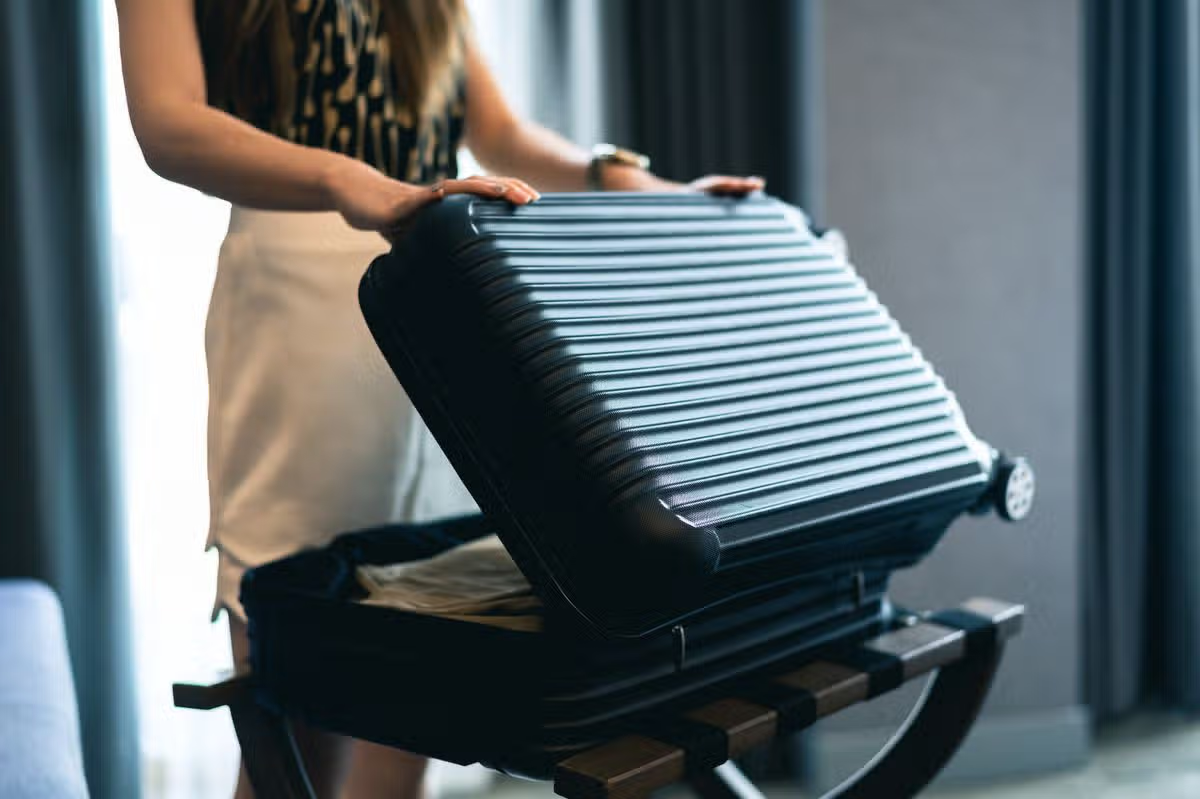
You should always remember to pack clothes pegs in your suitcase(Image: Kathrin Ziegler via Getty Images)
Planning what to pack for a holiday can be challenging. The task becomes even trickier if you’ve only booked hand luggage, as there’s nothing more frustrating than attempting to squeeze everything into limited space.
But there’s one small item you should always attempt to include in your suitcase when travelling anywhere. It comes in particularly useful if you’re heading somewhere far away and want to reduce your jet lag.
All that’s required is a few clothes pegs, which most of us have at home.
If you’re somebody who struggles to sleep unless the room is completely dark, staying in hotels can be problematic, as curtains don’t always meet properly.
This is where clothes pegs come in handy. You can simply use them to fasten the curtain fabric together, preventing any additional light from filtering through and disrupting your rest.
A similar technique circulated on TikTok in recent years, though it involved using a hanger rather than clips. Nevertheless, people have highlighted several flaws with this method, which is why it’s worthwhile packing a few extra pegs instead, reports the Express.
When travel influencer Emmaline Childs demonstrated the hack on TikTok, she explained: “Pull out a hanger with the clippies and use that.”
In the comments section, viewers acknowledged the hack worked effectively but also identified a problem. Anyone who has stayed in a hotel lately might have noticed that those types of hangers weren’t available.
In many cases , they’re permanently fixed to the rail and cannot be removed. One commenter noted: “Half the hotels don’t give you the option to remove the hangers now!! But the other half I sleep well.”
Due to this issue, travel specialists at Islands suggest packing some clips or clothespins as a precaution. The experts explained: “Not only do they help close those stubborn curtains, but they also serve other handy purposes.”
For instance, one Reddit user shared: “We always pack 4 wooden clothespins. The ones that have springs. Good for drapes, closing snack bags and whatever else.”
They’re equally useful for hanging damp clothing in the shower to dry overnight when you fancy doing laundry during your hotel visit, and resealing those crisp packets or toiletry pouches to prevent your items from spilling into your luggage.
Hello! I’m Mark Olsen. Welcome to another edition of your regular field guide to a world of Only Good Movies.
This is another strong week for new releases. By now you have likely heard something about “The Drama,” which has become inescapable thanks to the tireless promotion of its two stars, Zendaya and Robert Pattinson.
In a movie written and directed by Norwegian provocateur Kristoffer Borgli (“Dream Scenario”), the pair play Emma and Charlie, an engaged couple who find their wedding week thrown into disarray by the revelation of a deep secret from the bride-to-be.
Robert Pattinson and Zendaya in the movie “The Drama.”
(A24)
As Amy Nicholson put it in her review, “To another screenwriter, ‘The Drama’ would be an intimate study and a more emotionally wrenching film. But Borgli forces us to parse the mushy stuff from the mess and analyze the pending nuptials as an impersonal problem: What comes after a public shaming for the guilty and the inquisitors? That’s one of the most important (and unresolved) questions of the modern era, so I’ll forgive the filmmaker for being no more interested in writing Emma and Charlie as complex human beings than if they were character names in a math quiz about two people on two trains speeding toward a crash.”
Meanwhile, Tim Grierson spoke to Shira Small, the folk artist whose sole 1974 album features a song heard in an early scene of “The Drama.” Small, a delightful interview, goes into the music career she left behind a long time ago — one which may be reigniting now thanks to the movie.
Also opening in Los Angeles this week is Israeli filmmaker Nadav Lapid’s “Yes,” a guaranteed conversation-starter. Ariel Bronz stars as a musician who, in the aftermath of the Oct. 7 attacks, decides to say yes to composing a vicious new political anthem..
Reviewing the film, Joshua Rothkopf said, “It’s a movie about a citizenry at war with itself, hoping to keep the plates spinning for one more night. You watch it and think how easy it would be to envision an American remake — and wonder, too, if a filmmaker like Lapid even exists here.”
One of my favorite films from SXSW 2025, “Fantasy Life,” is finally coming to theaters. Written and directed Matthew Shear, the movie is an affectionate nod to the chatty dramedies of Noah Baumbach (some of which Shear has acted in). Here he plays Sam, a troubled law school dropout who takes a job looking after the children of a Brooklyn couple (Amanda Peet and Alessandro Nivola) and finds himself in an emotional affair with the wife.
“Fantasy Life” actor-writer-director Matthew Shear and star Amanda Peet bond in New York.
(Justin Jun Lee / For The Times)
I recently spoke to Shear and Peet about their collaboration on the film. Peet’s character in the film is also an actor and, though much of the film’s anxieties felt familiar to her, one scene in particular is drawn from Peet’s own experience: She is often mistaken in public for Lake Bell, including once on a red carpet.
“It’s a weird thing because you’re like, what do I do here?” said Peet with a laugh. “What’s the least douchey way to get out of this?”
The Black Pack’s resistance humor
Robert Townsend in the 1987 movie “Hollywood Shuffle.”
(Samuel Goldwyn Company / Photofest)
Curated around a new book by Artel Great, the UCLA Film and Television Archive is launching the series “The Black Pack: Rewriting American Comedy,” to spotlight a moment in the 1980s and ’90s when a small group of Black creators reached the very heights of Hollywood.
Eddie Murphy, Paul Mooney, Robert Townsend, Keenan Ivory Wayans and Arsenio Hall were friends and collaborators who, from 1987 to 1994, created the work showcased in the series. The Black Pack is a name they gave to themselves, partly in response to the John Hughes-affiliated Brat Pack.
Things begin tonight with a 35mm screening of Townsend’s essential 1987 satire “Hollywood Shuffle.” Great will be there for an introduction and a Q&A with cast member Anne-Marie Johnson and Spring Mooney, daughter of late actor Paul Mooney, who also appeared in the movie.
The cast of “In Living Color,” to be celebrated as part of the UCLA screening series “The Black Pack.”
(Fox / Photofest)
Other events include an evening of episodes of Wayans’ sketch comedy series “In Living Color,” 1988’s “Coming to America,” starring Murphy and Hall, a 35mm screening of Townsend’s 1991 “The Five Heartbeats” and a 35mm screening of 1989’s “Harlem Nights,” the only movie starring, directed, written and produced by Murphy, then at the height of his cultural capital.
This series is a terrific example of why smart programming matters. Here is a group of films (and a TV show) that might seem only related in a vague way, but when put together under a specific theme or idea, they are suddenly transformed into something revelatory.
Each evening of the series is designed to make the case for a different aspect of the Black Pack’s work and influence. The series as a whole puts forward a larger concept Great has coined a term for.
“I’m arguing through the series that the Black Pack’s cultural material is connected to a longstanding tradition that I call Black resistance humor,” says Great, now an associate professor at San Francisco State University, in an interview this week. “This idea of Black resistance humor is really a cultural practice where Black cultural workers are using political wit, irony, satire, parody, absurdity to challenge corrupt authority, to give voice to racial trauma and also attach themselves to re-imagining what freedom can really look like.”
From left, Arsenio Hall, Eddie Murphy, James Earl Jones and Madge Sinclair in the movie “Coming to America.”
(Paramount / Photofest)
There are plans for Black Pack programs in other cities, including Atlanta, San Francisco and Chicago, bringing this fresh look at their specific moment to venues around the country.
“I’m hopeful that the series will allow communities and audiences to see the Black Pack as cultural strategists who are using this idea of Black resistance humor to address very serious issues of power, identity and race,” says Great. “But also as a way of thinking, as a way of seeing and as a way of building alternative systems. Because that’s what they were able to do.”
Points of interest
‘The Birthday Party’ in 35mm
Actor Robert Shaw, left, with director William Friedkin on the set of “The Birthday Party” in 1968.
(Larry Ellis / Getty Images)
As part of its series celebrating the legacy of actor Robert Shaw, the Academy Museum will screen 1968’s “The Birthday Party” in 35mm on Sunday. One of the earliest features directed by William Friedkin (who would go on to such classics as “The Exorcist” and “To Live and Die in L.A.”), the film’s screenplay was written by Harold Pinter, adapting his own play. Shaw, Friedkin and Pinter make for a combustible intensity.
Shaw plays Stanley, the lone boarder at a seaside inn. When two mysterious men (Dandy Nichols and Sydney Tafler) arrive, they engineer a party for Stanley that becomes increasingly ominous.
In his original review, Charles Champlin lauded Shaw, saying he gives “one of the total and totally engrossing movie performances,” adding that Friedkin “as a director is everything a dramatist, and an audience, could want. The sense of loving care and artistic sureness which characterizes every aspect of the movie is extremely tonic. Pinter may be an acquired taste, but it is easy to acquire.”
‘He Got Game’ in 35mm
Denzel Washington in 1998’s “He Got Game.”
(David Lee / Touchstone Pictures)
Spike Lee’s prolific career is now studded with movies that maybe didn’t quite get their due in their day but deserve renewed attention. Screening in 35mm on Sunday at Brain Dead Studios is Lee’s 1998 “He Got Game,” which is just that kind of movie: stuffed with ideas and ambitions even if it doesn’t totally all come together for everyone. I particularly like his use of composer Aaron Copland’s music, which gives many of the images an epic quality they might not otherwise fully achieve, challenging preconceived notions of what can be thought of as Americana.
The movie stars a particularly electric Denzel Washington as Jake Shuttlesworth, a once-promising basketball player whose life took a turn. Now he’s in prison. His son, Jesus (played by NBA star Ray Allen), is a promising prospect and Jake is given an offer of a reduced sentence if he can convince his son to attend a certain college. The mixture of two of Lee’s own personal preoccupations, basketball and family, makes for a potent combination.
Reviewing the movie when it was released, Kenneth Turan wrote, “Given that writer-director Lee is one of the most visible of the New York Knicks’ celebrity fans, what’s surprising is not that he made a film about the sport he cares so much about but that he waited so long. … Though ‘He Got Game’ is periodically awkward and unruly, it benefits, as many of Lee’s films do, from the director’s determination to connect with the troublesome issues of the real world. Too few American directors work with Lee’s kind of social immediacy, and that makes his films, flawed and didactic though they sometimes are, essential viewing.”
Harmony Korine’s ‘Gummo’
Jacob Reynold, left, and Nick Sutton in Harmony Korine’s ‘Gummo’
(Criterion Collection)
Harmony Korine’s first feature as director, 1997’s “Gummo,” will screen at Vidiots on Monday. The event is co-presented by the Cinegogue, a group perhaps best known for their limited-edition movie-themed clothing drops, but who describe their mission thusly: “Our goal: make movies cool again through concert-like experiences and fanfare. … Because even though a movie might end, cinema is forever.” (And that’s a sentiment we here can get behind.)
The film finds Korine attempting to bring elements of experimental film and video to a nominally more mainstream context. It’s both confrontational and playful. Using a collage-like structure, the film follows a few kids as they make their way around their small town in Ohio after a tornado. Mostly featuring non-actors, the cast also includes Linda Manz and Chloë Sevigny, who is also credited as the film’s costume designer.
Writing about “Gummo” and Korine’s subsequent “julien donkey-boy,” Kevin Thomas made special note of “the intensity of Korine’s compassion for individuals who have so little going for them and so much going against them, yet at times are capable of experiencing an exhilarating freedom of spirit.”
As a travel journalist, I am away a lot, and there’s one £9 bag makes me feel like one of those super-organised people that can pack light
This article contains affiliate links, we will receive a commission on any sales we generate from it. Learn more
One item has made packing for trips so much easier(Image: Natalie King)
Despite travelling a lot for work, and fun, I’ve never mastered the art of packing light. I do not have a chic capsule wardrobe for city breaks, and I like to test those budget airline baggage capacities to their fullest.
As a perimenopausal woman, my carefree days of chucking a couple of lipsticks and a few makeup remover pads in a bag are also way behind me. When I go away for the night I need my skincare products, magnesium and collagen supplements, and industrial amounts of makeup, which arguably, are not making a huge amount of difference. A teeny tiny makeup bag is not going to do the job.
Last year, I stumbled across a toiletries bag on Amazon that has since become my favourite thing to take on trips, and at just £8.99 it’s something I’ve recommended to anyone I speak to who’s heading abroad. The Chakipee Travel Hanging Toiletry Bag looks just like an ordinary makeup bag on the outside. I bought the medium size, which measures 26x17x9cm, and when it arrived, I was sceptical about how much it would fit.
I don’t know what sorcery the manufacturers have used, but I can fit a surprising amount into this bag. I’ve managed to squeeze full size shampoo bottles into the big pockets, plus it has some smaller compartments for things like my toothbrush, contact lenses, and small stuff I don’t want to lose.
But perhaps the handiest feature is that it unfolds and can be hung up on a hook. While I’d love to pretend that my job always involves luxury travel to hotels with huge marble bathrooms, the truth is, I often stay in budget hotels where the bathroom is roughly the size of a postage stamp. If you are staying somewhere with zero bathroom counter space, just hang the bag from a spot such as a shower rail and you can easily access your products.
I’ve managed to fit a week’s worth of supplements and skincare products into the bag for longer trips, and as the ultimate test, once managed to do an everything shower in the tiny ensuite of a ferry cabin by hanging this bag on the door.
The only time the bag doesn’t come with me is if I’m travelling with hand luggage only, as annoyingly, the 100ml liquid rules are still in place at many airports. In general, the product reviews for the organiser are positive, with lots of people praising it for having plenty of pockets and compartments. A couple of reviews have complained about broken zips., but so far, I haven’t had that issue and have found it to be good quality.
If you’re looking for a bag solely for makeup then the Charlotte Tilbury Pillow Talk Makeup Bag also comes with some glowing recommendations. It also has a Tardis-like interior that can fit in full sized products, yet is compact when zipped up. One review says it offers: “Lots more room than I was expecting, can fit all my products in and love that I can organise things in the separate sections.”
If you’re travelling with hand luggage only, then Charlotte Tilbury also has lots of travel size skincare and makeup products that will ensure you don’t break the 100ml rules. Its Beauty Check-in Kit is currently on sale for £72 and includes a mini lip kit, powder, and setting spray that are just the right size for a week away.
Have a story you want to share? Email us at webtravel@reachplc.com