Column: Trump decries ‘communism’ while his government takes ownership of companies
As a student years ago, I dove deep into the history of the Red-hunting McCarthy era and became familiar with the actor who emerged second only to Wisconsin Sen. Joe McCarthy as the villain of that insidious time: his shameless, conniving young lawyer, Roy Cohn. Never would I have imagined that a future president would count Cohn as a mentor and role model.
Then came Donald Trump.
Now, in Cohn-inflected McCarthyesque style, President Trump is channeling his tutor yet again, baselessly labeling his political enemies — all Democrats — as communists as he looks ahead to the fall’s midterm elections. Once more Trump shows that his catchphrase “Make America great again” means regressing, this time to Trump’s formative 1950s and the McCarthy era that sadly helped define it.
In recent speeches, including on the Fourth of July, Trump’s utterances of “communist” or “communism” reached double digits each time. (As that implies, the president didn’t set aside his divisive rhetoric even for the nation’s 250th birthday.)
“Our warriors did not fight communism on battlefields across the world only to have that menace rear its ugly head right back here in America,” Trump said late on the Fourth on the National Mall.
Trump couples his commie-baiting with a dash of his trademark xenophobia. “There is now a resurgence of the communist menace in our land, including by newcomers to our country who embrace ideas totally opposed to our way of life and our great success,” he said at Mount Rushmore a day earlier. (He’s got it backward, of course: Immigrants come here for the American way of life and promise of success.)
Here’s the irony: Trump’s actions in his second term make him look more like the commie. He’s projecting again.
Now that Trump is exploiting a few victories lately by left-wing democratic socialists in Democratic primaries to paint the entire party as communists, it’s time to review the record — his record.
A hallmark of communism is government ownership of companies and control of the economy, at the expense of private property and free markets. In just over a year, Trump has used billions of taxpayers’ dollars to buy shares for the government in a growing list of private companies — U.S. Steel, Intel, Westinghouse and more — citing national security. The companies don’t always welcome their new stakeholder; at a minimum, they rightly fear it for the demands the government could make about prices and production.
“It’s what Putin did,” the estranged Republicans at the Lincoln Project posted online Monday. “Trump is the closest we’ve ever come to communism.”
“What began as a populist revolt against so-called elites has become a program of state ownership, price fixing and top-down industrial control,” free-market economist Veronique de Rugy wrote in The Times last October of Trump’s actions. “The power to ‘partner’ with business is the power to control it.”
Comrade Trump’s first big government grab, and a model for those to come, was in June last year, when he wrested a permanent “golden share” in U.S. Steel in return for approving its sale to Japan’s Nippon Steel. The company’s charter was revised to give the U.S. president extraordinary veto power over nearly a dozen corporate activities, including closing or relocating plants, supply-chain decisions, even pricing.
“We have a golden share, which I control,” Trump told reporters at the time, in words I never thought I’d hear from a president of the party once associated with free markets.
Just last week, Trump boasted to CNBC how he’d extracted a 10% stake in beleaguered chip giant Intel last August, after first demanding that its chief executive resign. “Intel came in. They had a problem. I said, ‘I can solve your problem, but I want 10% of the company.’ … Somebody said that’s not very American. I said, ‘No, I think it is very American, actually.’ And I’ve done that with other deals.”
And so he has.
The Pentagon is now the largest stockholder in struggling MP Materials, a large rare-earth mine in California, and guarantees a 10-year price floor for its output that stunned competitors. The administration has since taken shares in other rare-earth companies. The Commerce Department took an option for an 8% stake in Westinghouse, to spur construction of nuclear reactors, and has the right to 20% if the government decides the company should go public. The government takes a 15% cut of Nvidia’s and Advanced Micro Devices’ AI chip sales to China.
As much as anything he does, Trump’s direct intervention in private enterprise invites the question “What if Biden/Harris/Obama did that?” The answer, of course: Trump and Republicans would cry “Communist!”
Trump’s actions are the sort Americans generally have only seen during economic emergencies or major wars, and then rarely. I covered the frenzied and ultimately successful response to the near-collapse of the global financial system and the U.S. auto, insurance and housing industries. Behind the scenes in the Obama White House (and George W. Bush’s at the outset) was constant, angst-filled debate about any actions smacking of government takeovers and a determination that interventions be temporary, unlike Trump’s schemes. (For all the still-lingering unpopularity of the banking bailout, the Treasury — the taxpayers — got all the money back and then some, and exited the business.)
Trump’s economic big-footing isn’t the only way in which he resembles the commies Americans know best, and whom he so admires: Vladimir Putin, Xi Jinping, Kim Jung Un. There are also the images of himself everywhere, monuments planned, drearily long and self-adulating speeches and interference in the nation’s cultural, educational and legal spheres and — worst of all — in elections.
At Rushmore, Trump closed with a demand that Congress pass his so-called SAVE America Act to restrict voting. “We do that and we’re not going to lose an election for 100 years,” he said, speaking of course about Republicans.
One-party rule through central government election finagling? Now that’s a communist.
Bluesky: @jackiecalmes
Threads: @jkcalmes
X: @jackiekcalmes
DHS buys two California immigrant detention centers for $1.5 billion
WASHINGTON — The Department of Homeland Security bought two of the largest immigrant detention facilities in California for $1.5 billion, according to the private prison company that sold them.
The purchase comes as the department — flush with cash after Trump’s One Big Beautiful Bill Act infused the agency with $170 billion — has moved to scale up its capacity to detain immigrants without relying as heavily on private prison corporations.
In announcement Monday, the Tennessee-based CoreCivic said the sale of the 2,560-bed California City Detention Facility and the 1,994-bed Otay Mesa Detention Center in San Diego closed on July 2.
The company said it expects net proceeds of about $1.1 billion after income taxes and transaction expenses.
Ryan Gustin, public affairs director for CoreCivic, said such sales are not uncommon and that “the process was marked with rigor and integrity.” He added that the valuations were established through the federal government’s required appraisal process, using independent appraisers, who determined objective fair market value.
The sale doesn’t immediately change anything at the facilities — CoreCivic expects to continue managing them under existing contracts with U.S. Immigration and Customs Enforcement, according to the company and a filing with the Securities and Exchange Commission.
But the terms of those contracts could be modified given the change in ownership, the filing states. The California City facility contract expires in August 2027 and the Otay Mesa facility contract expires in December 2029, with the option to extend for another five years.
“We are pleased with the sales of these two mission-critical facilities for the Company’s government partner, which demonstrates the value of the Company’s underlying real estate portfolio, while reflecting our role as a long-term, flexible solutions provider to government,” CoreCivic CEO Patrick Swindle said in the announcement.
The Department of Homeland Security did not immediately respond to a request for comment.
During a quarterly earnings call in May, George Zoley, CEO of the GEO Group, another major private prison corporation, said that the company had been in discussions with ICE “regarding the potential sale of multiple facilities.”
Critics of the purchases of detention facilities say the Trump administration is simply looking to avoid state and local oversight by bringing them under federal ownership. That issue was raised during the GEO Group earnings call when a participant later asked why the federal government wants to own the facilities instead of contracting with third parties.
If the facilities are federally owned, Zoley replied, there are “more protections from unwarranted litigation that infringes upon the activities of the ICE processing centers.”
Zoley said federal ownership would bolster the legal defense of the facilities and the argument that “states can only have very limited involvement.”
“There’s been litigation regarding overseeing medical services, food services, general cleanliness, etc.,” Zoley continued. “It’s really unprecedented and I believe it’s fundamentally unconstitutional. As some blue states are considering more active involvement in oversight of facilities, I think the logical solution to much of that is federal ownership of the facilities.”
California tried to kick private detention operators out of the state, but the 2020 law was overturned in the Ninth Circuit Court of Appeals. Since then, state leaders have established oversight mechanisms through laws that allow for monitoring and investigation of detention centers by the California Department of Justice and local health authorities.
Asked to comment about the sale, Sen. Alex Padilla (D-Calif.) said his congressional oversight visits to facilities operated by CoreCivic have shown that immigrants who pose no public safety threat are being held in “unacceptable conditions.”
“Whether these facilities are operated by a private contractor or owned by the federal government, my expectations remain the same,” he said. “I will continue demanding transparency, accountability, and humane conditions that respect the dignity and rights of every person in immigration detention.”
Eight ICE detention facilities now operate in California, with a combined capacity to hold nearly 9,000 people.
The California City and Otay Mesa facilities have both been the subject of lawsuits by detainees alleging detainee mistreatment. CoreCivic calls such allegations unfounded and says it complies with all regulations concerning the treatment of detainees.
In its announcement on Monday, CoreCivic said the company is in discussions with ICE about potentially selling additional detention facilities, though it said those talks are in various stages and it’s unclear whether the sales will go through.
For Dodgers, getting to playoffs is not good enough for Mark Walter. For Lakers?
Here’s a bit of Dodgers trivia for the bandwagon fans in our midst: Who was the manager before Dave Roberts?
That was 11 years ago. He is Don Mattingly, who returns to Dodger Stadium on Friday as manager of the Philadelphia Phillies.
The Phillies were 9-19 when they fired Rob Thomson and replaced him with Mattingly. They are 20-8 since then, a better record than the Dodgers have posted over the same span.
In Philadelphia, Mattingly got his chance because the Phillies were losing. In Los Angeles, Mattingly departed amid a run of winning.
For Mark Walter and what was then a new Dodgers ownership group, that was not enough. As Walter enters his first offseason as the Lakers’ controlling owner, it’s worth keeping that in mind.
“They have a hunger for victory that is the greatest I’ve ever seen, without exaggeration,” former Dodgers general manager Ned Colletti told me.
In two seasons with Rob Pelinka as president of basketball operations and JJ Redick as coach, the Lakers won division titles both times, failing to get out of the first round of the playoffs one year and failing to get out of the second round of the playoffs the next.
In 2013 and 2014, with Colletti as GM and Mattingly as manager in the first full seasons of Walter’s ownership, the Dodgers won division titles both times, failing to get out of the first round one year and failing to get out of the second round the other.
The Dodgers replaced Colletti with Andrew Friedman.
In 2015, the Dodgers won the division but failed to get out of the first round of the playoffs. Friedman offered Mattingly a short-term extension, and Mattingly opted for a long-term deal to manage the Miami Marlins.
After Walter and Co. took over the Dodgers, Mattingly told me Wednesday, there was one year he thought he might be fired: 2013, when the Dodgers started 30-42 and fell 9 1/2 games out of first place in mid-June. The Dodgers then reeled off 42 wins in 50 games and won the division by 11 games.
He appreciated that Walter, team president Stan Kasten and eventually Friedman did not simply bring in a new manager at their first chance.
“You get to evaluate and see,” Mattingly said, “and you have your vision for where you want it to go, and sustain it. That’s the thing they’ve been great at: sustaining it. It’s been year after year. You can’t really doubt what they’re doing.”
Kasten’s first move was not to fire Colletti, but to ask what ownership could provide for him so that he could do a better job. The owners quickly responded by funding the addition of impact players (Adrián González and Hanley Ramirez), extending the contract of a popular home-grown player (Andre Ethier), revitalizing the Dodgers’ Latin American talent pipeline (Yasiel Puig and Julio Urías), renovating the clubhouse and, at Mattingly’s suggestion, refreshing the family room.
“We started to be able to compete with a different mindset, which was invaluable,” Colletti said.
Similarly, with Friedman and former Dodgers general manager Farhan Zaidi as consultants, the Lakers have added two positions for assistant general managers, overhauled the scouting staff, created more room at team headquarters by relocating their G League affiliate to the Coachella Valley, and borrowed from the Dodgers’ playbook in modernizing medical and biomechanical facilities.
This summer could be critical in determining the future of the Lakers, including who runs them. Walter can spend all he wants, as he does with the Dodgers, but the luxury-tax penalties in the NBA are more severe than in baseball and could restrict the roster flexibility so coveted by the likes of Friedman and Zaidi. A star-studded roster beyond Luka Doncic — say, a trade for Giannis Antetokounmpo? — could require the Lakers to sacrifice the draft picks that also would limit roster flexibility.
The Lakers will have the resources. Walter will want to see the creativity and the championships — or, at least, the path to them. Ultimately, he will decide what he did with the Dodgers: Does he have the best people he can get running the team?
“You see many organizations that win, and then they take a step back,” Colletti said. “They feel like they have some goodwill in the bank, they don’t have to chase the biggest free agents, and they don’t need to re-invest in the team or the stadium.
“From my vantage point, all the way up and down that organization and especially at the ownership level, it’s almost like they’ve never won, and they’re hungry to get there. To be there and be unsatisfied — that quest to be as great as you can be — is one of the great indicators of the excellent ownership it is.”
In the meantime, any advice for Pelinka and Redick? Colletti let out a hearty laugh.
“Do your best,” he said, “and turn it up a notch.”
Public ownership in AI: Trump and Sanders find common ground
WASHINGTON — It was perhaps a surprising private overture from OpenAI Chief Executive Sam Altman to Sen. Bernie Sanders.
The meeting between the two had come just after the Vermont senator announced a plan for the public to take a 50% ownership stake in artificial intelligence companies such as OpenAI, using their stock to create a public wealth fund that would spread the fortune generated by AI behemoths.
Altman told Sanders that he, too, wants the public to have equity in AI companies. Though the CEO said he couldn’t support Sanders’ threshold of 50%, he nonetheless wanted to work with him to advocate for the general idea, according to people with knowledge of the conversation.
The nearly hourlong meeting in Sanders’ Senate office this week, held at Altman’s request, highlighted the inherent tension between AI powerhouses and policymakers as Americans are increasingly asked to accept the costs of the AI boom even as many remain unconvinced of its direct benefits. Yet it’s also creating odd political bedfellows fueled by populism as politicians from Sanders to President Trump embrace giving the public a stake in AI’s growth.
Speaking to reporters Friday on Air Force One, Trump described a potential partnership “where the American people can benefit from the success of AI” and said executives from leading AI companies will visit the White House, perhaps in the coming week, to discuss the idea.
“There’s something very interesting about it, where it almost becomes a partnership with the American public,” Trump said.
When reporters noted to the Republican president that Sanders, a democratic socialist and political independent, had proposed public ownership in AI companies, he pointed to similarities in their coalitions. The economic views of Trump voters and those who have supported Sanders for president, Trump said, “aren’t that far apart.”
Trump has embraced government investment in private companies in his second term, scrambling his party’s politics. His administration last year secured a 10% stake in the struggling Silicon Valley company Intel, and it considered a government takeover of Spirit Airlines earlier this year, although the airline couldn’t reach a deal and ultimately closed.
Public backlash
The positioning of leading figures such as Trump and Sanders comes as concerns about AI are emerging far beyond Washington.
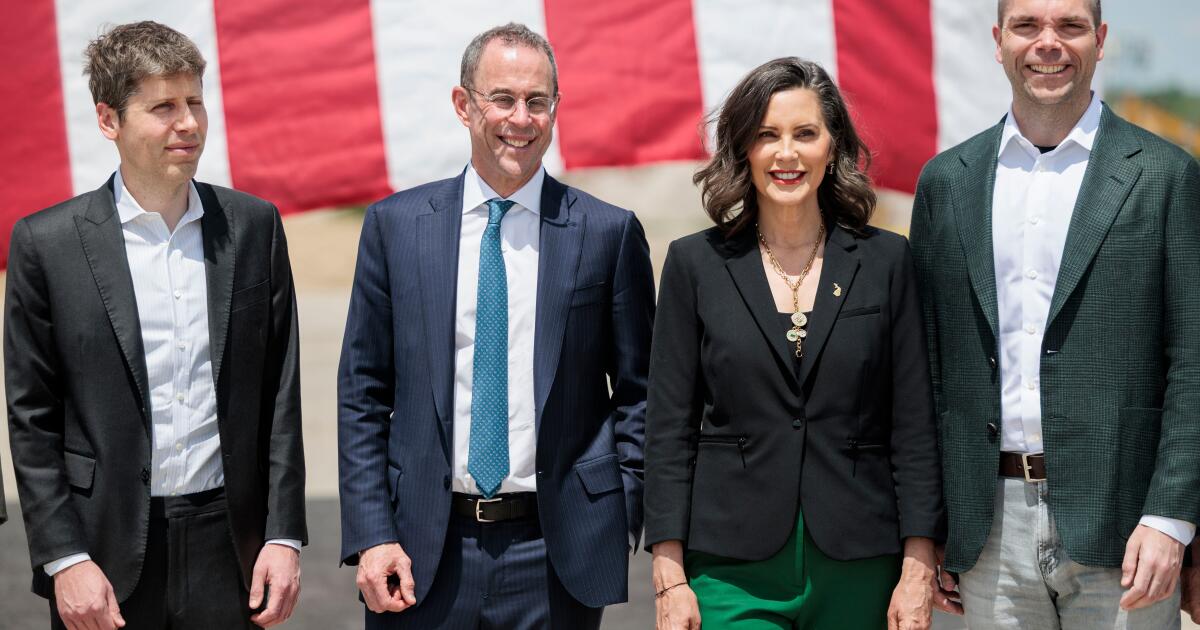
In Michigan, Democrats recently clashed over Gov. Gretchen Whitmer’s appearance with Altman at the site of a major data center. Candidates such as New York Democratic House candidate Alex Bores have also made AI regulation a campaign issue by tapping into voters’ unease about the technology.
“This is a real change to society,” Altman told reporters this week. “I think it’s possible both that people can use AI a lot and like using it and also have anxiety about what it’s going to do for the future.”
Data center projects across the country have drawn opposition from residents concerned about electricity demand, water consumption and environmental impacts. Some states once eager to attract the facilities, including Ohio and Virginia, have moved to reconsider tax incentives.
“We need to pass legislation right now that says there’s not going to be any further data center development until they agree to pay for their own electricity, build their own grids and pay for their own water supply,” Sen. Josh Hawley of Missouri, a leading Republican skeptic of Big Tech, told the Associated Press.
Before arriving in Washington, Altman stopped in Michigan on Monday to appear alongside Whitmer, a Democrat, at the site of a 1.65 million-square-foot data center project. Whitmer’s team said the project will create more than 2,500 union construction jobs.
But it also drew criticism from local activists and some fellow Democrats, including Rep. Rashida Tlaib of Michigan, who called the project “disgusting.” She said she was “so disappointed” in Whitmer.
“It’s a very controversial topic right now and it’s coming from the ground up,” Sen. Elissa Slotkin, another Michigan Democrat, said about the grassroots resistance. “People feel very strongly about it.”
Whitmer defended her appearance, telling reporters afterward that “one thing’s very clear: Everyone has a cellphone in our pocket.”
“We are all, more and more, consuming technology and data, and these data centers are going to get built. So, my thought is if we can hold them to a high standard and do it in Michigan, that’s the best way to do it,” she said.
The tensions extend beyond data centers. On college campuses, commencement speakers have been interrupted by boos when discussing artificial intelligence. About 70% of college students see AI as a threat to their job prospects, according to a 2025 poll by the Institute of Politics at the Harvard Kennedy School.
Altman acknowledged those concerns. He said that while “the impact on jobs has been less than many people in our field expected,” he understands “that college students have a lot of anxiety about the future.”
Washington seeks an AI bargain
The idea that AI’s expansion is inevitable is increasingly shared by leaders across the political spectrum, even as they disagree sharply about how to manage it.
That reality was at the center of Altman’s conversations in Washington. In addition to Sanders, Altman met with Trump administration officials such as Michael Kratsios, the White House’s chief science and technology advisor, and congressional leaders from both parties.
Sanders’ team emphasized that the two did not reach an agreement on the main points that the senator made to Altman, including the 50% figure to ensure that the public has decision-making power. The senator also expressed opposition to the growing spending on elections by the AI industry.
“Unfortunately, Sam Altman did not commit to any of those,” Sanders spokesperson Jeremy Slevin said.
Altman, emerging from the conversation, described it as “great,” though noting that the two “obviously don’t agree on everything.”
How AI should be governed
Congress this week released a bipartisan framework that would establish the first broad federal approach to AI regulation while temporarily preempting many state laws.
Anthropic, one of OpenAI’s top competitors, has proposed mechanisms for coordinating pauses on advanced AI development if systems become too powerful.
The Trump administration has also begun constructing its own oversight structure, signing an executive order to establish a process for reviewing national security risks posed by advanced AI systems before their public release.
Sanders said he found the administration’s move notable after years of warnings that regulation could slow American innovation.
“Even these guys are beginning to catch on that there are legitimate concerns that have to be dealt with,” Sanders said.
Cappelletti and Kim write for the Associated Press.
Letters to Sports: More calls for Angels ownership change
Bill Plaschke’s and many Angel fans’ desire for Arte Moreno to sell his ownership of the Angels is an overkill. Granted, us Angels fans have suffered under Moreno’s ownership, and the Angels would be better off with new ownership, but over the years Moreno has done many positive and charitable things. I suggest that the Angels provide Moreno with a 10%, non-voting interest, regardless of who the new owners might be. That way the fans are happy, and Moreno will still have a rooting interest.
Michael Gesas
Beverly Hills
Bill Plaschke’s column urging Angels owner Arte Moreno to sell the team hits the bull’s-eye. Clear, concise and comprehensive, it highlights most factors leading the Angels to the bottom of MLB. Most factors, except a significant one: Moreno’s ownership incompetence has been facilitated by the group of sycophants he has apparently surrounded himself with. These same people are now hard at work imploring Moreno, “just don’t read The Times today.”
Rob Fleishman
Placentia
If Bill Plaschke were an attorney delivering closing arguments at a jury trial, his recent article regarding Arte Moreno’s ownership of the Angels would certainly produce a verdict. The jury has reached its decision: the defendant must sell the team.
Wayne Muramatsu
Cerritos
Dear Angels,
I’ll start off by saying it’s not you, it’s me. I tried staying faithful to you but Arte Moreno’s interference in our relationship has clouded my better judgment. I thought I could stick it out knowing how hard you are working trying to reel me back in. It’s not working and I must now turn my back and walk away. What we have now is a shallow affair and it’s not fair to you that the charade continue. In the end, I take great comfort in knowing someday, somehow you will find what you are looking for.
Mark Petrasso
Port Hueneme
Lakers layoffs part of sweeping changes to business operations
The Lakers informed employees Wednesday there would be a round of layoffs as the organization continues restructuring under new ownership, according to multiple people.
Those familiar with the situation but unable to speak publicly confirmed to The Times that at least 15 people across multiple departments, including communications, marketing and sales, would be laid off.
Since Dodgers owner Mark Walter took over as the majority owner of the Lakers in a record-setting $10-billion deal that was finalized in October, the franchise has gradually overhauled both business and basketball operations.
The team hired a new assistant general manager this week, bringing Rohan Ramadas in from the New Orleans Pelicans to oversee strategy and data systems. The front office, led by president of basketball operations and general manager Rob Pelinka, will hire another assistant general manager focused on scouting and player development.
The Lakers functioned as a family business for more than 45 years under the ownership of the late Jerry Buss and his children. They blossomed into one of the premier sports teams in the world, but the ownership change brought swift business changes.
Former Dodgers executive vice president and chief marketing officer Lon Rosen became the Lakers’ president of business operations and created two positions to boost revenue and oversee business strategy.
Michael Spetner, who also most recently worked for the Dodgers, was hired as chief strategy and growth officer while Ryan Kantor, a former business executive with the Clippers, joined as the vice president of global partnerships.
Times staff writer Broderick Turner contributed to this report.
Cinerama Dome seeks a conditional-use alcohol permit
A city hearing concerning on-site alcohol sales provided the public a chance to air their opinions on the possible reopening of the Cinerama Dome and ArcLight Hollywood on Tuesday morning.
Though a final letter of determination is still to be issued, Tim Fargo, the associate zoning administrator in charge of Tuesday’s meeting, said he was “inclined to approve” the conditional-use permit under consideration. The permit would cover the Cinerama Dome, 14 adjacent auditoriums and a restaurant café with two outdoor spaces.
The Dome closed in March 2020 with the onset of the COVID-19 pandemic and in April 2021 it was announced that the venue would not be reopening. Film lovers in Los Angeles and around the world have since been hopeful the venue, seen by many as a symbol for Hollywood itself, could reopen.
During the meeting, Elizabeth Peterson-Gower, a land use consultant representing the owner and applicant Dome Center LLC, was asked if there was a timeline for reopening the theaters. She responded, “I too don’t have a schedule yet, but when I do, I’ll convey it to you.”
In a separate phone interview following the meeting Tuesday, Peterson-Gower referred to the approval of the conditional-use permit as a “milestone” in the process of reopening the theaters and added that ownership has noted the intense public interest around the Dome and the ArcLight and that “it will inspire a time frame in the near future.”
Throughout the meeting, Peterson-Gower referred to the success of the Blue Note jazz club that opened on a corner of the property in August 2025.
“What it proves to me is that the ownership cares greatly,” Peterson-Gower said after the meeting. “That’s a big undertaking and a big statement in favor of the fact that ownership care what’s there.”
Numerous other voices were heard throughout the hearing as well. Ted Walker, planning deputy for Council District 13, where the theater is located, said, “Too often we see [historic-cultural monuments] around our city sitting vacant. So we’re very supportive of anything to bring some life back into this. We know there’s a lot of love for the Cinerama Dome and we want to acknowledge the work of all the community members who are advocating for it. We believe resuming these operations will further enhance the vibrancy of Hollywood.”
Burbank City Council member Konstantine Anthony noted that he was a former usher at the Dome and also voiced support for the reopening.
More than 30 people provided public comment. Among those were Kat Kramer, daughter of filmmaker Stanley Kramer, director of “It’s a Mad, Mad, Mad, Mad World,” the very first film to play in the Dome in 1963, film critic Wade Major and Ben Steinberg, who has led a grassroots campaign to get the venue reopened.
The Blue Note Jazz Club undergoes construction near the Cinerama Dome on Tuesday, Aug. 5, 2025, in Los Angeles.
(Juliana Yamada / Los Angeles Times)
One commenter said, “Why have they kept it closed? Is this just a strategy to let it rot so that they can get building violations and just tear it down and build condos? There’s a lot of fear about what’s going to happen with this thing that people feel attached to. And to not answer questions over all this time has frankly been offensive.”
Another commenter said that the delays in reopening feel like ownership “keeping a bit of our heritage hostage from us.”
Even those who were asking for clear specifics from ownership were nearly all in favor of granting the conditional-use permit, which was the ostensible purpose of the meeting. As local preservation advocate Kim Cooper said, “I know that this has been hard and it has seemed like the citizens versus the ownership — that’s not what it is. People want to come together and help and bring this place back.”
Speaking after the meeting, Peterson-Gower noted her own history with the Dome, having been involved with many events there in the late ’80s and early ’90s when she was vice president of the Hollywood Athletic Club, located just a few blocks away on Sunset Boulevard.
“Everyone has a story about the Dome that’s lived here, even me,” she added. “I didn’t want to bring my personal life into the hearing, but I care passionately as well about it opening.”
While the final outcome of the hearing is still to be fully determined, all signs point to the permit being granted and the project being free to move forward.
“I was overwhelmingly pleased with the comments,” said Peterson-Gower. “I think that it shows that there’s a great historic use in a historic property and I think that people care passionately about it operating and are very, very proud of the property being here in Hollywood.”