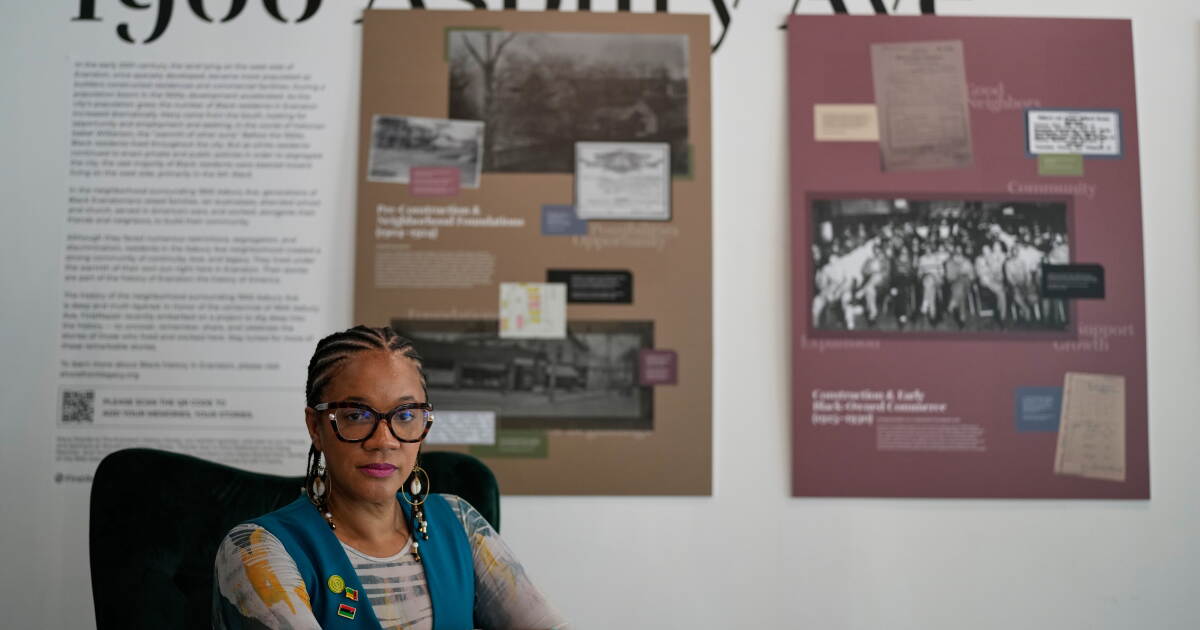
As Trump fights over what America owes, slavery descendants organize for the future
WASHINGTON — N’nanba (Robin Rue Simmons) has spent years trying to answer a question that has vexed the United States since the abolition of slavery: What would it actually look like to repair the damage?
In Evanston, Ill., she helped turn that question into a $25,000 housing grant for Black residents whose families were harmed by discriminatory housing policies. Now, Rue Simmons is spreading the nation’s first municipal reparations program to more than 100 communities across the country.
But as America celebrates its 250th anniversary, there is a formidable hurdle: President Trump’s administration.
The administration’s campaign against diversity, equity and inclusion programs, and its broader efforts to curtail federal support for race-based initiatives and Black history, have prompted some institutions to reconsider or quietly scale back reparations work.
Those reversals come while at least part of the world community is reexamining the past. In March the U.N. General Assembly issued a resolution declaring the trafficking of millions of enslaved Africans “the gravest crime against humanity” and calling for reparations. More than 120 countries supported the resolution — only three voted against it — Argentina, Israel and the U.S. Fifty-two, including England and 27 members of the European Union, abstained.
“Under this administration, of course, there are many barriers to achieving that, but we still stand on federal redress as our collective north star,” Rue Simmons, the chairman of Evanston’s Reparations Committee and a former city councilwoman, told the Associated Press.
For more than 3½ centuries, the transatlantic slave trade forced an estimated 12.5 million Africans aboard ships bound for the Americas; some 1.8 million didn’t survive the journey.
Roughly 388,000 enslaved people were taken to what is now the U.S. and their enslavers maintained a system of chattel slavery, treating the enslaved and their children as property, until abolition in 1865.
Enslavement deprived generations of Black Americans their freedom and any meaningful share of the fruits of their labor. Jim Crow segregation, discrimination and systemic racism further depressed the Black population’s ability to build wealth that is still largely concentrated among white families.
From the unfulfilled promise of 40 acres and a mule, to modern-day reparations proposals, initiatives to address the legacy of slavery are entering a new era of political uncertainty.
“I don’t think that there’s been any president who’s been supportive of comprehensive Black reparations — for a long time it was just taboo to even speak the word,” said William Darity, who wrote a book on reparations with A. Kirsten Mullen.
“Now, Trump will speak the word, but with hostility,” he added.
“They want to steal your money for reparations,” Trump told his supporters during a speech in September. “Our country doesn’t have that kind of money. … The people that hate our country are asking for it, but it’s going nowhere.”
Marcus Anthony Hunter, a sociologist in African American studies at UCLA, said reparations are about atoning for the past crime of chattel slavery, even if some programs come in the form of housing grants or college scholarships instead of direct cash payments.
“It’s not even a lot of money that they are given. But it comes back to the recognition, the acknowledgment, responsibility and remedy,” he said.
The Trump administration disagrees and has entered the legal fight in Evanston to stop it from happening.
The Republican administration’s attacks on modern-day repayment efforts include a lawsuit in Evanston, which was initially filed by Judicial Watch.
Michael Bekesha, who represents the plaintiffs, says the Evanston program distributes funds based on race without specific harm identification. He argues the city’s program is unlike historical reparations programs.
“The Constitution prohibits governments from picking winners and losers based entirely on race,” Beshka told the AP.
The Justice Department this month received a federal judge’s permission to intervene in the case, alleging that the city’s actions violate the equal protection clause of the 14th Amendment and the Fair Housing Act.
Last year, the Justice Department sent a letter of warning to leaders in Asheville and Buncombe County, N.C., contemplating creating their own programs.
Kiersten Pels, a spokeswoman for the Justice Department, said in a statement to the AP that “race-based government benefit programs are both unconstitutional and often violate federal civil rights laws.”
“Those implementing these programs do so in violation of federal law and the federal government has an obligation to stop them,” she said.
The White House referred questions to the Justice Department.
Georgetown University was one of the leaders, offering admission consideration for the descendants of enslaved people tied to the campus’ past, an effort that has continued despite Trump’s crackdown on campus DEI efforts.
But across higher education, new efforts have come to a standstill, said Richard Cellini, who previously led a Harvard University project to identify descendants of people enslaved by Harvard’s past leaders.
“People don’t want to talk about it, they don’t want to hear about it, they’re not hiring for it,” Cellini said.
Some Virginia universities have quietly been taking steps to provide scholarships to descendants, as required under a 2021 state law. But otherwise there has been no sign of new scholarship programs being started since Trump returned to office, said Kirt von Daacke, a University of Virginia historian who leads a consortium of colleges studying slavery.
The Georgetown initiative focuses on descendants of slaves sold by Georgetown’s Jesuit priests to slaveholders in Louisiana.
The Virginia Theological Seminary makes annual cash payments to the descendants whose family members labored on its campus during slavery and Jim Crow eras. The private institution’s program is funded by an endowment started in 2019 that has grown from $1.7 million to $2.8 million. Payments to individuals vary based on the closest lineage to the family members and continue into perpetuity.
“We believe we’re the only educational institution in the United States which makes annual cash reparations payments” with no strings attached, said Nicky Burridge, the seminary’s spokeswoman.
“The moral repair, the healing aspect is as great as the monetary one,” said Ebonee Davis-Hayes, its director of reparations.
Hussein, Fields and Binkley write for the Associated Press.