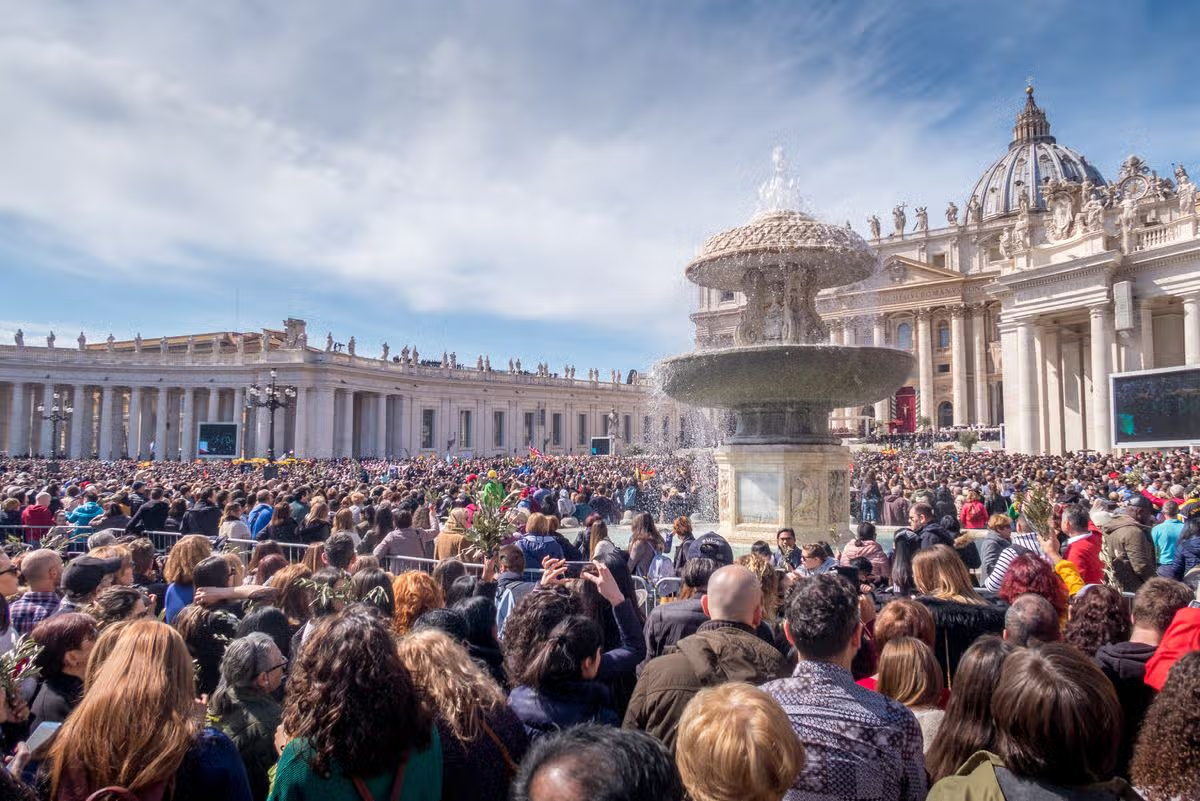
overtourism

Six new travel rules holidaymakers need to know ahead of 2026 breaks

From EU border fingerprint checks to new visa waivers and tourist taxes, British holidaymakers face major changes in 2026. Here are some of the most important ones you need to know about before you jet off

The world of travel is constantly changing, with alterations to airport regulations, tourism restrictions, and new paperwork to complete. These changes can often leave holidaymakers scratching their heads, unsure of how they’ll be affected or what steps they need to take.

The upcoming year promises a wave of significant changes, particularly for Brits traveling to or from the EU. The potential requirement for a visa waiver is on the horizon, and the new entry and exit system is likely to be implemented this year, reports the Express.

But what does this mean for the average holidaymaker? And what do Brits need to sort out before they set off? Here’s a breakdown of some of the changes you need to keep an eye on if you have a trip booked.

EU Entry/Exit System (EES)

After numerous delays, the Entry/Exit System (EES) finally got off the ground in October. This means anyone from outside the Schengen Area, including Brits, will have to provide fingerprints and a facial image at the border when entering EU countries.

This initiative aims to phase out manual passport stamps and make it easier to monitor tourists who overstay their welcome. However, the roll-out of the system has hit a number of snags.

For instance, the Port of Dover was initially set to start using EES in October for car passengers, but this was pushed back to early 2026 to prevent delays over the busy festive season. Not all EU airports have the system up and running yet, so if you’re planning to travel early next year, your experience may differ.

The deadline for full implementation across all Schengen members, as well as Iceland, Liechtenstein, Norway, and Switzerland, is set for 10 April 2026. Once operational, travellers won’t need to do anything beforehand, but there may be lengthier airport queues as people adjust to the new system.

ETIAS – EU Visas

ETIAS (European Travel Information and Authorisation System) is a new visa waiver programme for exempt visitors making trips to the EU. It’s similar to the United States’ ESTA, and the procedure will be largely the same.

Once implemented, Brits planning an EU holiday will need to complete an ETIAS application, which is a pre-screening that permits you to enter the Schengen Area without a visa.

The downside is that the visa will cost €7 per person (roughly £6.10). However, once approved, the ETIAS will remain valid for three years or until your passport expires, whichever happens first.

Currently, no launch date has been declared on the official ETIAS website, but it’s advisable to stay alert for any updates. The launch date for ETIAS has already been postponed several times, and while it’s presently set for Q4 of 2026, which is October, there could still be delays in rolling out the system.

As with any travel visa or application, only use the official ETIAS website for applications and steer clear of third-party sites.

Brits face bigger bills on arrival

Overtourism has consistently made the news throughout 2025, and Brits travelling to certain countries might be caught off guard by unforeseen additional costs.

An increasing number of destinations are implementing tourist taxes, and while these are typically minor nightly fees, they can quickly accumulate for extended stays or larger groups. English mayors are also set to be given the authority to impose tourist taxes, meaning even staycations could come with added expenses.

New tourist taxes set to begin in 2026 include Edinburgh, where a 5% surcharge will be added to hotel bills from July, and Thailand, which will levy a 300 baht fee (approximately £7) on air passengers.

Brits heading abroad might also discover they’re charged more than locals to visit popular sites. A recent case in point is the Louvre in Paris, which announced that from early 2026, EEA residents will be charged €22 for entry, roughly £19.15, whereas those from outside the EEA, including Brits, will be hit with a €32 admission fee (around £27.86).

U.S. National Parks are set to introduce a two-tier pricing system for American citizens and tourists, with the latter being hit with an additional $100 fee on top of standard charges to gain entry into popular parks such as the Grand Canyon and Yellowstone. This surcharge can be applied per person or per vehicle, depending on the park’s policy.

For instance, a family visiting the Grand Canyon typically pays $35 (roughly £25.87) for a private car. However, under the new rules for non-Americans, this will skyrocket to a staggering $135, meaning visitors could pay just under £100 to simply pass through the gates.

Changes to liquid rules

Air travellers should stay up-to-date with any changes to liquid rules at their departure and destination airports, as the 100ml rule is often subject to change and has even been scrapped in some places due to advancements in technology.

At Birmingham, Gatwick, and Edinburgh airports, passengers can now carry up to two litres of liquids in their hand luggage, thanks to enhanced scanning technology. Meanwhile, at Luton Airport, while the 100ml rule remains in effect, there’s no longer a requirement to remove liquids from your hand luggage. This means the small plastic bag is no longer necessary; you can simply place your luggage in the scanner.

However, it’s important to remember that the regulations at your destination may differ. So, if you bring a two-litre bottle from the UK in your hand luggage, it might need to be stowed in a checked bag for your return journey.

Tightening of smoking and vaping bans

Several Spanish holiday hotspots favoured by Brits are considering imposing stricter regulations on smoking and vaping in public areas. In certain tourist hotspots like Barcelona and the Balearic Islands, puffing away on a cigarette or vape is already prohibited on beaches, while some Canaries’ beaches have been declared ‘clean-air zones’.

However, new proposals set to potentially take effect in 2026 could see a total ban on smoking and vaping in various outdoor spaces, including beaches and bar terraces throughout Spain, with immediate fines for those flouting the rules. In the Canary Islands, penalties for violating anti-smoking laws currently range from €30 to €2,000 (approximately £26 to £1,730), so it’s anticipated that similar fines would accompany the new regulations.

Crackdowns on unruly passengers

A recently enacted law in France, which may soon be replicated across other EU nations, is set to clamp down hard on disruptive behaviour among air passengers.

READ MORE: Ryanair launches flash sale with £25 flights to 21C Canary Islands this JanuaryREAD MORE: Major boost for incredible £7.4bn tunnel that will connect Europe and Africa

Starting from November, passengers traversing French airspace who commit offences such as using an electronic device when forbidden, hindering flight crew, or failing to adhere to safety instructions, will face hefty fines of up to €10,000 and flight bans lasting up to four years. For repeat offenders, fines can soar to €20,000, serving as a stern reminder for passengers to maintain decorum when flying over France.

The French Civil Aviation Authority will maintain a database of misconduct, enabling French airlines to report troublesome passengers and identify habitual offenders.

Have a story you want to share? Email us at webtravel@reachplc.com

Source link

Most overcrowded city in Europe has more tourists than locals – not London or Paris

A study has identified the European cities with the highest ratio of tourists to residents, and the top spot didn’t go to London, Barcelona or Paris.

Europe boasts a diverse array of holiday destinations, from sun-drenched beaches and snowy ski resorts to vibrant city breaks in the spring.

Many of these locations have become tourist magnets, drawing millions of international visitors annually. As a result, even some spots once deemed ‘hidden gems’ are now grappling with overtourism.

Albania, a small Balkan nation, exemplifies this trend among European countries experiencing an unprecedented surge in tourism. Last year, Albania welcomed over 7.5 million tourists, with more than 10 million expected next year.

However, it’s not just the lesser-known destinations that are feeling the strain of overcrowding. A study carried out by the Holidu team earlier this year identified cities with the highest ratio of tourists to residents.

While one might expect London, Barcelona or Paris to feature, these renowned capitals didn’t make the list. Instead, a rather unexpected destination claimed the top spot, reports the Express.

10. Tallinn

Estonia’s capital city isn’t on everyone’s travel bucket list, but those who have visited it would say it’s a must-see.

With a beautiful old town branded by some visitors as one of the best in Europe, it makes for a charming summer city break.

Tallinn also boasts a unique Nordic-Eastern European fusion culture and is well-known for being a cruise ship destination. But its popularity, thanks to major sights like the Lahemaa National Park, means it’s become overrun with 10 tourists for every resident, according to Holidu. Those looking for a quieter Estonian break will find plenty to explore beyond Tallinn.

9. Dublin

Unsurprisingly, another major city has snagged a spot in the ranking, this time in the Republic of Ireland. Dublin ranks just inside the top 10, with 11 tourists for every resident, claims Holidu.

Temple Bar is one of the city’s most crowded spots, attracting approximately 3.5 million visits annually. The Guinness Storehouse is another renowned Dublin attraction, but visitors say it’s like a well-oiled machine, and you can beat the queues by booking tickets in advance.

8. Amsterdam

As one of Europe’s top tourist hotspots, Amsterdam has 12 tourists for every resident, which is straining the city’s housing market, local neighbourhoods, and character.

Similar to Prague in the Czech Republic, the city has grown frustrated by the influx of drunken stag parties. A campaign to discourage young Britons, particularly groups of men aged 18-35 from visiting was launched in Dutch capital. Additionally, Amsterdam has implemented one of the world’s highest tourist taxes, which might deter travellers in the future.

7. Heraklion

Crete is the largest island in Greece and the fifth largest in the Mediterranean Sea. While it is home to some incredible remote beaches like Balos, the island’s capital, Heraklion is quite the tourist attraction.

It’s been named one of Europe’s most overcrowded destinations, with 13 tourists for every resident. The city’s archaeological sites are a major attraction, but those seeking tranquillity can find quieter spots elsewhere on the island, particularly in the west near Chania.

6. Florence

This romantic Italian city ranks just outside the top five, with 13 tourists for every resident. Home to several cultural treasures, including Michelangelo’s iconic David statue, Botticelli’s Birth of Venus and Brunelleschi’s dome, Florence is popular among global visitors.

However, concerns over over-tourism have sparked frustration among locals, with some workshop owners reporting that they’ve had to close due to the overwhelming number of visitors.

5. Reykjavik

Reykjavik is another European city impacted by over-tourism, with 16 tourists visiting for every resident. Once considered an unexpected tourist destination, the city now has around 140,000 inhabitants and has around two million visitors yearly.

Reykjavik is Iceland’s capital and has taken steps to combat tourism by reinstating its tourist tax in January after it was paused during the pandemic.

4. Rhodes

A second Greek island on the list proves the appeal of a Mediterranean beach holiday, and Rhodes is even more popular than Crete. Rhodes hosts 21 tourists for every resident but faces a crisis affecting its population and visitors.

Wildfires in 2023 saw the island experience the largest evacuation in Greece’s history, while a surge in tourism has triggered overdevelopment and the accompanying pollution.

3. Bruges

The Belgian city of Bruges has 21 tourists for every resident, making it feel very crowded in the peak summer season and during the Christmas period.

Some locals are frustrated with the high volume of visitors, and tourism officials recommend visiting outside peak times to experience Bruges in a quieter, more relaxed atmosphere. In 2023, more than 8.3 million people visited Bruges, but the city has implemented measures to address over-tourism, including a ban on new hotels in the historic centre and new holiday home permits across the city.

2. Venice

The iconic Italian city hosts 21 tourists for every resident, so it’s no surprise that it’s landed second place on the list. Venice has attracted attention with its daytripper tax and a ban on cruise ships entering its lagoon, but the Italian hotspot remains severely overcrowded-so much so that UNESCO has included it on its list of endangered cities.

As for the local population, Venice has seen numbers decrease dramatically since the 1950s, going from 170,000 residents to less than 50,000 in just 75 years. The exodus has primarily impacted lower- and middle-class residents, youth demographics, and people who rent, according to travel guides at Adventure.com.

1. Dubrovnik

Dubrovnik is crowned Europe’s most overcrowded holiday destination, with 36 tourists for every resident. Known as Croatia’s historic coastal gem, its once quaint cobblestone streets have become plagued by the noise of suitcases being wheeled across them, and the limestone surface has been buffed by thousands of flip-flops and sandals to a marble-like finish.

The Old Town, surrounded by its famous walls, is the busiest part of the city and has become increasingly expensive as it grows in popularity. This means Croatian residents have been priced out of the city at prices far higher than anywhere else.

Source link