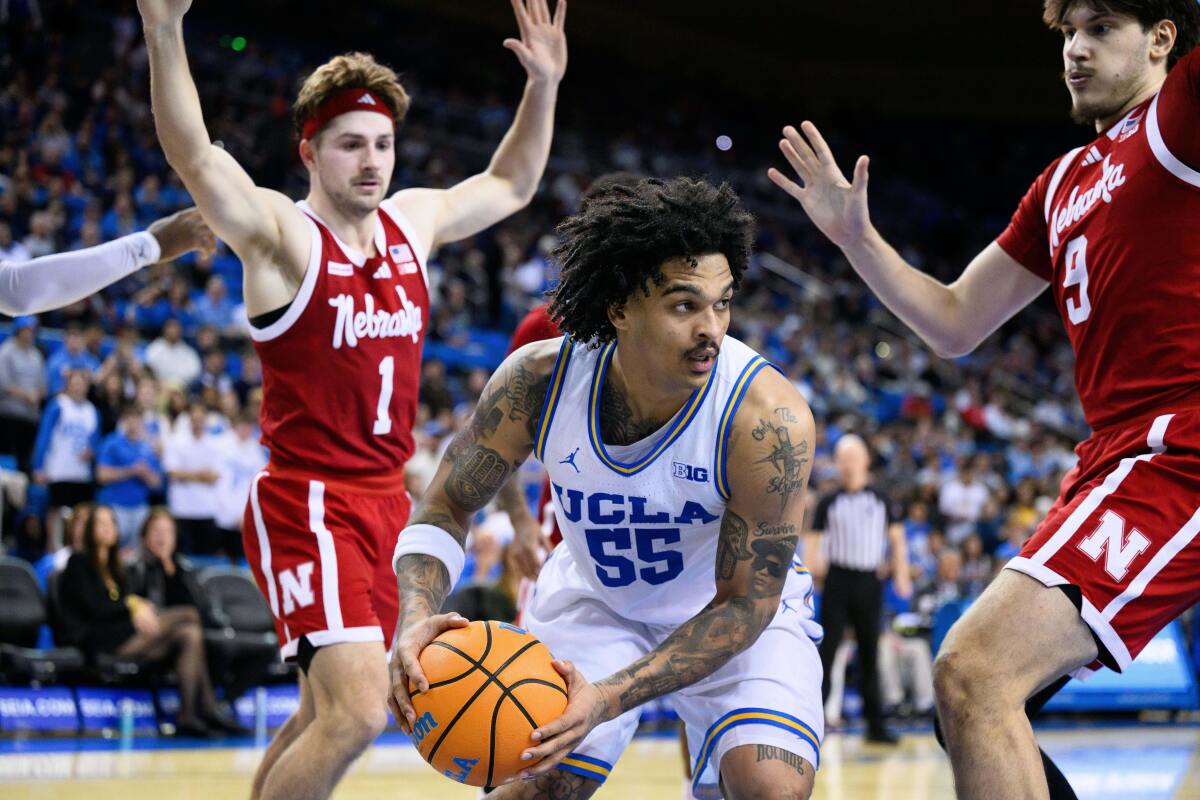
The UCLA men’s basketball team made Senior Night one to savor Tuesday, dominating No. 9 Nebraska 72-52 at Pauley Pavilion for its 20th victory of the season and third over a top-10 ranked opponent.
Trent Perry scored 20 points, Eric Dailey Jr. had 14 and three players — Tyler Bilodeau, Skyy Clark and Xavier Booker — each added eight points.
Sam Hoiberg had 12 points to lead Nebraska.
The Bruins were in control from the opening tip-off and never trailed the Cornhuskers (25-5, 14-5). UCLA improved to 10-3 in all-time against Nebraska and the win greatly strengthened its resume for an NCAA tournament berth as the Bruins also beat then-No. 4 Purdue 69-67 on Jan. 20 and then-No. 10 Illinois 95-94 in overtime on Feb. 21 on Donovan Dent’s layup with one second left.
This is the fifth time in head coach Mick Cronin’s seven seasons that the Bruins have won 20 or more games. They are 17-1 at home (their only loss in overtime to Indiana on Jan. 31).
UCLA went ahead by 15 points, 37-22, on Perry’s three-pointer with 2:41 left and led 37-24 at intermission. The Bruins shot 50% from the field in the first half (15 for 30) while Nebraska was only 31% (nine for 29).
The Bruins increased their advantage to 18 points on Dailey’s dunk less than five minutes into the second half and the visitors got no closer than nine the rest of the way.
Prior to pregame introductions the Bruins honored seniors Bilodeau, Dent and Clark; fifth-year player Jamar Brown; redshirt seniors Steven Jamerson II, Jack Seidler and Anthony Peoples Jr; and redshirt junior Evan Manjikian. In a media timeout, midway through the first half, former coach Jim Harrick (who led UCLA to its 11th national championship in 1995) was honored and got a loud ovation.
UCLA guard Skyy Clark looks to pass while under pressure from Nebraska guard Sam Hoiberg and forward Berke Buyuktuncel in the second half.
(William Liang / Associated Press)
Over the last four games, Dent has 46 assists and just two turnovers.
Bilodeau has scored in double figures in 26 of 28 games played, totaling 20 points or more nine times.
Dailey moved to within five points of reaching the 1,000-career point milestone.
UCLA has now made at least one three-pointer in 887 of 888 games dating to February 2000.
Beckett Sennecke kept the puck and shot on a two-on-one break, with Kreider backhanding the loose puck in at the side of the net.
After Leo Carlsson, Pavel Mintyukov and Ryan Poehling scored third-period goals to give the Ducks a 4-3 lead, Winnipeg’s Kyle Connor tied it with 1:22 left and Hellebuyck off for an extra attacker.
Hellebuyck made 35 saves in his first game since backstopping the United States to Olympic gold.
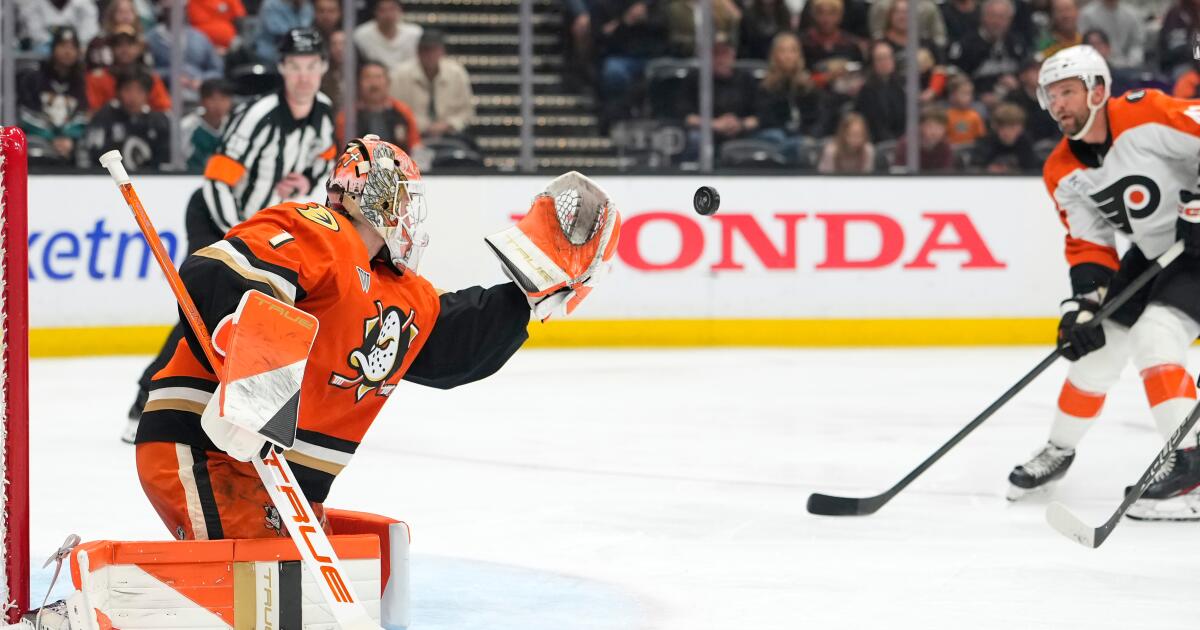
Jacob Trouba also scored for the Ducks, Sennecke had three assists and Lukas Dostal made 29 saves. The Ducks have won seven in a row at home and 11 of 13 overall.
It marked the ninth multi-goal comeback this season for the Ducks, who became the second team since the 1987-88 season to achieve such a feat through 58 games. No other team has had more than five multi-goal comeback wins this season.
The Ducks won two nights after returning from the break to beat Edmonton at home for coach Joel Quenneville’s 1,000th NHL victory. The Ducks have five games left on a nine-game homestand.
Winnipeg rookie defenseman Elias Salomonsson had his first NHL goal and Alex Iafallo and Gabriel Vilardi also scored. Well back in the race for a playoff spot, Winnipeg has a game left on three-game trip before an eight-game homestand.
Up next for the Ducks: vs. Calgary at Honda Center on Sunday.
The final medals of the Milan-Cortina Games were handed out Sunday and these Olympics truly saved the best for last, with the U.S. men’s hockey game grabbing the last gold with a 2-1 overtime win over Canada.
Of course it went to overtime. How else should a U.S.-Canada final end?
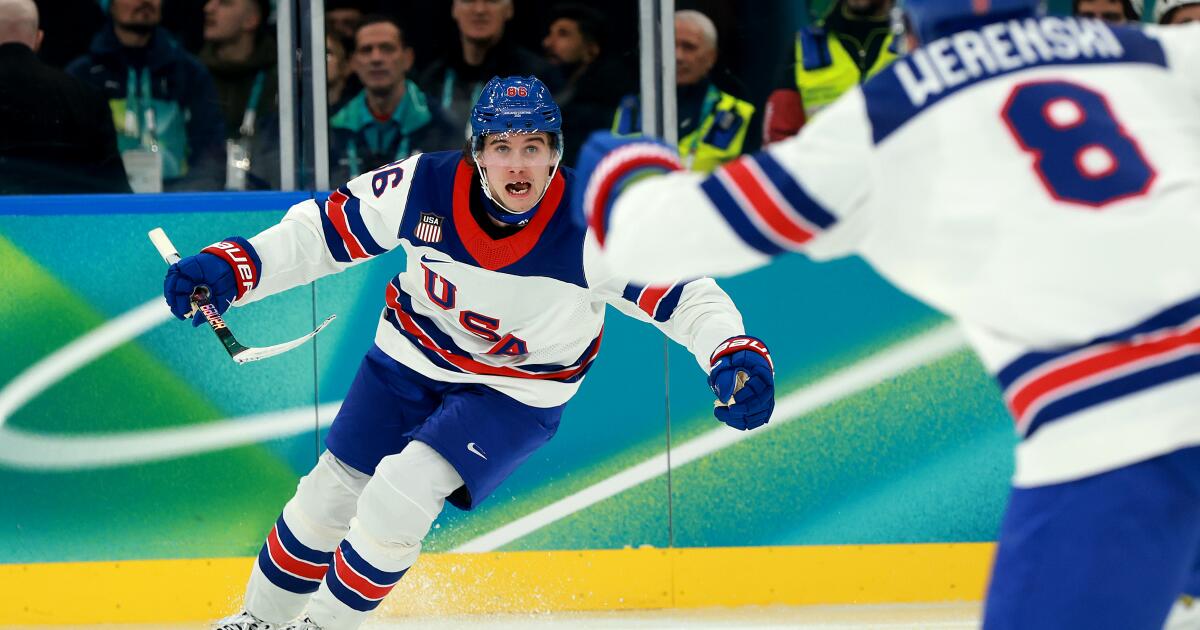
Jack Hughes, left alone on the left wing, provided the winning goal 1:41 into overtime, beating Canadian goalie Jordan Binnington cleanly and setting off a wild celebration that left the ice littered with U.S. gloves, sticks and helmets. The Canadian players watched from the bench, many with their heads in their gloves hands.
The other goals came from Matt Boldy, who gave the U.S. a lead early in the first period, and Cale Makar, who evened things for Canada late in the second.
The medal was the 33rd of these Games for the U.S. and the 12th gold, most by an American team in the Winter Olympics. They finished second to Norway, which won a record 41 medals, 18 of them gold.
The title was the Americans’ first in men’s hockey since 1980 and it came on the 46th anniversary of the “Miracle On Ice” win over the mighty Soviets, in what was essentially a semifinal in the Lake Placid Games.
The Canadian team the U.S. beat Sunday was no less mighty. It scored 27 times on its unbeaten run to the final, with Connor McDavid getting 13 points, a record for an Olympic tournament featuring NHL players. And with the NHL players returning to the Winter Games for the first time in 12 years, Canada may have had more elite-level marquee players than any team in Olympic history.
U.S. players celebrate immediately after beating Canada in overtime for the gold medal at the Milan-Cortina Olympic Games on Sunday.
(David J. Phillip / Associated Press)
But it was the U.S. that drew first blood, scoring in the sixth minute on a brilliant individual effort from Boldy. The play started with Toronto Maples Leafs captain Auston Matthews digging the puck out along the boards in the U.S. end. He then fed Boldy, a Minnesota Wild forward, who flipped the puck ahead of him as he entered the Canadian zone.
Boldy had Makar and Devon Toews to beat, which he did by skating between them before backhanding the puck by Binnington for his second goal of the tournament.
Back in the Catman Cafe in Mansfield, Mass., where Boldy’s mom Jen works as a bartender, the crowd came to its feet and cheered. It was the third time in as many elimination games that Canada trailed entering the second period.
The turning point in regulation came in a three-minute span in the middle of the second period. First, U.S. goalie Connor Hellebuyck stopped McDavid at the end of a breakaway it. Then less than a minute later, the U.S. took two penalties 28 seconds apart, giving Canada a five-on-three power play.
U.S. goaltender Connor Hellebuyck blocks a shot by Canada’s Macklin Celebrini during the third period Sunday.
(Carolyn Kaster / Associated Press)
With the crowd chanting “USA! USA!,” Hellebuyck, who stopped 41 shots in a phenomenal effort, came up big again and the Americans killed both penalties. The U.S. was 18 for 18 on the penalty kill in the tournament.
Makar, however, wouldn’t be denied later in the period, sending a blistering wrister from the center of the right circle just over Hellebuyck’s arm 84 seconds before the intermission. The score stayed that way until Hughes’ goal.
The game was arguably the most-anticipated event of the Milan-Cortina Games — in North America, if not in Italy. Hundreds of bars and restaurants in the U.S. and Canada were packed for early morning viewing parties. In Toronto, Scotiabank Arena, home to the Maple Leafs, opened its doors at 7 a.m. and sold $15 tickets to people to watch the game on TV. In Lake Placid, N.Y., the Olympic Center cafe opened to fans at 8 a.m. while in Milan, the 14,000 people packed into the Santa Giulia Arena were a sea of red Canadian jerseys and white American ones.
Six times the U.S. has finished second to Canada in an Olympic hockey tournament, the last in 2010 when Sidney Crosby’s goal in overtime gave Canada a record ninth gold medal. Crosby, Canada’s captain, did not dress for Sunday’s game after sustaining a lower-body injury earlier in the tournament.
United States players celebrate after defeating Canada for the gold medal at the Milan-Cortina Games on Sunday.
(Hassan Ammar / Associated Press)
That wasn’t the only sign this game would be different for the Americans. As the team was wrapping up its final practice in Milan on Saturday, a spider dropped from the ceiling. Don’t kill it, a local volunteer warned the players. In Italy, the appearance of a spider is considered a sign of coming good fortune.
With the U.S. beating Canada in overtime in the women’s gold-medal last Thursday, the Milan-Cortina Games marked the first time the Americans have beaten Canada in both hockey finals. Canada has swept the men’s and women’s gold three times, in 2002, 2010 and 2014.
Known for producing first-round draft picks as pitchers, Harvard-Westlake has assembled a group of hitters this season that look capable of producing lots of offense after a 15-1 season-opening five-inning win over Southlake (Texas) Carroll on Thursday at O’Malley Family Field.
Just look at the first five hitters in the lineup: Shortstop James Tronstein is headed to Vanderbilt; outfielder Ethan Price is committed to Santa Clara; center fielder Ira Rootman is a Texas commit; freshman third baseman Louis Lappe is the Little League star from El Segundo; designated hitter Jake Kim is a UCLA commit.
Freshman Louis Lappe of Harvard-Westlake got an RBI double in his first high school at-bat on a 3-and-2 count.
(Craig Weston)
Kim led the Mission League in home runs as a sophomore with seven and hit his first home run of 2026 to right field with a little help from the wind on Thursday. Rootman hit a ball so far over the left-field fence for a three-run home that it might have gone out of a big-league stadium. Lappe, in his first high school at-bat, delivered an RBI double.
“It was cool,” Lappe said. “A lot of pressure came off. I got that weight off my shoulders.”
The Wolverines have been focused on getting stronger in the weight room and no one has benefited more than Rootman, a junior who added 10 pounds and can’t wait to see how his improved strength is going make him a better hitter.
As for first impressions of Lappe, Rootman said, “I think he’s a very special kid and has so much talent it’s unbelievable.”
Justin Kirchner struck out nine in four innings. He’s a junior committed to Yale.
Boys soccer
El Camino Real 1, Palisades 0: Defending champion El Camino Real advanced to the City Section Open Division championship game with a victory in overtime. Jayden de la Cruz scored the overtime goal. El Camino Real will face the winner of Friday’s semifinal between South East and Marquez.
MILAN — A gold medal that seemed firmly in the grasp of the U.S. women’s hockey team nearly slipped through its fingers in the final of the Milan-Cortina Games on Thursday, but the Americans rallied to win 2-1 on Megan Keller’s goal just over four minutes into overtime.
Kristin O’Neill’s shorthanded goal less than a minute into the second period gave Canada its goal while Hilary Knight matched that for the U.S. with 2:04 to play, deflecting a Laila Edwards’ slap shot from the high slot through her legs and past Canadian goalie Ann-Renee Desbiens to send the game to the extra period.
The goal, Knight’s 15th in Olympic competition, broke the American record and came seconds after U.S. coach John Wroblewski had pulled his goalie for an extra attacker.
Keller then won it, taking a long Taylor Heise pass on the left wing, racing into the Canadian zone, stickhandling around defender Claire Thompson before beating goalie Desbiens cleanly.
The gold was the second in the last three Olympics for the Americans, who are ranked No. 1 in the world. Both have come against Canada while the victory was the eighth straight for the U.S. over their northern neighbor dating to last April’s world championship.
The overtime rules are unique for gold-medal games, with the teams playing three-on-three for 20-minute periods, with the first goal deciding the winner. Games cannot end in a shootout.
In the preliminary round, overtimes were limited to five minutes, followed by a five-round shootout. In the knockout stage, the overtime period was extended to 10 minutes, followed by a shootout.
None of that figured in Thursday’s result.
The young Americans, who had 12 women playing in their first Olympics, looked uncharacteristically rattled in a scoreless first period in which they took two penalties — one for too many players on the ice — and were outshot 8-6. It was just the third time in the tournament the U.S. went an entire period without a goal.
Things got worse 54 seconds into the second period when O’Neill outskated Edwards up the center of the ice on a breakaway, took a short centering pass from Laura Stacey, then deked U.S. goalie Aerin Frankel to the ice before beating her to her gloved side for the first goal of the game.
That snapped a 352-minute scoreless streak for the U.S. and marked the first time the Americans trailed in Milan.
For much of the game Canada was faster, smarter and more poised. And Desbiens was spectacular in goal. In Canada’s group-play loss to the U.S., she was pulled in the third period after giving up five goals. This time she came within two minutes of shutting out a team that had scored 31 times in its previous six games.
Alina Muller repeats history from Sochi in 2014, scoring an overtime winner as Switzerland beat Sweden 2-1 to claim bronze in the women’s ice hockey at the 2026 Winter Olympics.
Muller scored the winner 12 years ago as a 15-year-old against the same opponents in a 4-3 victory to win the bronze medal.
MILAN — The U.S. men haven’t stood on the podium at the end of an Olympic hockey tournament in 16 years and haven’t played for a medal in 12.
In fact, it’s been so long since an American hockey team took home a prize from the Winter Games none of the players on this year’s team, the second youngest in the Milan-Cortina competition, had finished high school the last time it happened.
No one on the team was even alive the last time the U.S. won gold in 1980.
This team has a chance to end that drought after beating Sweden 2-1 in overtime Wednesday to advance to Friday’s semifinals, where they will play Slovakia. The win was the Americans’ first over Sweden in an Olympic tournament in nine games dating to 1960.
The winning goal came from Quinn Hughes 3:27 into the extra period. Canada also advanced to the semifinals, overcoming one-goal deficits twice to beat Czechia 4-3 in overtime. Canada will play Finland, another overtime winner, in its semifinals.
The first U.S. goal came from Dylan Larkin of the Detroit Red Wings but Sweden forced the overtime when it pulled its goalie, allowing Mika Zibanejad to score on a slap shot from the left circle with 91 seconds left in regulation.
Hughes, a Minnesota Wild defenseman, then ended things, circling around the ice to create space, then skating into the high slot and blasting a shot between two defenders and past Swedish goalie Jacob Markstrom.
“Quinn, he’s a special player,” said defenseman Noah Hanifin of the Vegas Golden Knights. “So much swagger and confidence on the ice. And he’s always looking to take over. He did that for us in overtime.”
The game began like a heavyweight title fight, with both teams cautiously probing the other for weaknesses. The U.S. finally found one midway through the second period with Larkin deflecting in a one-timer from Jack Hughes at the blue line. Hughes’ shot was headed directly into the pads of Markstrom, who was perfectly positioned for an easy save, before Larkin, perched on the doorstep, reached out to deflect the puck by Markstrom on his gloved side.
The Americans haven’t trailed since the middle of the second period of their second game. But losing a lead with just 1 ½ minutes to play tested the team’s “character, just the will to win,” forward Brady Tkachuk said.
“That’s something that can deflate you and end your tournament, if you don’t just put your mind back in a good spot,” he added. “It shows the character being able to bounce back get that one.”
“That’s a big momentum shift. But there wasn’t any panic,” Charlie McAvoy added. “I got back to the bench [and] it’s just you’ve got to flush it. That was kind of what I was saying to myself. It’s a tie game now.”
Dylan Larkin (21) is congratulated by U.S. teammates on the bench as he skates off the ice after scoring a goal against Sweden during the second period Wednesday.
(Hassan Ammar / Associated Press)
It didn’t stay that way for long before Hughes broke Sweden’s heart, beating Markstrom cleanly. Markstrom was otherwise spectacular, making 38 saves — two with his helmeted head and probably deserved a better fate.
In the last two Olympic tournaments the Americans, playing without NHL players, were bounced in the quarterfinals while Canada got no further than the bronze-medal game. The top pros didn’t participate in the 2018 Games because of a dispute between the NHL and the International Olympic Committee regarding insurance, travel costs and marketing rights. They were held out four years ago over scheduling complications caused by the coronavirus pandemic.
Not surprisingly, getting some of the best players in the world back has made a difference, with the unbeaten Canadians rolling to a tournament-best plus-18 goal differential while the averaged 4 1/2 goals a game in their four wins.
“It’s been unreal,” Hanifin said of the tournament. “It’s so fun to be a part of. Anytime you get into these one-game eliminations, anything can happen so you’ve got to be to be prepared.
“But that’s part of what makes the Olympics so special and hard to win.”
Canada’s comeback spoiled good performances by a pair of Anaheim Ducks. Defenseman Radko Gudas got an assist on the Czechs’ first score while NHL teammate Lukas Dostal turned away 37 shots in goal. But Montreal Canadiens’ captain Nick Suzuki got a fortunate bounce on a deflection to tie the score with 3:27 left in regulation before Vegas’ Mitch Marner scored the game-winner 82 seconds in overtime for Canada, which led for less than six minutes.
On his way to the dressing room, Gudas picked some snow off the ice and kissed it. At 35, this was his second and likely last Olympic tournament.
“It’s a mix of emotions, because you feel sad but proud in the same time,” said Dostal, who was playing in his first Olympics. “It hurts. It’s probably gonna hurt for a long time.”
The victory might have come at a high cost for Canada, which saw captain Sidney Crosby limp to the dressing room in the second period following a collision with Gudas along the boards. Crosby, who has two goals and four assists in the tournament, will undergo an MRI exam on Thursday; his status for Friday’s semifinal is unknown.
For the U.S. and Canada, two more wins brings a gold medal while a loss Friday means that dream is over.
“It’s a one-game tournament,” Canada’s Tom Wilson said. “It’s not seven games. It’s a one-game tournament. And everybody thinks they can win.”
Lakers star LeBron James eased his way to the interview podium Sunday with a giant water jug in his hand and a do-rag covering his hair, the last of the NBA All-Stars to speak with the media.
James was selected as a reserve, breaking his NBA record of 21 consecutive starts but extending his record for most appearances to 22.
At 41 and playing in his record 23rd season, James was asked about his future, because his eventual retirement always seems to be a source of curiosity.
So, James was asked before he played in the “U.S. vs. “World” All-Star Game tournament at Intuit Dome whether he had any inkling about what he wants to do next season.
“I want to live,” James said. “When I know, you guys will know. I don’t know. I have no idea. I just want to live. That’s all.”
James played on Team Stripes, joining fellow veterans Kevin Durant and Stephen Curry, who didn’t play because of a right knee injury.
They are long-time combatants, friends and U.S. Olympic teammates. And they are All-Stars again, all older than 37 and still playing at a high level.
“It’s always an honor to see those guys,” James said. “We have had such an unbelievable journey throughout our individual careers and then intersecting at certain points in our careers, matchups in the regular season, Finals appearances, postseason appearances, then Olympics two summers ago. When it comes to me, Steph and KD, we’ll be interlocked for the rest of our careers, for sure. It’s been great to be able to have some moments with those guys, versus those guys, teaming up with those guys.”
The All-Star format has changed from East versus West to U.S. versus the World.
Team Stars forward Scottie Barnes, left, celebrates with Cade Cunningham after hitting a three to beat Team World in the first matchup of the All-Star Game tournament Sunday at Intuit Dome.
(Jae C. Hong / Associated Press)
There were three teams — Team Stars, Team Stripes and Team World, and they played 12-minute games in a round-robin tournament.
Game 1 was Team World vs. Team Stars, a game that went into overtime after Anthony Edwards tied the score 32-32 at the end of the first 12 minutes.
Team Stars, the first team to score five points in overtime, won 37-35 on a Scottie Barnes three-pointer,.
Victor Wembanyama led Team World with 14 points, six rebounds and three blocks.
Anthony Edwards had 13 points for Team Stars, which will play Team Stripes next.
James and Clippers star Kawhi Leonard are on the USA Stripes and Lakers superstar Luka Doncic, the leading all-star vote getter, is on Team World because he is from Slovenia.
James was asked whether he could have ever imagined a USA versus the World all-star format.
“No,” James said, laughing. “No. I mean, East-West is definitely, it’s a tradition. It’s been really good. Obviously, I like the East and West format. But they are trying something. But we’ll see what happens. I mean, it’s the US versus the World. The World is gigantic over the U.S. So, I’m just trying to figure out how that makes sense. But, I don’t want to dive too much into that. Yeah, East-West is great. We’ll see what happens with this.”
Just before the tipoff of the first game, former President Barack Obama and former First Lady Michelle Obama were introduced to a standing ovation.