overthrow

Can US, Middle Eastern powers unite Libya 15 years after Gaddafi overthrow? | Conflict News

Fifteen years since the uprising against Muammar Gaddafi in Libya began, and with civil strife leading to the downfall of what was once one of Africa’s wealthiest countries, several actors are seeking to end the civil war and reunite the country.

Among them are the US, which has commercial interests in Libya’s oil fields. Qatar, Egypt and Turkiye are also pushing for a return to “One Libya”, after more than a decade of fighting between two rival authorities for control of the country.

Recommended Stories

list of 4 itemsend of list

Here’s what we know:

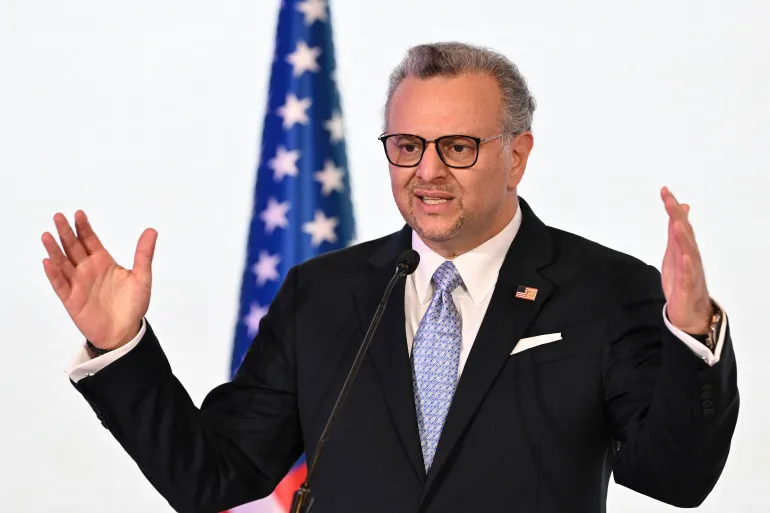
US Department of State's senior advisor to the president for Arab and African Affairs, Massad Fares Boulos, speaks during the signing ceremony of the Doha Framework for a Comprehensive Peace Agreement between the DRC Government and the Congo River Alliance/March 23 Movement (AFC/M23) in Doha on November 15, 2025.
US Department of State’s senior adviser to the president for Arab and African Affairs, Massad Fares Boulos, speaks in Doha, November 15, 2025 [AFP]

What happened 15 years ago?

The Libyan uprising erupted during the Arab Spring, when thousands of people in the port city of Benghazi took to the streets to protest against Gaddafi’s more than four decades of absolute power.

Violence against the demonstrations pushed the protesters into an armed rebellion against Gaddafi’s rule, with a civil war starting between the two sides.

A United Nations Security Council resolution authorised an international military intervention force – led by NATO members, the United States, United Kingdom and France – to enforce a no-fly zone and ensure the protection of civilians in Libya. This bombing campaign pushed back Gaddafi’s forces from Benghazi and aided the rebels in seizing territory.

Gaddafi was eventually captured and killed in October 2011, 42 years after he first seized power in a military coup that overthrew King Idris.

How is Libya divided?

Following Gaddafi’s death, a power vacuum emerged, with multiple groups – and their allied militias – competing for power.

Control of the country is now split between two rival administrations: the UN-recognised Government of National Unity (GNU) in Tripoli, led by Prime Minister Abdul Hamid Dheibah, and the eastern, Tobruk-based administration backed by Khalifa Haftar and his self-styled Libyan National Army (LNA).

The GNU is recognised by the UN and other countries, and officially has authority in the capital and western Libya.

Under Gaddafi, Haftar was exiled in the US for two decades where he holds citizenship.

His forces control vast resource-rich lands in the east, including the strategic port city of Benghazi, reportedly with the backing of Russia.

The UN began formal mediation efforts in 2020 under the UN Support Mission in Libya (UNSMIL). This roadmap advocates for a three-track strategy that includes unifying the two rival administrations, presidential and parliamentary elections, and hosting national dialogue meetings.

The US was a key mediator behind the scenes, and in May 2021, appointed Ambassador Richard Norlan as Special Envoy to Libya, to lead high-level talks between the two sides.

What is the US’s new plan?

Under Massad Boulous, US President Donald Trump’s African and Middle Eastern affairs adviser, and father-in-law to Tiffany Trump, Washington is intensifying efforts to reunite the country. But this can only be achieved if both sides agree to form a single government.

According to leaked details, Trump’s initiative centres on the promise that if the rival governments cooperate, the US would encourage American investment in Libya’s sizable oil fields. This comes as the Libyan Central Bank, which is attempting to finance both authorities, sounds the alarm over the dire economic situation.

While Tripoli has international legitimacy, Haftar’s forces control the oilfields and terminals.

The US is also proposing a power-sharing deal that would see Dheibah continue to lead the government while Haftar’s son and LNA army chief, 35-year-old Saddam Haftar, serves as president.

There are obvious opportunities for US energy companies and economic and political incentives for European countries in a unified and stable Libya.

They include stopping irregular migration from Libya and other North African countries to the EU.

Some criticise the US-led plan as lacking input from the Libyan people. The deal, some say, could entrench the power of political dynasties, which might be best for long-term stability in Libya.

TRIPOLI, LIBYA - JULY 28: Protesters place piles of rubble at the entrances of the company buildings as demonstrations over the prolonged power cuts continue outside the buildings of companies affiliated with Libya's National Oil Corporation (NOC) in the Zahra district of Tripoli, Libya, on July 28, 2026, to protest daily electricity outages across the country. ( Hamza Al Ahmar - Anadolu Agency )
Protesters in Tripoli against prolonged power cuts aimed at Libya’s National Oil Corporation, July 28, 2026, [Hamza Al Ahmar/Anadolu Agency]

What have the results been?

There are signs that Haftar’s camp, at least, is on board with the US plan. Saddam Haftar, whose father, Khalifa, was based in Virginia until 2011, reportedly met with US Secretary of State Marco Rubio in DC in July.

Experts attribute the ongoing mediation efforts to the unified national budget of 2026, signed in April – the first in more than a decade.

However, there are still no talks or signs of a unified government forming.

What is Turkiye’s role?

Turkiye, which earlier deployed troops to support the GNU, has also made efforts to mediate between the two sides and is pushing a ‘One Libya’ policy.

Last month, Foreign Affairs Minister, Hakan Fidan, met with Saddam Haftar in Ankara. Earlier this month, Fidan travelled to both Tripoli and Benghazi for high-level talks with Dheibah and Khalifa Haftar.

What has Egypt done?

The Egyptian government has traditionally cooperated with Haftar’s Tobruk government, which is just across the border.

On Wednesday, President Abdel Fattah el-Sisi met with Khalifa Haftar in Cairo and discussed unification talks.

Earlier this month, Dheibah visited Cairo, while Egyptian intelligence chief Hassan Rashad travelled to Tripoli.

What is Qatar’s stance?

Qatar has largely backed the UN mediation channels in Libya: the UNSMIL and the UN roadmap for peace.

While it has good relations with the GNU, Qatar seeks stabilisation efforts led by Libyan parties and elections.

In April, Qatar and other states welcomed the unified budget for 2026. A statement issued by Qatar, Egypt, France, Germany and several others called for all parties in Libya to follow the UN roadmap to “advance a Libyan-led political process leading to unified governance and national elections.”
Source link

Ex-Defense Secretary Donald Rumsfeld dead at 88, family says

Calling Donald H. Rumsfeld energetic was like calling the Pacific wide. When others would rest, he would run. While others sat, he stood. But try as he might, at the pinnacle of his career as Defense secretary, he could not outmaneuver the ruinous politics of the Iraq war.

Regarded by former colleagues as equally smart and combative, patriotic and politically cunning, Rumsfeld had a storied career in government under four presidents as well as nearly a quarter century in corporate America. After retiring in 2008 he headed the Rumsfeld Foundation to promote public service and to work with charities that provide services and support for military families and wounded veterans.

The two-time Defense secretary and one-time presidential candidate died Tuesday, surrounded by his family in Taos, N.M. He was 88.

“Rummy,” as he was often called, was ambitious, witty, engaging and capable of great personal warmth. But he irritated many with his confrontational style. An accomplished wrestler in college, Rumsfeld relished verbal sparring and elevated it to an art form; biting humor was a favorite weapon.

Still, he built a network of loyalists who admired his work ethic, intelligence and impatience with all who failed to share his sense of urgency.

From his earliest years in Washington, he was seen by friend and foe alike as a formidable political force. Bryce Harlow, an associate of President Nixon who helped persuade Rumsfeld to resign from Congress and join Nixon’s Cabinet as director of the Office of Economic Opportunity in 1969, called him “rough and ready, willing to tangle” and “the kind of guy who would walk on a blue flame to get a job done.”

Rumsfeld is the only person to serve twice as Pentagon chief. The first time, from 1975 to 1977, he was the youngest ever. The next time, from 2001 to 2006, he was the oldest.

He made a brief run for the 1988 Republican presidential nomination, a spectacular flop that he once described as humbling after being used to success at the highest levels of the government, including stints as White House chief of staff, a U.S. ambassador and a member of Congress.

For all Rumsfeld’s achievements, it was the setbacks in Iraq in the twilight of his career that will likely etch the most vivid features of his legacy.

::

By the time he arrived at the Pentagon in January 2001 for his second stint as Defense secretary, the military that Rumsfeld inherited was in a slow-motion transition from the Cold War era to a period dominated by ethnic conflicts in the Balkans, humanitarian crises in the Horn of Africa and spasms of terrorism around the globe. Among the other prominent worries: China’s military buildup and the nuclear ambitions of Iran and North Korea.

But nine months into his tenure, on Sept. 11, Rumsfeld found himself facing a threat that would consume the remaining years of his tenure. When a hijacked American Airlines jetliner slammed into the Pentagon, he was in his third-floor office, meeting with nine House members. He later recalled that at the instant of impact, the small wood table at which they were working trembled.

Rumsfeld was among the first to reach the smoldering crash site, and he helped carry the wounded in stretchers before returning to his duties inside the building.

The nation suddenly was at war. U.S. forces invaded Afghanistan on Oct. 7, and with Rumsfeld at the Pentagon helm, the Taliban government in Kabul was toppled within weeks. Frequently presiding at televised briefings on the war, Rumsfeld became something of a TV star, known for his plainspokenness.

Within months of that success, President George W. Bush’s attention shifted to Iraq, which had played no role in the Sept. 11 attacks. Rumsfeld and others in the administration asserted that Iraqi President Saddam Hussein was armed with nuclear, biological or chemical weapons, and that the U.S. could not afford the risk of Hussein one day providing some of those arms to Al Qaeda or other terrorist groups.

The U.S.-led invasion of Iraq was launched in March 2003 with a go-ahead from Congress but no authorization from the United Nations Security Council. Baghdad fell quickly, but U.S. and allied forces soon became consumed with a violent Iraqi insurgency. Critics faulted Rumsfeld for dismissing the public assessment of the Army’s top general, Eric K. Shinseki, that several hundred thousand allied troops would be needed to stabilize Iraq.

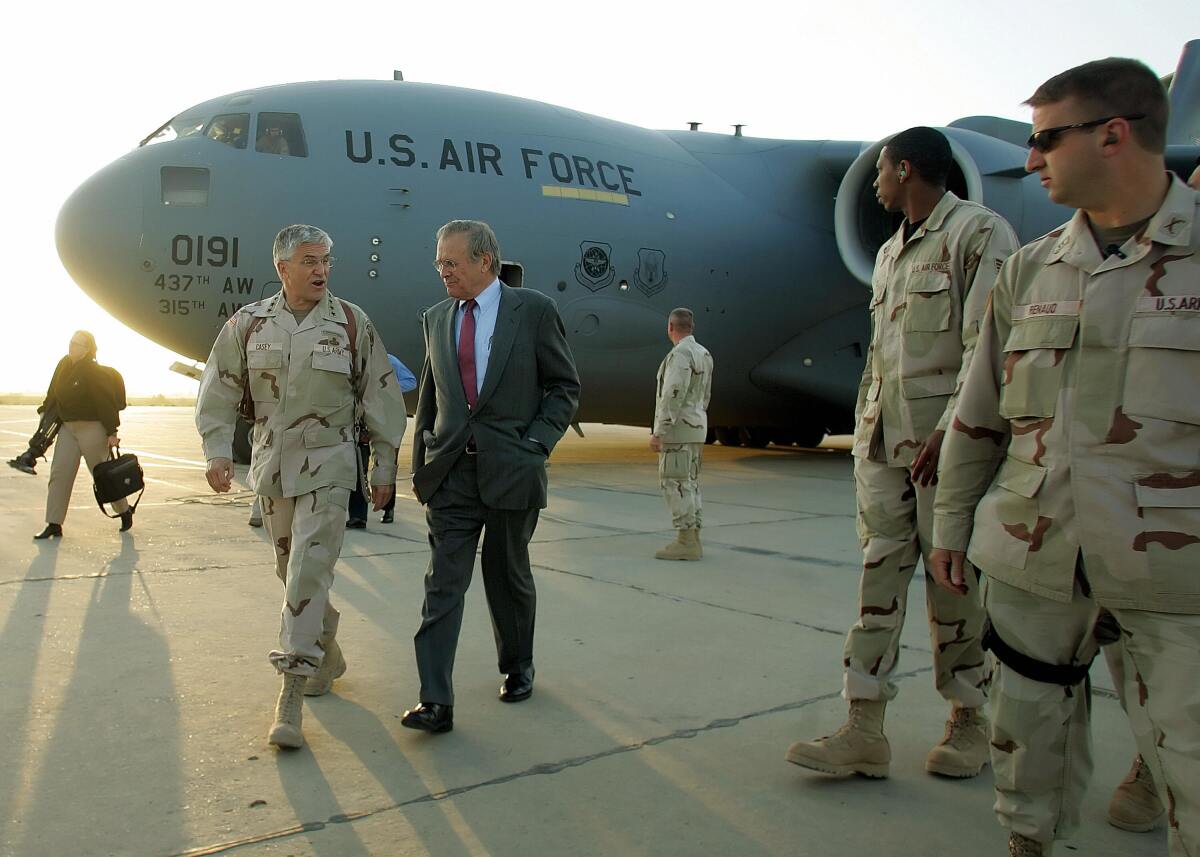
Donald H. Rumsfeld walks on an airport tarmac with a U.S. military official.

Defense Secretary Donald H. Rumsfeld arrives in Baghdad in April 2006 to meet with U.S. and new Iraqi government officials.

(Jim Watson / AFP/Getty Images)

Square-jawed with an acid tongue, Rumsfeld grew combative in defense of the war effort, and became a lightning rod for Democrats’ criticism. Years afterward, the degree of blame that should be shared among the White House, Rumsfeld and the U.S. military for the disasters in Iraq remained in debate.

In “By His Own Rules,” a 2009 biography of Rumsfeld, author Bradley Graham wrote that it was “both incorrect and unfair to heap singular blame” for Iraq on Rumsfeld.

“But much of what befell Rumsfeld resulted from his own behavior,” Graham wrote. “He is apt to be remembered as much for how he did things as for what he did. And here, too, he was an internal contradiction. Capable of genuine charm, kindness and grace, he all too frequently came across as brusque and domineering, often alienating others and making enemies where he needed friends.”

In his 2011 memoir, “Known and Unknown,” Rumsfeld offered no hint of regret about Iraq, but acknowledged that its future remained in doubt.

“While the road not traveled always looks smoother, the cold reality of a Hussein regime in Baghdad most likely would mean a Middle East far more perilous than it is today,” he wrote.

He seemed unconvinced that the failure to find weapons of mass destruction in Iraq poked a hole in the justification for invading, writing: “Our failure to confront Iraq would have sent a message to other nations that neither America nor any other nation was willing to stand in the way of their support for terrorism and pursuit of weapons of mass destruction.”

Rumsfeld twice offered his resignation to Bush in 2004 amid disclosures that U.S. troops had abused detainees at Iraq’s Abu Ghraib prison — an episode he later referred to as his darkest hour as Defense secretary.

Not until November 2006, after Democrats gained control of Congress by riding a wave of antiwar sentiment, did Bush finally decide he had to go. Rumsfeld left office in December and was replaced by another Republican, Robert M. Gates.

Defiant to the end, Rumsfeld expressed no regrets in his farewell ceremony, at which point the U.S. military’s death toll in Iraq had surpassed 2,900. The number would eventually exceed 4,400.

“It may well be comforting to some to consider graceful exits from the agonies and, indeed, the ugliness of combat,” he told his colleagues. “But the enemy thinks differently.”

::

Born in Chicago in 1932 as the second child of George and Jeannette Rumsfeld, Donald Rumsfeld wrote in his memoir that he and his father shared a favorite sports team: the Chicago Bears. He recalled that while listening to a Bears game on the radio at home one Sunday in 1941, the announcer interrupted the broadcast to announce that Japanese airplanes had launched a surprise attack on Hawaii.

Rumsfeld was 9.

“I could feel that something terrible had happened,” he wrote. “I saw it in my parents’ faces and heard it in the tense voices reporting the news of the attack.”

After Pearl Harbor, Rumsfeld’s father joined the Navy at age 38, and the family moved frequently to be near him on the West Coast.

In high school Rumsfeld met his future wife, Joyce Pierson. He attended Princeton on a partial scholarship and joined the campus Navy ROTC program to cover his other expenses. In June 1954, Rumsfeld graduated and was commissioned an ensign in the Navy. Six months later he married Joyce.

Rumsfeld launched his Washington career in 1957 as an assistant to Rep. David Dennison (R-Ohio). Soon he was serving as a congressman himself, first elected to represent Illinois in 1962. He served four terms.

One of his early acts as a member of the Nixon White House was to hire a young Dick Cheney, starting a lifelong friendship.

Rumsfeld was working as U.S. ambassador to NATO in Brussels when he was recalled to Washington to lead President Ford’s transition team after Nixon resigned in August 1974. He became the new president’s chief of staff, and in November 1975, his Defense secretary.

After leaving the Pentagon in 1977, Rumsfeld embarked on a successful business career, including as chief executive officer, president and then chairman of G.D. Searle & Co., a major prescription drug manufacturer.

He still dabbled in government service, including serving as a special envoy to the Middle East for President Reagan from 1983 to 1984. It was in that capacity that he met with Saddam Hussein in Baghdad in December 1983, while Iraq was at war with Iran.

“None of us in the Reagan administration bore any illusions about Saddam,” Rumsfeld wrote in his memoir. “Like most despots, his career was forged in conflict and hardened by bloodshed. He had used chemical toxins in the war he initiated with Iran three years earlier. But given the reality of the Middle East, then as now, America often had to deal with rulers who were deemed ‘less bad’ than the others.”

Two decades later, he was again dealing with Hussein, this time overseeing a U.S. invasion that toppled the Iraqi leader — and led to Rumsfeld’s own downfall.

He is survived by his wife, Joyce; three children; and his grandchildren.


Source link