overlooked

I stayed in colourful UK city often overlooked because of its famous neighbour

I visited a unique British city which has plenty of character, a liberal vibe and a thriving art scene, but it’s often overshadowed by its posher neighbour

Britain boasts numerous cities waiting to be explored, and it’s remarkable how distinctive each one is, moulded by its heritage, residents, and surrounding terrain. I recently returned to a British city I’ve visited before, and whilst much has evolved in this vibrant metropolis over the years, it frequently gets overlooked because of its more celebrated neighbour.

I’ve been travelling to Bristol for several decades now, and the city conjures up warm memories of the Lakota nightclub from the late 1990s – the night spot is still open.

This urban centre has always possessed a rebellious “soul” with an independent spirit – and in recent years, the Green Party have effectively assumed complete control of Bristol City Council. During my visit to the city, I was struck by how spotless it was in the shopping area – and also how welcoming locals were.

As with everywhere else I’ve travelled to recently, there appears to be substantial construction underway in Bristol as the need for new housing continues to surge, but the city also boasts some striking, well-maintained period buildings.

I observed that many of the historic structures in Bristol were constructed from the same stone as those in the neighbouring city of Bath – and Bristol is frequently overshadowed when compared to the more conventionally picturesque city of Bath.

Nevertheless, Bristol possesses its own distinctive appeal and a progressive atmosphere, the city has a multicultural population alongside a flourishing arts culture, as well as some excellent retail and culinary destinations.

Bristol’s historic structures, constructed from a honey-hued limestone (referred to as Bath stone), contrast strikingly with the contemporary cityscape, whilst numerous modern buildings in Bristol have been decorated in vibrant colours, enhancing its distinctive charm.

A trip to Bristol can often prove more budget-friendly than Bath, and the city boasts excellent transport connections including a train service to London taking merely one hour and 30 minutes.

During my visit to Bristol I was accommodated at the Clayton Hotel on Broad Street, this four-star establishment occupies what was formerly a historic printworks location – with the structure dating back to approximately 1900.

The hotel’s striking Art Nouveau facade was created by William James Neatby, who served as the principal designer at Royal Doulton throughout the late 1800s to the early 1900s.

Broad Street itself proved fascinating, as upon exiting the hotel and glancing right, positioned just at the street’s end stood an ancient church, St Johns, which I’ve since learnt originates from medieval times and sits within the original city walls.

Visitors can pass through an archway of St Johns church (Nelson Street) to reach a main thoroughfare and considerably newer section of the city, creating the genuine sensation of travelling back in time; this district comprises Bristol’s old town.

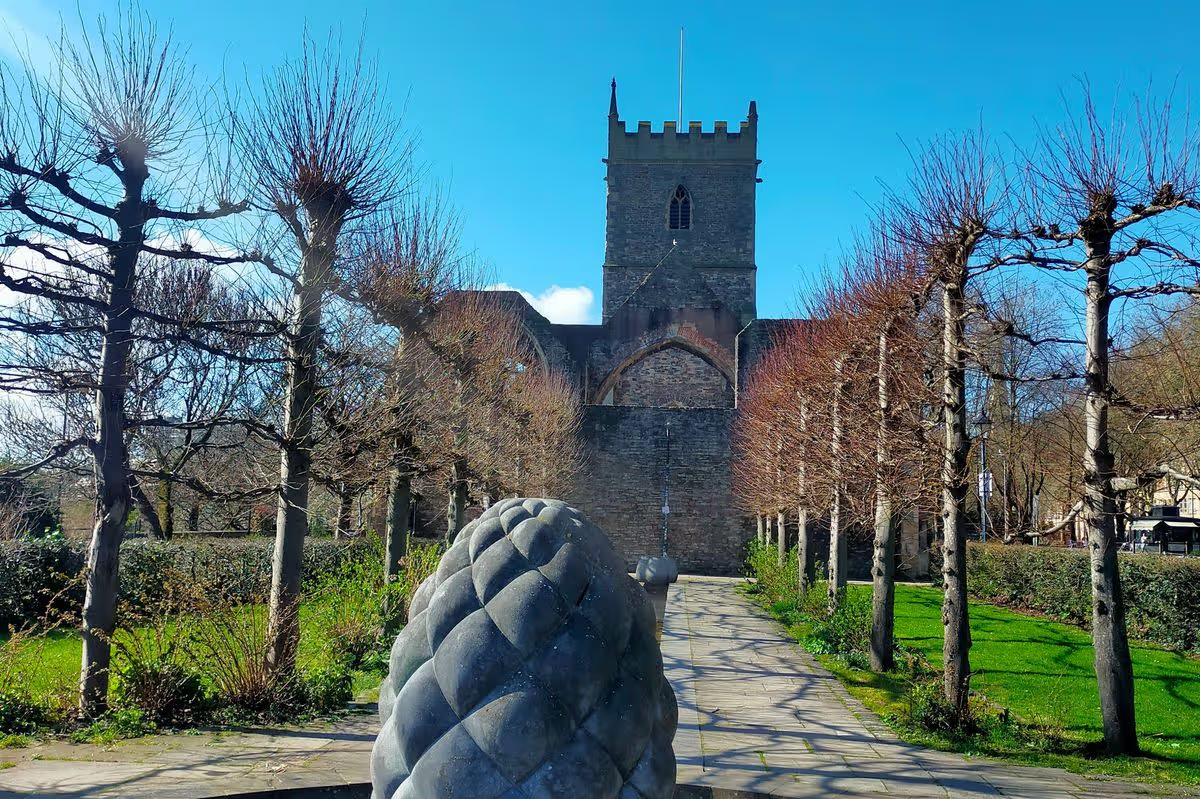
Stumbling upon remnants of Bristol’s historic quarters is captivating, and nestled within the charming Castle Park in the city stands another church (St Peter’s) which traces its origins to the 11th century, encircled by a Physic Garden – and spending time here allows you to envision the lives that once unfolded in centuries past.

Today, Bristol city centre sits just 30 minutes from Bristol Airport with regular buses and coaches ferrying passengers back and forth – and there are rail connections or coaches to South West locations including Cornwall or Devon.

Many people mistakenly believe that Bristol sits within Somerset, but the city and its surrounding areas are actually an independent county corporate, established as far back as 1373, with a present-day unitary authority council.

The About Bristol website put it clearly: “Bristol is the largest city in the south west of England, with a population of approximately half a million.

“The city lies between Somerset and Gloucestershire and has been politically administered by both counties in part at various times. However, Bristol is historically a county in its own right and is properly entitled the City and County of Bristol.”

So what makes Bristol “better” than Bath, well there’s the Banksy claim to fame and the Banksy trail – and I’ve encountered a couple of these iconic works on previous trips.

Then there’s the nightlife. During this visit I attended an experimental gig at Strange Brew and the vibe was edgy yet inviting (that encapsulates Bristol perfectly I’d say).

Bath is undeniably a beautiful city to explore, but it exudes an air of affluence, whereas Bristol, rich in its own history, has a more down-to-earth vibe – and there are far fewer tourists to navigate around.

Indeed, Bristol made headlines in 2020 when a historical contentious bronze statue of Bristol-born slave trader Edward Colston was defaced and toppled during an anti-racism protest nearly six years ago – and this certainly raised some eyebrows at the time.

Those involved were making a stand and delivering a significant message, despite many labelling the statue’s toppling as vandalism at the time.

This act by protesters will also be etched in history as those responsible spotlighted Colston’s involvement in the Atlantic slave trade, in a manner that brought it to the attention of a wider audience – and I believe Bristol will always possess a rebellious spirit, it’s simply the nature of the city.
Source link

Overlooked castle crowned ‘stunning’ with ‘super detailed’ interior and Italian-style gardens

The 13th-century National Trust castle features the UK’s largest private collection of South and East Asian artefacts and Britain’s best baroque terraced gardens

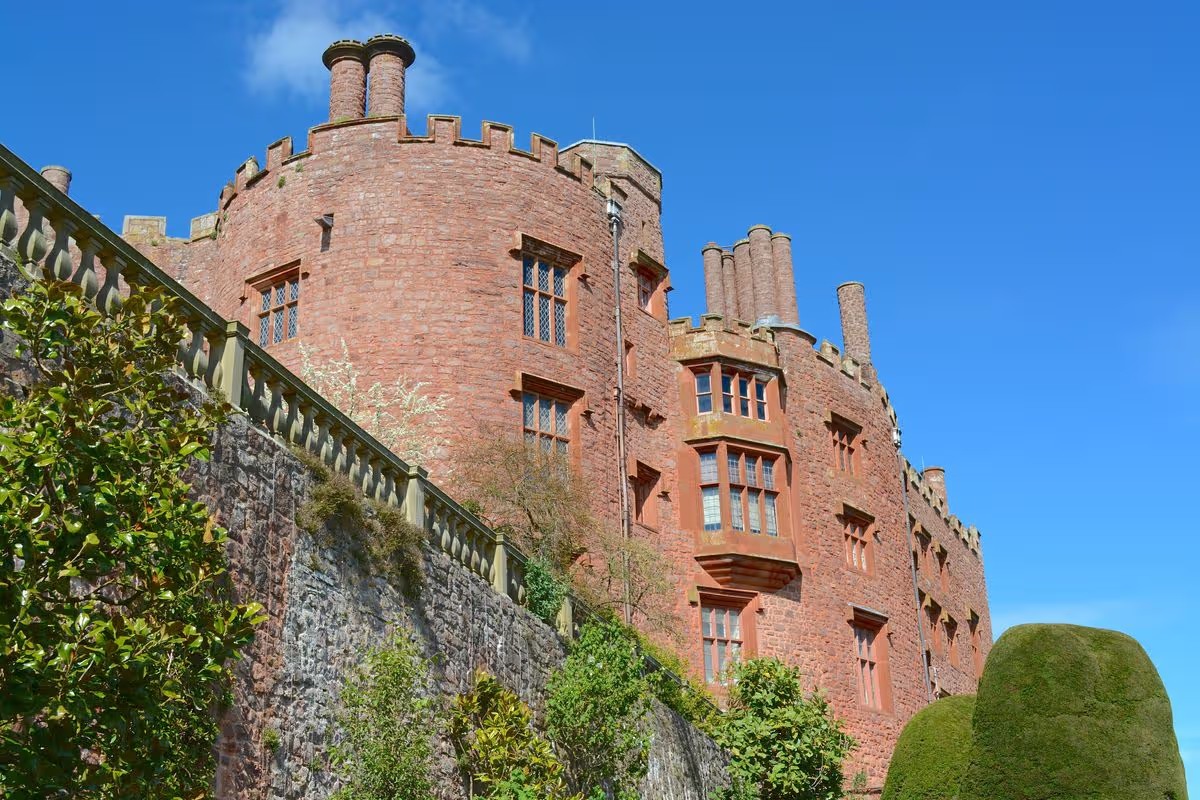
Nestled close to the English-Welsh border, in the town of Welshpool, stands a genuine fairy-tale fortress which appears straight out of a storybook and provides a vibrant splash of colour against its sprawling green backdrop.

Built in the 13th century, this mediaeval stronghold is brimming with stories and continues to evolve, much to the delight of those who visit.

For the perfect day spent appreciating historic architecture, discovering a different heritage and exploring the most spectacular of gardens, Powis Castle is the destination to seek out.

Its most recent ownership belonged to the same family, who resided in the castle from as early as the 1570s – the Herbert family. This continued until the castle and its grounds were handed over to the National Trust in 1952 by the 4th Earl of Powis.

Best holiday cottage deals in Wales

This article contains affiliate links, we will receive a commission on any sales we generate from it. Learn more
Sykes Cottages

From £35 per night

Sykes Cottages

See the deals

Wales is renowned for its stunning mountains, picturesque coastline and rich Celtic history. Sykes has a wide and varied collection of holiday cottages, houses and apartments across the country. Prices start from £35 per night with current deals.

One TripAdvisor reviewer said: “This site is stunning. I was blown away by how picturesque the place is.”

Another wrote: “This place really exceeded my expectations. The interior is super detailed and interesting, with some spectacular pieces of furniture.

“The gardens are truly beautiful on a lovely warm hillside and some stupendous giant yew trees. Has to be seen.”

History

The heritage of this fortress stretches back hundreds of years, encompassing numerous owners, as the property expanded and transformed, whilst preserving its original character throughout.

However, it all started in the 13th century when a Welsh prince, Gruffudd ap Gwenwynwyn, established some independence. When he and the remainder of his direct lineage died in 1309, leaving no male heir, the castle passed to an heiress called Hawise. She then married Sir John Charlton from Shropshire.

The fortress came under attack during this period from Hawise’s uncle, who was trying to claim the lordship he believed he was entitled to instead of her, but was unsuccessful.

In response, they chose to repair the damage and constructed two imposing drum towers on either side of the castle’s west entrance. Charlton’s descendants remarkably remained lords of Powis for more than 100 years, until no male heir could be found.

Consequently, in 1421, the castle was split between two daughters, after which the fortress entered a sharp decline, desperately needing restoration following years of abandonment. Before long, it was taken over and lovingly rebuilt before being leased to the Herbert family.

Most significantly since that time, one of the most substantial changes occurred when the Clive family introduced what is now recognised as the Clive collection. A collection teeming with South and East Asian artefacts exhibited in the castle, and the largest private collection of its kind in Britain.

Clive Collection

What makes this fortress particularly unique is its fascinating array of artefacts housed within it. Originally assembled by two generations of the Clive family, comprising Robert and his son Edward, who had wed Henrietta Herbert, the daughter of the 1st Earl of Powis.

The collection was assembled during Britain’s colonial rule of India, when these artefacts were removed from their country of origin and brought to the castle, starting in the 1800s. Today it houses more than 1,000 pieces originating from South and East Asia.

According to its website, visitors can expect to discover an extensive array of ivories, textiles, statues of Hindu deities, decorative silver and gold, weapons and ceremonial armour.

Naturally, this remarkable collection carries with it a troubling past, one which connects the castle to a proprietor who played a role in the invasion of India. Robert Clive was directly employed by the East India Company, which sent armies to both invade and subjugate India.

In doing so, they exploited the nation financially and profited from the natural resources it possessed. This contributed to establishing the British Empire’s presence within India and, consequently, secured a lifetime of riches and prosperity for Clive, which is evident in the castle’s magnificence.

Gardens

Beyond the striking castle itself, the true highlight of the estate lies in its grounds and immaculately-maintained gardens. Part of its impressive display of flowers, plants and trees is attributed to the captivating hedging that encircles the castle.

It covers up to 8,500 square metres of the estate, with the yett, tumps and top terrace contributing an extra 7,000 square metres to that figure. And with this comes some extreme-gardening methods adopted by the National Trust to guarantee it stays in impeccable condition.

To put that into perspective, it states that one skilled gardener can spend up to 10 weeks annually working at height, using a hydraulic cherry picker to trim and sculpt the towering hedges. That represents just one element of these magnificent gardens.

What makes them particularly remarkable is their Italian-influenced design dating back to 1680. The gardens at Powis Castle are regarded as the finest surviving example of a baroque terraced garden in the entire country – blending both Italian and French influences.

Without a National Trust membership, it costs £18 for entry to the castle and gardens for an adult, excluding gift aid. Meanwhile, children will be charged £9, while families can choose a family ticket for a reduced price.

It’s worth noting that ticket prices are reduced during off-peak periods of the year.

Source link