overcome

Gaza students overcome Israel’s genocide to mark Tawjihi results | Education News

In the Musa family home in Khan Younis, southern Gaza, for three siblings, the announcement of this year’s high school examination results on July 24 reflected a long journey of determination.

Despite the ongoing genocide in Gaza, Sama, Abdullah and Nada Musa had focused all their attention on their Tawjihi, a series of exams that decide Palestinian high school students’ academic future, to insulate their futures from incessant hardships and uncertainty.

Their trepidation turned into a family celebration when all three found out that they had passed their exams with flying colours. Sama scored 97.5 percent, Abdullah 94.6 percent, and Nada, 94.4 percent.

Sama Musa, who achieved the highest grade among the siblings, said the path to academic success was “exceptional and difficult”.

“Thank God for everything. I expected a higher grade, but the circumstances determined the result we achieved,” he told Al Jazeera.

“Even psychologically, a person did not have the energy to continue, but I challenged all circumstances so I could make my family happy and achieve the grade I had dreamed of for years.”

Educational challenges

The path was particularly demanding for Abdullah and Nada, who could not attend private lessons due to their physical disabilities, so the family arranged for teachers to come to their home.

Their mother, Hind Muhanna, says years of care and support had played a role in their children achieving exceptional grades. “Thank God, we worked very hard for them, and today I am reaping the fruits of their success. Our efforts did not go to waste,” she told Al Jazeera.

“We always made them feel that they were better than everyone else. From kindergarten through school, everyone who knew them would ask me: ‘What is the secret behind their confidence?’”

Nada Musa acknowledged that their parents’ support was a key motivation to push them towards achieving high grades.

“Thank God, because of my parents I was able to challenge all difficulties. They supported me at every step and never fell short,” she said.

Despite the students’ work and parents’ backing, the genocide in Gaza inevitably affected their academic year, so Abdullah was relieved that their grades reflected the family’s joint efforts.

“Thank God, it was a grade that reflected the effort and hard work. It was a very difficult year filled with displacement and hardships, but despite the pain, we were able to reach the top and achieve the goals we worked for,” he said.

The Musa family in Khan Younis [Eman Aby Zayed/Al Jazeera]
The Musa family in Khan Younis [Eman Abyu Zayed/Al Jazeera]

In an environment that makes life for Palestinians unbearable, thousands of students in Gaza – including the three siblings – worked hard over the year to prepare themselves for the exams.

Palestinian Minister of Education Amjad Barham said about 89,000 students in the occupied West Bank, occupied East Jerusalem and the Gaza Strip took the Tawjihi this year. Another 2,000 students sat for the exams in 46 other countries.

Barham said that more than 106,000 students in Gaza have taken the Tawjihi exams over the past three years, including 36,900 students in 2026. More than 1,100 students who were due to take the Tawjihi exams this year were killed by Israel.

Israel’s war on Gaza has also seen thousands of homes destroyed, schools bombed, roads uprooted, and educational resources barred from entering Gaza.

The United Nations said in November, shortly after a truce was announced for Gaza, that more than 97 percent of schools have been damaged or destroyed over the past two years of war.

Gaza’s educational system was on the verge of collapse, the UN added, with nearly 92 percent of education facilities requiring full reconstruction or major rehabilitation to become functional.

Teaching amid a genocide

Also behind the students’ success were teachers who continued their duties despite the exceptional circumstances.

Hanaa al-Sayed, a mathematics teacher, supported a number of Tawjihi students through classes at an educational centre in Deir el-Balah, central Gaza, amid the destruction wrought by Israel.

Many students arrived at class carrying heavy psychological loads caused by the grief and trauma of losing family members. Her response to the situation was to treat them not just as her students, but also as children, with love and care.

“The students did not only need someone to explain the curriculum; they needed someone to listen to them and stand beside them,” she told Al Jazeera.

“I treated them as if they were my own daughters, trying to support them psychologically before teaching them mathematics.”

Children play in a tent camp for displaced Palestinians in Nuseirat, central Gaza Strip Friday, July 31, 2026. (AP Photo/Abdel Kareem Hana)
Thousands of Palestinian children have had to study in tents or shelters during Israel’s war on Gaza [Abdel Kareem Hana]

Inside the school, which also served as a shelter for displaced people, children sat on mats during lessons.

“There were no desks or chairs. The school was divided between Tawjihi students and displaced people, but despite that, we insisted on continuing education,” she said.

Palestinians have demonstrated a commitment to education despite the difficult circumstances they have faced over the past decades, and the Tawjihi results this year reflect this.

“What I saw from the students was something exceptional. They came to study despite everything around them because they believe education is their path to the future,” Hanaa said.

Some of her students who paused their education before the war have since returned to school.

“There were students who had lost hope of completing their education before the war, but they returned and decided to start again,” Hanaa said. “This reflects the level of determination and desire to achieve their dreams.”

Celebrations amid grief

While many students celebrated their Tawjihi results, this was also a time mixed with grief.

Tala Abu Sukkar, from the Bureij refugee camp in central Gaza, lost her mother, Salwa, in 2010 when she was just two years old. During the war on Gaza, she lost her older brother Yusuf, then her father, Mahmoud, followed by her sister and her four nephews and nieces. Tala now lives with her uncle, who became her main support carer after the loss of so many family members, and took her Tawjihi exams this year.

The final year of school was not only an academic challenge, but also a major psychological struggle as she tried to cope with the pain and grief that followed her throughout the year.

“I lost people who were part of my life. The hardest thing was continuing my path while carrying all this pain inside me, but I tried to stay strong and keep going,” she said.

“The Tawjihi period was one of the most difficult stages I have gone through. I was studying while trying to deal with grief, but I had a goal to succeed and achieve something that would make my family proud.”

Tala's father with his grandchildren [Eman Abu Zayed/Al Jazeera]
Tala’s father, Mahmoud, with three of his grandchildren [Supplied/Al Jazeera]

When she received her certificate, achieving an average score of 86 percent, it was a moment mixed with joy and sadness.

“When the results appeared, I felt mixed emotions. I was happy that I succeeded, but I wished my father and my family members were with me to share this joy,” she said.

“My uncle has been my support after losing my family, and his presence beside me helped me continue and not give up.”

The stories of this year’s Tawjihi students in Gaza represent the determination of a generation to continue education and work towards a better future, despite great hardships.

Despite losing loved ones, changing learning environments and daily difficulties, students continued their journey with the support of loving family members and teachers.

The Tawjihi journey is a story of patience and determination but also shows how important education is to Palestinians’ lives. For the children of Gaza, schools remain a place of hope, care and ambition.

Source link

Galaxy can’t overcome first-half goals, fall to visiting St. Louis

Lukas MacNaughton and Marcel Hartel scored four minutes apart late in the first half to break open St. Louis City’s 3-1 victory over the Galaxy on Wednesday night.

Simon Becher scored in the second half after Galaxy defender Emiro Garcés was sent off in the 49th minute with his second yellow card, and St. Louis cruised to its third straight win.

St. Louis, which is unbeaten in six straight since early May, also leapfrogged the Galaxy into the Western Conference’s playoff positions with this victory.

Troy Elgersma scored his first MLS goal in the 86th minute for the Galaxy, who have lost two home matches by a combined 6-1 since selling top goal-scorer Gabriel Pec to Brazil’s Cruzeiro for a club-record fee of at least $12 million during the World Cup break. Pec had 43 goals and 28 assists across 101 matches for the Galaxy.

MacNaughton opened the scoring in the 42nd minute when he glided through the box and headed Hartel’s corner in off the Galaxy’s back post.

With Galaxy captain Marco Reus down behind the play after a St. Louis player stepped on his foot in the first minute of stoppage time, Hartel dribbled outside the penalty area and looped in a shot that froze goalkeeper JT Marcinkowski, who made eight saves. The teams exchanged shoves after the goal, with Reus and Garcés receiving yellow cards.

Garcés was sent off shortly after the break for kicking the ball away after a foul.

Becher sneaked behind L.A.’s back line and chipped home on the counter in the 68th minute.

Elgersma, a 22-year-old midfielder who starred at Redlands High, entered his second MLS match as a late substitute and ruined Roman Bürki’s clean sheet.

Harbor Miller started in Pec’s place on LA’s front line for the Galaxy, whose fans chanted “We want better!” in the second half. The Galaxy are awaiting the arrival of Kyōgo Furuhashi after acquiring the Japanese striker from Birmingham City on Tuesday.

João Klauss, the longtime St. Louis forward acquired by the Galaxy in January, has been out since undergoing foot surgery in April.

Source link

Can Pakistan-administered Kashmir’s election overcome a violent summer? | Politics

Muzaffarabad, Pakistan-administered Kashmir: The traffic crawled beneath densely strung election bunting.

Overhead hung the Pakistan Muslim League-Nawaz’s (PMLN) green tigers. Further down, Pakistan Peoples Party’s (PPP) red and black flags bearing the party’s arrow encircled the clock tower at Lal Chowk, a square near Muzaffarabad’s main market, built to honour the original Lal Chowk across the Line of Control in Indian-administered Kashmir’s Srinagar.

Recommended Stories

list of 4 itemsend of list

Muzaffarabad, the capital of Pakistan-administered Kashmir, does not look like a city in the grip of a crisis. It looks like a city preparing for an election.

Both are true.

Since early June, the territory has witnessed weeks of protests and sit-ins that have killed dozens. The protests are tied to elections for the region’s provincial legislature that were scheduled for July 27, but that on Monday were divided into voting now to be held on three separate days. Voting in the region’s Mirpur division will continue as planned on July 27. Elections in Poonch division, which has been the hotbed of protests, will now be held on August 10.

Voting in Muzaffarabad and for 12 other seats reserved for refugees from Indian-administered Kashmir who now live elsewhere in Pakistan will be held on August 2, the region’s Chief Election Commissioner Justice (retired) Ghulam Mustafa Mughal told Al Jazeera, citing security concerns arising from the unrest as the reason for the changed schedule.

It is those reserved seats for refugees that are at the heart of the agitation, with protesters demanding that they be scrapped, arguing that only those living in Pakistan-administered Kashmir should now be eligible to contest in elections to the regional legislature.

And it is in the backdrop of those tensions that the region is now readying to vote.

“I have never joined them, I never participated in their protest,” a 60-year-old driver, bespectacled and bearded, said of the Jammu Kashmir Joint Awami Action Committee (JKJAAC), commonly known as JAAC, the movement whose protests have dominated the politics of Pakistan-administered Kashmir, particularly Poonch division, in recent months.

“But my only reason to support them is that all the people in this movement are poor people, my sympathies are with them. They are the ones fighting and demanding for my rights,” the driver, who requested anonymity, told Al Jazeera, as he finished his lunch at a roadside hotel in Muzaffarabad on July 20.

When it came to the election, however, he was unequivocal: he would not vote.

“We should be part of the democratic process, but the person you want to vote for isn’t allowed on the ballot,” he said, referring to the JAAC, which was banned in June. “A vote is a responsibility, and it should only be given to those who deserve it. Right now the candidates on offer are all corrupt, and I will not be giving my vote.”

An election amid unrest

The Kashmir region, a scenic but disputed Himalayan territory, has been at the centre of multiple wars between Pakistan and India since both gained independence from British rule in 1947.

Government officers leave a polling station on Monday after early polls for government officials began
Government officers leave a polling station on Monday after early polls for government officials began [Abid Hussain/Al Jazeera]

While both countries claim the region in full, they administer separate parts of it.

Home to more than four million people, Pakistan-administered Kashmir, locally known as Azad Jammu and Kashmir (AJK), has a semi-autonomous government with its own president, prime minister and Supreme Court.

The election was always going to be shaped by the latest crisis, JAAC’s fifth major mobilisation since the movement was founded in September 2023.

But Mughal, AJK’s chief election commissioner, said Poonch was the only division where, he said, “we have a bit of security-related concern”.

He is not the only official insisting the electoral process remains on track.

In Muzaffarabad, Deputy Commissioner Munir Qureshi pointed to bustling markets, heavy traffic and an active campaign trail as evidence that daily life continues largely uninterrupted.

“It is not our job to tell people to go and vote,” he said. “If they decide, for whatever reason, not to show up, it is their democratic right.”

The city, he added, has five constituencies and 890 polling stations, with additional security personnel requested ahead of polling day.

What neither official addressed directly, however, is the absent party hanging over the election.

The banned JAAC is absent from the ballot in any form. Some of its members who attempted to contest as independents had their nomination papers rejected.

The movement’s sit-ins have entered their second month across Rawalakot, Sudhnoti and other parts of Poonch division, closer to the Indian border, while its leadership has openly urged the public to boycott the vote.

How the region votes – or not – will tell whether the election carries legitimacy in the eyes of the people of AJK.

A movement outside the ballot box

The protests that have shaped this election began more than two years ago over prices.

A large number of supporters present at the sit-in in Rawalakot in Poonch division last week [Courtesy Joint Awaami Action Committee]

JAAC was formed in 2023 around 10 demands, including subsidised wheat, cheaper electricity, and a government commitment to curb the perks and pensions enjoyed by AJK officials and elected representatives.

The Pakistani government intervened in May 2024, agreeing to provide subsidies, while a charter of demands signed by the AJK government in October that year was intended to resolve most of the movement’s concerns.

By this June, however, JAAC’s focus had shifted to the 12 assembly seats reserved for Kashmiri refugees settled in Pakistan, which it wants abolished.

The group argues the seats give outsiders influence over AJK’s governance and budget, while residents themselves have no say over who occupies them.

On June 5, the AJK government declared JAAC a proscribed organisation under anti-terrorism legislation ahead of a planned June 9 protest, just weeks before the election.

Within days, police had arrested dozens of JAAC members and supporters, including the movement’s leader and public face, Shaukat Nawaz Mir.

What followed was the deadliest period of unrest AJK has witnessed in years.

The death toll remains disputed by JAAC and the authorities, but even conservative estimates place it at nearly 30 people since early June, including protesters and law enforcement personnel.

Access to Pakistan-administered Kashmir was also restricted, with entry into Poonch division almost entirely blocked for weeks, disrupting supplies of flour and other essential goods to a region dependent on routes from Muzaffarabad and Mirpur.

Banks remained closed for two weeks, leaving residents without access to cash. Mobile and fibre internet services have also remained suspended across almost the entire territory, with exceptions only for banks and a handful of government offices, including district administrations and the Election Commission.

And the Election Commission itself has become an institution whose role faces questions from the JAAC.

Sardar Amanullah, a JAAC member from Sudhnoti district in Poonch division, more than 155km (96 miles) south of Muzaffarabad, said he had submitted nomination papers as an independent candidate, only for them to be rejected.

“I don’t think these are free and fair elections,” he said. “When you cannot let people’s representation out there, the government keeps finding ways to reject our papers,” he told Al Jazeera.

Chief Election Commissioner Mughal offered a different account.

“There were only two or three people who submitted their nomination papers, who claim to be affiliated with JAAC, and their papers were rejected by the returning officer since their names were mentioned in FIRs and the Fourth Schedule,” he said, referring to police reports and Pakistan’s anti-terrorism watchlist.

Abid Shaheen, a JAAC core committee member from Bagh district, was more blunt. With the group now proscribed, he described the vote as “a selection, not an election”.

A dozen seats, one dispute

Of the AJK Legislative Assembly’s 45 general seats, 12 are reserved for Kashmiri refugees who settled in Pakistan after 1947: six linked to Jammu and six to the Kashmir Valley.

PPP supporters were gathering near the Lal Chowk at night to prepare for a corner meeting
PPP supporters were gathering near the Lal Chowk at night to prepare for a corner meeting [Abid Hussain/Al Jazeera]

The arrangement dates back to legislation introduced in the 1960s and was later entrenched in AJK’s 1974 Interim Constitution.

In June, the AJK Supreme Court, ruling on a presidential reference, held that the seats could only be abolished through a formal constitutional amendment passed by the assembly, not through public protest.

AJK’s electorate has grown from just over 3.2 million in 2021 to more than 3.8 million this year, according to Election Commission figures.

Within that, the 12 refugee constituencies alone have expanded from about 405,000 voters to nearly 439,000. JAAC argues that the increase has further amplified the influence of seats that were never intended to carry such political weight.

Since AJK adopted its current parliamentary system in 1975, all 10 general elections have produced governments aligned with the party in power in Islamabad.

Zulfiqar Ali, a Muzaffarabad-based political analyst, argued that the seats themselves have rarely determined who governs AJK.

“Across all the governments AJK has had, these 12 seats have played no significant role in actually making or breaking a government,” he said. “That role has always belonged to native AJK politicians, or whichever party holds federal power in Islamabad.”

Islamabad, meanwhile, has shown little interest in rethinking the refugee seats.

Defence Minister Khawaja Asif told the National Assembly last month that abolishing the seats under pressure from street protests would amount to “sabotaging the electoral process”.

The campaign that resumed late

For the parties actually on the ballot, the crisis all but wiped out campaigning in June.

“Frankly speaking, the campaigning was dead due to the protests all June,” said Iftikhar Gillani, a PMLN candidate contesting from Muzaffarabad.

“The campaign only picked up in the last few days,” Gillani told Al Jazeera after meeting supporters at a polling station on July 20, where government officials were casting advance ballots.

Dressed in a white shalwar kameez and repeatedly wiping his face with a tissue on a severely humid Monday afternoon, Gillani argued that many Kashmiris distinguish between supporting JAAC and participating in the election, even if some committed supporters may stay away from the polls.

“People here are cognisant of the importance of the election and understand that they don’t have to mix their support for JAAC with their responsibility to participate in the polls,” he said. “But there is obviously no denying that there is a chunk of the population which fully believes in JAAC, and they might not cast their votes.”

A 28-year-old PMLN activist, who requested anonymity to speak candidly, said the internet shutdown had forced campaign workers to abandon social media in favour of door-to-door canvassing and loudspeakers mounted on vehicles to publicise the party’s manifesto.

But, he added, the election had also exposed social divisions unlike any he had witnessed before, fuelled by the JAAC-led protests.

“Families are divided over this,” he said. “Those who don’t support JAAC are being called supporters of our oppressors.”

The PPP, which currently governs Pakistan-administered Kashmir, has maintained the more visible street presence.

Its flags dominate Lal Chowk, and a Saturday night corner meeting near the square drew a crowd of supporters waving the party’s arrow banner close to midnight.

But Sardar Mukhtar, a PPP candidate in Muzaffarabad, acknowledged the changed mood.

“The campaign environment is not like previously. I personally feel that turnout might not be as strong as in the past,” he told Al Jazeera from his camp office, where party workers crowded in to catch a glimpse of the candidate.

The party’s clearest position has come from its chairman.

In a letter to JAAC’s negotiating committee last week, Bilawal Bhutto Zardari proposed establishing a Truth and Reconciliation Commission to “examine the present situation, establish the relevant facts, consider the grievances and positions of all sides”.

He also urged JAAC to suspend its protest once such a commission was agreed, while calling on the state to halt further action pending its findings.

Bilawal is scheduled to address a public rally in Muzaffarabad on July 24.

AJK’s Prime Minister Faisal Mumtaz Rathore, the PPP’s most senior leader in the territory, has been more measured on the campaign trail, telling reporters after the revised election schedule was announced only that “the current environment is not suitable for the state” and that “problems can only be solved through dialogue”.

In the region’s legislature, he has previously said that the JAAC bears “the primary responsibility for this situation,” while conceding that “we have not absolved ourselves of responsibility as a government”.

What the election can’t fix

For Ali, the Muzaffarabad-based political analyst, the real issue lies not in the vote itself but in everything that has unfolded over the past few years.

Election campaign posters plastered outside the government office compound in Muzaffarabad
Election campaign posters plastered outside the government office compound in Muzaffarabad [Abid Hussain/Al Jazeera]

He pointed to commitments the government made to JAAC in October 2024 that remain unfulfilled, including promises to devolve development budgets to local councillors and eliminate the perks and privileges enjoyed by politicians.

“However, people will vote,” he told Al Jazeera. “Because the entire system is designed in a certain way, tying government jobs and small favours to elected representatives. So turnout will be fine, but it will not resolve people’s fury and anger.”

Ershad Mahmud, a Canada-based researcher and author of Poonch: Identity, Politics and Resistance, sees the problem differently, arguing that the election is diminished by who is missing from the ballot.

“PTI did win last time, and they have significant following, as well as JAAC,” he said, referring to Imran Khan-founded Pakistan Tehreek-e-Insaf, which ruled Pakistan from 2018 to 2022 before being ousted through a vote of no confidence.

PTI also formed the AJK government after the 2021 election, but since 2023 the territory has had four prime ministers.

Mahmud argued that with two major democratic forces absent from the contest, many voters will stay away as well.

“I don’t think this election will be seen as legitimate. The distance from Muzaffarabad to Islamabad is more than 120km [75 miles]. But the mental distance is now 1,000km [621 miles],” he told Al Jazeera.

An uncertain verdict

However, not everyone has reached the same conclusion.

Muhammad Ramzan, a property dealer from Mirpur division in the south of the territory, supported JAAC when its demands centred on subsidised wheat and lower electricity prices.

His support cooled once the movement shifted its focus to abolishing the 12 refugee seats, a campaign he considers disconnected from the concerns of residents and his own livelihood.

“Even I am curious,” he said. “Earlier they asked for roads or electricity or school, but now that they have changed their focus to 12 seats, I am flabbergasted why would they do that.”

He intends to vote, although he expects turnout to fall, with much of the boycott driven by younger voters aged between 18 and 35 who remain committed to JAAC.

“There are a lot of people like me,” he said, describing his gradual drift away from the movement.

But he remains doubtful that the election will resolve the crisis.

“I fear that things will go bad,” he said quietly.

Source link

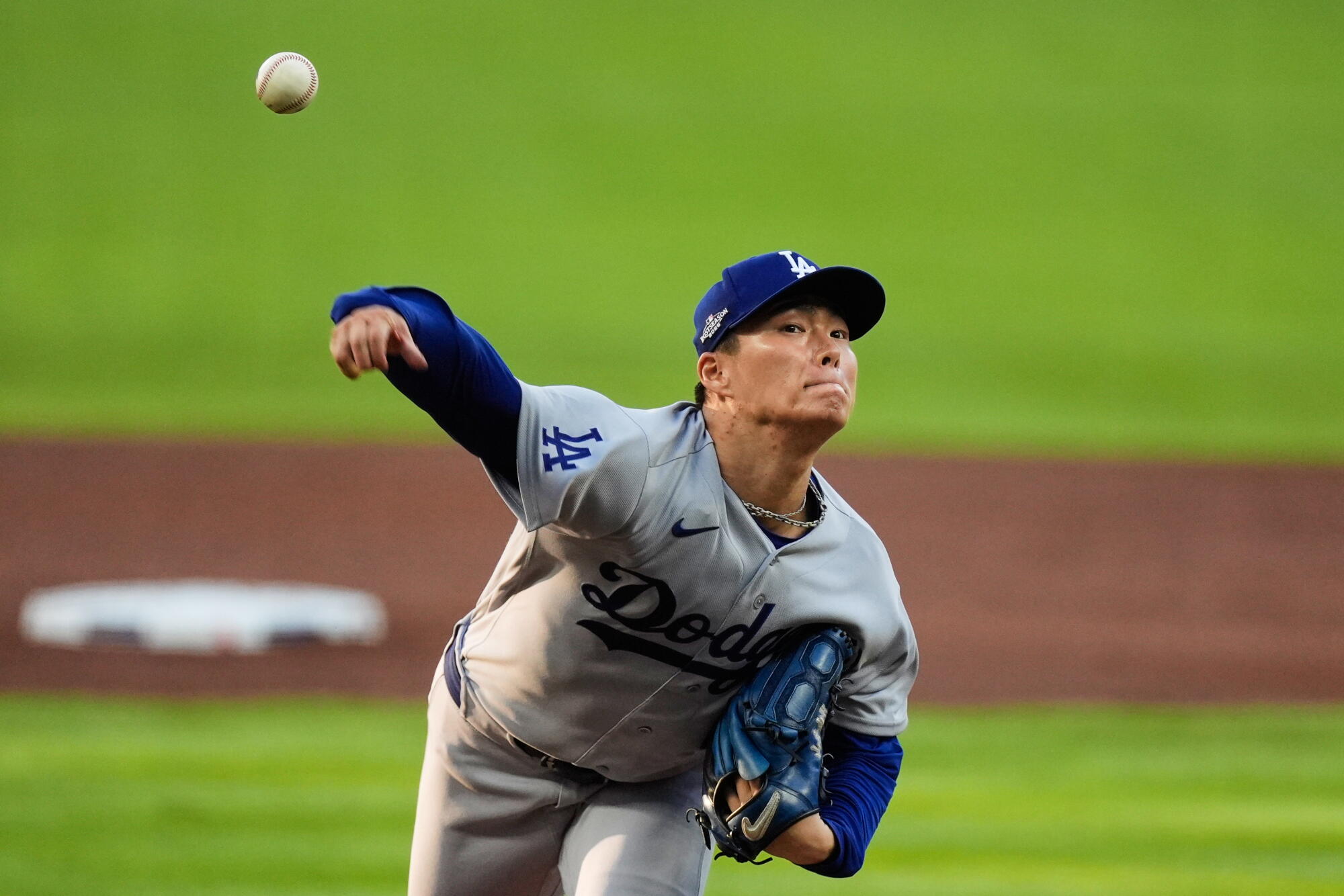
Dodgers overcome Roki Sasaki’s poor performance to rout Padres

Roki Sasaki’s abysmal appearance faded away in the Dodgers’ 12-7 win over the San Diego Padres after Los Angeles rose from a catatonic first inning. The Dodgers roared back from a 6-0 deficit as Andy Pages skirted a tying double down the left-field line, and Mookie Betts and Max Muncy each drove in runs to give them the lead in a four-run fourth inning. All of which sent the sellout crowd into jubilant celebrations, some jumping, others breaking out World Cup chants.

“I don’t know,” manager Dave Roberts said of the team’s ability to turn the game around. “Thankfully, it played out the way I didn’t expect, or the way it started.”

By the time the game ended, Sasaki’s three-inning start seemed like a murky nightmare the Dodgers awoke from in a sweat. Except the Dodgers weren’t dreaming, and the team hadn’t done much to assuage the concerns with Sasaki.

The problem with Sasaki isn’t his stuff. On his best nights, when the velocity and command combine, Sasaki blows past batters with a triple-digit fastball and cutting off-speed pitches. The problem has been how to tick the radar without making the strike zone look like a Jackson Pollock painting — and recently, it has.

Sasaki’s June swoon, impervious to the calendar change, continued into Thursday’s series opener against the Padres, in which the right-hander gave up three home runs and seven hits before Roberts called it quits going into the fourth inning.

“They were on everything,” Roberts said. “You could see it.”

One possible concern? Tipping pitches. While Roberts and catcher Dalton Rushing said the team would need to do some more research into Sasaki’s start, both left the door open to this answer.

“That would be a big explanation as to how they felt like they were on every pitch,” Rushing said.

As San Diego chugged through its lineup, Sasaki struggled to keep up. With his first pitch, he gave up a double to Fernando Tatis Jr., who scored on Manny Machado’s home run that left center fielder Pages staring at the ball’s path as it plopped down on the other side of the blue outfield fence.

The inning was only a preview of the Padres’ power. Each of the nine San Diego batters got his chance against Sasaki in the second, and the team quickly dug the Dodgers into a six-run hole. He surrendered two home runs in the second inning. First, Jackson Merrill blasted a ball to left-center field, and, two outs later, Jake Cronenworth drove in two runs with a shot to right-center.

Sasaki said through interpreter Kensuke Okubo that he felt like he needed work on his command to improve, but he felt like his fastball was good.

Roki Sasaki has his head down after giving up a solo homer to Jackson Merrill in the second inning.

Roki Sasaki has his head down after giving up a solo homer to Jackson Merrill in the second inning.

(Gina Ferazzi / Los Angeles Times)

“I don’t think my stuff was bad today,” Sasaki said. “Overall, it wasn’t great but a lot of things evolved.”

Part of Sasaki’s issue lies with his approach. Roberts said he wants the second-year pitcher to be aggressive, to play the cat-and-mouse game required to beat batters in the box. But when given the opportunity, Sasaki has shrunken in recent outings, struggling with his command and his ability to pitch deep into games.

“We had a great May, so let’s just get back to competing and making pitches,” Roberts said.

When reliever Will Klein walked out to the mound in the fourth to the aggressive, rambunctious clamor of the Dropkick Murphys’ “I’m Shipping Up to Boston” and collected two scoreless, one-hit innings, the relief was immediate: The Dodgers took the lead.

The lineup already was revving, as Dalton Rushing homered in the second inning while Sasaki was still in the game, and both Kyle Tucker and Max Muncy drove in runs in the third, cutting the deficit to two. The Dodgers broke through against the Padres’ bullpen to score six runs in the fourth and fifth innings.

“The bullpen was fantastic tonight, and then the offense came up big,” Roberts said.

A late catch by Pages helped close out the game after he gloved a ball despite ramming into the padding of the center field wall. A combined effort by Paul Gervase and Tanner Scott shut down San Diego’s ninth-inning momentum after it pushed across a run.

“Turned back around, was able to find the ball and make a really good catch right there,” Tucker said. “That was a huge out.”

The Dodgers (57-31) beat their division rivals for the fifth time in seven games to open a 13-game lead over both San Diego and Arizona. The Padres, meanwhile, have given up 65 runs over the last six days, the most in such a span in franchise history.

But San Diego’s flaws don’t negate the Dodgers’ as they burned through six relievers in their win. So, while the Dodgers crawled out of the hole with a season-high 17 hits, the steep cost heightens the pressure on the rest of the rotation the rest of the series.

Source link

Angels can’t overcome two homers from Yandy Díaz in loss to Rays

Yandy Díaz hit two home runs, including back-to-back shots with Jonathan Aranda in a seven-run seventh inning, and the Tampa Bay Rays beat the Angels 8-5 on Friday night to end a four-game losing streak.

Bryan Baker walked Mike Trout on a 3-2 pitch to load the bases with two outs in the ninth before retiring Vaughn Grissom on an infield pop-up for his 15th save in 18 opportunities.

Nick Martinez (5-1) allowed two runs and eight hits in seven innings to earn the win. The right-hander has allowed two runs or less in all 11 starts this season.

Díaz hit his ninth home run on the second pitch from Walbert Ureña for a 1-0 lead. Díaz gave the Rays a 3-2 lead in the seventh with a two-run shot off Ryan Zeferjahn (2-3) after Cedric Mullins drew a leadoff walk.

Aranda followed with his 10th homer, but the Rays (35-19) were just getting started.

Junior Caminero singled and Zeferjahn left in favor of Brent Suter after a groundout. Chandler reached on an error at first by Grissom and Oliver Dunn made it 5-2 with an RBI bunt single.

Richie Palacios added a two-run triple before scoring on a sacrifice bunt by Nick Fortes for an 8-2 lead.

Hunter Bigge walked Zach Neto and Trout to start the eighth and left without retiring a batter after Grissom doubled in a run to make it 8-3. Kevin Kelly entered and surrendered RBI groundouts to Jo Adell and Wade Meckler to cap the scoring.

Ureña allowed one run on five hits in six innings for the Angels (22-36). Zeferjahn and Suter were tagged for seven runs — five earned — in the final two innings.

The Rays’ Ben Williamson went one for two after missing eight games on the injured list with lower back issues before he was hit on the forearm by a pitch from Ureña in the sixth inning and forced to exit.

Up next: Angels LHP Reid Detmers (1-5, 4.57) starts Saturday opposite Rays RHP Drew Rasmussen (4-1, 2.78).

Source link

Will Smith, Alex Call help Dodgers overcome mistakes in win over Giants

The Dodgers beat the San Francisco Giants 5-2 on Thursday night, reclaiming first in the National League West after San Diego lost to Milwaukee. The Dodgers also escaped a third straight series loss at home ahead of their weekend road series against the Angels.

Designated hitter Will Smith, whom Dodgers manager Dave Roberts described earlier in the day as “unflappable,” hit from the leadoff spot and homered to right-center field in the first inning to set the tone for the series-splitting win.

The decision to put Smith in the leadoff spot allowed Roberts to maximize the 31-year-old’s plate appearances without moving other players after Shohei Ohtani was held out of the lineup.

The Dodgers (26-18) are trying to lighten Ohtani’s workload after his recent struggles at the plate. It’s the first time a healthy Ohtani has been out of back-to-back batting orders, except for the paternity list, since the universal designated hitter rule was implemented in 2022.

Though the Dodgers outlasted the Giants (18-26) without Ohtani’s help, the team’s compounded mistakes almost cost it a win.

In the second inning, the bottom of the lineup strung together two hits to score Max Muncy, who reached on a walk. However, after Miguel Rojas softly hit a ground ball to Giants starter Landen Roupp, Teoscar Hernández found himself stranded in no-man’s land after running toward home from third — there was no force play at the plate.

Rojas, who stood on the basepath, slammed his helmet down in frustration after Smith struck out to end the inning.

Will Smith gets a face full of sunflower seeds from teammate Andy Pages after hitting a leadoff home run.

Will Smith gets a face full of sunflower seeds from teammate Andy Pages after hitting a leadoff home run in the first inning for the Dodgers on Thursday.

(Gina Ferazzi / Los Angeles Times)

Rojas wasn’t the only one upset. Dalton Rushing was shown on the game broadcast breaking his bat in the dugout and slamming his leg guard on the back bench after striking out in the fourth inning. Dodgers starter Emmet Sheehan shared some words of encouragement with the catcher and patted him on the back.

Sheehan’s night was relatively uneventful before the fifth. He put together three hitless innings before San Francisco’s Rafael Devers hit a one-out single to left field.

From there, things got worse. In the fifth, Jung Hoo Lee hit an inside-the-park home run when Hernández misread the ball off the left-field wall in foul territory, allowing the ball to roll past him. Rojas’ relay throw was too high for Rushing to catch, and Lee slid into home to become the first Giants player to hit an inside-the-park homer at Dodger Stadium.

But the Dodgers responded in the sixth. After Max Muncy reached base on a force out at second and was moved over to third on a single from Hernández, Alex Call delivered a pinch-hit, two-run single to right field. Rojas then blooped a ball over the infield to drive in Call.

Sheehan finished his night after six innings, giving up two earned runs, two hits with six strikeouts and two walks. With combined efforts from relievers Tanner Scott, Alex Vesia and Edgardo Henriquez, the Dodgers shut down the Giants the rest of the way.

Source link

Immortality beckons – but Hearts must overcome Celtic & weight of history

For Heart of Midlothian, the tantalising, scarcely-believable, bottom line is this: after 66 years they may be crowned champions of Scotland on Wednesday.

A large asterisk must sit beside that sentence, of course. For history to happen, Hearts must beat Falkirk at Tynecastle and Celtic lose to Motherwell at Fir Park.

Few can see it turning out this way, but Hearts’ home record is exceptional and Motherwell have already beaten Celtic this season. Schooled them, in fact.

That was in Wilfried Nancy’s time, though. A relative lifetime ago.

There’s been so much change at Celtic, Martin O’Neill’s wise counsel dragging the team forward and back into contention after the dismal days under Nancy.

They’re still playing catch-up, though. Still chasing and knowing all the while that one slip of their own against Jens Berthel Askou’s impressive and dangerous side and it could be curtains.

Despite trailing Hearts by a point, Celtic are the bookies’ favourite to win the title again. The cold-blooded odds-layers have rarely bought into the Hearts fairytale, most of them reckoning that Celtic would come good in the end.

The mere fact that Hearts have come this close is trippy. Thirty-six games played, 3,240 minutes across 10 months, table toppers since September and they have arrived at this point.

In their greatest league season since falling on the last day 40 years ago, they’ve been doubted along the way. Laughed at in the beginning when Tony Bloom bought into the club and said they could split the Old Firm in one season, and questioned in December when they dropped points in four games in a row.

Scepticism came in waves in late spring when they lost to two of the bottom six and then drew with Livingston, plumb last in the Premiership.

Injuries hampered them then as they hamper them now, but Hearts kept the show on the road. ‘Believe’ is the Tynecastle mantra, the gospel the manager Derek McInnes has preached.

Source link

Women’s Six Nations 2026: Ireland 33-12 Wales: Ireland overcome Wales for hard-fought home win

Despite losing their previous eight Six Nations matches, Wales came into the game with confidence after they registered a record four tries against world champions England in their last outing.

They started stronger in Belfast, but Wafer gave Ireland the lead against the run of play when the back row’s persistence paid off and she forced her way over the line before Dannah O’Brien added a challenging extra two.

Wales looked to respond quickly with a huge tackle from Parsons denying Hannah Dallavalle after Carys Cox had taken advantage of a mix-up and fed the ball through.

The visitors kept pushing and registered their first try when Georgia Evans dived over from close range and Keira Bevan was able to convert to level the match.

A double movement denied Cliodhna Moloney-MacDonald after she had powered her way over as the home side, buoyed by a vocal crowd, began to settle.

Wafer then turned provider, shrugging off multiple white shirts before a superb offload to Parsons, who raced down the right wing to restore Ireland’s lead.

They then struck a hammer blow just before the break as, opting to play on with clock in the red, Ireland were rewarded for their persistence as they added their third try when Hogan crossed after sustained pressure from a ruck.

After the restart, a television match official [TMO] check confirmed Moloney-MacDonald’s kick out at Evans warranted a yellow card.

Wales were unable to take advantage of having an extra player and it was soon 14-players apiece for a period as Jasmine Joyce was shown a yellow card for placing her hands on the ground when bringing Eve Higgins down.

As the hour mark approached, Aoife Dalton and Linda Djougang linked up and fed the ball to Wafer to cross to secure the bonus point.

Bemand then turned to his bench and made a flurry of changes which added energy to their play.

Replacement Jones thought she had added Ireland’s fifth shortly after her introduction, only for her effort to be ruled out after a TMO review.

Joyce added Wales’ second try in the final five minutes as she held off Parsons and stretched to ground the ball.

Ireland did land a fifth try in the final seconds as Hogan bundled over from close range, with O’Brien able to convert for a fourth time.

Source link