WASHINGTON — A dozen U.S. senators are calling on the Justice Department’s watchdog to examine the department’s failure to release all records pertaining to the late sex offender Jeffrey Epstein by last Friday’s congressionally mandated deadline, saying victims “deserve full disclosure” and the “peace of mind” of an independent audit.
Republican Sen. Lisa Murkowski of Alaska joined 11 Democrats in signing a letter Wednesday urging Acting Inspector General Don Berthiaume to audit the Justice Department’s compliance with the Epstein Files Transparency Act, the law enacted last month that requires the government to open its files on Epstein and his longtime confidant Ghislaine Maxwell.
“Given the [Trump] Administration’s historic hostility to releasing the files, politicization of the Epstein case more broadly, and failure to comply with the Epstein Files Transparency Act, a neutral assessment of its compliance with the statutory disclosure requirements is essential,” the senators wrote. Full transparency, they said, “is essential in identifying members of our society who enabled and participated in Epstein’s crimes.”
Murkowski and Sens. Richard Blumenthal (D-Conn.) and Jeff Merkley (D-Ore.) led the letter-writing group. Others included Democratic Sens. Amy Klobuchar of Minnesota, Adam Schiff of California, Dick Durbin of Illinois, both Cory Booker and Andy Kim of New Jersey, Gary Peters of Michigan, Chris Van Hollen of Maryland, Mazie Hirono of Hawaii, and Sheldon Whitehouse of Rhode Island.
Meanwhile, Republican Rep. Thomas Massie of Kentucky, a co-sponsor of the transparency act, posted Wednesday on X: “DOJ did break the law by making illegal redactions and by missing the deadline.”
Despite the deadline, the Justice Department has said it plans to release records on a rolling basis. It blamed the delay on the time-consuming process of obscuring survivors’ names and other identifying information. More batches of records were posted over the weekend and on Tuesday. The department has not given any notice when more records might arrive.
“The reason why we are still reviewing documents and still continuing our process is simply that to protect victims,” Deputy Atty. Gen. Todd Blanche told NBC’s “Meet the Press” on Sunday. “So the same individuals that are out there complaining about the lack of documents that were produced on Friday are the same individuals who apparently don’t want us to protect victims.”
Records that have been released, including photographs, interview transcripts, call logs, court records and other documents, were either already public or heavily blacked out, and many lacked necessary context. Records that hadn’t been seen before include transcripts of grand jury testimony from FBI agents who described interviews they had with several girls and young women who described being paid to perform sex acts for Epstein.
Other records made public in recent days include a note from a federal prosecutor from January 2020 that said Trump had flown on the financier’s private plane more often than had been previously known and emails between Maxwell and someone who signs off with the initial “A.” They contain other references that suggest the writer was Britain’s former Prince Andrew. In one, “A” writes: “How’s LA? Have you found me some new inappropriate friends?”
The senators’ call Wednesday for an inspector general audit comes days after Minority Leader Chuck Schumer (D-N.Y.) introduced a resolution that, if passed, would direct the Senate to file or join lawsuits aimed at forcing the Justice Department to comply with the disclosure and deadline requirements. In a statement, he called the staggered, heavily redacted release “a blatant cover-up.”
When Fernando Mendoza won the Heisman Trophy this weekend with another Latino finalist looking on from the crowd, the Cuban-American quarterback did more than just become the first Indiana Hoosier to win college football’s top prize, and only the third Latino to do so. He also subtly offered a radical statement: Latinos don’t just belong in this country, they’re essential.
At a time when questions swirl around this country‘s largest minority group that cast us in a demeaning, tokenized light — how could so many of us vote for Trump in 2024? Why don’t we assimilate faster? Why does Supreme Court justice Brett Kavanaugh think it’s OK for immigration agents to racially profile us? — the fact that two of the best college football players in the country this year were Latino quarterbacks didn’t draw the headlines they would’ve a generation ago. That’s because we now live in an era where Latinos are part of the fabric of sports in the United States like never before.
That’s the untold thesis of four great books I read this year. Each is anchored in Latino pride but treat their subjects not just as sport curios and pioneers but great athletes who were and are fundamental not just to their professions and community but society at large.
Shea Serrano writing about anything is like a really great big burrito — you know it’s going to be great and it exceeds your expectations when you finally bite into it, you swear you’re not going to gorge the thing all at once but don’t regret anything when you inevitably do. He could write about concrete and this would be true, but his latest New York Times bestseller (four in total, which probably makes him the only Mexican American author with that distinction) thankfully is instead about his favorite sport.
“Expensive Basketball” finds Serrano at his best, a mix of humblebrag, rambles and hilarity (of Rasheed Wallace, the lifelong San Antonio Spurs fan wrote the all-star forward “would collect technical fouls with the same enthusiasm and determination little kids collect Pokémon cards with.”) The proud Tejano’s mix of styles — straight essays, listicles, repeated phrases or words trotted out like incantations, copious footnotes — ensures he always keeps the reader guessing.
But his genius is in noting things no one else possibly can. Who else would’ve crowned journeyman power forward Gordon Hayward the fall guy in Kobe Bryant’s final game, the one where he scored 60 points and led the Lakers to a thrilling fourth-quarter comeback? Tied a Carlos Williams poem that a friend mistakenly texted to him to WNBA Hall of Famer Sue Bird? Reminded us that the hapless Charlotte Hornets — who haven’t made it into the playoffs in nearly a decade — were once considered so cool that two of their stars were featured in the original “Space Jam?” “Essential Basketball” is so good that you’ll swear you’ll only read a couple of Serrano’s essays and not regret the afternoon that will pass as quickly as a Nikola Jokic assist.
“Mexican American Baseball in the South Bay”
(Gustavo Arellano/Los Angeles Times)
I recommended “Mexican American Baseball in the South Bay” in my regular columna three years ago, so why am I plugging its second edition? For one, the audacity of its existence — how on earth can anyone justify turning a 450-page book on an unheralded section of Southern California into an 800-page one? But in an age when telling your story because no one else will or will do a terrible job at it is more important than ever, the contributors to this tome prove how true that is.
“Mexican American Baseball in the South Bay” is part of a long-running series about the history of Mexican American baseball in Southern California Latino communities. What’s so brilliant about this one is that it boldly asserts the history and stories of a community that too often get overlooked in Southern California Latino literature in favor of the Eastsides and Santa Anas of the region.
As series editor Richard A. Santillan noted, the reaction to the original South Bay book was so overwhelmingly positive that he and others in the Latino History Baseball Project decided to expand it. Well-written essays introduce each chapter; long captions for family and team photos function as yearbook entries. Especially valuable are newspaper clippings from La Opinión that showed the vibrancy of Southern Californians that never made it into the pages of the English-language press.
Maybe only people with ties to the South Bay will read this book cover to cover, and that’s understandable. But it’s also a challenge to all other Latino communities: if folks from Wilmington to Hermosa Beach to Compton can cover their sports history so thoroughly, why can’t the rest of us?
(University of Colorado Press)
One of the most surprising books I read this year was Jorge Iber’s “The Sanchez Family: Mexican American High School and Collegiate Wrestlers from Cheyenne, Wyoming,” a short read that addresses two topics rarely written about: Mexican American freestyle wrestlers and Mexican Americans in the Equality State. Despite its novelty, it’s the most imperfect of my four recommendations. Since it’s ostensibly an academic book, Iber loads the pages with citations and references to other academics to the point where it sometimes reads like a bibliography and one wonders why the author doesn’t focus more on his own work. And in one chapter, Iber refers to his own work in the first person — profe, you’re cool but you’re not Rickey Henderson.
“The Sanchez Family” overcomes these limitations by the force of its subject, whose protagonists descend from Guanajuato-born ancestors that arrived to Wyoming a century ago and established a multi-generational wrestling dynasty worthy of the far-more famous Guerrero clan. Iber documents how the success of multiple Sanchez men on the wrestling mat led to success in civic life and urges other scholars to examine how prep sports have long served as a springboard for Latinos to enter mainstream society — because nothing creates acceptance like winning.
“In our family, we have educators, engineers and other professions,” Iber quotes Gil Sanchez Sr. a member of the first generation of grapplers. “All because a 15-year-old boy [him]…decided to become a wrestler.”
Heard that boxing is a dying sport? The editors of “Rings of Dissent: Boxing and Performances of Rebellion” won’t have it. Rudy Mondragón, Gaye Theresa Johnson and David J. Leonard not only refuse to entertain that idea, they call such critiques “rooted in racist and classist mythology.”
(University of Illinois Press)
They then go on to offer an electric, eclectic collection of essays on the sweet science that showcases the sport as a metaphor for the struggles and triumphs of those that have practiced it for over 150 years in the United States. Unsurprisingly, California Latinos earn a starring role. Cal State Channel Islands professor José M. Alamillo digs up the case of two Mexican boxers denied entry in the United States during the 1930s, because of the racism of the times, digging up a letter to the Department of Labor that reads like a Stephen Miller rant: “California right now has a surplus of cheap boxers from Mexico, and something should be done to prevent the entry of others.”
Roberto José Andrade Franco retells the saga of Oscar De La Hoya versus Julio Cesar Chávez, landing less on the side of the former than pointing out the assimilationist façade of the Golden Boy. Mondragón talks about the political activism of Central Valley light welterweight José Carlos Ramírez both inside and outside the ring. Despite the verve and love each “Rings of Dissent” contributors have in their essays, they don’t romanticize it. No one is more clear-eyed about its beauty and sadness than Mondragón’s fellow Loyola Marymount Latino studies profe, Priscilla Leiva. She examines the role of boxing gyms in Los Angeles, focusing on three — Broadway Boxing Gym and City of Angels Boxing in South L.A, and the since-shuttered Barrio Boxing in El Sereno.
“Efforts to envision a different future for oneself, for one’s community, and for the city are not guaranteed unequivocal success,” she writes. “Rather, like the sport of boxing, dissent requires struggle.”
If those aren’t the wisest words for Latinos to embrace for the coming year, I’m not sure what is.
“Democrats have been relentless in their targeting of TINA PETERS, a Patriot who simply wanted to make sure our elections were fair and honest,” Trump said in a typically gaseous, dissembling post on social media.
“Tina is sitting in a Colorado prison for the ‘crime’ of demanding Honest Elections,” the president went on. “Today I am granting Tina a full pardon for her attempts to expose voter fraud in the rigged 2020 Presidential Election.”
That’s because Trump has precisely zero say over Peters’ fate, given the former Mesa County elections chief was convicted on state charges. The president’s pardon power — which Trump has twisted to a snapping point — extends only to federal cases. If we’re going to play make-believe, then perhaps Foo-Foo the Snoo can personally escort Peters from prison and crown her Queen of the Rockies.
That’s not to suggest, however, that Trump’s empty gesture was harmless. (Apologies to Foo-Foo and Dr. Seuss.)
Some extremists, ever ready to do Trump’s malevolent bidding, have taken up Peters’ cause, using the same belligerent language that foreshadowed the Jan. 6, 2021, attack on the U.S. Capitol. In fact, threats have come from some of the very same thugs whom Trump pardoned in one of the first shameless acts of his presidency.
“WE THE PEOPLE ARE COMING TO BREAK TINA PETERS OUT OF PRISON IN 45 DAYS,” Jake Lang, a rioter who was charged with attacking police with an aluminum baseball bat, said on social media. “If Tina M. Peters is not released from La Vista Prison in Colorado to Federal Authorities by January 31st, 2026; US MARSHALS & JANUARY 6ERS PATRIOTS WILL BE STORMING IN TO FREE TINA!!”’
(Capitalization and random punctuation are apparently the way to show fervency as well as prove one’s MAGA bona fides.)
Enrique Tarrio, the former head of the Proud Boys extremist group whom Trump also pardoned, shared a screenshot of the president’s social media post. “A battle,” Tarrio said, “is coming.”
Trump’s pretend pardon is not the first intervention on Peters’ behalf.
In March, the Justice Department asked a federal judge to free her from prison, saying there were “reasonable concerns” about the length of Peters’ sentence. The judge declined.
In November, the administration wrote the Colorado Department of Corrections and asked that Peters be transferred to federal custody, which would presumably allow for her release. No go.
Earlier this month, apparently looking to up the pressure, the Justice Department announced an investigation of the state’s prison system. (Perhaps Peters was denied the special “magnetic mattress” she requested at her sentencing, to help deal with sleep issues.)
Like any child, when Trump doesn’t get his way he calls people names. On Monday, he set his sights on Colorado’s Democratic governor, Jared Polis — “a weak and pathetic man” — for refusing to spring Peters from state prison.
“The criminals from Venezuela took over sections of Colorado,” Trump said, “and he was afraid to do anything, but he puts Tina in jail for nine years because she caught people cheating.”
While Trump portrays Peters as a martyr, she is nothing of the sort.
As Polis noted in response to Trump’s “pardon,” she was prosecuted by a Republican district attorney and convicted by a jury of her peers — a jury, it should be noted, that was drawn from the citizenry of Mesa County. The place is no liberal playpen. Voters in the rugged enclave on Colorado’s Western Slope backed Trump all three times he ran for president, by margins approaching 2-to-1.
If Peters’ sentence seems harsh — which it does — hear what the judge had to say.
Peters was motivated not by principle or a search for the truth but rather, he suggested, vanity and personal aggrandizement. She betrayed the public trust and eroded faith in an honestly run election to ingratiate herself with Trump and others grifting off his Big Lie.
“You are as privileged as they come and you used that privilege to obtain power, a following and fame,” Judge Matthew Barrett told Peters in a lacerating lecture. “You’re a charlatan who used and is still using your prior position in office to peddle a snake oil that’s been proven to be junk time and time again.”
Peters remains unrepentant.
In petitioning Trump for a pardon, her attorney submitted nine pages of cockamamie claims, asserting that Peters was the victim of a conspiracy involving, among others, voting-machine vendors, Colorado’s secretary of state and the Venezuelan government.
To her credit, Peters has rejected calls for violence to set her free.
“Tina categorically DENOUNCES and REJECTS any statements or OPERATIONS, public or private, involving a ‘prison break’ or use of force against La Vista or any other CDOC facility in any way,” a post on social media stated, again with the random capitalization.
Perhaps the parole board will take note of those sentiments when the 70-year-old Peters becomes eligible for conditional release in January 2029, a date that just happens to coincide with the end of Trump’s term.
Which seems fitting.
Keep Peters locked up until then, serving as an example and deterrent to others who might consider emulating her by vandalizing the truth and attacking our democracy.
The best of Los Angeles architecture in 2025 felt like attractive experiments with an uncanny sense of the future. They include micro-scaled production studios to a high school completed in two months after the Palisades fire to the mammoth LAX Metro Transit Center.
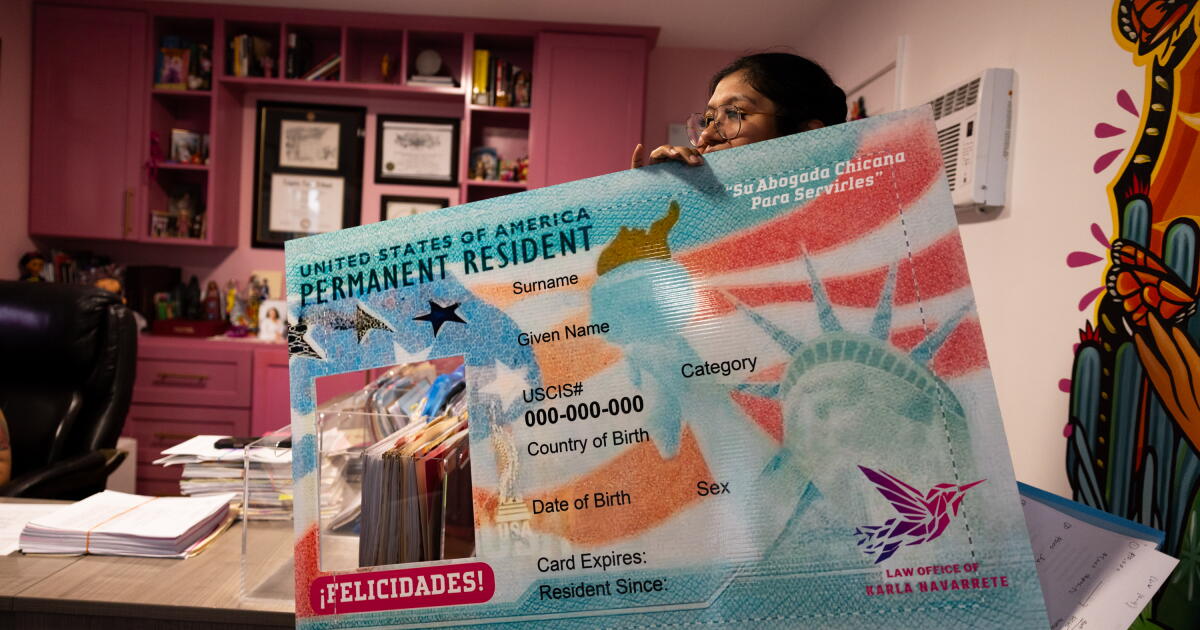
WASHINGTON — President Trump suspended the green card lottery program on Thursday that allowed the suspect in the Brown University and MIT shootings to come to the United States.
Homeland Security Secretary Kristi Noem said in a post on the social platform X that, at Trump’s direction, she is ordering the United States Citizenship and Immigration Services to pause the program.
“This heinous individual should never have been allowed in our country,” she said of the suspect, Portuguese national Claudio Neves Valente.
Neves Valente, 48, is suspected in the shootings at Brown University that killed two students and wounded nine others, and the killing of an MIT professor. He was found dead Thursday evening from a self-inflicted gunshot wound, officials said.
Neves Valente had studied at Brown on a student visa beginning in 2000, according to an affidavit from a Providence police detective. In 2017, he was issued a diversity immigrant visa and months later obtained legal permanent residence status, according to the affidavit. It was not immediately clear where he was between taking a leave of absence from the school in 2001 and getting the visa in 2017.
The diversity visa program makes up to 50,000 green cards available each year by lottery to people from countries that are little represented in the U.S., many of them in Africa. The lottery was created by Congress, and the move is almost certain to invite legal challenges.
Nearly 20 million people applied for the 2025 visa lottery, with more than 131,000 selected when including spouses with the winners. After winning, they must undergo vetting to win admission to the United States. Portuguese citizens won only 38 slots.
Lottery winners are invited to apply for a green card. They are interviewed at consulates and subject to the same requirements and vetting as other green-card applicants.
Trump has long opposed the diversity visa lottery. Noem’s announcement is the latest example of using tragedy to advance immigration policy goals. After an Afghan man was identified as the gunman in a fatal attack on National Guard members in November, Trump’s administration imposed sweeping rules against immigration from Afghanistan and other counties.
While pursuing mass deportation, Trump has sought to limit or eliminate avenues to legal immigration. He has not been deterred if they are enshrined in law, like the diversity visa lottery, or the Constitution, as with a right to citizenship for anyone born on U.S. soil. The Supreme Court recently agreed to hear his challenge to birthright citizenship.
In January 2018, conservative Fox News host Laura Ingraham was having dinner at Toscana, an Italian restaurant in Brentwood, when she spotted the renowned Hollywood director — and unabashed liberal — Rob Reiner.
She asked him to come on her show, “The Ingraham Angle.” He was on set the next day.
After introducing him as “a brilliant director,” who made her favorite movie, “This is Spinal Tap,” Ingraham said: “Last night, the first thing Reiner says is: ‘Are they gonna shut the government down?’’ I’m like, wow, I’m here in L.A.; I wanna talk about Hollywood stuff. But he wants to talk about politics.”
Al Gore and Rob Reiner attend the Tribeca Film Festival in New York in April 2007.
(Scott Gries / Getty Images)
Ingraham and Reiner vehemently disagreed — about alleged Russian influence on the 2016 presidential election, about whether President Trump is racist, about the treatment of conservatives in Hollywood.
But Reiner also called Ingraham “smart as hell.” And Ingraham said Reiner “should be lauded” for being willing to spar with her, unlike many politicians on both sides of the aisle.
It was the kind of blunt but ultimately respectful exchange that added to Reiner’s widespread appeal off-screen, both because of — and in spite of — his views.
Reiner and his wife, Michele, were killed at their Brentwood home last weekend, allegedly by their son, Nick, who has been charged with murder. The couple’s deaths have sent a thunderclap through Hollywood and beyond, partly because the Reiners had so many friends and connections in creative and political circles.
Rob Reiner — who, in the role of Michael “Meathead” Stivic in the groundbreaking sitcom “All in the Family,” played the liberal foil to his bigoted, conservative father-in-law, Archie Bunker — seemed to relish his real-life role as a progressive celebrity activist. That made him a hero to many in blue California but a villain to others, especially the reality-TV-show-star-turned-president, Donald Trump.
In a highly criticized social media post, Trump attributed the deaths to “the anger he caused others through his massive, unyielding, and incurable affliction with a mind crippling disease known as TRUMP DERANGEMENT SYNDROME.”
But while Reiner, a blistering critic of the president, disagreed with many conservatives on policy, he also worked to build relationships with them — in media and entertainment circles, the California State Capitol, and beyond.
Actors Alec Baldwin and James Woods listen to director Rob Reiner in between scenes for the 1996 film “Ghosts Of Mississippi.”
(Columbia Pictures via Getty Images)
Actor James Woods, a longtime Trump supporter, said in a Fox News interview this week that Reiner saved his career by casting him in the 1996 film “Ghosts of Mississippi” over studio objections. He called Reiner “a great patriot” with whom he shared a mutual respect despite myriad political disagreements.
Andrew Kolvet, a spokesman for conservative powerhouse Turning Point USA, wrote on X that he “shared approximately zero in common with Rob Reiner politically, but I am so saddened by this news” and praying that “justice would be swift and without conspiracies [sic] theories.”
Kolvet said Reiner “responded with grace and compassion” to the September killing of TPUSA founder Charlie Kirk — a violent end that Reiner said nobody deserved, regardless of their views.
Hard-right Republican Rep. Marjorie Taylor Greene, of Georgia, called the deaths “a family tragedy, not about politics or political enemies.” And GOP Sen. Ted Cruz, of Texas, wrote on X that “The Princess Bride” was his favorite film and called Reiner “a comedic and story-telling master.”
Off screen, Reiner had a unique ability to connect with people of all persuasions, in various mediums, at the top of their careers or just starting. He was very much influenced by Norman Lear, the creator of “All in the Family,” who blended his Hollywood career with progressive activism.
Similar to Lear, Reiner didn’t just dabble in social causes and campaigns. He launched them, led them and brought people aboard. “He wasn’t building an operation the way Hollywood typically does, making donations, hosting fundraisers,” said Ben Austin, a former aide to Reiner who worked in the White House during the Clinton administration.
And all the time, he did it while making movies, some of them deeply personal, intertwined with his life as a parent.
Reiner was the driving force behind the successful 1998 California ballot measure, Proposition 10, a landmark policy that put a tax on tobacco products and pumped billions of dollars into preschools, teacher training, and support for struggling families. He enlisted help in that effort from such beloved figures as Steven Spielberg, Robin Williams and his own father, comedy legend Carl Reiner.
After the initiative passed, Gov. Gray Davis, a Democrat, appointed the younger Reiner chairman of the First 5 commission overseeing disbursement of the funds.
Rob Reiner co-founded the group that would help overturn Proposition 8, the 2008 ballot measure that banned same-sex marriage in California.
(Los Angeles Times)
And in 2009, Reiner co-founded the American Foundation for Equal Rights, which led the successful legal fight to overturn Proposition 8, the 2008 ballot measure that banned same-sex marriage in California. The group hired legal luminaries from opposite sides of the political spectrum to overturn the ballot measure: the conservative former U.S. Solicitor General Theodore Olson and litigator David Boies, a liberal who squared off against Olson in the U.S. Supreme Court ruling that gave George W. Bush the presidency in 2000.
Former Los Angeles Mayor Eric Garcetti, a Democrat, said in an interview Wednesday that Reiner successfully rallied people to the cause because he was so adept at humanizing the stories of the plaintiffs and other same-sex couples — and emphasizing love.
“I don’t think you can overstate how influential he was at the national, state and local level and how well-liked he was,” Garcetti said. “Politics and movies share this in common: They both need good stories … and he was such a gifted storyteller.”
Garcetti said that while many celebrities lend money and faces to political causes, prettying up political mailers and email blasts, “Rob built those causes. He wasn’t like the frosting on the cake. He actually was the baker.”
Garcetti, then a Los Angeles City Council member, joined Reiner in stumping for 2004 Democratic presidential hopeful Howard Dean, for whom the director was an early backer. Garcetti crossed paths with him often, including during the push to overturn Proposition 8 — and at the Los Angeles City Hall wedding of Paul Katami and Jeff Zarrillo, two of the plaintiffs in the federal case that struck it down.
Katami wrote in an Instagram post this week that Reiner and his wife “stood with us in court for 4.5 years” and that he and his husband sat at the couple’s table in their home many times.
Rob Reiner chats in 2012 with Paul Katami and Jeff Zarrillo, plaintiffs in the case that struck down Proposition 8, which banned same-sex marriage in California.
(Brian van der Brug / Los Angeles Times)
“Because of them, they were able to sit at our table, at our wedding, on a day and in a moment that would not exist without their belief in who we are and how we love,” Katamami wrote.
He added: “They are brave. They are funny. They are generous. They are deeply human. And they make everyone around them feel seen, protected, and encouraged to be more fully themselves.”
Former L.A. Mayor Antonio Villaraigosa, a Democrat now running for California governor, officiated Katami and Zarrillo’s wedding. He said in an interview that Reiner personally bankrolled much of the legal fight because he genuinely believed it was the right thing to do.
In 2008, Villaraigosa kicked off his successful reelection campaign with a private reception at the Reiners’ home.
“You know, the one thing about Rob Reiner: There was no pretense,” Villaraigosa said. “If you go to his house … he’s a very wealthy man — he has been a director, an actor, co-founder of Castle Rock Entertainment — and yet his house was like a home. It wasn’t a mansion. It was like a ranch-style house, very homey.”
Rob Reiner hugs then-Mayor Antonio Villaraigosa in January 2015. The director had just introduced Villaraigosa at a school as the mayor kicked off his Leadership Tour highlighting his support for universal preschool.
(Al Seib / Los Angeles Times)
Villaraigosa and others said Reiner had a granular knowledge of the policies he supported, garnering the respect — if not always the affection — of those with whom he disagreed.
Gale Kaufman, a veteran Democratic strategist who was a longtime advisor to the influential California Teachers Assn., clashed with Reiner over education policy but admired his commitment to — and knowledge about — the issue.
Kaufman told The Times this week that she was amazed by “his attention to detail and his dogged determination that he was right.”
“This was not just someone giving you a pot of money and saying, ‘Go do this.’ This was a guy who was … in every piece of it.”
Cinematographer Reed Morano was one of several in Hollywood whose career soared because of Reiner.
In the late 2000s, Morano was known for filming low-budget projects — often in a gritty, hand-held style. Many of them premiered at the Sundance Film Festival, including the Oscar-nominated “Frozen River.”
In the early 2010s, Morano got a chance to pitch her talents to Reiner and producer Alan Greisman, who were assembling a team to shoot 2012’s “The Magic of Belle Isle,” starring Morgan Freeman and Virginia Madsen and directed by Reiner.
Barely 15 minutes after leaving the meeting, Morano got a call telling her she had the job.
“The thing that strikes me is he could have had anybody he wanted,” said Morano on a call Tuesday from New York City, noting that “Belle Isle” was the biggest budget project she had worked on up to that point. “It’s just he was so open-minded and so forward-thinking, and I think he could see potential that other people couldn’t see.”
Morano then handled cinematography for Reiner’s “And So It Goes,” starring Michael Douglas and Diane Keaton, released to 2014. Reiner, she said, also wanted her to work on “Being Charlie,” the 2015 addiction drama co-written by his son Nick, but she was unable to because of scheduling conflicts. Separately from Reiner, she would go on to win an Emmy in 2017 for directing on the series “The Handmaid’s Tale” and a prize at Sundance for her second film as director, 2018’s “I Think We’re Alone Now.”
A decade before Morano connected with Reiner, Michael Trujillo, now a veteran campaign consultant, went to work for him as a young communications and policy aide for First 5. He was in his early 20s and was stunned to learn he would be working steps from Reiner’s office in the Beverly Hills headquarters of his legendary Castle Rock Entertainment.
Rob Reiner speaks in 1998 to a child development policy group about Proposition 10, which added sales tax to tobacco products to fund early childhood education.
(Robert Durell / Los Angeles Times)
“I show up to Castle Rock Entertainment as a 22-year-old, in Beverly Hills, off Maple Drive. I’m just a Mexican kid from the northeast San Fernando Valley. My dad was a construction worker. My mom was a secretary … and I’m like, ‘What the f— am I doing here?” Trujillo said with a laugh.
Castle Rock, he said, was simultaneously a Hollywood hot spot and “a classroom in politics.” Trujillo said he once played office golf — blue cardboard for water hazards; brown paper for sand traps — with actors Christopher Guest and Eugene Levy while the movie “A Mighty Wind” was being edited. Politicians were always there, too.
Trujillo regularly joined Reiner on his once-a-month flights from Santa Monica to Sacramento for First Five commission meetings and tagged along to news conferences and school classrooms. He usually carried a Sharpie, knowing fans would show up with DVDs or VHS tapes of their favorite Reiner flicks to be signed.
“Rob was able to have conversations with anyone and everyone,” Trujillo said. “If you’re a Republican or Democratic legislator nationally, or even local or in the state, you were still a fanboy. You still wanted to meet his character from ‘All in the Family.’ You still wanted to shake the hand of the guy that made ‘Princess Bride.’ You still wanted to talk to the guy that made ‘A Few Good Men.’”
L.os Angeles City Councilmember John Lee is facing a steep fine for his notorious 2017 trip to Las Vegas, with the city’s Ethics Commission saying he must pay $138,424 in a case involving pricey meals and expensive nightclub “bottle service.”
On Wednesday, the commission decided 4 to 0 that Lee, who represents the northwest San Fernando Valley, committed two counts of violating the city’s gift law and three counts of violating a law requiring that such gifts be disclosed to the public.
By a 3-1 vote, the panel found that Lee violated five additional counts of misusing his city position or helping his boss at the time — Councilmember Mitchell Englander — misuse his position. After that, the commission voted unanimously to levy the maximum financial penalty, as recommended by city ethics investigators.
The commission went much further than an administrative law judge, who, after a multiday hearing, concluded that Lee violated five of 10 counts and recommended a fine of nearly $44,000.
Commission President Manjusha Kulkarni argued for the maximum fine, saying it would discourage others from violating ethics laws. She said Lee directly benefited from his decision not to report the gifts — which came from three men who sought business with City Hall — on his economic disclosure forms.
Lee, by failing to report those gifts, gained an unfair advantage during his 2019 and 2020 election campaigns, both of which he won by small margins, Kulkarni said.
“There was a concealment effort made there in order to win those two elections,” she said.
Commissioner Aryeh Cohen voted against the five additional ethics counts, saying he wasn’t convinced that the gift information would have made a difference. Last year, after city investigators accused Lee of violating gift laws, he won reelection handily.
“Voters knew, and he won by a larger margin” than in 2019 or 2020, Cohen said. “So I don’t think that that was a misuse of a position or gaining benefit from it.”
Brian Hildreth, an attorney representing Lee, had argued for a maximum fine of $10,000. Appearing before the commission, he said city investigators incorrectly calculated the value of the gifts and failed to take into account how much Lee had actually consumed at the food and drink venues.
Lee, in a statement, vowed to keep fighting the charges, calling the case “wasteful and political.” An appeal would need to be filed in Los Angeles County Superior Court.
“Today is but one step in the process of fighting these baseless charges,” he said. “I look forward to finally having an opportunity to have this matter adjudicated in a fair and impartial setting.”
The Lee case revolves around gifts — mostly meals and alcohol but also hotel stays, transportation and $1,000 in gambling chips — provided by the three businessmen: Andy Wang, who peddled Italian cabinets, “smart home” technology and facial recognition software; architect and developer Chris Pak; and lobbyist Michael Bai.
Lee, while working as Englander’s chief of staff, flew with his boss and several others — including Wang and Bai — to Las Vegas in 2017. Englander resigned from office the following year, after being contacted by FBI agents about the trip.
In 2020, federal prosecutors accused Englander of accepting $15,000 in cash from Wang, lying to FBI agents and obstructing their investigation. He eventually pleaded guilty to a single count of providing false information to the FBI and was sentenced to 14 months in prison.
In 2023, Englander agreed to pay $79,830 to settle an Ethics Commission case focused on his own gift law violations. That same year, the commission filed a case against Lee, saying he violated the gift law not just in Vegas but also at restaurants in downtown L.A. and Koreatown.
Lee repeatedly denied the allegations and argued that the statute of limitations had run out. The commission responded by scheduling a multiday hearing, held in June before Administrative Law Judge Ji-Lan Zang.
During those proceedings, Lee said he made a good faith effort to pay his own way and, in some cases, declined to eat during meals. For example, he testified that he did not remember eating during the meetings at Yxta Cocina Mexicana and Water Grill, both in downtown L.A.
Zang, in her written report to the commission, called those denials “not credible,” saying it “strains credulity” to believe that he would join the group at those restaurants without eating any food.
During the Las Vegas trip, Lee stayed at the Aria hotel, went to Blossom restaurant and spent an evening with the group at Hakkasan Nightclub.
At Blossom, Wang ordered a dinner worth nearly $2,500 that included shark fin soup, Peking duck and Kobe beef. Lee testified over the summer that he arrived at the restaurant in time for a dessert of bird’s nest soup, tasting it and deciding he did not like it.
At Hakkasan Nightclub later that night, Wang purchased three rounds of bottle service for the group for around $8,000 apiece, while Pak purchased a fourth round for $8,418.75.
Lee said he gave Wang $300 in cash as reimbursement for his drinks, withdrawing money from an ATM. Hildreth, his attorney, told the commission that drinks were served to a large number of nightclubgoers.
“The testimony and the evidence suggests that dozens and dozens of people were joining Councilmember Lee and others,” he said.
Kulkarni, before the vote, said she was especially troubled that Lee, after being contacted by FBI agents in 2017, sent Wang a backdated check for $442 to reimburse him for some of the Vegas trip. That act on its own, she said, constituted “a very serious offense.”
“That is not a mistake that one does. That is an affirmative act,” she said.
Hildreth said his client wrote a reimbursement check right away but that it was lost, necessitating a second, backdated check. He also noted that Lee cooperated with federal law enforcement and city ethics investigators.
“He sat for two interviews with the FBI,” Hildreth said. “That’s not something that deserves a punitive penalty.”